

Subscribe to receive new articles by e-mail. It’s free, but if you like, you can pledge a donation:
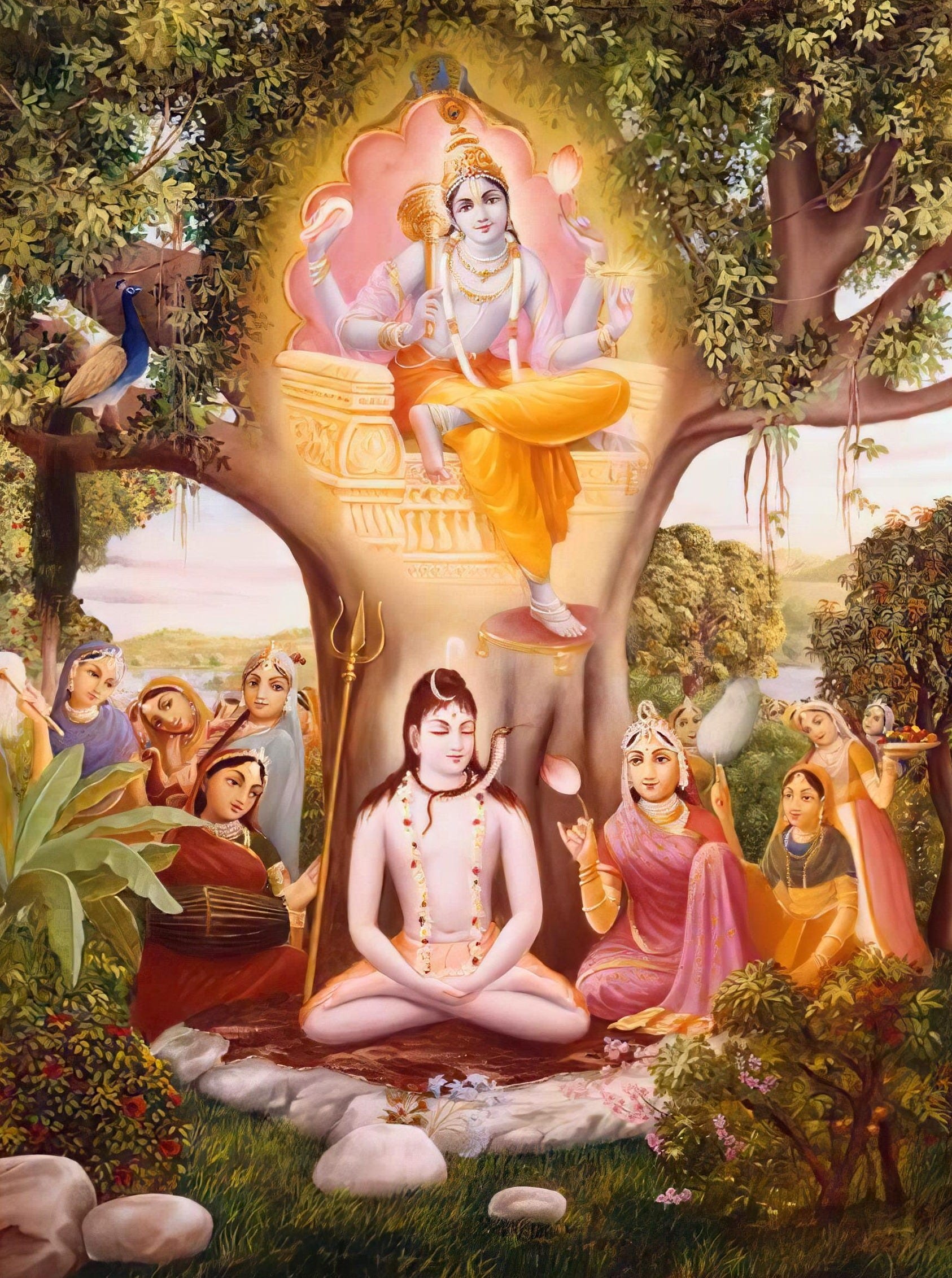
A beautiful part of the 4th canto is the Rudra Gītā, the prayers of Lord Śiva. Despite acting as a demigod to the atheists who worship him as such in exchange for material benedictions, Lord Śiva reveals his inner mood as the greatest Vaiṣnava when he has the opportunity of meeting other exalted devotees. In these prayers, the interlocutors are the Pracetas, whom Lord Śiva wants to instruct on the confidential path of pure devotion to the Lord.
The Lord is the Supersoul, the Supreme Being, and He is all-perfect. Because He is perfect, He can give perfect instructions to His devotees so they can also become perfect, be it internally as the Supersoul or externally as the spiritual master. Through these instructions, devotees worship the Lord, and by worshiping the all-perfect, they also become perfect. Perfect knowledge means to recognize the personal form of the Lord and remain His devotee.
Lord Śiva appeared from the anger of Brahma, and in his humility, he considers himself a product of this material world. He therefore addresses the Lord as Garbhodakaśāyī Viṣnu, the source of the whole universal manifestation and the father of Brahma. The Lord is the supreme controller of the senses, and thus, when we surrender to Him, He can control our senses from within and engage them in His service.
He also addresses the Lord as Vāsudeva, the all-pervading source of consciousness, which allows us to perform devotional service. To be engaged in devotional service means to remain always under the protection of Lord Vāsudeva; therefore, by mentioning Him, Lord Śiva indirectly prays to be always engaged in devotional service.
The ultimate goal of pious activities
Both the Lord and the jīva are all-pervading. The difference is that the jīva is all-pervading only in his own body, while the Lord pervades everything. Just like one’s body moves according to his desire, in the same way, the whole universe moves according to the desire of the Lord. Everything that exists should be used in the service of the Lord, and such devotional service is the true pious activity. This practice brings us to the Lord; therefore, the Lord is the ultimate goal of all pious activity. Since devotional service continues after we attain one of the spiritual planets, the Lord is the ultimate goal of pious activities executed both within this material world and beyond it.
To help the souls entrapped in this material world, the Lord reveals his transcendental vibrations, the Vedas, which, when studied under the spiritual master, reveal the actual meaning of everything. Because the Vedas constitute the ultimate understanding, they are known as śabda-brahma (the Absolute in the form of sound). The ultimate understanding of the Vedas, however, is the Hare Krsna Mahā-mantra, and by the chanting of the mantra, everything becomes known. Lord Śiva thus prays to the Lord to be kind to us and give His mercy so we can be successful in chanting the Mahā-mantra.
The Lord is not partial
Lord Śiva mentions that the Lord is inclination, disinclination, and their resultant activities. In other words, from the Lord come the different natures of the living entities and their desire to perform certain activities and avoid others, and the Lord is also the one who gives the results of one’s pious and impious activities. The Lord is also the one who put the jīva in contact with matter, and the one who can liberate us. Hearing this, one may think that the Lord is partial, making some demigods and others lower animals, and sending some of the jīvas to enjoy eternal bliss in the Vaikuṇṭha planets, while condemning others to perpetual suffering in this material world.
The answer is that while it is a fact that the Lord is the controller of everything, He does so according to the desires of the jīva. Because one desires to enjoy his senses without restriction, the Lord puts one in an animal body, where one may do so. Similarly, because one wants to be pious, the Lord may put him in a brāhmaṇa or demigod’s body, giving him facilities to cultivate such piety. Similarly, the Lord sends the jīva to the material world due to one’s desire to enjoy matter, and as one becomes sinful, He helps one to forget Him and glide down to the lower species of life. Conversely, when we sincerely desire to return, He helps us to do so. All the situations of life are thus granted by the Lord according to the desire of the soul.
The source of all benedictions
The Lord is the topmost of all bestowers of all benediction. It’s only because of the blessings of the Lord that sages and demigods can give benedictions to others. Although we are eternal, Krsna is considered the oldest because He is the foundation of everything. Even Balarāma is supported by Krsna, as we can observe in the deities of Krsna-Balarāma in Vṛndāvana.
Kṛṣṇa is sāṅkhya-yoga-īśvarāya because He is the master of the principles of sāṅkhya-yoga, since He personally comes as Lord Kapila, and the sāṅkhya system describes Him. Yogeśvarāya also means He is the master of all mystical powers, different from yogīs and other powerful living entities who possess just fragments of this power.
The Lord is also called dharmāya (one who knows the best of all religion), because real religion is established by Him. No one can create a new system of religion, because religion is already there eternally, being established by the Lord through the scriptures. Being unlimited and the possessor of all knowledge, the Lord is also called akuṇṭha-medhase (He whose brain activity is never restricted). Empiricists and mental speculators have limited brains that can accommodate only tiny amounts of knowledge, but the Lord has no such limitations. He knows everything about everyone, and also about the past, present, and future. Because the Lord knows everything, there is no question of chance. Everything has a cause, and the ultimate cause is the Lord.
Becoming free from false ego
Lord Śiva, or Rudra, is the controller of egotism, but he does so as a representative of the Lord; therefore, the Lord is the supreme controller of egotism. Under the influence of this false ego, we forget our eternal spiritual identity and accept temporary identities in this material world. It was already established that although the supreme controller of everything, the Lord reciprocates our desire, therefore He will not remove our false ego until we sincerely desire it. Lord Śiva thus prays for our benefit, teaching us how we should pray to the Lord so that our false ego may be removed and our real ego as eternal servants of the Lord may be awakened.
The practical process for removing false egotism is to be engaged both in thought and actions in devotional service, according to the directions of the scriptures, received through the spiritual master. If the Vedic vibration, or the instructions received, is pure, without adulteration, it leads to perfect knowledge and perfect activities. Perfect knowledge includes chanting the Mahā-mantra, which is the conclusion of all scriptures. In this way, our mind, senses, and words will all turn toward devotional activities. Again, Lord Śiva shows by his own example how we should pray.
You can also donate using Buy Me a Coffee, PayPal, Wise, Revolut, or bank transfers. There is a separate page with all the links. This helps me enormously to have time to write instead of doing other things to make a living. Thanks! You can also receive the updates on Telegram.
Haha, now tell us what you *really* think about Saivites!