

« Things I Wish Someone Had Taught Me When I Started Krishna Consciousness
Love and relationships play an important role in our spiritual practice
The term “sense gratification” in the perspective of spiritual practice can sound quite awkward at first. Normally, when we think about “gratification”, we think about gratifying ourselves by enjoying good food, seeing beautiful places, and so on. The term “sense gratification”, however, calls our attention to the idea that these experiences actually gratify something else: our senses. The idea that I’m not the body also implies I’m not the senses, or even the mind that processes these material sensations into feelings of happiness or distress. Once I understand I’m not the body, the senses, and the mind, the term “sense gratification” starts to make sense. It explains the concept that I’m not gratifying myself, but something else, the senses, which are not even alive.
Philosophically speaking, sense gratification in this material world is problematic. Some things are recommended in the scriptures without reservation, such as chanting the holy names (there is no limit on how much we can chant; we can chant all day if we are able). However, when it comes to sense gratification, there are many rules. Eating meat and drinking are allowed in the Vedas for certain classes of people, but with many restrictions. Sex life is allowed only inside marriage, and eating is restricted to food offered in sacrifice (prasāda), and even then, there are certain days one should refrain from grains or even fast completely.
As Śrila Prabhupāda explains, restrictions apply to things that are inherently bad. Parents may restrict how many hours a child can watch TV or play video games, but they will not limit how much the child can read or study, for example. Similarly, chanting the holy names and spiritual activities are always good and therefore recommended without limits, while activities connected with sense gratification often bring negative results and thus are allowed only with restrictions. The idea is that if one can avoid it completely, it’s better.
Interestingly enough, there is a lot of sense gratification going on in the spiritual world; it’s just that sense gratification there is of a different nature, and therefore can also be enjoyed without limits. The first difference is that sense gratification in the spiritual world is enjoyed through spiritual senses, which are connected with Kṛṣṇa’s internal energy, while here we enjoy through material senses that are connected with the material nature. There is another important difference, however: in the spiritual world, all the inhabitants relate their happiness to the happiness of Kṛṣṇa; therefore, they are anxious to give enjoyment to Kṛṣṇa, not to enjoy themselves. Actually, they enjoy thousands of times more when they see Kṛṣṇa enjoying than when they personally experience the same enjoyment.
One of the eternal characteristics of the soul is ananda, bliss. It’s not possible, therefore, for a soul to remain in a neutral state for a long time. The soul has to find enjoyment either in the spiritual platform or in the material platform.
Sense gratification in this material world is considered negative because it brings us further from Kṛṣṇa, while sense gratification in the spiritual world, conversely, brings us closer to Him. As we can see, the main difference is the identification: in the material world, we identify with the pleasure of our senses and mind, and in the spiritual world, we identify with the pleasure of Kṛṣṇa.
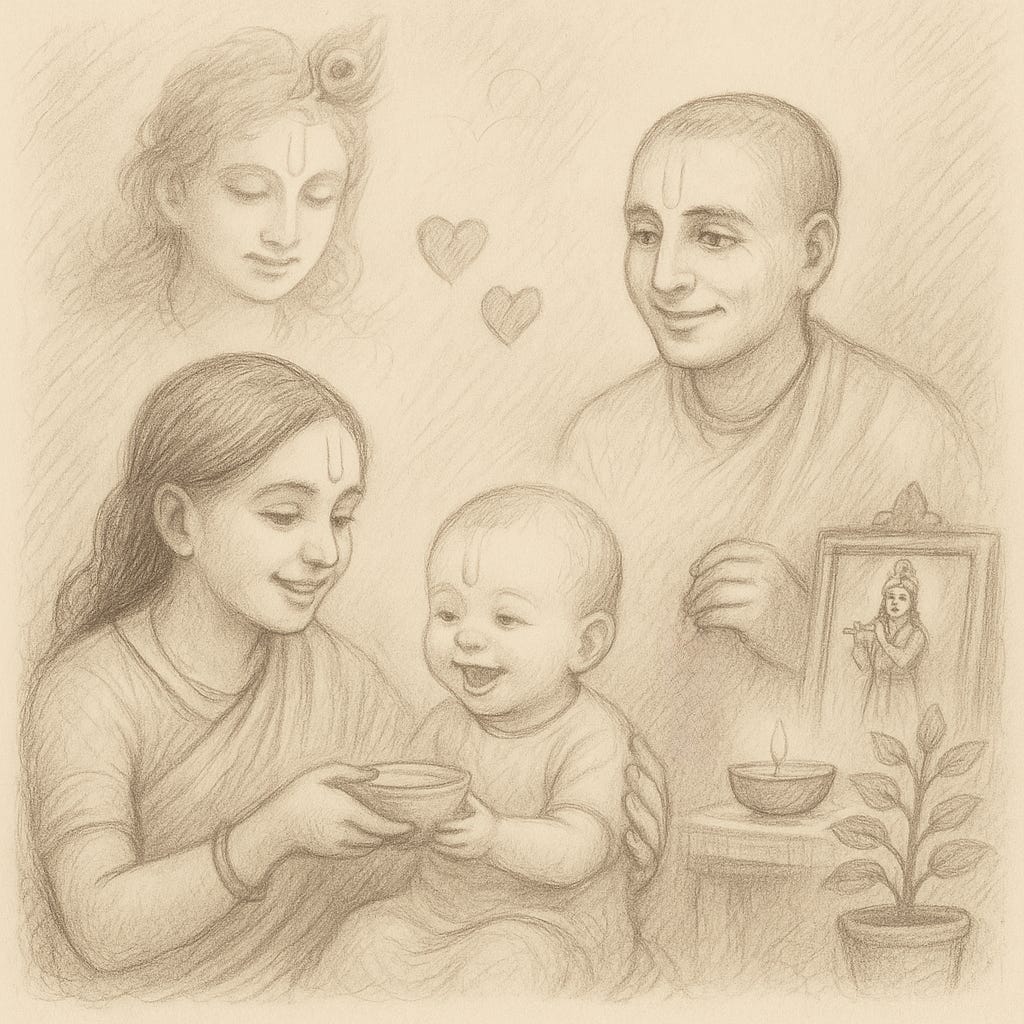
For one coming from a modern materialistic society, the idea of being happy by satisfying someone else may sound very alien, but it’s actually quite easy to understand. Parents often identify more with the happiness of their children than with their own comfort. A senior lady, a disciple of Śrila Prabhupāda, once commented to me how she was surprised when she saw a mother taking out the pieces of paneer in her sabji to feed her small child. She said she could not understand it at the time, since she liked panner, but after getting her own baby, she said, she started doing the same thing. A mother feels much happier when the baby gets something than when she personally gets it, so she tries to give him all the best. Similarly, a pure devotee feels happier when Kṛṣṇa enjoys something than when he himself enjoys; therefore, he wants to give all the best for Kṛṣṇa, and he feels happy when he sees Kṛṣṇa is happy.
The lowest level of identification is when we identify with our own bodies and try to satisfy the body through the senses. The highest is when we identify with Kṛṣṇa’s happiness and try thus to satisfy Him. Between the two extremes, there is something else: when we identify with the happiness of another person. This is the path that can help us move from one extreme to the other.
We can see that, although still material (because it is still under the conception of “I and mine” of the false ego), the love of the mother is quite close to the pure love the inhabitants of the spiritual world have for Kṛṣṇa. Once a lady has the opportunity to serve her baby in a relationship of love, it becomes much easier to understand the joy of doing the same for Kṛṣṇa. The father also experiences it to a certain degree, but it’s much more pronounced in the mother. This is an opportunity given by the material nature for women to develop an attitude of service that is closer to the eternal nature of the soul in serving Kṛṣṇa. That’s a point where the ladies get a better bargain, so to speak.
Ladies are, in general, more attached to sense gratification than men; therefore, it’s difficult to renounce sense gratification based on just philosophical understanding, as some men can do. Children are thus often the best opportunity women have to transcend the platform of selfish sense gratification and enter into the mood of selfless service, which can be later transferred to Kṛṣṇa. This is important, especially nowadays, when society pushes us in the direction of increasing our selfishness instead of diminishing it. When one tries to cultivate renunciation from this selfish platform, the result is often a dry, unhealthy type of renunciation that is actually not good in the long term.
People who are spiritually advanced from their past lives often can understand what spiritual love is through their spiritual practice, as a fruit of their past evolution. However, for most of us, it is quite difficult to understand if we don’t have experience of what love is in the material platform. Love between men and women is heavily contaminated by lust and, therefore, can hardly be considered love at all. Only the love of a mother for her child is close to being pure. Unless one had a good mother or has a beloved child, it’s quite probable that he or she never experienced anything close to love in this life. As a result, it also becomes difficult to understand what love for Kṛṣṇa is.
Another possibility of experiencing love is when one has the opportunity to associate with a guru who really shows love for his disciples. Many narrate how Śrila Bhaktisiddhanta Sarasvati Thakura and Śrila Prabhupāda showed this love for their disciples, and such love made them understand what love for Kṛṣṇa is. Many nowadays have the same opportunity to receive love from their spiritual masters, but unfortunately this doesn’t always happen, since most spiritual masters nowadays have many disciples, and not all of us are qualified to benefit from close association with the guru. The relationships with godbrothers and godsisters may also not be very harmonious at times, and may also not fill this role.
Spiritual practice without a good understanding of love and relationships in the spiritual world more often than not results in impersonalism, when one becomes frustrated with this material world and, without a positive alternative, desires to extinguish his individuality. This is not our goal.
Not only can this limit our spiritual potential, but it may also make it hard to properly relate to others, which, in turn, causes other problems. Many of us may know cases of devotees who, although performing their services, tend to be very impersonal or even mean in their relationships with others. That’s not a path we would like to follow.
« Things I Wish Someone Had Taught Me When I Started Krishna Consciousness
You can also donate using Buy Me a Coffee, PayPal, Wise, Revolut, or bank transfers. There is a separate page with all the links. This helps me enormously to have time to write instead of doing other things to make a living. Thanks!