

Subscribe to receive new articles by e-mail. It’s free, but if you like, you can pledge a donation:
🔉 Audio of the lesson »
🎙Podcast (Search for “Mysteries of the Vedas” on Spotify, iTunes, etc. to hear all the lessons
Join the Telegram group if you would like to join the live lessons. This course is maintained with your donations. Click here to donate.
💬 Text of the lesson
Mahārāja Rahūgaṇa inquires further, and Jaḍa Bharata deepens his teachings
After hearing these teachings, Rahūgaṇa again became repentant for his offenses to Jaḍa Bharata. He had completely disregarded him, forced him to carry his palanquin, and even threatened him. Now he understands the extent of his mistake.
“King Rahūgaṇa said: O most exalted personality, you are not different from the Supreme Personality of Godhead. By the influence of your true self, all kinds of contradiction in the śāstras have been removed. In the dress of a friend of a brāhmaṇa, you are hiding your transcendental blissful position. I offer my respectful obeisances unto you.
O best of the brāhmaṇas, my body is filled with dirty things, and my vision has been bitten by the serpent of pride. Due to my material conceptions, I am diseased. Your nectarean instructions are the proper medicine for one suffering from such a fever, and they are cooling waters for one scorched by the heat.” (SB 5.12.1-2)
Rahūgaṇa addresses Jaḍa Bharata with the word avadhūta, accepting him in the highest stage of self-realization, even though he was behaving externally as an unqualified member of a brāhmana family who was neglecting the external rules and regulations. This is contrasted with Rahūgaṇa’s position, which identifies with a material body composed of revolting substances. In his purport, Prabhupāda notes the words kāraṇa-vigrahāya, which indicate that Jaḍa Bharata’s body emanates from the Supreme Person. Of course, everything emanates from the Supreme Person, but in the case of Jaḍa Bharata, this was literal, because in his previous life, as Bharata Maharaja, he was born from Lord Ṛṣabhadeva, who is the Lord Himself.
“Whatever doubts I have about a particular subject matter I shall ask you about later. For the time being, these mysterious yoga instructions you have given me for self-realization appear very difficult to understand. Please repeat them in a simple way so that I can understand them. My mind is very inquisitive, and I want to understand this clearly.” (5.12.3)
Rahūgaṇa couldn’t understand the instructions of Jaḍa Bharata, but he is following the right process, putting forward his questions, so the guru can instruct him.
As Prabhupāda explains in his purport, “Although Jaḍa Bharata explained everything to Mahārāja Rahūgaṇa, it appears that his intelligence was not perfect enough to understand clearly. He therefore requested a further explanation. As stated in Bhagavad-gītā (4.34): tad viddhi praṇipātena paripraśnena sevayā. The student must approach a spiritual master and surrender unto him fully (praṇipātena). He must also question him in order to understand his instructions (paripraśnena). One should not only surrender to the spiritual master but also render loving service unto him (sevayā) so that the spiritual master will be pleased with the student and explain the transcendental subject matter more clearly. A challenging spirit before the spiritual master should be avoided if one is at all interested in learning the Vedic instructions in depth.”
In his answer, Jaḍa Bharata may appear displeased, or even angry at Rahūgaṇa, but that’s not the case. This just shows that Rahūgaṇa got his attention, and he is seriously trying to help him to understand. Often, we take the chastisement of the spiritual master as disapproval or irritation, but that’s not the case. A self-realized soul does not need to become angry at anyone. When he appears angry, that’s just a display of mercy, meaning he is investing the time and energy to try to correct the disciple. When a spiritual master becomes factually displeased, the reaction is not chastisement, but silence.
Rahūgaṇa mentions he has a few secondary questions he plans to ask later. For now, there are two more urgent points: first, he wants Jaḍa Bharata to explain his instructions on self-realization in a simple way, so he can be sure to understand. He also reveals his bewilderment in hearing the teachings:
“O master of yogic power, you said that fatigue resulting from moving the body here and there is appreciated by direct perception but actually there is no fatigue. It simply exists as a matter of formality. By such inquiries and answers, no one can come to the conclusion of the Absolute Truth. Because of your presentation of this statement, my mind is a little disturbed.” (SB 5.12.4)
In his book The Veil Begins to Part, Burijāna Prabhu quotes Viśvanātha Cakravartī Ṭhākura, clarifying the king’s thoughts: “O master of yoga, I said that one becomes tired from work. You replied that although there appear to be actions like carrying a load and results like becoming tired, this is only a worldly convention. You said that we cannot conclude that our direct perceptions actually indicate truth. I find that confusing, and I can’t quite understand your meaning.”
In his first presentation, the king defended that our practical experience of being tired, feeling pain, etc., is real and affects the soul, just as the heat of a fire cooks the rice inside a pan.
Jaḍa Bharata replied that being tired or in pain is a prerogative of the body and mind, not of the soul. The soul is not affected by the pain, but it identifies with the pain of the body. The pain is not false, but it exists only in the level of social and empirical dealings, not in the level of tattva (ultimate truth). “I’m tired” or “I’m in pain” is a conventional way of speaking in the bodily platform, but ultimately it is not true. If I’m a soul, and I’m transcendental to the body, who is this “I” that is tired or in pain? As long as Rahūgaṇa remains in this bodily platform, he will not be able to grasp transcendental topics.
This point is emphasized by Prabhupāda in his purport to text 5.12.4: “Formal inquiries and answers about the bodily conception do not constitute knowledge of the Absolute Truth. Knowledge of the Absolute Truth is quite different from the formal understanding of bodily pains and pleasures. In Bhagavad-gītā Lord Kṛṣṇa informs Arjuna that the pains and pleasures experienced in relation to the body are temporary; they come and go. One should not be disturbed by them but should tolerate them and continue with spiritual realization.”
This point is simple enough. Why then is Rahūgaṇa disturbed? The point is that he was used to think in this superficial level, thinking that what he feels is reality, and then using this experimental knowledge to try to understand the soul. From this mistaken approach, he was coming up with his analogy of the soul being just like the rice being cooked inside the pan, and so on. Jaḍa Bharata, however, made it clear that as long as he was using this process, he would get it wrong.
This made Rahūgaṇa confused, feeling that if he can’t trust his practical experience, how could he understand the soul at all? We can see that he understood that the process he was previously using to obtain knowledge was incorrect, but he still couldn’t properly grasp the knowledge about ātmā-tattva that Jaḍa Bharata was trying to convey.
“The self-realized brāhmaṇa Jaḍa Bharata said: Among the various material combinations and permutations, there are various forms and earthly transformations. For some reason, these move on the surface of the earth and are called palanquin carriers. Those material transformations which do not move are gross material objects like stones. In any case, the material body is made of earth and stone in the form of feet, ankles, calves, knees, thighs, torso, throat and head. Upon the shoulders is the wooden palanquin, and within the palanquin is the so-called King of Sauvīra. The body of the King is simply another transformation of earth, but within that body Your Lordship is situated and falsely thinking that you are the King of the state of Sauvīra.” (SB 5.12.5-6)
Jaḍa Bharata starts by describing the material situation. The material energy assumes different forms. Some of them move, such as humans and animals, and some don’t move, such as earth and stones. A human body may look at first very different from a stone, but it is, in fact, made from the same material elements. The same calcium found in some rocks and minerals, for example, forms the human bones and teeth, while carbon, phosphorus, nitrogen, iron, and other elements combine with water to form flesh, blood, and other components of the body.
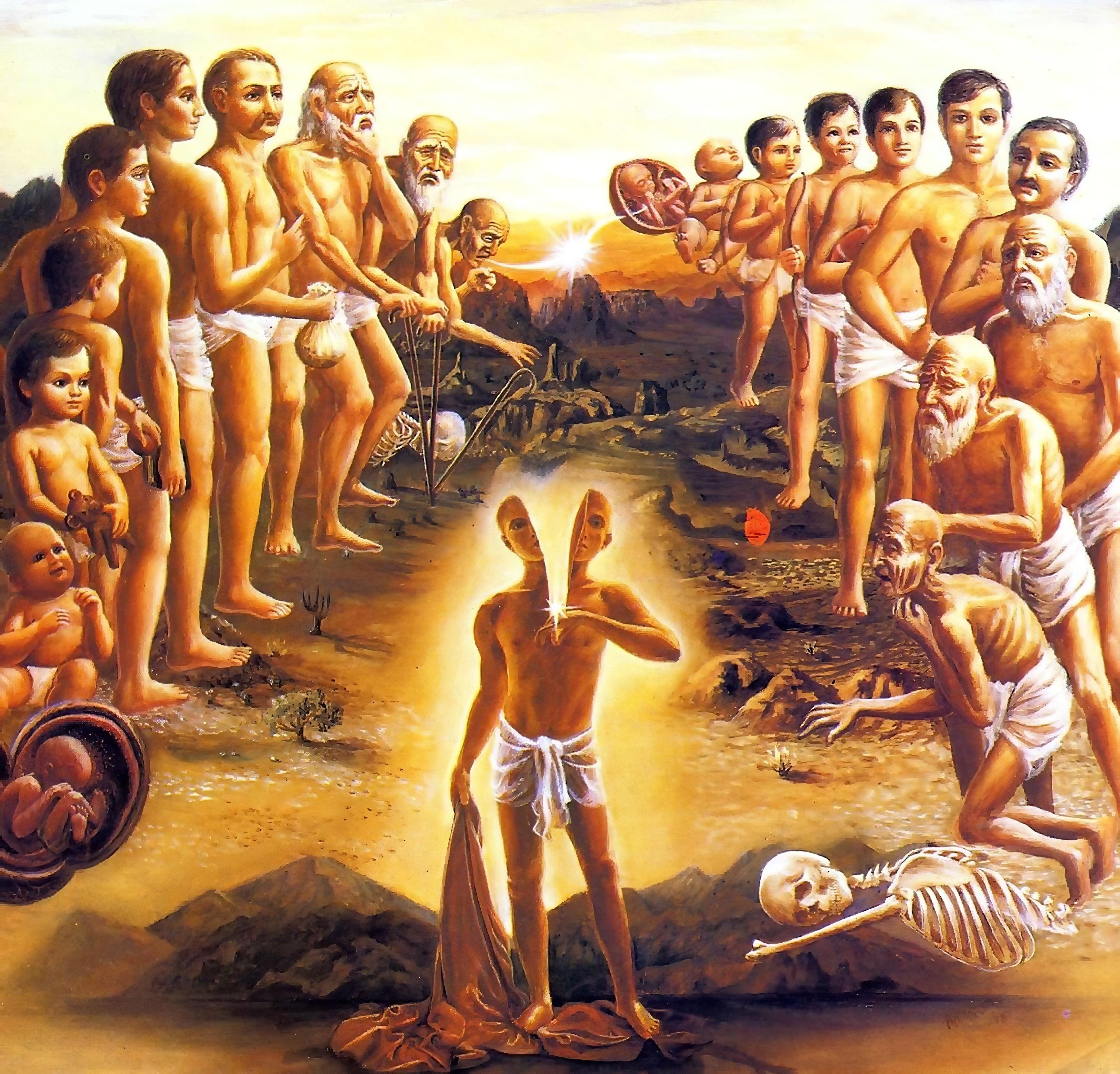
Some of these material transformations are called palanquin carriers, and they carry a palanquin, which is also a material transformation. On top, there is another transformation that, by general convention, is called “the king.” None of this is false, but it has no factual connection with the soul. The mistake of Rahūgaṇa is to identify himself with this material body in which he, as the jīva, is temporarily situated, thinking he is the king and others are his servants.
Jaḍa Bharata thus contests the bodily identification of the king, addressing him as pārthiva (O King made of earth), indicating the absurdity of identifying with a temporary body made of material elements.
Behind all forms of life, the soul is the living principle. The soul is, however, part of the transcendental potency of the Supreme Lord, and therefore He is the real principle behind everything. Understanding that is true knowledge, different from false identification with flesh, bones, and artificial identities. This point is raised by Prabhupāda in his purport: “The living entity is the offshoot or offspring of Lord Viṣnu; therefore within this material world, among moving and nonmoving things, the real principle is Lord Viṣnu. Due to His presence, everything is working, and there are actions and reactions. One who understands Lord Viṣnu as the original cause of everything is to be understood to be perfectly situated in knowledge.”
What about the example of the child with golden ornaments mentioned by Prabhupāda in the purport? “Śrīla Viśvanātha Cakravartī gives an example of a child heavily decorated with ornaments; although the child’s body is very delicate, he does not feel fatigue, nor do the parents think that his ornaments should be taken away. The living entity has nothing to do with bodily pains and pleasures. These are simply mental concoctions.”
Just like a worker carries a heavy load in the form of a palanquin, a child may carry a load in the form of golden ornaments. The child, however, does not see this “load” in the same way as the palanquin carrier, remaining happy and absorbed in play. Similarly, an adult carrying a heavy bag of money would see this “load” as happiness, and not at all mind carrying it home, while a self-realized soul may carry either the palanquin or money without experiencing either tiredness or happiness. If the presence of weight on the body would automatically mean that the self is suffering, then all four would be similarly suffering, but that’s not the case. This proves that suffering comes not from the weight, but from the interpretation of the mind and the identification with the body. Therefore, an intelligent person focuses not on the changing material situation, but on the cause of everything, the Supreme Lord.
“It is a fact, however, that these innocent people carrying your palanquin without payment are certainly suffering due to this injustice. Their condition is very lamentable because you have forcibly engaged them in carrying your palanquin. This proves that you are cruel and unkind, yet due to false prestige you were thinking that you were protecting the citizens. This is ludicrous. You were such a fool that you could not have been adored as a great man in an assembly of persons advanced in knowledge.” (SB 5.12.7)
After destroying the bodily identification of the king, Jaḍa Bharata dismounts his false concept of being the protector of the citizens. Rahūgaṇa could argue that even if, in the depths of ignorance, he was still executing the important function of protecting the public, but even this is negated. Because of his entitlement and ignorance, he was misusing his position and causing suffering to others.
One could argue that, since Jaḍa Bharata is explaining that the sufferings of the body do not affect the soul, what is the problem in causing suffering to others? This equals, however, the Māyāvādi thought of everything being false, which was dismissed by Rahūgaṇa since the beginning. The proper understanding is that there are two levels of existence (material and spiritual), and even though the suffering of the body does not affect the eternal soul, we should not create unnecessary suffering for others who are stuck in the material level.
Prabhupāda captures the whole situation perfectly in his purport: “King Rahūgaṇa was proud of being king, and he felt he had the right to control the citizens as he liked, but actually he was engaging men in carrying his palanquin without payment, and therefore he was causing them trouble without reason. Nonetheless, the King was thinking that he was the protector of the citizens. Actually the king should be the representative of the Supreme Personality of Godhead. For this reason he is called nara-devatā, the Lord among human beings. However, when a king thinks that because he is the head of the state he can utilize the citizens for his sense gratification, he is in error. Such an attitude is not appreciated by learned scholars. According to the Vedic principles, the king should be advised by learned sages, brāhmaṇas and scholars, who advise him according to the injunctions given in the dharma-śāstra. The duty of the king is to follow these instructions. Learned circles do not appreciate the king’s utilizing public endeavor for his own benefit. His duty is to give protection to the citizens instead. The king should not become such a rogue that he exploits the citizens for his own benefit.”
“All of us on the surface of the globe are living entities in different forms. Some of us are moving and some not moving. All of us come into existence, remain for some time and are annihilated when the body is again mingled with the earth. We are all simply different transformations of the earth. Different bodies and capacities are simply transformations of the earth that exist in name only, for everything grows out of the earth and when everything is annihilated it again mingles with the earth. In other words, we are but dust, and we shall but be dust. Everyone can consider this point.”
One may say that varieties arise from the planet earth itself. However, although the universe may temporarily appear to be the truth, it ultimately has no real existence. The earth was originally created by a combination of atomic particles, but these particles are impermanent. Actually the atom is not the cause of the universe, although some philosophers think so. It is not a fact that the varieties found in this material world simply result from atomic juxtaposition or combination.
Since this universe has no real ultimate existence, the things within it — shortness, differences, grossness, skinniness, smallness, bigness, result, cause, living symptoms, and materials — are all imagined. They are all pots made of the same substance, earth, but they are named differently. The differences are characterized by the substance, nature, predisposition, time and activity. You should know that all these are simply mechanical manifestations created by material nature.” (SB 5.12.8-10)
In these three verses, Jaḍa Bharata dismounts, layer by layer, the misconception of material existence.
One could insist that there are many forms, which are different from each other, but all these forms are temporary, and are formed by the same element: earth. Considering this point, what is the real difference between the king and the servant?
However, earth itself is not the ultimate cause; it is just a combination of atomic particles and is always changing. Therefore, the material manifestation may appear to be true for the time being, but ultimately it is illusory, because it has no permanence. As Kṛṣṇa explains in Bg 2.16, things that are real are eternal. The material manifestation is not false, but it is illusory. Reality exists in the spiritual world.
Since the universe in itself is illusory, including all bodies and objects inside of it, what to say about the attributes of these bodies and objects, such as short, tall, fatty, skinny, big, small, etc? These are all mental constructions. Knowledge about these different material transformations is thus of little value.
If even the universe itself is illusory, what is ultimately real? This is the point Jaḍa Bharata is hinting at the whole time, and that he will explain openly in the next verses. Ultimately, everything is the energy of the Supreme Lord. The whole cosmos is just a transformation, or permutation of His energy, and the souls are His eternal parts and parcels. Each material planet is the shelter of many living entities, but the planets themselves rest on the potencies of the Lord. Nothing is false, but the different situations we deal with in material life are illusory, the fruit of the misunderstanding of identifying with body and mind.
It is a mistake, however, to reject this world as false, as done by the Māyāvādis. All material objects should be used in the service of the Lord, and, in fact, when this is done, they become spiritual, just as a bar of metal becomes incandescent when put inside a fire.
“What, then, is the ultimate truth? The answer is that nondual knowledge is the ultimate truth. It is devoid of the contamination of material qualities. It gives us liberation. It is the one without a second, all-pervading and beyond imagination. The first realization of that knowledge is Brahman. Then Paramātmā, the Supersoul, is realized by the yogīs who try to see Him without grievance. This is the second stage of realization. Finally, full realization of the same supreme knowledge is realized in the Supreme Person. All learned scholars describe the Supreme Person as Vāsudeva, the cause of Brahman, Paramātmā and others.” (SB 5.12.11)
Jaḍa Bharata mentions that this ultimate truth is non-dual (ekam), free from material contamination (viśuddham). It is without interior and exterior (in other words, all-pervading), the nondual Brahman, which is satyam (ultimate reality) and the inner, perfectly peaceful reality (pratyak praśāntaṁ). Up to here, the description appears vague, which can give margin for interpreting this absolute truth as impersonal, as done by the Māyāvādis. When one studies just the Sanskrit, it is hard to understand what exactly the verse means.
The verse, however, gives the key for the proper interpretation at the end: bhagavac-chabda-saṁjñaṁ, yad vāsudevaṁ kavayo vadanti. This absolute truth is known in its highest sense as Bhagavān, and personally identified as Vāsudeva, Kṛṣṇa. Prabhupāda uses this key to decipher the whole verse, giving its true meaning in his translation.
This verse is connected with Śrīmad Bhāgavatam 1.1.1 and 1.2.11. The first verse defines the absolute truth as Vāsudeva Kṛṣṇa, the son of Vasudeva, while the second gives the key to understanding the qualities described here, describing the three levels of understanding of the Absolute Truth.
When the verse is properly decoded, it becomes easy to understand what Jaḍa Bharata is explaining: One can understand this Absolute Truth as a non-dual substance who is the source of everything (Brahman), the localized Supersoul who is everywhere and is seen by yogīs (Paramātmā), or in His supreme aspect as Bhagavān, the possessor of all potencies and opulences. We can see that this meaning is perfectly revealed by Prabhupāda.
“My dear King Rahūgaṇa, unless one has the opportunity to smear his entire body with the dust of the lotus feet of great devotees, one cannot realize the Absolute Truth. One cannot realize the Absolute Truth simply by observing celibacy [brahmacarya], strictly following the rules and regulations of householder life, leaving home as a vānaprastha, accepting sannyāsa, or undergoing severe penances in winter by keeping oneself submerged in water or surrounding oneself in summer by fire and the scorching heat of the sun. There are many other processes to understand the Absolute Truth, but the Absolute Truth is only revealed to one who has attained the mercy of a great devotee.” (SB 5.12.12)
Now that the Absolute Truth was defined, the next question is how to attain Him. It was already defined that He can’t be understood by the material mind or the material intelligence. These were the tools Rahūgaṇa was using, and we can see that he couldn’t even understand the transcendental nature of the soul, what to say about understanding the Supreme Person.
This verse adds that He also can’t be understood by mechanical processes such as penance or the practice of the principles of varnāśrama. Understanding the Absolute Truth requires a type of purification that can be bestowed only by pure devotees. As Prabhupāda explains: “One cannot attain the perfection of spiritual life simply by following the directions of the Vedas. One has to approach a pure devotee: anyābhilāṣitā-śūnyaṁ jñāna-karmādy-anāvṛtam. By the grace of such a devotee, one can understand the Absolute Truth, Kṛṣṇa, and one’s relationship with Him.”
With this, the passage upholds the same conclusion consistently given in other passages of the Śrīmad Bhāgavatam: Kṛṣṇa is the Supreme Personality of Godhead, fixing our mind on Him is the supreme goal, and to attain this goal we should associate with pure devotees and learn the process of Kṛṣṇa Consciousness from them.
“Who are the pure devotees mentioned here? In an assembly of pure devotees, there is no question of discussing material subjects like politics and sociology. In an assembly of pure devotees, there is discussion only of the qualities, forms and pastimes of the Supreme Personality of Godhead. He is praised and worshiped with full attention. In the association of pure devotees, by constantly hearing such topics respectfully, even a person who wants to merge into the existence of the Absolute Truth abandons this idea and gradually becomes attached to the service of Vāsudeva.” (SB 5.12.13)
How can we find such pure devotees? The main symptom is that they are not interested in material subjects. Because their consciousness is fixed in the Supreme Person, they automatically lose interest in material topics. Such an association is beneficial both for neophytes who are coming from materialistic life and for transcendentalists who were previously fixed in the impersonal aspects. By hearing about the qualities, forms, and pastimes of the Supreme Lord, we can become attracted to the process of devotional service, and thus gradually revive our eternal nature.
As Prabhupāda mentions: “A devotee has no other ambition than to serve Kṛṣṇa, the Supreme Personality of Godhead. This Kṛṣṇa consciousness movement was started to engage people twenty-four hours daily in the service of the Lord and in His glorification.” The whole purpose of the society he created is to offer a place where we can find the association of pure devotees and gradually become pure devotees ourselves. Just as an ordinary virus is propagated by personal contact, pure devotional service is also spread by personal association. We need this personal touch to even understand what it is. We can see that Rahūgaṇa was completely confused even after a long time inquiring about the Absolute Truth, but this is all being fixed in just a short meeting with Jaḍa Bharata.
“In a previous birth I was known as Mahārāja Bharata. I attained perfection by becoming completely detached from material activities through direct experience, and through indirect experience I received understanding from the Vedas. I was fully engaged in the service of the Lord, but due to my misfortune, I became very affectionate to a small deer, so much so that I neglected my spiritual duties. Due to my deep affection for the deer, in my next life I had to accept the body of a deer.
My dear heroic King, due to my past sincere service to the Lord, I could remember everything of my past life even while in the body of a deer. Because I am aware of the falldown in my past life, I always keep myself separate from the association of ordinary men. Being afraid of their bad, materialistic association, I wander alone unnoticed by others.
Simply by associating with exalted devotees, anyone can attain perfection of knowledge and with the sword of knowledge can cut to pieces the illusory associations within this material world. Through the association of devotees, one can engage in the service of the Lord by hearing and chanting [śravaṇaṁ kīrtanam]. Thus one can revive his dormant Kṛṣṇa consciousness and, sticking to the cultivation of Kṛṣṇa consciousness, return home, back to Godhead, even in this life.” (SB 5.12.14-16)
To emphasize what he had just explained, Jaḍa Bharata reveals his own experience. He had almost reached perfection in his previous life, but fell due to inattentiveness. Because he was practicing alone, he didn’t approach his guru or another senior Vaiṣnava when he had difficulties, and because of this, he ended up receiving an animal body in his next life. Text 15, however, reveals that even in this situation, he was protected by the Lord and thus was able to remember Him. This emphasizes two essential points: the need for association and the protection of the Lord, a topic that will be described in more detail in the Sixth Canto.
In this pastime of Bharata Maharaja, we learned about two traps that can make one fall even from an advanced platform: inattention and attachment to dependents. In his purport, Prabhupāda adds a third: “If one always follows the orders of the spiritual master, there is no question of falling down. As soon as a foolish disciple tries to overtake his spiritual master and becomes ambitious to occupy his post, he immediately falls down. Yasya prasādād bhagavat-prasādo yasyāprasādān na gatiḥ kuto ’pi. If the spiritual master is considered an ordinary man, the disciple surely loses his chance to advance further.”
We can advance by associating with pure devotees as much as we have faith in them and accept their teachings. Just as when we see the deity as a statue, the Lord stops reciprocating with us, when we see a pure devotee as an ordinary person, we lose the opportunity from advancing from his association. Often, we start the process correctly, approaching a spiritual master, offering some service, and hearing from him, but over time, we start seeing faults and end up giving up the association with the guru, seeing him as an ordinary man. When this happens, we lose the opportunity of advancing further and become vulnerable to being attracted again to material association. Unfortunately, this is common, and thus the personal testimony of Jaḍa Bharata is very instructive.
Another point is that an attentive reader could notice an apparent contradiction in these verses. It seems that Jaḍa Bharata is instructing Rahūgaṇa to seek the associations of pure devotees, while he himself is staying aloof, but that’s not the case.
Even in his previous life, he was not exactly alone. The problem, as pointed out by Prabhupāda, is that he didn’t seek the right association at the crucial moment. Because his fall was caused by the association with the deer, he was very strictly following the principle of ahaṁ jana-saṅgād asaṅgo (I always keep myself separate from materialistic society). However, as previously indicated, he had attained the constant association of the Lord; therefore, even “alone,” he was constantly in good association.
That’s the feature of pure devotees like Jaḍa Bharata that sets them apart from ordinary sādhakas. In the beginning, we need to always remain physically in the association of devotees, since being alone means spiritual stagnation and the risk of becoming again attracted to materialistic association. A mahā-bhāgavata, however, becomes fixed in the spiritual platform and becomes thus free from the limitations of physical association. He can thus always remain in the association of his spiritual master and the Lord Himself. From this platform, they can enlighten sincere conditioned souls, like Rahūgaṇa himself, and when such mahā-bhāgavatas meet, the most powerful spiritual discussions ensue, like the Śrīmad Bhāgavatam itself.
This is a publication for thoughtful readers who want to go deeper into Kṛṣṇa consciousness. I publish daily, and all posts are available to free subscribers. If you wish, you can also choose a paid subscription to support this work. By subscribing, you also gain access to the manuscripts of the books I’m currently working on.
If you would like to contribute further, you can find the donation links here.