

« Things I Wish Someone Had Taught Me When I Started Krishna Consciousness
Making our family part of our service to Kṛṣṇa
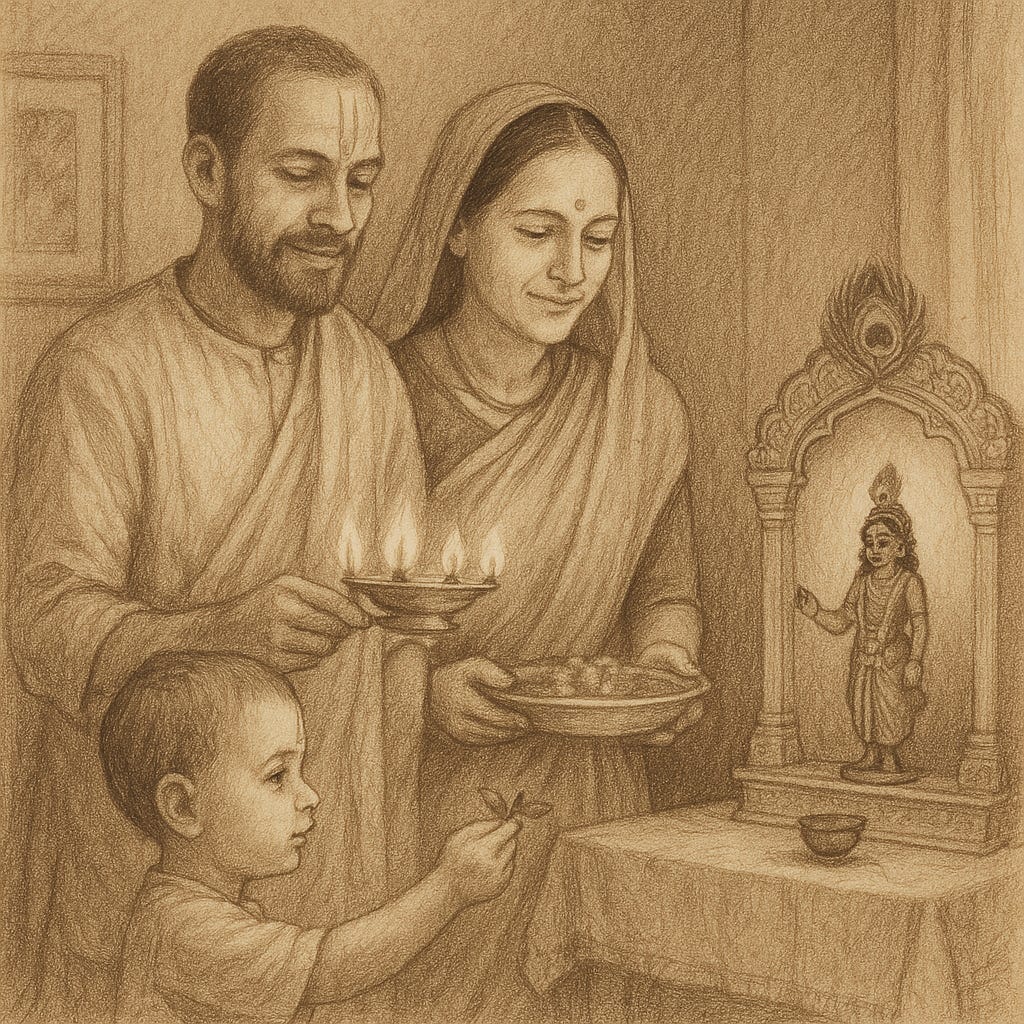
The whole purpose of family life in Kṛṣṇa consciousness is to advance spiritually. When a materialist enters into family life, he is called “gṛhamedhi”, because his idea is to just increase his sense enjoyment. On the other hand, a devotee is called “gṛhastha” because his goal is to advance spiritually. His family life is an āśrama, a base from which to advance to higher spheres of devotional service.
The difficulty of family life in Kṛṣṇa Consciousness is that it involves combining two factors that may look incompatible at first: taking care of the material needs of a family and practicing a spiritual process.
Frequently, we see these as two separate things, and as a result, we focus on one to the detriment of the other: or we take good care of our families but forget Kṛṣṇa, or become very serious about sādhana and other aspects of devotional life but neglect our families.
I remember once speaking with a second-generation devotee who narrated how sometimes his mother would be very engaged in serving in the temple and as a result, neglect taking care of the house, and how this led him to grow up having a negative image of devotees, seeing them as rivals for the attention of his mother, something that took him a long time to overcome. Many of us may commit similar mistakes.
What is the solution then? Considering our limited attention span, how can we do both things simultaneously? As always, the Bhagavad-gītā can give us some insight.
In the first chapters, Kṛṣṇa explains the concept of karma-yoga, executing one’s duties as an offering to Him. This concept is extremely valuable because it directly applies to our practical lives.
While some may practice spiritual life in solitude, as renounced persons, most of us are not ready for it. According to the teachings of Śrila Bhaktisiddhānta Sarasvatī Thākura, this is not even very much recommended, since in most cases it just leads to one becoming an impostor, playing the role of a bābājī just to get some cheap adoration from the public, while secretly cultivating bad habits and illicit relationships.
Instead, we are advised to perform our material duties, according to the āśrama we are in, executing these activities as an offering to Kṛṣṇa. In this way, just as a sannyāsi follows the principles of his āśrama, such as keeping clean, avoiding association with women, and living simply, a householder should also practice the principles of his āśrama, such as educating his children, doing it with the idea of satisfying Kṛṣṇa by his efforts.
When we see our family life as being separated from our spiritual practice, the tendency is to pick a side, according to what we consider most important. However, when we see family life as part of our service to Kṛṣṇa, as an offering to Him, it becomes much easier to reconcile the two worlds.
This is not just some kind of white lie we are told, but actually the truth. Family life means taking care of other souls Kṛṣṇa sends as our wives, husbands, and children. All these souls are important to Him, and He becomes pleased when we properly take care of them, performing this service as an offering to him. When we do that, we can reconcile the two sides, taking proper care of our family, and at the same time remembering Kṛṣṇa. When we learn this art, our lives become much more successful, and our families become a catalyst for our spiritual practice instead of an impediment.
Of course, a crucial factor is the choice of our spouse. It’s not easy to perform our family duties as an offering to Kṛṣṇa when the husband or wife is not a devotee, and the children are not at all interested in spiritual life.
How to find a serious and reliable devotee to become our wife or husband? The first step is to work on ourselves. If we ourselves are materialists, chances are we are going to find another materialist to be our spouse, or even if we find a good devotee, he or she will be forced to act as a materialist to keep the marriage in one piece. The more we work on ourselves and on our expectations before marriage, the better our chances of finding a good person. When our idea is to serve and not to exploit, it becomes easier to find someone who is sincere and has similar goals in spiritual life, with whom we can easily cooperate.
Many devotees choose their partners simply based on superficial attraction, which is a serious mistake. The scriptures alert that love marriage in Kali-yuga is considered inauspicious since people don’t know how to properly choose a partner, and thus base their decision merely on sexual attraction. As Śrila Prabhupāda phrases, “I like you. You like me. That’s all right. Let us live together.” Things work much better when we choose a partner based on the similarity of goals and interests and mutual affinity.
To be too sexually attracted to someone is actually not a good signal, because it can easily make us lose our intelligence, which is counterproductive in family life. One’s behavior can increase the influence of either the mode of goodness, passion, or ignorance in the partner. One should look for a partner who inspires him or her in the direction of the mode of goodness, inspiring calmness, peace, responsibility, etc. If a person makes us feel passionate or gets on our nerves, it is probably not a good choice.
We can see that, in most countries, divorces are becoming more and more common. Marriages between devotees are even more complicated than between regular people because, on top of emotional compatibility, there should also be spiritual compatibility. If one has views on spiritual life that are opposed to the other, if their goals or values in spiritual life are too different, etc., the relationship may not survive, even if they are otherwise compatible. Both should have similar goals and priorities in spiritual life and similar values and mentalities, being thus able to cooperate in harmony.
Another problem is that often when one tries to find a partner, the mind and senses become agitated, the mode of passion takes over, and it’s very difficult to remain sober and to make an objective decision. The mind plays tricks, leading to all kinds of mistakes and erratic behavior.
The best way to find a good partner, at least in my experience, is with the help of a serious senior devotee who has sufficient experience and agrees to help, someone whom you trust. Temple presidents and other local authorities are usually not the best choice, because in their case, there is frequently a conflict of interest. A local authority may suggest someone whom they want to keep in the yatra, for example. In this particular situation, it’s better to approach someone who is not involved with management. As mentioned, the main consideration should be trust, and nothing else. Institutional pressure should have no place in it.
In previous eras, parents used to do this, but in our current spiritual society, we depend on our seniors for help and guidance. We know that everything is controlled by Kṛṣṇa, but a lot of times we forget that He likes to act through His devotees.
A good approach for a senior willing to help in this sense is to first separately talk with the potential partners about their views and priorities in spiritual life, their expectations in family life, and their ideas about common topics, like where to live, how to run the house, who is going to work, if there will be Netflix or not, how to educate the children, etc. By getting this type of information, the mentor can see to what extent they are compatible in terms of lifestyle and goals, and from there try to give them good advice. If there is good compatibility in values, ideals, and goals, the match can be considered good. If not, he may present the potential difficulties and allow the couple to decide. If they decide to go ahead, they should also be instructed about how to start and conduct the relationship in a proper way, get advice about difficulties they may face, and so on.
« Things I Wish Someone Had Taught Me When I Started Krishna Consciousness
You can also donate using Buy Me a Coffee, PayPal, Wise, Revolut, or bank transfers. There is a separate page with all the links. This helps me enormously to have time to write instead of doing other things to make a living. Thanks!