


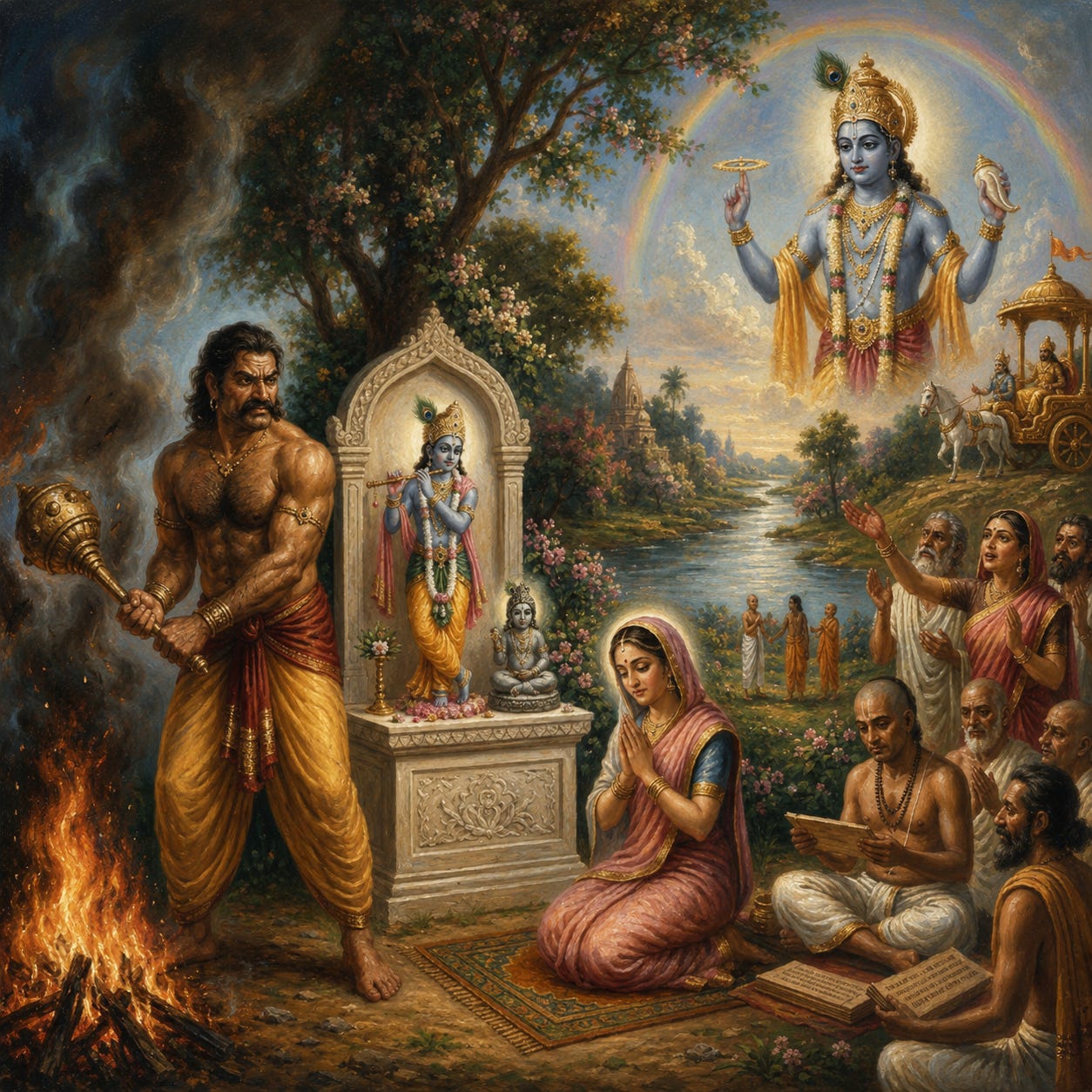
In Vedic astrology, human beings are divided into three gaṇas (devatā, manuṣya, and rākṣasa) according to the predominant influence of the modes of material nature. Those who have a stronger influence of the mode of goodness fall into the devatā gaṇa, those who have a stronger influence of the mode of passion fall into the manuṣya gaṇa, and those who have a more significant influence of the mode of ignorance fall into the rākṣasa gaṇa. This doesn’t mean one will be a demigod or a rākṣasa, or if one will be a devotee or not, or even if one will be a good person or not, but it is connected with certain standards of behavior. For example, persons on the rākṣasa gaṇa tend to be angrier, while the ones in the devatā gaṇa tend to be milder, for example. These are also not permanent characteristics. The soul is transcendental. The devatā, manuṣya, or rākṣasa ganas are not the svarūpa of the soul. The deeper philosophical principle is: jīvera ‘svarūpa’ haya — kṛṣṇera ‘nitya-dāsa’. The constitutional position of the living entity is to be an eternal servant of Kṛṣṇa.
However, as long as we are conditioned, we identify with a certain material nature that is received at birth. It is the fruit of our past actions and desires, and cannot be easily changed until one is elevated to the transcendental level. A pure devotee can easily break with his conditioned nature, but as long as we are still advancing in the process, we need to deal with the particular nature we received in this life, using it to serve Kṛṣṇa, build relationships, and so on.
Another point is that temperament does not equal moral worth or spiritual advancement. Certain characteristics may be more favorable than others, but the defining factor is how we use them, not the characteristic itself. Bhima used his angry nature to exterminate the impious Kaurava soldiers during the battle of Kurukṣetra, while Kuntī used her mild nature to offer beautiful prayers to Kṛṣṇa. If we can find ways to properly engage our natures in the service of Kṛṣṇa, they can be gradually purified.
Yet another factor is that everyone has a mixture of qualities—different sides, so to speak—and learning to use the right side according to the situation is also decisive. A woman who has to work may show her fierce side while outside, dealing with opposition, reserving her tender side for her family, for example.
Self-control is also an essential factor. Self-control is the filter that allows us to prevent our nature from showing in the wrong situations. While changing one’s nature can be extraordinarily difficult, developing self-control is much more doable. By using self-control, we can blunt the negative aspects of our personality and thus continue engaging in the spiritual process until our real spiritual nature begins to change. As mentioned in the Caitanya Caritamrta, nitya-siddha kṛṣṇa-prema ‘sādhya’ kabhu naya: “Love for Kṛṣṇa is eternally present and awakens in the purified heart.” Ultimately, everyone is a pure soul, endowed with all good qualities, but until we can revive this forgotten nature, we have to work with what we have.
That’s why, although temporary, our conditioned natures play an important role. The gaṇa, or the classification as devatā, manuṣya, and rākṣasa, is one of the characteristics taken into consideration for compatibility amongst couples, for example. A woman with the devatā and a man with the rākṣasa gaṇa is not considered a good combination, because the man can be overaggressive, and being sāttvic, the woman will not have defenses against it, which can lead to an abusive relationship. The opposite is also considered bad. On the other hand, if both the man and the woman share the same rākṣasa gaṇa, the combination is considered better. The rationale in this case is that an aggressive man is paired with a woman who is better equipped to fight back, neutralizing it. We can imagine the image of a couple that fights and fights, but in the end love each other, for example.
This is a mistake we may often commit. We may presume that just because a man and a woman are both devotees, the combination will work regardless of their material natures. This can work if both are pure devotees, but not amongst conditioned souls. “Devotee”, in the sense we normally use it, is a very broad term, applicable from the pure devotee who just happens to be temporarily encased in a material body, all the way to the psychopath that chants Hare Kṛṣṇa. We often encourage bad combinations, just because both are devotees, and then tell the oppressed part to simply tolerate, accept it as their karma, etc., which is not a very workable strategy in the long-term.
Compatibility of couples is a complicated science, and there are many other factors involved, but the main point is that people have different sets of qualities, and for successful relationships to be formed, people need to understand how they are pulled by the modes of nature, do the best with the combination of the three modes he got, and find a partner that has a compatible disposition. A pure devotee is not a good match for a woman with a lot of material desires, just as a pure devotee lady is not a good match for a man with a lot of carnal desires. In both situations, the difference in disposition, goals, and habits will lead to conflict and dissatisfaction. On the other hand, two people with similar dispositions and goals can work together and progress on the desired path. Marriage, as well as other types of relationships, work better amongst people with similar dispositions. Like-minded people can go a long way together, while people of very different dispositions may keep sabotaging each other.
The same applies when we speak about devotional service. Devotional service means to work according to our natures for the satisfaction of Kṛṣṇa, engaging our talents and natures. Generally, a brāhmana is considered higher than a kṣatriya, because a brāhmana performs duties of a higher nature. However, when Arjuna wanted to leave the battlefield and try to imitate a brāhmana, meditating in the forest, Kṛṣṇa opposed the idea. The whole Bhagavad-gītā is based on the idea that we should engage our current material nature in the service of Kṛṣṇa. That’s the tool we can use to advance. Even when one becomes a pure devotee, Kṛṣṇa advises one to continue working according to his or her nature, performing duties in Kṛṣṇa consciousness to give an example to others.
A very simple example of the application of this principle: Some devotees may have a tendency to be renunciants, while others may have more material desires. However, both types can be equally useful in their service to Kṛṣṇa. The renounced devotee may preach, serve in a temple, and so on, while the devotee with material desires can use this tendency positively to make money and build temples, for example. If the renounced devotee tries to make money, or if the devotee with material desires tries to become renounced, however, the result may not be so good. We should try to understand what our talents and dispositions are and learn to use them for Kṛṣṇa, instead of trying to adapt to stereotyped role models.
Kṛṣṇa mentions this point in the Gītā when he mentions that “It is far better to discharge one’s prescribed duties, even though faultily, than another’s duties perfectly. Destruction in the course of performing one’s own duty is better than engaging in another’s duties, for to follow another’s path is dangerous.”
Different positions and services can have positives and negatives, but people suffer when they try to live according to a nature that is not theirs. Many of the difficulties we face in spiritual life are because of trying to fit into roles that are opposed to our natures. Everyone can be useful in the service of Kṛṣṇa, but when we are not properly engaged, we can become erratic. Both the hand and the leg can be useful for the body, but if the hand is put in the place of the leg, it will not be able to do the job properly. The same applies to relationships: a person may be perfectly good and well-intentioned, but if he or she is not paired with another of a similar disposition, things can go terribly wrong.
If you are interested in reading more about the challenges we face in spiritual life, check the book:

This is a publication for thoughtful readers who want to go deeper into Kṛṣṇa consciousness. I publish daily, trying to offer high-quality spiritual content, and all posts are available to free subscribers. If you wish, you can also choose a paid subscription to support this work.
You can also receive the updates on WhatsApp or Telegram.
If you would like to contribute further, you can find the donation links here.