

« Things I Wish Someone Had Taught Me When I Started Krishna Consciousness
Material science is not necessarily an enemy
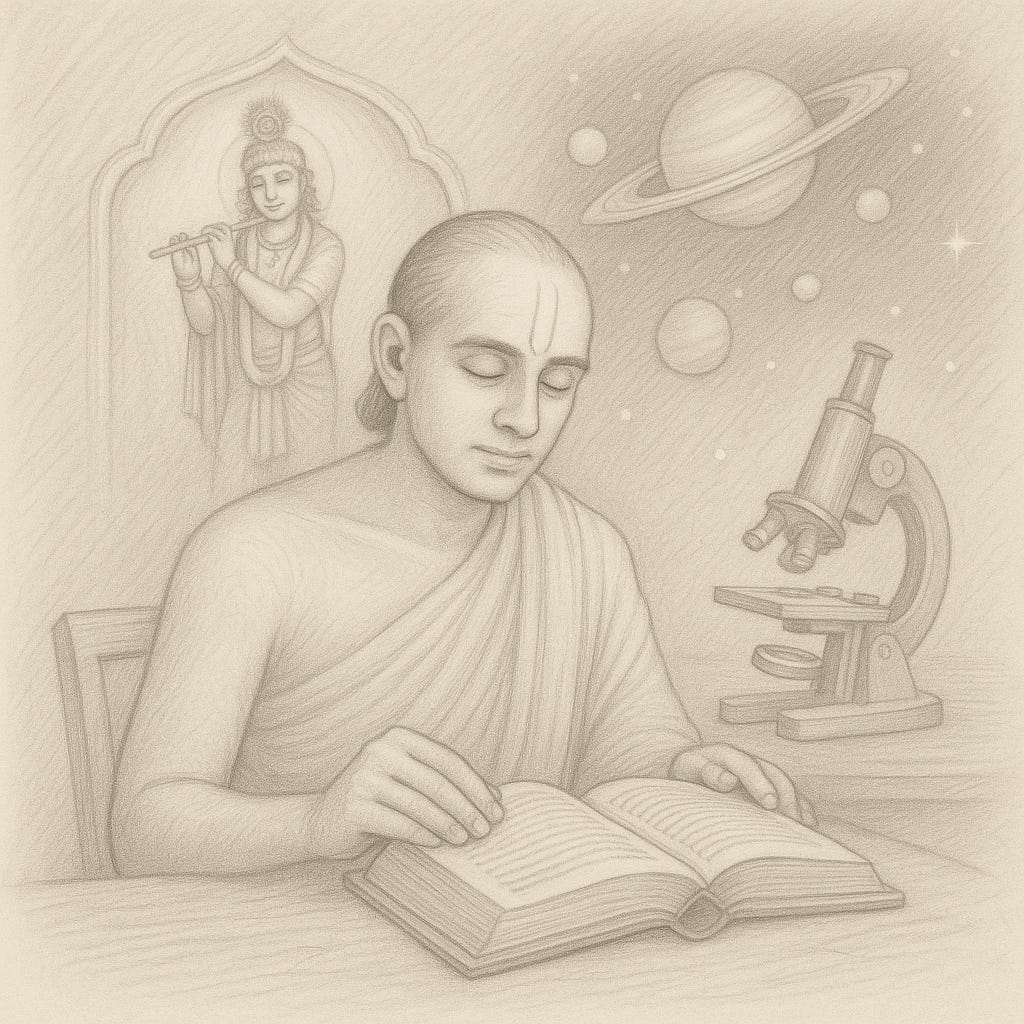
Many think that following the Vedas and the teachings of Prabhupāda means automatically having a very negative view of material science, calling all scientists rascals, cheaters, and so on. There are many nuances, however.
First of all, there is no evidence that all scientists, as individuals, are cheaters. There are even many devotees who work in different branches of scientific research. If we generalize, we are also offending the ones who are honest. There are indeed many scientists who are rascals and cheaters, as well as many people from other areas. In essence, everyone who doesn’t accept Kṛṣṇa as the Supreme Personality of Godhead is a cheater, because voluntarily or involuntarily, he is speaking untruths. Śrila Prabhupāda raised this point on many occasions, but when it comes to us, we can’t generalize.
A second point is that material science or experimental knowledge is also considered a valid way to obtain knowledge. It’s called āroha, or the ascending process. It’s a valid process, it’s just that it’s not the best one. Śrila Prabhupāda mentions this in the Sri Isopanishad (intro): “In the beginning the first living creature was Brahmā. He received this Vedic knowledge and imparted it to Nārada and other disciples and sons, and they also distributed it to their disciples. In this way, the Vedic knowledge comes down by disciplic succession. It is also confirmed in the Bhagavad-gītā that Vedic knowledge is understood in this way. If you make experimental endeavor, you come to the same conclusion, but just to save time you should accept.”
Vedic knowledge is perfect knowledge; therefore, when experiments are properly done and interpreted, the results are going to support the conclusions of the Vedas. Good science is, therefore, an ally because it corroborates the knowledge from the Vedas.
Numbers that are offered in modern astronomy for the beginning of the universe, the creation of the solar system, and the Permian-Triassic extinction match almost perfectly the dates given in the Puranas, as I explain in other writings. There are also many other common points in the areas of genetics, physics, and so on. As science progresses, it’s gradually coming to an agreement with the Vedas in more areas, validating and corroborating the validity and authority of the Vedas.
For example, the Vedas recommend ghee as the best type of fat. This is something that used to be strongly dismissed by science. Until two or three decades ago, the consensus was that butter and ghee were dangerous types of fat, and everyone should eat margarine. However, this idea was destroyed by newer studies, which proved that margarine is dangerous and butter and ghee are actually the healthy options. We can see that science disagreed with the conclusions of the Vedas for some time, but as it evolved, it came to agree with them. The knowledge of the Vedas was always correct, while the knowledge of modern science had to pass through a long maturation until the right conclusion was reached.
There are also cases in which we misinterpret passages of the Vedas to come to conclusions that are flawed and are later contradicted by modern studies. Some read the descriptions of the Puranas and conclude that the Earth is flat, for example. In this case, experimental studies can give us data that may help us to find the correct interpretation of the scriptures. Just as scientists without proper data and understanding can create incorrect theories, neophyte students of the Vedas, without the proper understanding, can also make many mistakes.
The risk of rejecting material science dogmatically is that it takes away a potential system of checks and balances for our practical application of the knowledge of the scriptures. We risk then becoming fanatics, trying to impose incorrect conclusions of the scriptures, just like Christians during the Middle Ages. A healthier approach is to understand, as far as possible, both the process of knowledge in the Vedas and the methods used in scientific studies, being thus able to point out the defects in scientific theories when they are flawed, but at the same time be able to accept valid points. When this is applied in the right measure, it can result in a more refined understanding of the scriptures.
In this way, knowledge from experimental studies can’t be completely dismissed. On the other hand, we should take results that don’t agree with conclusions from the Vedas with a grain of salt, since there is a great possibility that they may be incorrect. As Śrila Prabhupāda explains, our senses and instruments are imperfect, as well as the intelligence we use to convert data into theories; therefore, there is the possibility of mistakes at all steps.
Some completely dismiss all information that comes from science. I find this questionable, especially when blank statements are used. However, there are also those on the other extreme, who blindly believe data and theories, even if they can’t fully understand how the data was obtained and how the conclusions were drawn. I believe this is equally condemnable. As in other situations, the right is somewhere in the middle.
« Things I Wish Someone Had Taught Me When I Started Krishna Consciousness
You can also donate using Buy Me a Coffee, PayPal, Wise, Revolut, or bank transfers. There is a separate page with all the links. This helps me enormously to have time to write instead of doing other things to make a living. Thanks!
Reimagining The Matter
We are living in a profoundly challenging time of social and political upheaval, with the previous foundations of Western (and now world civilisation) unraveling … and for the first time nations and peoples are connected by the internet, and “face-to-face” with all the tribes, myths and religions either needing to come to terms with each other or else fighting it out to the end.
Much of the chaos and bewilderment of this time has its roots in the now predominant world philosophy of materialism, which philosophy considers matter to be the senior principle … and consciousness, light (and spirit) to be secondary and mere by-products of matter.
Materialism is not a new philosophy but it was revived in the West at the time of the European Renaissance, a revolution (or turn about) where matter, and the body-mind of man became, again, the “measure of all things”. At that time the orientation began to change from the Universal Collective to the individual, from the “Divine to man”, from the Spiritual to the material, from the subtle to the gross, from the subjective to the objective.
This materialistic revolution has allowed extraordinary advances in science and technology (and in some cases living standards), but it has also come at a cost … the cost of unbridled physical consumerism and the exploitation of earth and others, with the (often) belief that happiness is in the having of things and the controlling of others.
At this pivotal moment in human history a greater understanding (of Who, What and Where Is Happiness) is required if we are to grow beyond mankind’s current (and materialistic) bewilderment and psychosis.
This greater understanding will require that we move beyond the idea that the Universe, and life altogether, is merely (Newtonian) matter.
Perhaps as an intellectual start we need to catch up with Einstein (and quantum physics altogether) in a greater understanding of matter being most basically energy and light … and as the 2025 Nobel laureate in chemistry, Prof Omar Yaghi, puts it we need to “reimagine matter”.
But most fundamentally, we need to realise what the Buddhist and Advaitic Sages of mankind’s Great Spiritual Tradition, have Realised and anciently Taught, namely that matter is secondary, and is arising in, and is permeated by, Consciousness and Light.
We need to use our material technology wisely in the now-required revolutionary knowledge that Consciousness is the primary principle, Standing Perfectly Subjectively (and Presently) at the heart of every being, and not the byproduct of some objectively (and historically occurring ) materialistic Big Bang or Act of Creation.
People in the modern era typically presume they are “in” the only “real world” — which, to them, means the physical “world”. In actuality, however, such people are merely in the waking-state mind — not in the Real (or non-mental) “world”, not in the “world” As “it” Is (Prior to mind) … from The Aletheon by Adi Da Samraj.