


You can receive new articles directly in your inbox. Subscription is free; donations are welcome.
This is a continuation of the article How can we be eternal servants of Kṛṣṇa if we are eternally conditioned?
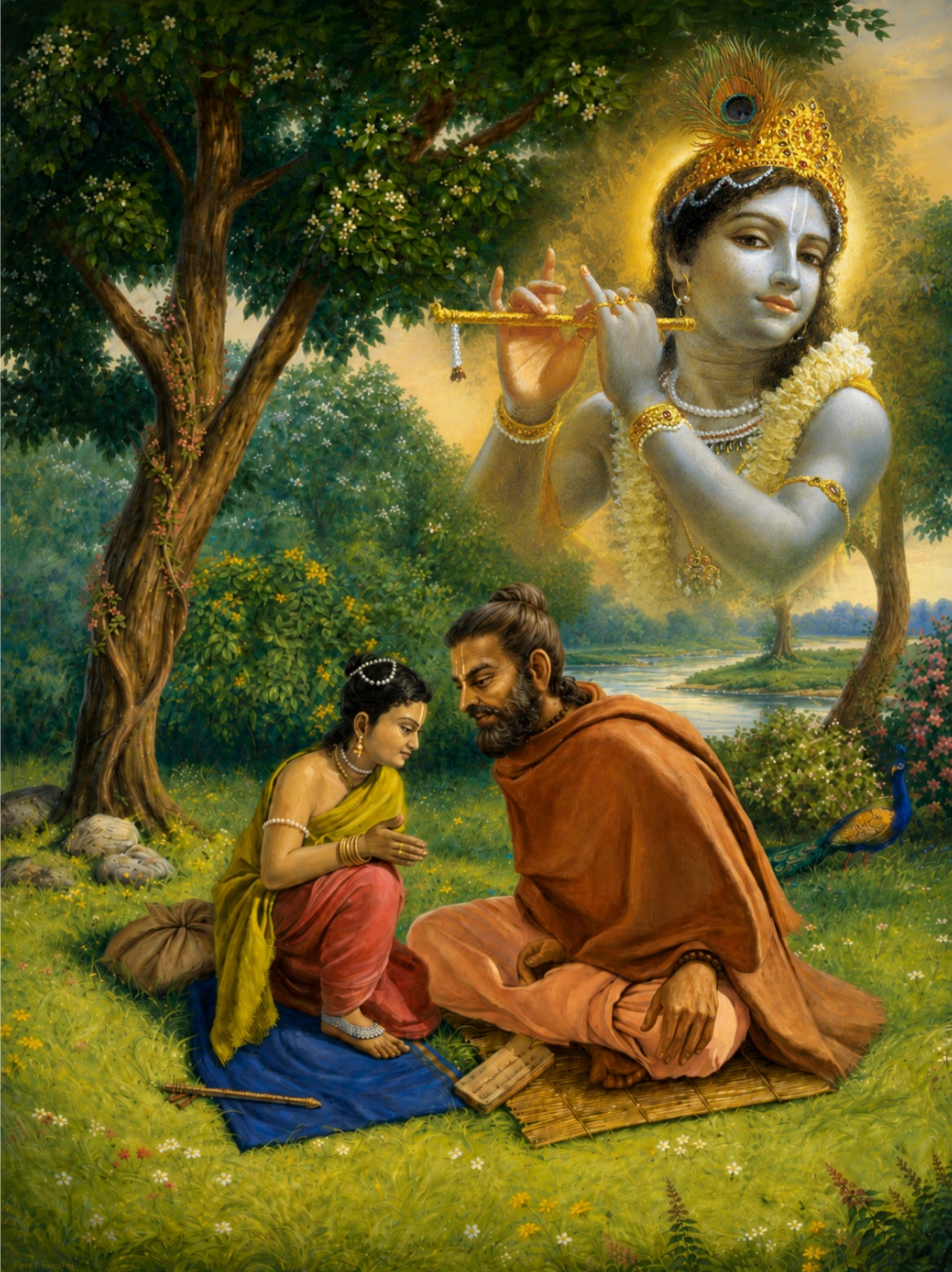
The Bṛhad-bhāgavatāmṛta describes the adventure of Gopa Kumāra in searching for Kṛṣṇa. He starts as a cowherd boy on this planet, born in Vṛndāvana. Receiving the Gopāla Mantra from his Guru, his love for Kṛṣṇa awakens, and by the potency of the same mantra, he meets Kṛṣṇa in many different forms and positions, culminating with Kṛṣṇa in His original form in Goloka Vṛndāvana.
He first becomes the king of Jagannātha Puri, where he serves Lord Jagannātha. Becoming somehow dissatisfied with this position, he ascends to the celestial planets, where he becomes Indra and gains the personal association of the Lord as Upendra. Later he becomes a resident of Maharloka, meeting the Lord as Yajñeśvara, and eventually meets the four Kumāras in Tapoloka, who show him the Lord’s form as Paramātmā. Eventually, he becomes Brahmā and serves the Lord personally as Mahā-Puruṣa.
Becoming dissatisfied even with this position, he goes out of the material universe, meeting Lord Śiva in his eternal form as Sadā-śiva. Ascending further, he finally reaches Vaikuṇṭha, where he becomes an associate of Lord Narāyana. However, because the mantra received from his guru had fully awakened Gopa Kumāra’s love for Kṛṣṇa, he was not satisfied even with this position, for he hankered for associating with Kṛṣṇa in His original form as Gopāla, in friendship. He was thus not satisfied in relating to Lord Narāyana with all the reverence and etiquette of Vaikuṇṭha.
This extraordinary situation was picked up by Nārada Muni. He observed the impossible: Gopa Kumāra was feeling despondent even in Vaikuṇṭha. Normally, when one reaches Vaikuṇṭha, one becomes fully satisfied and never wants to leave. Gopa Kumāra, however, was, unprecedentedly, feeling despondent there. Nārada Muni also identified the reason: Gopa Kumāra’s love for Kṛṣṇa was awakened to such an extent that he hankered for a closer relationship with Kṛṣṇa, which was not possible in Vaikuṇṭha.
Nārada then instructed him in how to go further. Gopa Kumāra then proceeded from Vaikuṇṭha to Ayodhyā, where he met Lord Rāma, and then to Dvārakā, where he finally met Kṛṣṇa Himself and lived in the company of the Yadus. Again, however, he was not fully satisfied. Nārada approached him again, together with Uddhava, and both identified that Gopa Kumāra was fit to attain a perfection that even they could not attain: to become one of Kṛṣṇa’s eternal associates in Vṛndāvana. To reach there, they instruct Gopa Kumāra to return to the material universe and serve Kṛṣṇa in the earthly Vṛndāvana. Gopa-kumāra closes his eyes in Dvārakā and opens them in a grove in earthly Vraja; Sanātana Gosvāmī explains that Kṛṣṇa secretly carried him there.
Following Nārada’s instructions, Gopa Kumāra practices sādhana, chanting incessantly and going to visit the places of Kṛṣṇa’s pastimes and remembering them. In an increasingly state of bhāva, he spends his days and nights crying in separation. After practicing like this for a long time, Kṛṣṇa personally appears before him in earthly Vṛndāvana. When Kṛṣṇa again disappears, Gopa-kumāra becomes overwhelmed in separation and falls unconscious into the Yamunā. From there he is mysteriously transported through the spiritual realms until he reaches Goloka Vṛndāvana, joining Kṛṣṇa’s eternal pastimes.
Then, we come to the most surprising passage. He doesn’t simply become some unnamed cowherd boy among millions, as we could imagine. No, Kṛṣṇa personally recognizes him and runs to embrace him as His dear friend. This is narrated in the Bṛhad-bhāgavatāmṛta, starting from text 2.6.55.
Śrīla Sanātana Gosvāmī gives the context in his commentary:
“In texts 55 through 59, Gopa-kumāra describes his first impression upon seeing Kṛṣṇa in Goloka. Because Kṛṣṇa recognized Gopa-kumāra as His friend Sarūpa, Kṛṣṇa left behind the cowherd boys and the cows and ran forward to greet him.”
So, what are the verses that describe their meeting?
“Then from a distance I saw Him, His charming flute in hand. Running quickly, He emerged from among His friends and animals and approached me, saying in a sweet voice, “Look, Śrīdāmā! Here is My dear friend Sarūpa, the sun who shines on the lotus of your family!”
Kṛṣṇa was dressed for the forest. His garments, earrings, and peacock-feather crown all swayed to and fro, and so did His garland of kadamba flowers. His fragrance perfumed all directions, and His beautiful lotus face blossomed with a playful smile.
His lotus eyes beamed with a merciful glance, and the varied assets of beauty decorated Him in a singular way. The fingers of His lotus hand busily pushed back the locks of His hair, which flew about, adorned with the dust raised by the cows.
His tender, divine lotus feet touched the surface of the earth just to grant her the gift of supreme splendor. Playfully dancing as they moved, they attracted everyone’s heart with their great eagerness to walk quickly with large steps.
The effulgence of His cloud-colored body, shining with the full sweetness of youth, lit up all corners of the sky. His beauty, which captured the hearts of the ever-dear devotees of Vraja, was an ocean abounding with countless excellences.
He leaped forward and came close to me, compelled by the affection of His helpless devotee. I fainted in love at seeing Him. He caught hold of me by the neck. And suddenly He too fell to the ground.
A moment later I reawoke and carefully freed my neck from His grasp. I stood up and saw Him on the ground, in a faint, moistening the dust-covered path with His tears. Some gopīs came and said, “Look! Who has come here? What has he done? He has put our life and soul into such a state! Alas! Alas! Just see, people of Vraja — now we are all dead!”
There are a few more details in the commentary:
“Gopa-kumāra was already aware, at least theoretically, that Kṛṣṇa is very affectionate to His helpless devotees, but now he learned that Kṛṣṇa had affection specifically for him. Merely seeing Kṛṣṇa was enough to utterly enchant Gopa-kumāra, but this new discovery pushed him toward the limit of ecstasy.
Even though Kṛṣṇa was unconscious, He was crying so profusely that His tears were turning the dust on the road into mud.
The gopīs didn’t know who Gopa-kumāra was, other than some stranger dressed as a cowherd boy.”
Here we have a paradoxical situation. Gopa Kumāra is the eternal friend of Kṛṣṇa, who recognizes him. At the same time, he is a newcomer who meets Kṛṣṇa for the first time. That’s where we need to leave our material logic behind and get immersed in the spiritual atmosphere to be able to understand.
In his commentary on the Gītā, Śrīla Viśvanātha Cakravartī Thākura mentions that when devotees attain perfection in their devotional service, they happily take birth when Kṛṣṇa appears as Vasudeva’s son and become associates in His pastimes. Prabhupāda explains this in more detail in the Kṛṣṇa Book, chapter 28:
“The fact is that those who are always engaged in Kṛṣṇa consciousness and mature, pure devotional service are given the chance, after death, to gain Kṛṣṇa’s association in one of the universes within the material world. Kṛṣṇa’s pastimes are continuously going on, either in this universe or in another universe. Just as the sun globe is passing over many places across this earthly planet, so kṛṣṇa-līlā, or the transcendental advent and pastimes of Kṛṣṇa, are also going on continuously, either in this or another universe. The mature devotees, who have completely executed Kṛṣṇa consciousness, are immediately transferred to the universe where Kṛṣṇa is appearing. In that universe the devotees get their first opportunity to associate with Kṛṣṇa personally and directly. The training goes on, as we see in the Vṛndāvana-līlā of Kṛṣṇa within this planet.”
As Prabhupāda explains in other passages, there are no changes in the spiritual platform. There, nothing is created or ceases to exist. However, as he explains, spiritual things increase. There are thus no limits for spiritual bliss, spiritual love, spiritual affection, etc. Therefore, our natural affection for Kṛṣṇa, which is the very nature of the soul and eternally existent, attains perfection when we come to join Kṛṣṇa in His eternal pastimes in Vṛndāvana. The soul is eternally connected with Kṛṣṇa and, in fact, is always with Kṛṣṇa, even while living as a conditioned soul here. The point is not the presence of Kṛṣṇa, but our awareness of Him, and our desire to be with Him.
Prabhupāda explains these points in many other passages; you can check our book on the “Fall” of the Jīva for more details.
In a class on Śrīmad-Bhāgavatam 1.15.28, he makes the central point:
“So we have got intimate relationship with Kṛṣṇa. That is eternally fact. Simply we have to revive. Śravaṇādi-śuddha-citte karaye udaya [Cc Madhya 22.107]. We have to create. Just like the young man likes to love a young woman and the young woman likes to love a young man. That is natural. That is natural. But when they meet together, it is revived. It is not that something new imposition. It is there. But by chance or anyway, when they are in contact, the loving propensity increases. The love increases. So our relationship with Kṛṣṇa, that is natural. That is not unnatural. Nitya-siddha. Nitya-siddha means it is eternally fact. Simply it is covered. It is covered. That covering has to be taken away. Then we are immediately in relationship with Kṛṣṇa, in natural way. That is perfection of Kṛṣṇa consciousness.”
There is, however, an apparent contradiction that may be raised.
In texts 8.15 and 8.16 of the Gītā, Kṛṣṇa emphasizes that one who attains Him never returns to material existence. Similarly, the last aphorism of the Vedānta-sūtra confirms:
anāvṛttiḥ śabdāt anāvṛttiḥ śabdāt
“There is no return from the abode of the Lord. This is confirmed in all scriptures.”
The Vedānta-sūtra offers many instructions that bring us to the conclusion that pure devotional service is the ultimate goal of the scriptures, and the last sūtra confirms that when we attain the abode of the Lord, there is no need to take birth again in this material world. Similarly, the emphasis in text 8.15 is “mām upetya” (attaining Me). Kṛṣṇa makes clear to us that His planet is the supreme abode and is different in essence from the temporary abodes of the demigods.
Understood in this context, both passages sound natural. They emphasize prayojana, the ultimate destination. That’s what the story of Gopa Kumāra also teaches us about. After reaching Kṛṣṇa’s pastimes in Goloka Vṛndāvana, there is nothing else to attain; that’s the ultimate perfection.
If, however, one tries to reconstruct the beginning of material conditioning from this statement of “no return,” one comes to an apparent contradiction: “How can we have an eternal relationship with Kṛṣṇa if no one comes down from the spiritual abode?”
This is not a contradiction in the verses per se, but it appears when we take them out of context and try to make them answer a different question. We already discussed how Prabhupāda deals with this question of the conditioning of the soul in previous articles. Here we come to another point in his teachings: he warns us against dwelling too much on this question and especially against speculating on it.
Prabhupāda emphasizes that the intelligent question is not how we came here, but how we can go back. Why? Because trying to reconstruct how we came here means using our material intelligence to understand something inconceivable, or to put a date on something whose beginning cannot be traced in material time. This is a topic that can be fully understood only with spiritual realization.
Each soul is an eternal lover of Kṛṣṇa. At the same time, this love eternally increases. Spiritual reality does not have to fit within the categories of our material experience.
Read more:


This is a publication for thoughtful readers who want to go deeper into Kṛṣṇa consciousness. I publish daily, trying to offer high-quality spiritual content, and all posts are available to free subscribers. If you wish, you can support this work with a monthly contribution. When you subscribe, you can choose between a free subscription and a monthly contribution, and you can switch from a free subscriber to a supporter at any time.
You can also receive updates on WhatsApp or Telegram.
If you would like to contribute further, you can find the donation links here.