


You can receive new articles directly in your inbox. Subscription is free; donations are welcome.
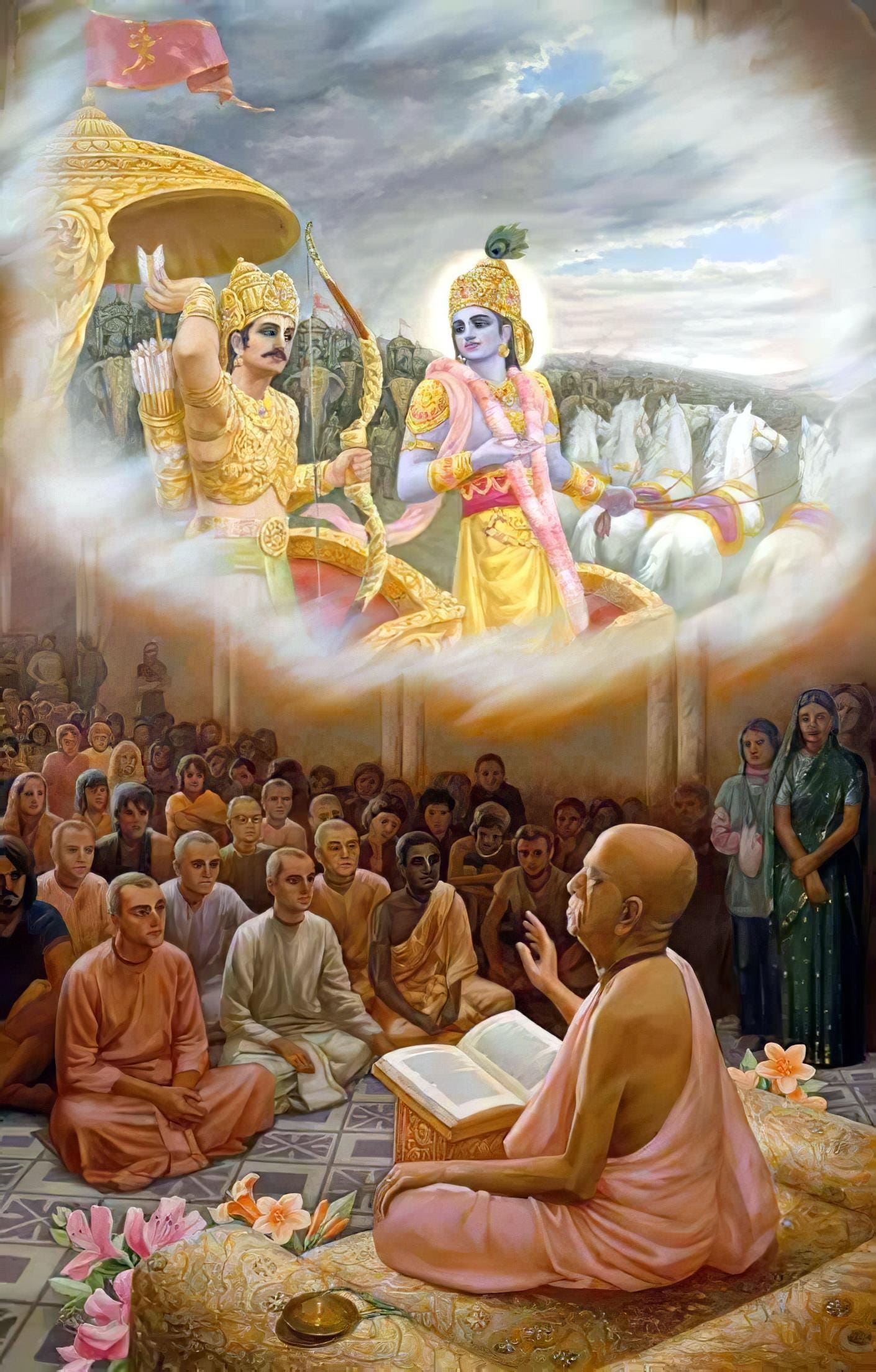
The third chapter of the Bhagavad-gītā is one of the most important parts of the whole text, as it deals with practical problems we face in daily life. It is always inspiring to hear about advanced levels of devotional service and useful to not lose track of the goal, but practically speaking, the knowledge Kṛṣṇa gives us in the Gītā is more useful because it teaches us how to get there. Without this knowledge, our understanding of devotional service may remain completely disconnected from our practical reality.
In 3.30, for example, Kṛṣṇa gives us the essential formula of devotional work:
“Therefore, O Arjuna, surrendering all your works unto Me, with full knowledge of Me, without desires for profit, with no claims to proprietorship, and free from lethargy, fight.”
The work may remain the same, but the internal focus shifts to Him. This simple and sublime system leads to liberation from the bondage of karma, while rejecting it in the name of artificial renunciation can lead to ruin. We are all more or less forced to act according to the particular nature we have acquired under the influence of the three material modes. Therefore, instead of a superficial show of detachment, Kṛṣṇa instructs us to follow the path given to us by the scriptures, regulating our activities and connecting them to Him. This natural path is called karma-yoga.
The difficulty is that we also hear about pure devotional service and love of Godhead, and we may be confused about where this path of karma-yoga Kṛṣṇa describes in the Gītā fits this progression.
One clue in this direction is what Kṛṣṇa explains in 3.25:
“As the ignorant perform their duties with attachment to results, the learned may similarly act, but without attachment, for the sake of leading people on the right path.”
Even though a pure devotee is free from material attachment, he should give the proper example to others. In this way, both a materialist and a self-realized soul perform some kind of work. The difference is that the materialist works to satisfy his senses, while the devotee works for the satisfaction of Kṛṣṇa. Superficially, a pure devotee and a materialist may appear to perform similar activities, but there will be a crucial difference in their consciousness.
When Śrīla Prabhupāda was living in Vṛndāvana, before coming to the West, he was personally printing and selling his books. Many pseudo-Vaiṣnavas were criticizing him, confusing this with ordinary business. In their stereotyped idea, a Vaiṣnava should simply sit, chant, and pretend to be humble. Prabhupāda, however, could understand and apply the essence of the Gītā, performing activities in devotional service and accepting all sorts of inconveniences to spread the teachings of Kṛṣṇa and the previous ācāryas.
Another misconception is that karma-yoga is merely a platform for neophytes that is later replaced by devotional service. This is similar to believing that the foundation is different from the building. Technically speaking, there is a division, but they are so intimately connected that the separation remains merely technical. A teacher may emphasize the technical difference in order to help the student to understand the structure, but one errs if he thinks the foundation is separated from, or less important than the rest of the building and can thus be neglected. Noticing this tendency in his students, another teacher may do the opposite, emphasizing that the foundation is an essential and inseparable part of the building that cannot be skipped.
Similarly, if we study the commentary of Śrīla Viśvanātha Cakravartī Ṭhākura, for example, we can notice that he emphasizes the distinctions to help us understand the structure and hierarchy of the different yoga processes explained in the Gītā. Prabhupāda, on the other hand, speaking to a modern audience prone to inactivity, impersonalism, and false renunciation, often emphasizes the common ground, teaching us that karma-yoga and bhakti-yoga should be seen as different steps of the same ladder. We can see that in the Gītā, Śrīla Prabhupāda usually translates karma-yoga and other processes performed in Kṛṣṇa consciousness directly as “devotional service,” emphasizing thus the substance instead of the details.
Both emphases are valid, but Prabhupāda emphasizes the points that are more essential to us. He carefully studied the commentaries made by previous ācāryas and presented their conclusions in a way that makes the practical application unmistakable.
When work is connected with Kṛṣṇa, it is already devotional service in progressive form, regardless of the faults of the practitioner. The natural progression is to gradually transition from sakāma-karma-yoga (service performed with attachment to the results) to niṣkāma-karma-yoga (service performed without attachment), and from this platform, gradually come to the platform of pure love of Godhead, without necessarily ceasing to work. As we can see practically, even the greatest Vaiṣnavas continue to work for Kṛṣṇa, often until their last breath, but they do so from a platform of pure love.
In this way, the activities of a pure devotee are completely spiritual, even while printing and selling books, building temples, or managing a spiritual institution. Similarly, we can spiritualize all our actions if we connect them to Kṛṣṇa. From the start, it is considered devotional service, and by performing it, we continue to progress, as our consciousness is purified and we become more intimately connected with Kṛṣṇa. The practical message of the Gītā, emphasized by Śrīla Prabhupāda, is thus to learn to maintain ourselves connected with Kṛṣṇa at every step of our lives, instead of jumping into premature renunciation, fantasy, or imitation.
A person who is still full of material desires can’t stop performing actions. This is simply not possible. Even if one tries to renounce and go to chant in the forest, the mind will continue dwelling in the objects of sense gratification. One will then either fall back into his previous lifestyle or become one of the pretenders already condemned in the previous sections of the Gītā.
Instead, we should keep ourselves engaged in activities connected with Kṛṣṇa consciousness, without falling into the mistake of thinking that practical service and regulated activities are only for neophytes. As Kṛṣṇa explains, “Kings such as Janaka attained perfection solely by performance of prescribed duties.” The simple process of devotional service can purify even self-realized souls.
Read also:

This is a publication for thoughtful readers who want to go deeper into Kṛṣṇa consciousness. I publish daily, trying to offer high-quality spiritual content, and all posts are available to free subscribers. If you wish, you can also choose a paid subscription to support this work.
You can also receive the updates on WhatsApp or Telegram.
If you would like to contribute further, you can find the donation links here.