

Subscribe to receive new articles by e-mail. It’s free, but if you like, you can pledge a donation:
Many think that Satya-yuga is a time when human society is perfect. Certainly, it is better than now, but it is far from perfect. Not only are there many impersonalists in Satya-yuga, but there are also a few materialists who manifest qualities such as harshness and envy. In other words, the world is also inhabited by imperfect individuals in Satya-yuga. It is better than now, but still shares the same material faults. The only place where we can find a perfect society is in the spiritual world.
One example of human faults manifesting in Satya-yuga is the case of Suruci (the stepmother of Dhruva Maharaja) becoming envious and offending him. This led Dhruva to abandon his life in the palace and go to meditate in the forest, aiming at meeting the Supreme Lord.
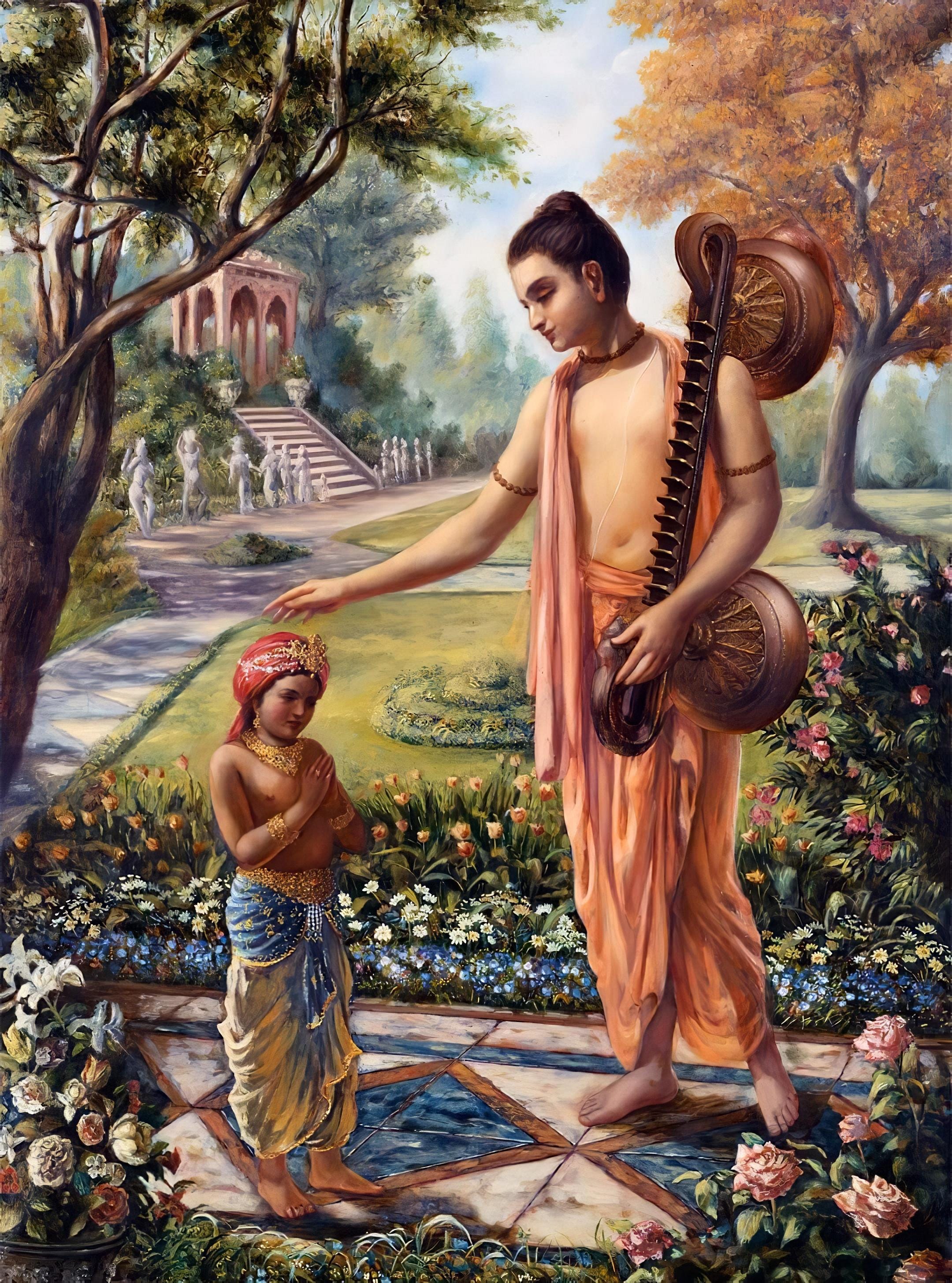
At first, Dhruva was just a child who had some sentiment and had decided to meditate and practice austerities, but didn’t know exactly what to do. He was, however, helped by Nārada, who was inspired by the Lord in the heart to meet him and help him in his process of self-realization.
At first, Nārada Muni wanted to test Dhruva’s determination. He explained how dangerous the forest was, how difficult it is to satisfy the Lord by the process of mystic yoga he was planning to perform, and advised him to instead go home. Everything comes as a result of our previous actions, he said, and thus Dhruva should not be affected by the words of his stepmother. Instead, he should be satisfied with whatever comes naturally. When he had grown up, he could try to practice yoga, and by the mercy of the Lord, he could be successful.
In the context of the passage, these instructions have the purpose of testing the determination of Dhruva, but at the same time, these are very valuable general instructions that we can take to heart:
a) Honor and dishonor are both destined by our previous actions; therefore, we should be sober, neither sorry, nor excessively happy under any circumstances, as Krsna confirms in the Bhagavad-gītā. The feeling of dissatisfaction when we face reverses is another feature of the illusory energy, destined to keep us chained to this world.
b) A devotee should accept both happiness and distress as the mercy of the Lord. It’s easy to see the connection when we receive happiness, but distress can be a very powerful tool in the hands of the Lord to save us from the material clutches. As Nārada mentions, one who is intelligent should accept that process and be satisfied with whatever comes, favorable or unfavorable, by His supreme will.
c) It is very difficult to satisfy the Lord by any process, except the process of bhakti. The Lord can be satisfied even by a humble offering of water and Tulasī leaves by a devotee, but He will refuse even the most opulent offering from a proud materialist. The path of devotional service can be very easy for one who is determined and sincere, but when these two qualities are absent, the process can be very difficult.
d) By serving the Lord and remaining satisfied in any condition of life, understanding that both are the result of the supreme will, we can easily cross over the material ocean. As Prabhupāda explains, “When we enjoy life in so-called material happiness, it is to be understood that we are diminishing the resultant actions of our pious activities. And when we are put into suffering, it is to be understood that we are diminishing the resultant actions of our impious activities. Instead of being attached to the circumstantial happiness and distress resulting from pious or impious activities, if we want to get out of the clutches of this nescience, then whatever position we are put in by the will of the Lord we should accept. Thus if we simply surrender unto the Supreme Personality of Godhead, we shall get out of the clutches of this material existence.”
e) Instead of being envious, we should be happy in receiving more qualified persons and learning from them, and instead of being oppressive to less qualified persons, we should be compassionate with them and try to raise them, especially by teaching them the process of Krsna consciousness. When we meet an equal, we should treat him or her as a friend, instead of becoming proud or inimical.
What about the situation of Dhruva? Certainly, a Brāhmaṇa should be able to tolerate reverses patiently, and a regular boy would be in great danger in the forest. However, Dhruva was not an ordinary boy, nor a Brāhmaṇa. He was a hot-blooded Kṣatriya with unshakable determination. Dhruva thus accepted the truth of Nārada’s instructions, but admitted that he could not accept them.
The father of Dhruva was the king of Bhu-Mandala, and his great-grandfather was Brahmā, the master of the universe. Dhruva desired a position more exalted than any of his ancestors, including Lord Brahmā. How could this be possible? Dhruva understood that Nārada Muni was directly empowered by the Lord, and therefore, with his mercy, nothing was impossible. We can see that by the end of the pastime, Dhruva effectively attained a position more exalted than Brahma, becoming the ruler of a Vaikuṇṭha planet, an eternal position much more exalted than any temporary position in this material world, including that of his great-grandfather. In his purport, Prabhupāda makes an important point: although Nārada Muni was competent to bless Dhruva with whatever he wanted, he limited himself to give him instructions to worship the Lord in devotional service, similarly to Krsna instructing Arjuna in the battlefield instead of simply giving him victory without having to fight. This shows how the duty of the spiritual master is not to just give the disciple what he wants but to give him instructions and engage him in the practice of devotional service so he can attain true success.
Although Dhruva’s desire was somehow childish, Nārada became compassionate towards him. He could fully understand the determination of Dhruva and advised him on how he could attain his goal. Nārada Muni thus instructed Dhruva in the practice of the process of bhakti-yoga, living in Vṛndāvana, bathing in the Yamunā, worshiping the deity, and practicing meditation in the form of the Lord inside the heart. The Lord is everywhere, but it is easier to approach Him in places of pilgrimage because these places are inhabited by great sages and pure devotees. The Lord is where His devotees are chanting his glories, therefore, these are the places where we can easily contact Him.
What was the process of worship taught to Dhruva?
Nārada instructed Dhruva to practice a combination of rules and regulations, chanting of the holy names, worship of the deity, and meditation in the form of the Lord. At first, it may appear that this is a process suitable only for Satya-yuga, especially when we consider the austerities performed by Dhruva Mahārāja, but that’s because Dhruva was able to practice it in a very high level. When we take into consideration the differences in time and place, the process taught by Nārada is the same we regularly practice.
Nārada started by instructing Dhruva to live in a holy place, a place favorable to his spiritual practice. Prabhupāda explains that unless one is very advanced in devotional service, one can obtain great benefit in living in holy places where the Lord performed His pastimes. He also mentions in other passages that temples of the Lord, as well as places of residency of pure devotees, are also holy places. If we can take shelter in one of such places, we will have greater facility in our spiritual practice.
Nārada Muni then explained to Dhruva Mahārāja the process of aṣṭāṅga-yoga, including detailed instructions of meditation in the personal form of the Lord, similar to the instructions of Lord Kapila in the 3rd canto. This process of meditation, described by Nārada Muni, translates into our daily practice in the form of the process of chanting the holy names and meditating in the form of the Lord.
How to meditate in the form of the Lord? Prabhupāda makes the connection between the description of meditation on the form of Paramātmā inside the heart described by Nārada Muni and deity worship, just as he does in the third canto during the description of Lord Kapila. At first, seeing the form of the Lord as the deity and meditation on the mantra (japa) may be two separate things, but as we progress, we become capable of seeing the form of the Lord within when we chant. He explains, however, that this is not an artificial process of imagination, but happens automatically when the Lord becomes pleased and decides to present Himself.
Nārada also initiated Dhruva in the chanting of the holy names thorough the mantra Oṁ namo bhagavate vāsudevāya, emphasizing the power of the mantra by stating that by chanting the mantra for just one week, he would become so perfect that he would be able to see the demigods.
Nārada Muni also instructed Dhruva in the process of deity worship and remembering the Lord’s pastimes. How could Dhruva worship a deity while living in the forest? This was actually very simple because Dhruva could make a deity out of the materials available there, such as metal, wood, or clay, and worship Him by offering pure water, flower garlands, fruits, flowers, and vegetables available in the forest, as well as Tulasī leaves. Living in Vṛndāvana, Dhruva would certainly not have any difficulties in collecting pure water from the Yamunā and Tulasī leaves.
Pure devotional service means to engage in devotional service without any desire apart from serving the Lord in pure love. However, Nārada also explained that even though Dhruva had material desires, this was not a disqualification, for anyone who worships the Lord attains his desires and simultaneously advances in spiritual realization.
Instructed in this way, Dhruva circumambulated Nārada and offered obeisances unto him. He then departed for Madhuvana, one of the twelve forests of Vṛndāvana, to practice as he was instructed.
You can also donate using Buy Me a Coffee, PayPal, Wise, Revolut, or bank transfers. There is a separate page with all the links. This helps me enormously to have time to write instead of doing other things to make a living. Thanks! You can also receive the updates on Telegram.