

Subscribe to receive new articles by e-mail. It’s free, but if you like, you can pledge a donation:
Join the Telegram group if you would like to join the live lessons. This course is maintained with your donations. Click here to donate.
💬 Text of the lesson
Nārada Muni worships Nara-Nārāyaṇa in Bhārata-varṣa
“[Śukadeva Gosvāmī continued:] The glories of the Supreme Personality of Godhead are inconceivable. He has appeared in the form of Nara-Nārāyaṇa in the land of Bhārata-varṣa, at the place known as Badarikāśrama, to favor His devotees by teaching them religion, knowledge, renunciation, spiritual power, sense control and freedom from false ego. He is advanced in the opulence of spiritual assets, and He engages in executing austerity until the end of this millennium. This is the process of self-realization.” (SB 5.19.9)
Bhārata-varṣa is different from the other varṣas of Jambūdvīpa, which are celestial places where pious souls reap the results of their past karma. Bhārata-varṣa is the place where those who have exhausted their past karma, coming either from the other varṣas or animal species, take birth to perform a new set of work that will decide where they will go next.
Because Bhārata-varṣa is a crossroads from where all kinds of souls take birth, it’s possible to encounter people influenced by all three modes of nature, some taking birth as exalted persons, ordinary men or women, or degraded personalities. These births are not by chance, but according to their past work. Lord Kapila mentions in the 3rd canto that when a human being acts sinfully and goes to hell, he takes his next human birth (after passing through the animal species) in a similar situation to that of his previous human birth, and then has the opportunity of doing differently. Similarly, souls coming back from the celestial planets take births according to their natures.
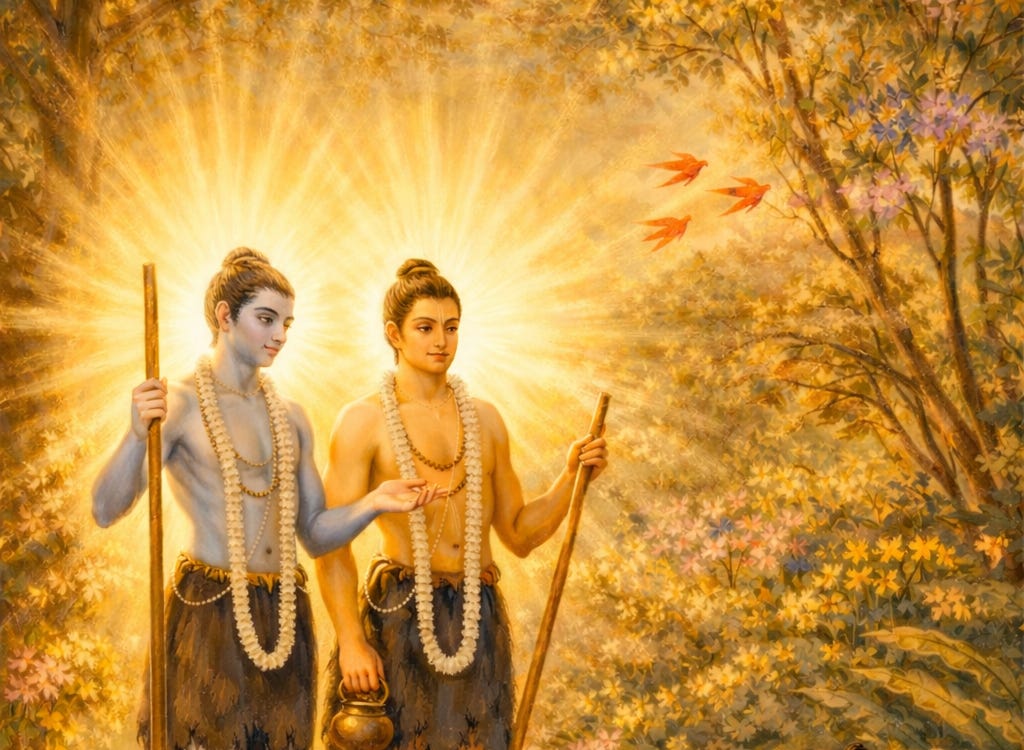
The predominating deities are Nara-Nārāyaṇa, the twin-sages, who perform austerities in Badarīkāśrama to give example to all human beings on how to attain the perfection of life. They are described on SB 11.4.7:
“Nara-Nārāyaṇa Ṛṣi, who is perfectly peaceful and is the best of sages, was born as the son of Dharma and his wife Mūrti, the daughter of Dakṣa. Nara-Nārāyaṇa Ṛṣi taught the devotional service of the Lord, by which material work ceases, and He Himself perfectly practiced this knowledge. He is living even today, His lotus feet served by the greatest of saintly persons.”
Once, Indra became envious, thinking that Nara-Nārāyaṇa would exceed his austerities and take his position, and sent a group of apsarās and gandharvas, led by Cupid himself (the demigod, not the incarnation of the Lord), to tempt the great sages. The Lord, however, showed a number of celestial girls emanating from His own potency, each of them much more beautiful than any of the apsarās sent by Indra, and, instead of being angry, asked the demigods to choose one to become the ornament of the heavenly planets. This led to Ūrvaśī being selected and becoming the leader of the apsarās in the heavenly abode.
Later, in the 12th canto (chapter eight), it is described how Mārkaṇḍeya Ṛṣi met Nara-Nārāyaṇa Ṛṣi and, after offering prayers, asked for the benediction of seeing the Lord’s illusory energy. This led to the pastime of his struggling for a whole night of Brahmā on the waters of devastation.
There, it is described:
“Desiring to bestow His mercy upon the saintly Mārkaṇḍeya, who had perfectly fixed his mind in self-realization through penance, Vedic study and observance of regulative principles, the Supreme Personality of Godhead personally appeared before the sage in the forms of Nara and Nārāyaṇa.
One of Them was of a whitish complexion, the other blackish, and They both had four arms. Their eyes resembled the petals of blooming lotuses, and They wore garments of black deerskin and bark, along with the three-stranded sacred thread. In Their hands, which were most purifying, They carried the mendicant’s waterpot, straight bamboo staff and lotus-seed prayer beads, as well as the all-purifying Vedas in the symbolic form of bundles of darbha grass. Their bearing was tall and Their yellow effulgence the color of radiant lightning. Appearing as austerity personified, They were being worshiped by the foremost demigods.
These two sages, Nara and Nārāyaṇa, were the direct personal forms of the Supreme Lord. When Mārkaṇḍeya Ṛṣi saw Them, he immediately stood up and then with great respect offered Them obeisances by falling down flat on the ground like a stick.” (SB 12.8.32-35)
Who exactly are they? In his purport to SB 4.1.59, Prabhupāda reveals that they are none other than Kṛṣṇa and Arjuna:
“Nārāyaṇa is the Supreme Personality of Godhead, and Nara is a part of the Supreme Personality of Godhead, Nārāyaṇa. Thus the energy and the energetic together are the Supreme Personality of Godhead. Maitreya informed Vidura that Nara, the portion of Nārāyaṇa, had appeared in the family of the Kurus and that Nārāyaṇa, the plenary expansion of Kṛṣṇa, had come as Kṛṣṇa, the Supreme Personality of Godhead, with the purpose of delivering suffering humanity from the pangs of material burdens. In other words, Nārāyaṇa Ṛṣi was now present in the world in the forms of Kṛṣṇa and Arjuna.”
Nara-Nārāyaṇa Ṛṣi live accompanied by many other great sages, including Vyāsadeva himself, in the high-dimensional Himalayas, in an āśrama that is accessible only for highly qualified persons. The verse mentions the world ākalpāntam, which indicates that they will continue to be present there until the end of the current kalpa, or in other words, until the end of the day of Brahmā. From there, they instructed many great sages over the ages, including Nārada Muni, who worships them by the prayers described in the following verses.
In his purport, Śrīla Prabhupāda connects this to the ancient Śrī Badarinātha (Badrinath) temple, where the deities of Nara-Nārāyaṇa Ṛṣi are worshiped. As he mentions, “People in India may visit the temple of Nara-Nārāyaṇa at Badarikāśrama just to learn how the Supreme Personality of Godhead in His incarnation as Nara-Nārāyaṇa engages in austerities to teach the people of the world how to achieve self-realization. It is impossible to realize oneself simply by absorbing oneself in speculation and material activities. One must be very serious about self-realization and the practice of austerity.” In this way, he shows how the contents of the verse remain true even in our current reality.
He then connects the teachings of Nara-Nārāyaṇa Ṛṣi with Śrī Caitanya Mahāprabhu, mentioning that people of our age have no capacity to perform austerities as taught by the sages, therefore the Lord appeared as Mahāprabhu to offer us an easy method of self-realization by simply chanting the holy names. He thus equates the two processes, revealing that Śrī Caitanya Mahāprabhu is none other than Nārāyaṇa Ṛṣi (Kṛṣṇa) Himself.
It is described that when Kṛṣṇa appears as an incarnation, all the other forms of Viṣnu and incarnations merge into His body, just like many rays of light. The body of Kṛṣṇa includes thus all the other forms. In Kali-yuga, Kṛṣṇa appears personally as Śrī Caitanya Mahāprabhu. In other words, Mahāprabhu includes all the other forms, and the process of saṅkīrtana includes all other teachings. All the prayers of the inhabitants of Jambūdvīpa, thus, ultimately bring us to Him.
In the 11th canto (11.29.41-44), it is also described that Kṛṣṇa sent Uddhava to Badarīkāśrama to give instructions to the many great sages living there. These sages had no opportunity to personally associate with Him, and thus Kṛṣṇa sent His representative to meet with them.
“In his own book, known as Nārada Pañcarātra, Bhagavān Nārada has very vividly described how to work to achieve the ultimate goal of life — devotion — through knowledge and through execution of the mystic yoga system. He has also described the glories of the Lord, the Supreme Personality of Godhead. The great sage Nārada instructed the tenets of this transcendental literature to Sāvarṇi Manu in order to teach those inhabitants of Bhārata-varṣa who strictly follow the principles of varṇāśrama-dharma how to achieve the devotional service of the Lord. Thus Nārada Muni, along with the other inhabitants of Bhārata-varṣa, always engages in the service of Nara-Nārāyaṇa, and he chants as follows.” (SB 5.19.10)
Nārada Muni instructs the inhabitants of Bhārata-varṣa to worship the Lord by performing their prescribed duties according to the varnāśrama system. In this way, all the inhabitants worship the Lord under his guidance. Of course, in Kali-yuga, the system is gradually forgotten, but it used to be followed strictly in the previous areas.
In his purport, Prabhupāda connects Bhārata-varṣa with current-day India to encourage all Indians to take up the saṅkīrtana movement and not only save themselves, but the whole world.
“The real success or fulfillment of the mission of human life can be achieved in India, Bhārata-varṣa, because in Bhārata-varṣa the purpose of life and the method for achieving success are evident. People should take advantage of the opportunity afforded by Bhārata-varṣa, and this is especially so for those who are following the principles of varṇāśrama-dharma. If we do not take to the principles of varṇāśrama-dharma by accepting the four social orders (brāhmaṇa, kṣatriya, vaiśya and śūdra) and the four orders of spiritual life (brahmacārī, gṛhastha, vānaprastha and sannyāsa), there can be no question of success in life. Unfortunately, because of the influence of Kali-yuga, everything is now being lost. The inhabitants of Bhārata-varṣa are gradually becoming degraded mlecchas and yavanas. How then will they teach others? Therefore, this Kṛṣṇa consciousness movement has been started not only for the inhabitants of Bhārata-varṣa but for all the people of the world, as announced by Śrī Caitanya Mahāprabhu. There is still time, and if the inhabitants of Bhārata-varṣa take this movement of Kṛṣṇa consciousness seriously, the entire world will be saved from gliding down to a hellish condition. The Kṛṣṇa consciousness movement follows the process of pañcarātrika-vidhi and that of bhāgavata-vidhi simultaneously, so that people can take advantage of the movement and make their lives successful.”
“Let me offer my respectful obeisances unto Nara-Nārāyaṇa, the best of all saintly persons, the Supreme Personality of Godhead. He is the most self-controlled and self-realized, He is free from false prestige, and He is the asset of persons who have no material possessions. He is the spiritual master of all paramahaṁsas, who are the most exalted human beings, and He is the master of the self-realized. Let me offer my repeated obeisances at His lotus feet.
Nārada, the most powerful saintly sage, also worships Nara-Nārāyaṇa by chanting the following mantra: The Supreme Personality of Godhead is the master of the creation, maintenance and annihilation of this visible cosmic manifestation, yet He is completely free from false prestige. Although to the foolish He appears to have accepted a material body like us, He is unaffected by bodily tribulations like hunger, thirst and fatigue. Although He is the witness who sees everything, His senses are unpolluted by the objects He sees. Let me offer my respectful obeisances unto that unattached, pure witness of the world, the Supreme Soul, the Personality of Godhead.” (SB 5.19.11-12)
These verses confirm conclusions that were already stated in the previous verses. Prabhupāda, however, catches an interesting point: Kṛṣṇa is described simultaneously as the creator of the cosmic manifestation and as unattached from it. As he mentions:
“Kṛṣṇa is the creator of the entire cosmic manifestation, yet He is unattached to it. If we were to construct a very tall skyscraper, we would be very attached to it, but Kṛṣṇa is so renounced that although He has created everything, He is not attached to anything (na badhyate).”
Conditioned souls perform material work out of attachment. A king may build an empire, thinking that he will live eternally to enjoy it, while a renounced person will not be capable of performing such a work. Kṛṣṇa, however, builds the whole cosmic manifestation, the most complex and intricate creation, while at the same time being fully renounced. This proves He acts on the transcendental platform, free from material attachment or aversion.
Prabhupāda continues on the same line of thought, describing one by one different characteristics of the transcendental form of the Lord and once again proves He is fully transcendental:
“Furthermore, although Kṛṣṇa has His transcendental form, sac-cid-ānanda-vigraha, He is not disturbed by the bodily necessities of life, which are called daihika; for example, He is never hungry, thirsty or fatigued (na hanyate deha-gato ’pi daihikaiḥ). Then again, since everything is Kṛṣṇa’s property, He sees everything and is present everywhere, but because His body is transcendental, He is above vision, the objects of vision and the process of vision. When we see someone beautiful, we are attracted. The sight of a beautiful woman immediately attracts a man, and the sight of a man naturally attracts a woman. Kṛṣṇa, however, is transcendental to all these faults. Although He is the seer of everything, He is not afflicted with faulty vision (na dṛg yasya guṇair vidūṣyate). Therefore, although He is the witness and seer, He is aloof from all affection for the activities He sees. He is always unattached and separate; He is only a witness.”
“O my Lord, master of all mystic yoga, this is the explanation of the yogic process spoken of by Lord Brahmā [Hiraṇyagarbha], who is self-realized. At the time of death, all yogīs give up the material body with full detachment simply by placing their minds at Your lotus feet. That is the perfection of yoga.” (SB 5.19.13)
Kṛṣṇa explains in the Gītā that material energy is very difficult to overcome, but those who surrender to Him can easily cross beyond it. Because the jīva is very small, we can be very easily overpowered by the illusory energy, but when we become again connected with Kṛṣṇa, it suddenly appears to not be any larger than the water contained in the hoofprint of a calf. This connection with Kṛṣṇa, that allows us to overcome all material conditioning, including the material desires of the mind, sinful habits, and so on is the ultimate goal of the process of mystic yoga taught by Nara-Nārāyaṇa Ṛṣi
As Prabhupāda concludes in his purport:
“The only purpose of life is to be fully absorbed in thoughts of Kṛṣṇa and His form, pastimes, activities and qualities. If one is able to think of Kṛṣṇa in this way, twenty-four hours a day, he is already liberated (svarūpeṇa vyavasthitiḥ). Whereas materialists are absorbed in material thoughts and activities, devotees, on the contrary, are always absorbed in thoughts of Kṛṣṇa and Kṛṣṇa’s activities. Therefore they are already on the platform of liberation. One has to think of Kṛṣṇa with full absorption at the time of death. Then he will certainly return home, back to Godhead, without a doubt.”
Śrīmad-Bhāgavatam continues:
“Materialists are generally very attached to their present bodily comforts and to the bodily comforts they expect in the future. Therefore they are always absorbed in thoughts of their wives, children and wealth and are afraid of giving up their bodies, which are full of stool and urine. If a person engaged in Kṛṣṇa consciousness, however, is also afraid of giving up his body, what is the use of his having labored to study the śāstras? It was simply a waste of time.
Therefore, O Lord, O Transcendence, kindly help us by giving us the power to execute bhakti-yoga so that we can control our restless minds and fix them upon You. We are all infected by Your illusory energy; therefore we are very attached to the body, which is full of stool and urine, and to anything related with the body. Except for devotional service, there is no way to give up this attachment. Therefore kindly bestow upon us this benediction.” (SB 5.19.14-15)
In conditioned life, material attachment is the norm. Even lower animals, such as insects and fish, run away when they are threatened. This indicates that even in such primitive forms, the soul is attached to the body. As soon as consciousness is present, material attachment becomes prominent.
Kṛṣṇa Consciousness is the natural antidote for material attachment, and therefore, we can measure our advancement by simply measuring how attached we are to our bodies, the objects of the senses, and the whole idea of enjoying the world. Ideally, we should develop detachment while still engaged in our material duties and become externally renounced only after completing this process of internal renunciation. As Kṛṣṇa explains in the Gītā, “One who restrains the senses of action but whose mind dwells on sense objects certainly deludes himself and is called a pretender.”
One of the most reliable ways to measure attachment is by reflecting on how much we are afraid of death. A person who is genuinely detached doesn’t fear death, understanding that he is serving Kṛṣṇa now and will simply continue serving Kṛṣṇa in a different situation. Fear of death means attachment to the body; therefore, if we are practicing for a long time, but are still afraid of death, it means we are not reaping the results of all this spiritual practice. As Nārada questions, “What is the use of his having labored to study the śāstras? It was simply a waste of time.”
As Prabhupāda comments in his purport:
“Therefore by practicing the mystic yoga system one must become detached from bodily relationships. If despite practicing bhakti-yoga and studying all the Vedic literature, one is afraid of giving up his bad body, which is the cause of all his suffering, what is the use of his attempts to advance in spiritual life?”
He then mentions that,
“The secret of success in practicing yoga is to become free from bodily attachments.” This may sound contradictory at first. Is not becoming free from attachment the very goal of the process of Kṛṣṇa Consciousness? Not exactly, it is a preliminary goal, but not the final goal. Kṛṣṇa explains this clearly in the Gītā: “One who is thus transcendentally situated at once realizes the Supreme Brahman and becomes fully joyful. He never laments or desires to have anything. He is equally disposed toward every living entity. In that state he attains pure devotional service unto Me.”
Becoming free from material attachment means being elevated to the platform of liberation. From there, there is still a way to go until we attain the ultimate goal, which is pure devotional service to the Lord. This is the key to understanding the rest of the purport:
“The secret of success in practicing yoga is to become free from bodily attachments. Śrīla Narottama dāsa Ṭhākura says, deha-smṛti nāhi yāra, saṁsāra-bandhana kāhāṅ tāra: one whose practice has freed him from the anxieties of bodily needs is no longer in conditional life. Such a person is freed from conditional bondage. A person in Kṛṣṇa consciousness must fully discharge his devotional duties without material attachment. Then his liberation is guaranteed.”
Prabhupāda uses the word “liberation” in a few different senses in his purports. One of them is in the sense of being free from the influence of the material modes. One can be free from the material modes while still living in a material body and trying to perfect his’s Kṛṣṇa Consciousness. Another sense is in going back to Godhead. Living without attachment means attaining the first type of liberation, and by continuing to practice on this platform, we attain perfection and attain the second type of liberation, joining Kṛṣṇa in his pastimes.
Nārada thus concludes his prayers by asking Kṛṣṇa to help us by giving us the power to execute bhakti-yoga, which is the source of all success. As Prabhupāda mentions, “The perfect yoga system consists of always thinking of Kṛṣṇa, always engaging in devotional service, always worshiping Kṛṣṇa and always offering obeisances unto Him. Unless we practice this yoga system, our illusory attachment for this bad body, which is full of stool and urine, is impossible to give up.”
In this way, we can observe that the leaders of all the varṣas in Jambūdvīpa, as well as the inhabitants follow the process of bhakti-yoga, making clear that this is the most elevated process. All other processes, including karma and jñana are effective only to the extent they are combined with bhakti.
The opportunity of taking birth in Bhārata-varṣa
The rest of the 19th chapter is dedicated to describing Bhārata-varsa and its importance from the point of view of spiritual realization.
“In the tract of land known as Bhārata-varṣa, as in Ilāvṛta-varṣa, there are many mountains and rivers. Some of the mountains are known as Malaya, Maṅgala-prastha, Maināka, Trikūṭa, Ṛṣabha, Kūṭaka, Kollaka, Sahya, Devagiri, Ṛṣyamūka, Śrī-śaila, Veṅkaṭa, Mahendra, Vāridhāra, Vindhya, Śuktimān, Ṛkṣagiri, Pāriyātra, Droṇa, Citrakūṭa, Govardhana, Raivataka, Kakubha, Nīla, Gokāmukha, Indrakīla and Kāmagiri. Besides these, there are many other hills, with many large and small rivers flowing from their slopes.
Two of the rivers — the Brahmaputra and the Śoṇa — are called nadas, or main rivers. These are other great rivers that are very prominent: Candravasā, Tāmraparṇī, Avaṭodā, Kṛtamālā, Vaihāyasī, Kāverī, Veṇī, Payasvinī, Śarkarāvartā, Tuṅgabhadrā, Kṛṣṇāveṇyā, Bhīmarathī, Godāvarī, Nirvindhyā, Payoṣṇī, Tāpī, Revā, Surasā, Narmadā, Carmaṇvatī, Mahānadī, Vedasmṛti, Ṛṣikulyā, Trisāmā, Kauśikī, Mandākinī, Yamunā, Sarasvatī, Dṛṣadvatī, Gomatī, Sarayū, Rodhasvatī, Saptavatī, Suṣomā, Śatadrū, Candrabhāgā, Marudvṛdhā, Vitastā, Asiknī and Viśvā. The inhabitants of Bhārata-varṣa are purified because they always remember these rivers. Sometimes they chant the names of these rivers as mantras, and sometimes they go directly to the rivers to touch them and bathe in them. Thus the inhabitants of Bhārata-varṣa become purified.” (SB 5.19.18)
Differences in the geographical features mentioned here and the current geography of our planet should not be taken as a contradiction. The verse speaks about eternal features, which can be visible or not at a given time. The Mahābhārata, for example, describes the river Sarasvatī, which was very important in previous ages, but it is not currently available. Some speculate it is still exists as a subterranean river or as a groundwater reservoir, but in any case, it is not present in the same sense as described in the text. Similarly, Govardhana is gradually submerging into the ground and may disappear in the future, as also predicted in the scriptures. These sites may become unavailable for the time being and reappear in other cycles of creation.
Prabhupāda notes that “All these rivers are transcendental. Therefore, one can be purified by remembering them, touching them, or bathing in them. This practice is still going on.” This sets the proper tone. As mentioned in the Bṛhad-bhāgavatāmṛta, holy places such as Vṛndāvana and Jagannātha Pūrī, as well as holy rivers and other sites, exist eternally. They may or may not be present on our planet at a given time, and their location may be known or unknown, but this doesn’t affect their transcendental status. For many centuries, for example, the location of many holy sites in Vṛndāvana were lost, until they were rediscovered by the Six Goswami. Later, Śrīla Bhaktivinoda Thākura revealed that they are also present in Navadvīpa Dhāma.
This is a publication for thoughtful readers who want to go deeper into Kṛṣṇa consciousness. I publish daily, and all posts are available to free subscribers. If you wish, you can also choose a paid subscription to support this work. By subscribing, you also gain access to the manuscripts of the books I’m currently working on.
If you would like to contribute further, you can find the donation links here.
I would love for you to expand deeper on Nar and Narayan Rushi’s.. 💙🙏🏼