

« The ‘Fall’ of the Jīva, as Explained by Śrīla Prabhupāda
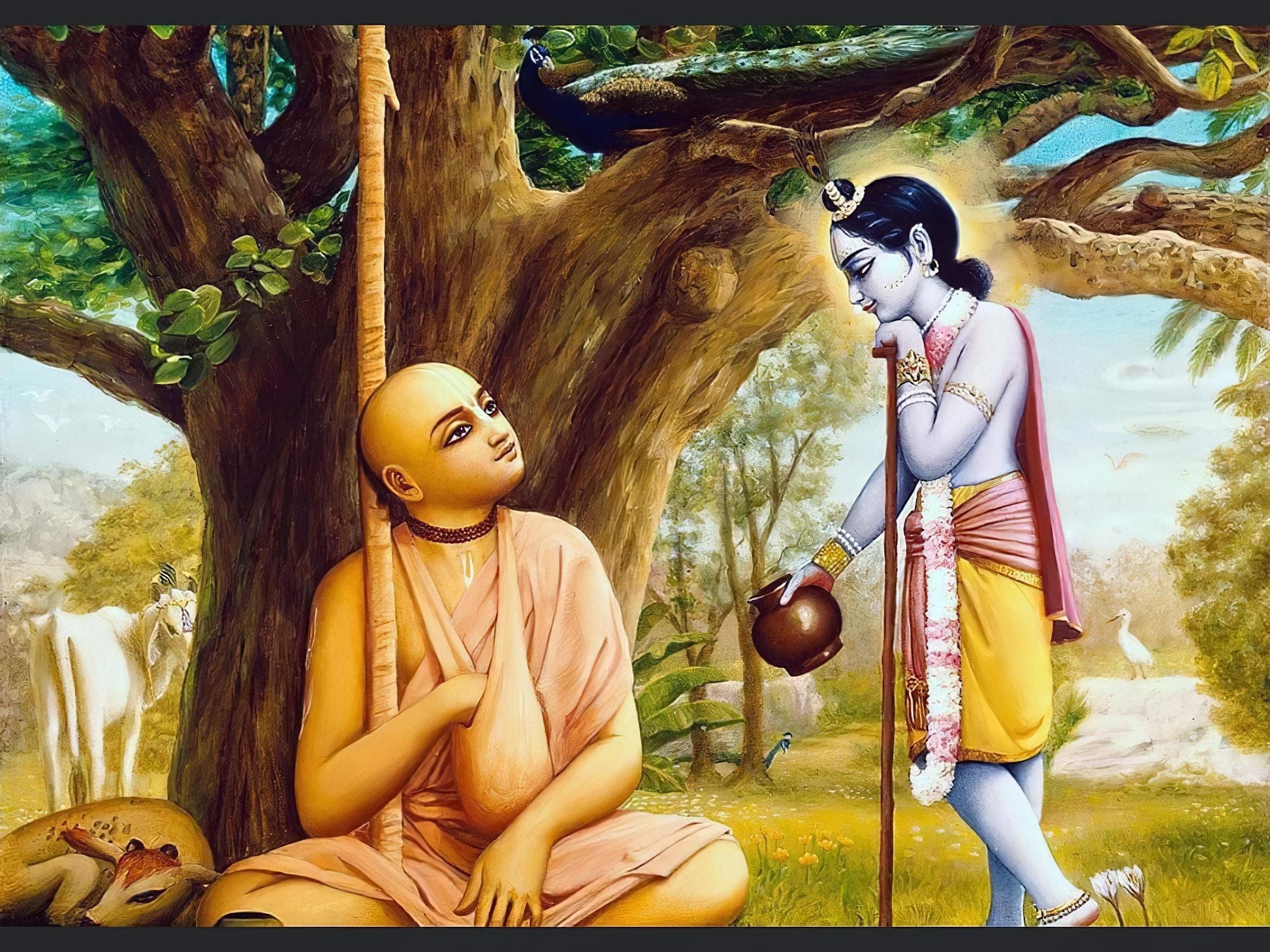
Our real position and relationship with the Lord
Conditioned life is often compared to a dream. The stage of liberation is compared to the end of such a dream, when we can again understand our real situation and wake up to the spiritual reality. While dreaming, one may see different situations, but when one awakens, one sees nothing apart from oneself. Similarly, in material life we create an illusory situation for ourselves, with growing material entanglement, but when we attain liberation by the devotional process, we see ourselves in our real position in relationship with the Lord. This is explained next:
“When a person becomes devoid of all material desires and liberated from all material qualities, he transcends distinctions between actions executed externally and internally. At that time the difference between the soul and the Supersoul, which was existing before self-realization, is annihilated. When a dream is over, there is no longer a distinction between the dream and the dreamer.” (SB 4.22.27)
The verse mentions that “the difference between the soul and the Supersoul, which was existing before self-realization, is annihilated” and in his purport Prabhupāda mentions that “a liberated person understands that he is part and parcel of the Supreme Lord acting in accordance with the desire of the Supreme Lord, and as such there is no distinction between himself and the Supreme Lord, although both of them retain their individuality (nityo nityānām cetanaś cetanānām).”
This may sound like a contradiction at first, but it is nicely explained by Śrīla Madhvācārya in his commentary to the Māṇḍūkya Upanisad. It is similar to when we say, “in the dark, everything becomes one.” It doesn’t mean everything merges together, but that in the dark, we don’t see the distinction between the different objects. Similarly, in conditioned life, we see ourselves as separated from the Lord, which leads to an attitude of material enjoyment and illusion. In the stage of liberation, this distinction caused by the false ego disappears, and our desires become dovetailed with the Lord. Just as a mother identifies with the needs and desires of her child, we forget about any separate interest and become absorbed in the desires of Kṛṣṇa. This is the true spiritual platform of oneness.
Another meaning of unity is that, as aspiring devotees, we sometimes practice activities connected with sense gratification and sometimes with Kṛṣṇa Consciousness. For a pure devotee, however, there is no such distinction, as Prabhupāda explains:
“When one is liberated from the material qualities, he does not do anything for his personal sense gratification. At that time all activities performed by him are absolute. In the conditioned state there are two kinds of activities: one acts on behalf of the body, and at the same time he acts to become liberated. The devotee, when he is completely free from all material desires or all material qualities, transcends the duality of action for the body and soul. Then the bodily concept of life is completely over.”
This distinction between practice in the conditioned state and the liberated stage is further emphasized in the next verse:
“When the soul exists for sense gratification, he creates different desires, and for that reason he becomes subjected to designations. But when one is in the transcendental position, he is no longer interested in anything except fulfilling the desires of the Lord.” (SB 4.22.28)
The main difference between a liberated soul and a conditioned soul is that a conditioned soul lives under the material designations created by the false ego, identifying with the body and mind. This is accompanied by many material desires that make one absorbed in matter. Even when we start our spiritual practice, this identification with matter persists to a certain degree, and in this way, we see a difference between matter (what we use for our sense gratification) and spirit (what we see as connected with Kṛṣṇa). For a pure devotee, however, there is no matter; he sees everything as connected with Kṛṣṇa and is ready to use everything and anything in His service. On this platform, there is not even the need to renounce anything, because he doesn’t see anything as his possession. He sees Kṛṣṇa in everything and everything in Kṛṣṇa. This is yet another meaning of oneness.
In his purport, Prabhupāda describes this vision in detail:
“The liberated person has no attachment for anything material or for sense gratification. He understands that everything is connected with the Supreme Personality of Godhead and that everything should be engaged in the service of the Lord. Therefore he does not give up anything. There is no question of renouncing anything because the paramahamsa knows how to engage everything in the service of the Lord. Originally everything is spiritual; nothing is material. In the Caitanya-caritāmṛta (Madhya 8.274) also it is explained that a mahā-bhāgavata, a highly advanced devotee, has no material vision:
sthāvara-jangama dekhe, nā dekhe tāra mūrti
sarvatra haya nija iṣṭa-deva-sphūrti
Although he sees trees, mountains, and other living entities moving here and there, he sees all as the creation of the Supreme Lord and, with reference to the context, sees only the creator and not the created. In other words, he no longer distinguishes between the created and the creator. He sees only the Supreme Personality of Godhead in everything. He sees Kṛṣṇa in everything and everything in Kṛṣṇa. This is oneness.”
One more meaning of oneness is to not make distinction between ourselves and others, based on the idea that we are all spirit souls, parts and parcels of Kṛṣṇa. As defined by Madhvācārya, one soul is distinct from another in the sense that we are different individuals, but at the same time, we are equal in nature. This is emphasized by Sanat-kumāra in text 29:
“Only because of different causes does a person see a difference between himself and others, just as one sees the reflection of a body appearing differently manifested on water, on oil or in a mirror.” (SB 4.22.29)
What does this example mean? The same person appears different when reflected on different surfaces. Because the water moves, the reflection appears to move; when reflected in a mirror, the reflection is stable; when reflected on oil, it appears hazy, and so on. Similarly, the spirit soul acquires different varieties of forms and activities due to contact with the three modes, accepting different upādhis, or designations. This, however, doesn’t change the actual position of the soul. In the Gītā (18.21), Kṛṣṇa explains that knowledge by which one sees that in every different body there is a different type of living being is in the mode of passion. In Bg 5.18, He emphasizes that a learned person does not discriminate based on the body.
The conclusion of the instructions of Sanat-kumāra
In the previous verses, Sanat-kumāra explained that the soul and the Supersoul are of the same nature and defined the material experience of the soul as “svapne yathā” (like in a dream). If the soul is originally transcendental to matter, how did it come to be so entangled in it?
“When one’s mind and senses are attracted to sense objects for enjoyment, the mind becomes agitated. As a result of continually thinking of sense objects, one’s real consciousness almost becomes lost, like the water in a lake that is gradually sucked up by the big grass straws on its bank.” (SB 4.22.30)
In his purport, Prabhupāda explains how this verse reveals the basic dynamic of the soul’s conditioning: how the soul comes in contact with matter and how an inexperienced transcendentalist can again become attracted to sense gratification if the root cause is not destroyed:
“In this verse it is very nicely explained how our original Kṛṣṇa Consciousness becomes polluted and we gradually become almost completely forgetful of our relationship with the Supreme Lord. In a previous verse it is recommended that we should always keep in touch with the devotional service of the Lord so that the blazing fire of devotional service can gradually burn into ashes material desires and we can become liberated from the repetition of birth and death. This is also how we can indirectly keep our staunch faith in the lotus feet of the Supreme Personality of Godhead. When the mind is allowed to think of sense gratification continuously, it becomes the cause of our material bondage. If our mind is simply filled with sense gratification, even though we want Kṛṣṇa Consciousness, by continuous practice we cannot forget the subject matter of sense gratification. If one takes up the sannyāsa order of life but is not able to control the mind, he will think of objects of sense gratification — namely family, society, expensive house, etc. Even though he goes to the Himālayas or the forest, his mind will continue thinking of the objects of sense gratification. In this way, gradually one’s intelligence will be affected. When intelligence is affected, one loses his original taste for Kṛṣṇa Consciousness.”
He goes further, stating that, “The material desire for sense enjoyment is the cause of our fall down in this material world, and thus we suffer the threefold miseries and continuous birth, death, old age and disease. However, if we turn our desires toward the transcendental loving service of the Lord, our desires become purified. We cannot kill desires. We have to purify them of different designations. If we constantly think of being a member of a particular nation, society or family and continuously think about them, we become very strongly entangled in the conditioned life of birth and death. But if our desires are applied to the service of the Lord, they become purified, and thus we become immediately freed from material contamination.”
To exemplify this point, Sanat-kumāra makes the analogy of a lake drying up because of kuśa grass growing on its banks. If the grass is allowed to grow freely, it sucks the water until the lake completely dries up. In the same way, if material desires are allowed to grow, they progressively cover the original Kṛṣṇa Consciousness of the soul, to the point that one can become a dog or a pig. Therefore, these heaps of kuśa grass that are drying up our consciousness should be cut down from the beginning. We should understand the danger of unrestricted sense gratification and where it can lead us.
In verse 31, Sanat-kumāra continues to explain the process of forgetfulness of the soul:
“When one deviates from his original consciousness, he loses the capacity to remember his previous position or recognize his present one. When remembrance is lost, all knowledge acquired is based on a false foundation. When this occurs, learned scholars consider that the soul is lost.” (SB 4.22.31)
Our practical actions are based on identification. If I think I’m a man, I will act in a certain way, and if I think I’m a dog, I will act in another. If I see myself as an eternal servant of Kṛṣṇa, my actions will manifest in the form of service to Him, but if I see myself as the enjoyer of this material world, all my actions and knowledge will be based on this false foundation. When this happens, it is said that the soul is lost, because I start acting as a body, and not as a soul. When an object is “lost”, it doesn’t mean it stops existing, but it can’t be seen. Similarly, the soul is still there, even in the biggest materialist, and one’s original Kṛṣṇa Consciousness is never lost, but it can be covered to such an extent that it becomes factually lost. One becomes thus separated from one’s eternal Kṛṣṇa Consciousness by the effect of material illusion, and if someone helps one to recover it, he becomes the greatest benefactor.
Prabhupāda further explains these points in his purport:
“Our original consciousness is Kṛṣṇa Consciousness because we are part and parcel of Kṛṣṇa. When this consciousness is misguided and one is put into the material atmosphere, which pollutes the original consciousness, one thinks that he is a product of the material elements. Thus one loses his real remembrance of his position as part and parcel of the Supreme Personality of Godhead, just as a man who sleeps forgets himself. In this way, when the activities of proper consciousness are checked, all the activities of the lost soul are performed on a false basis.”
You can also donate using Buy Me a Coffee, PayPal, Wise, Revolut, or bank transfers. There is a separate page with all the links. This helps me enormously to have time to write instead of doing other things to make a living. Thanks!