


You can receive new articles directly in your inbox. Subscription is free; donations are welcome.
One detail that puzzled me the first time I read the Prabhupada Lilamrta was the description of the family of Śrila Prabhupada, more specifically his wife and children.
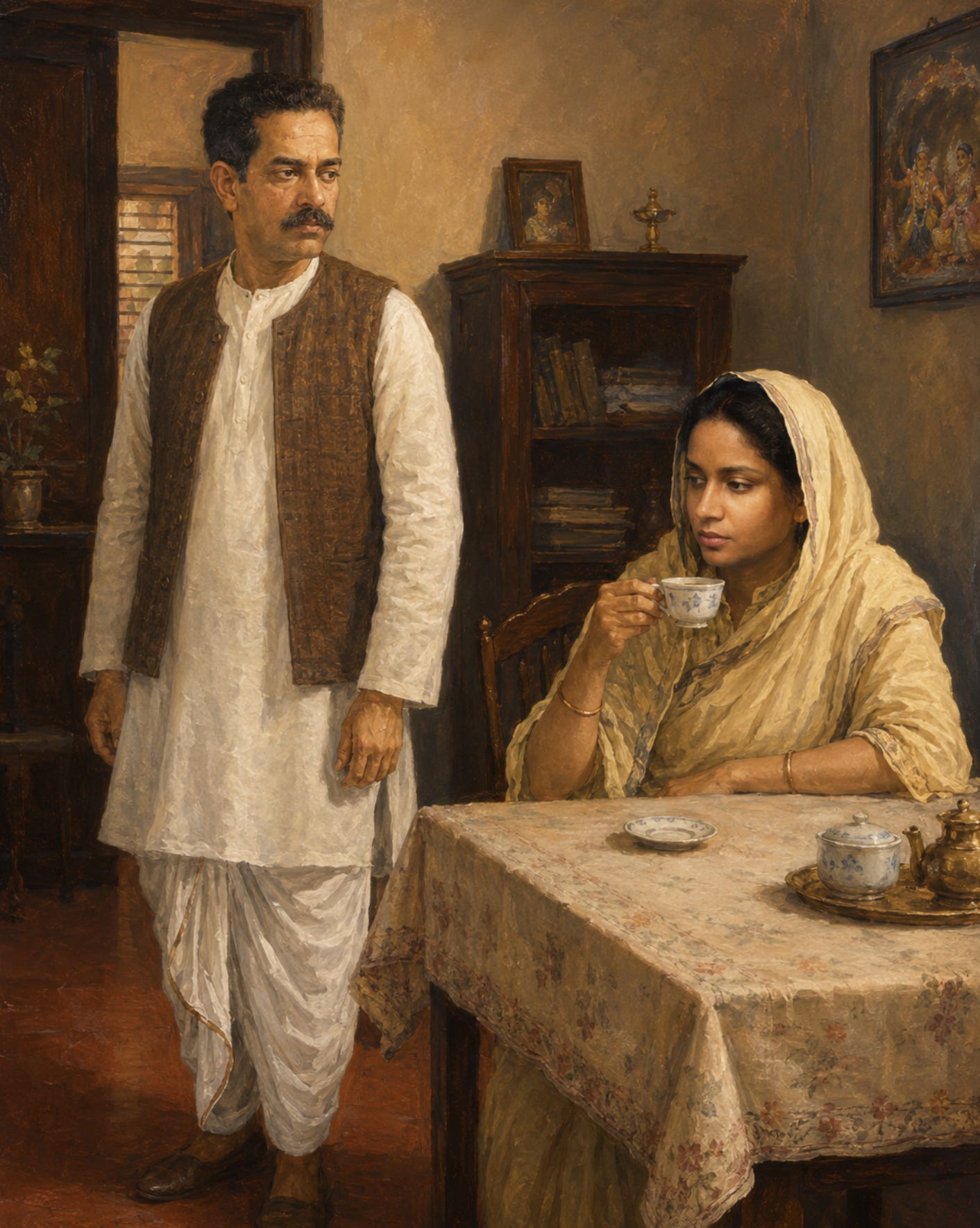
According to the description in the Lilamrta, they didn’t appear to be very interested in spiritual life. It describes, for example, how the wife of Śrila Prabhupada would go upstairs and drink tea while Prabhupada was discoursing on Śrīmad Bhagavatam to visitors in the main room. Somehow, she adopted the habit of drinking black tea, like the British, despite the protests of her husband, and would use it to voice her displeasure at his preaching activities.
This is described in the Lalamrta:
“Śrīla Prabhupāda: I wanted as much as possible to get her to work with me in spreading Kṛṣṇa consciousness, to get her help. But she was very determined. She wouldn’t help me in spreading Kṛṣṇa consciousness. So finally, after many years, I could understand – she would not be any assistance to me.
She was very attached to drinking tea. I was always telling her not to drink tea, because I wanted to have a nice Vaiṣṇava family. So although I was repeatedly telling her, this time I finally said, “You have to choose between me or tea. Either the tea goes or I go.” In this way, I was even criticizing my own family. But because they were thinking I was the husband or father, they couldn’t take my instruction seriously. So she replied, “Give up tea-drinking or give up my husband? Well, I will have to give up my husband, then.” Of course, she thought I was joking.
One day, Radharani made a great mistake. There was a system of barter in which a customer would place on a scale an object a shopkeeper considered valuable and the shopkeeper would then balance it with an equal weight of merchandise. So while Abhay was out, his wife took his worshipable Bhāgavatam to the market and traded it for tea biscuits. When Abhay came home and looked for the book, she told him what had happened. She hadn’t taken the matter as a very serious thing – she was out of tea biscuits – but Abhay was shocked. At first he felt depressed, but then a wave of absolute resolution passed over him: his family life was finished.
When he told them he was leaving, they didn’t understand what he meant. He had been leaving for thirty years. He was always coming and going. When he walked out the door, they thought, “There he goes again. He’s leaving.” It was the usual routine. Everyone could see, even the neighbors – Mr. De was going again. He had been at home; now he was going. He would be back again. But Abhay knew he would never come back.”
From the same Prabhupada Lilamrta, we hear how even many of the most exalted disciples of Śrila Prabhupada had the opportunity to associate with him for only brief periods directly. Most of their association would be through his books and through a few letters they exchanged with him. If just such brief moments of association were sufficient to make devotees of the stature of Jayapataka Swami, Bhakti Tirtha Swami, and Gopal Kṛṣṇa Goswami, one could imagine how purifying it would be to have the opportunity of associating with Śrila Prabhupada for a few decades non-stop.
I would ask myself how it could be that the wife and children of Śrila Prabhupada, who had more opportunity of associating with him than any of his initiated disciples, could be so callous to Kṛṣṇa consciousness.
Later, I learned that the wife of Śrila Prabhupada was actually practicing Kṛṣṇa consciousness. Although she refused to be initiated by Śrila Bhaktisiddhanta Sarasvati because of her reluctance to make the vows at the time, she later took initiation from one of his disciples, a godbrother of Śrila Prabhupada. Although maybe not so strictly, she was following in her way, just like most of us nowadays. Similarly, the children of Śrila Prabhupada were vegetarians; they would not drink or smoke, and they would regularly go to the temple and follow basic spiritual practices. They were doing better than most of our children nowadays.
The Prabhupada Lilamrta, however, makes clear the difference between their understanding of Kṛṣṇa consciousness and that of Śrila Prabhupada, who was a pure devotee from birth and wanted to take upon himself the responsibility of fulfilling his spiritual master's mission. This shows the gulf of difference between the understanding of a neophyte devotee, who sees Kṛṣṇa only as the deity in the temple and is not very interested in sharing Kṛṣṇa consciousness with others, and a pure devotee, who is prepared to sacrifice everything for the sake of the Lord. For a neophyte, Kṛṣṇa consciousness is just a part-time religion that they practice in the temple but don’t want to mix with their personal life, while for a pure devotee, Kṛṣṇa consciousness is life itself.
There are a few lessons I learned from this. The first lesson is that even for a pure devotee, things rarely go without difficulties. Śrila Prabhupada had to face and surpass an outrageous volume of challenges until he could even start fulfilling his mission of spreading Kṛṣṇa consciousness in the West. The reason Kṛṣṇa sends such difficulties to his pure devotees is, in my understanding, twofold.
The first reason is to glorify his pure devotees, making clear for future generations how exalted they are, and to make them a living example of how we should behave when facing our own difficulties. We read about how the Pandavas went through so many difficulties without ever deviating from their devotion to Kṛṣṇa. Similarly, we can see how the difficulties Śrila Prabhupada went through never curbed his determination. We would not be able to surpass the same difficulties the Pandavas or Śrila Prabhupada faced, but according to our situation, we face our small set of challenges that we should also surpass by following their example.
The second reason is that Kṛṣṇa gives His pure devotees the necessary skills and experiences they would later need to fulfill their missions. As Śrila Prabhupada explains, pure devotees are not omniscient. They know things to the extent Kṛṣṇa wants them to know. Sometimes Kṛṣṇa may give them knowledge directly from the heart, but other times he may use different ways. We can understand thus that the challenges Śrila Prabhupada faced in his family life were also part of the plan to give him the tools and experience he would later use to create our movement.
Another point that is clear to me is about the free will of the soul. One may have the opportunity of associating with a pure devotee for just a moment and use it to the fullest extent, while others may have the opportunity of much longer association, but use it frivolously and thus don’t derive so much benefit out of it. The wife of Śrila Prabhupada had the opportunity of associating with him much longer than any of his disciples, but she did not see him with the same reverence, nor did she hear from him with the same interest. Certainly, she was also not serving him with the same fervor. As a consequence, the benefit of the association was also different.
Reflecting on my own life, I see how this is a mistake I myself committed on so many occasions, taking the association of pure devotees casually, and thus missing the opportunity. It is said that familiarity breeds contempt. We should be careful to use any opportunity to associate with pure devotees to the fullest extent, and not just miss it frivolously, or, worse, by neglecting, envying, or offending them in different ways.
Another point I learned is that the process of Krsna consciousness is not automatic. One has to make a conscious effort to practice, serve, learn, and thus advance. If one is apathetic in his or her spiritual practice, even the association of a pure devotee may not help much. The soul has his free will and can, at any moment, use this free will to come closer to Kṛṣṇa or closer to the material energy. The example of the wife of Śrila Prabhupada drinking tea while he was discoursing on Śrīmad Bhagavatam is thus emblematic of our own apathy in spiritual life.
Read more:

This is a publication for thoughtful readers who want to go deeper into Kṛṣṇa consciousness. I publish daily, trying to offer high-quality spiritual content, and all posts are available to free subscribers. If you wish, you can support this work with a monthly contribution. When you subscribe, you can choose between a free subscription and a monthly contribution, and you can switch from a free subscriber to a supporter at any time.
You can also receive updates on WhatsApp or Telegram.
If you would like to contribute further, you can find the donation links here.
How could you write an article like this...what do you know about his wife...mataji? He himself said to his son much later your mother was a very good wife...I was not easy.
You have no goddam idea of that souls journey or destination. Pls stop writing such offensive articles in the name of praising Srila Prabhupada. You're hurting his gentle heart.