

Subscribe to receive new articles by e-mail. It’s free, but if you like, you can pledge a donation:
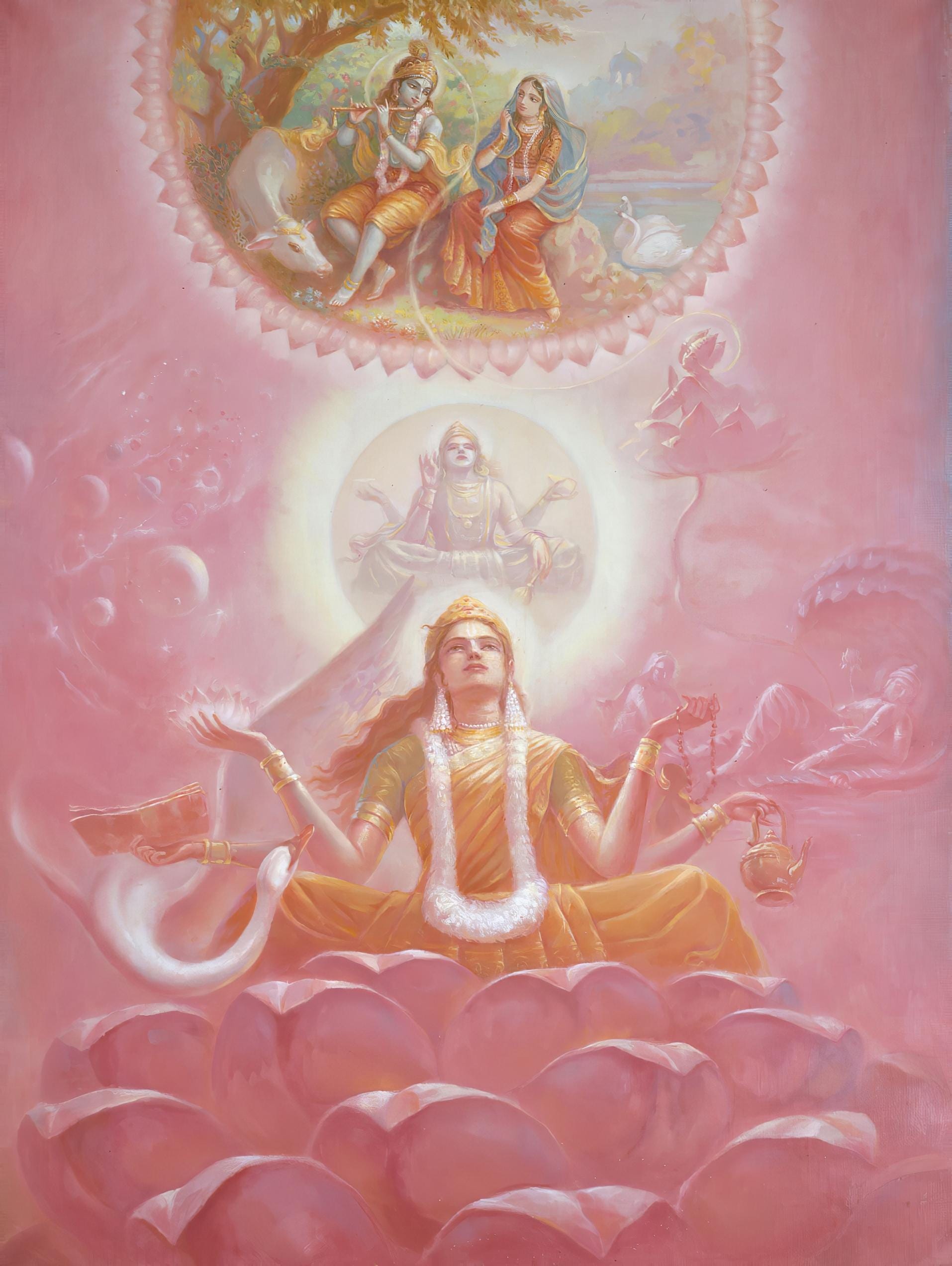
It is described that Ramādevī (Lakṣmīdevī) lives in Ketumāla-varṣa, in Jambūdvīpa, where she worships the Lord with prayers, described in the 18th chapter of the 5th canto of Śrīmad Bhāgavatam.
In these prayers, she takes compassion on the position of all women and gives us a higher understanding of family life. She addresses the position of women and shows the path of pure devotion to the Lord as beyond the ordinary recommendations of the varnāśrama system.
One interesting point she makes is that in conditioned life, one who receives a male body may claim to be a male, but in reality, all souls are ultimately female, part of the energy of the Supreme Lord, and meant to serve Him. In this world, every woman desires material comfort and other facilities, but there is no need to worship the Lord for this, because all these are supplied by her, who constantly serves the Lord and is very attentive to the needs of His devotees. Instead, a woman should directly worship the Lord, seeing Him as the only true husband and protector.
Material life is based on sense enjoyment, but the senses are given by the Lord who is Hṛṣīkeśa, the master and controller of the senses. Even a materialist is completely dependent on the Lord, since the power to enjoy using one’s senses comes from Him. Since in any case we are dependent on the Lord, why not accept that, and try to cultivate this transcendental relationship? A lady accepts a husband seeking maintenance, nourishment, and protection, but in any case, these come from the Lord. A man may act as a representative and appear to give these resources, but ultimately, it all comes from the Lord. Just as rain appears to come from Indra, but ultimately is bestowed by Lord Viṣnu alone, wealth, love, children, and other facilities a husband may appear to provide are in reality given by the Supreme Lord. Without His sanction, no man has the power to provide anything, being slacked to his own karma. Therefore, developing this forgotten relationship with Kṛṣṇa, the Supreme Lord, is the true purpose of life, behind all material relationships and social conventions. Lakṣmīdevī thus guides all of us in this direction.
These prayers of Lakṣmīdevī do not necessarily mean a woman should not get a husband, but emphasize that the Lord should be seen as the ultimate cause. No man has any potency to act independently of Him.
Marriage, therefore, should be conducted in a spirit of service to the Lord, instead of mere material satisfaction. A wife should see the husband as a servant of the Lord, meant to be respected and served, and similarly, the husband should see his wife as the dear servant of the Lord, who should be protected and nourished. When we support each other in this understanding, we can peacefully cooperate in the service of the Lord. With Kṛṣṇa in the center, our marriage becomes instrumental in our spiritual progress, instead of an obstacle to it.
Conversely, if we prefer to insist on the model of the husband being seen as a provider of material resources and the wife as a source of enjoyment, then the relationship will remain mundane and illusory, and will simply distract us from the ultimate goal.
Lakṣmīdevī also mentions that “if a woman worships Your lotus feet for a particular purpose, You also quickly fulfill her desires, but in the end she becomes broken-hearted and laments.”
Why is that?
Even though the Lord is the only true husband and protector, people often prefer to accept other ordinary persons for this function. The Lord has no objection, and he in fact sanctions these arrangements. Kṛṣṇa is providing husbands for everyone, and if a devotee lady prays to him with this goal in mind, the Lord can very easily give her a husband. However, this will be a fallible and temporary arrangement, since no ordinary man has the power to protect anyone or make anyone happy. The lady will thus inevitably become broken-hearted and lament. This is not the Lord’s fault, but just the inevitable result of such a material arrangement. If we want to touch the fire, the Lord can arrange for us the possibility of doing so, but He is not responsible for our hands being burned; this is the result of our own choice.
What is the solution then? “Na te viduḥ svārtha-gatiṁ hi viṣṇum: people do not know that real advancement in life consists of accepting the Supreme Personality of Godhead as one’s master. Instead of deceiving themselves and others by pretending to be all-powerful, all political leaders, husbands and guardians should spread the Kṛṣṇa consciousness movement so that everyone can learn how to surrender to Kṛṣṇa, the supreme husband.”
There is no problem in one becoming a husband, father, or even a spiritual master or demigod. However, one who does so should understand the spirit of the instructions of Ṛṣabhadeva, and see himself as a servant of the Lord, meant to elevate one’s dependents to the platform of Kṛṣṇa consciousness, directing them to the only real husband, father, and protector. Anyone who thinks they can give shelter to someone is under illusion. Only the Lord can fulfill this function.
Considering that one understands that the Lord is the Supreme Protector, but still has material desires, what should be done?
The best platform is to practice unalloyed devotional service and just serve the Lord out of love. This is the natural result of a platform of true knowledge, when we understand that the Lord is omniscient and the protector of His devotees. If the Lord is already seeing everything and is eager to give us protection, it means that all situations are simply the best for us, the fastest path for us to become purified and find our way back to Godhead.
However, if one has pressing material desires, then the second-best alternative is to just pray to the Lord for that. Kṛṣṇa is very intelligent, and He is capable of supplying it in a context that will not hamper our spiritual progress. Once it is understood that no one can act without the sanction of the Lord, only a person bereft of all good sense will approach a demigod or other powerful material personality for that.
Lakṣmīdevī mentions that although many materialists and even demigods seek her favor, she is not at all inclined to give them material opulences. On the other hand, we can see many powerful and opulent people around. If their wealth doesn’t come from Lakṣmī, from where does it come?
The answer is that they come not from Lakṣmī, but from Durgā, her expansion. However, these material blessings bestowed by Durgā are illusory and can give only illusory happiness (māyā-sukha). They are quickly lost, leaving only bewilderment and frustration. One practical example of this is Rāvana. He tried to capture Sītādevī, but instead got just an expansion of Durgā, who ultimately led to his downfall.
On the other hand, when a devotee obtains some extraordinary opulences, they are given by the real Lakṣmīdevī, just like Sudhāmā (the brāhmana) obtaining a towering celestial palace and other opulences after visiting Kṛṣṇa and giving Him a morsel of broken rice. These opulences tend to stick and don’t become an obstacle in their devotional service.
Kṛṣṇa’s general policy is to never give a blessing that leads a devotee to ask for the same thing again. In other words, when the Lord gives something, it solves the problem once and for all. Dhruva Maharaja desired to be a king more exalted even than Brahma, and the Lord made him the eternal king of a Vaikuṇṭha planet, where He personally resides.
Often, Indians are reluctant to worship Viṣnu because they think they will lose their material opulences (since many Vaiṣnavas are quite poor). This verse shows, however, that Vaiṣnavas have no scarcity of resources available to them, since the goddess of fortune herself is eager to bless them unlimitedly. However, Vaiṣnavas aim for something much more valuable, and are generally not very interested in material blessings, and the Lord Himself, understanding what is really valuable, does not impose them. Instead, He helps a devotee to gradually ascend to a platform of devotional service.
What is the proof that pure devotional service is the real blessing of the Lord? We can see that in the last verse of her prayers, Lakṣmīdevī mentions that the Lord shows His real mercy to His devotees, not to her.
Even though Lakṣmīdevī resides always in the chest of Lord Viṣnu, she desired to join the conjugal pastimes of Kṛṣṇa in Vṛndāvana. For this, she practiced austerities for a very long time, but was still unsuccessful. In this mood, she prays that “although You already bear my insignia of golden streaks on Your chest, I regard this honor as merely a kind of false prestige for me. You show Your real mercy to Your devotees, not to me.”
This closes the cycle, bringing us to the highest stage of devotional service, the true benediction of the Lord, the most valuable benediction of all. Even great demigods desire the favor of the Goddess of fortune, but Lakṣmīdevī herself, the possessor and bestower of all material opulences, hankers for something else, something she can’t achieve. This very thing is available for devotees who reject all material benedictions as insignificant and fully surrender to the Lord, following the footsteps of the inhabitants of Vṛndāvana.
You can also donate using Buy Me a Coffee, PayPal, Wise, Revolut, or bank transfers. There is a separate page with all the links. This helps me enormously to have time to write instead of doing other things to make a living. Thanks!