

Deep spiritual knowledge, but incoherent cosmology? A preface for the book.
The same scriptures that describe the deepest spiritual knowledge describe a universe that may seem incoherent. This book tackles this apparent incongruence and offers a consistent model.
« The Universe of the Vedas
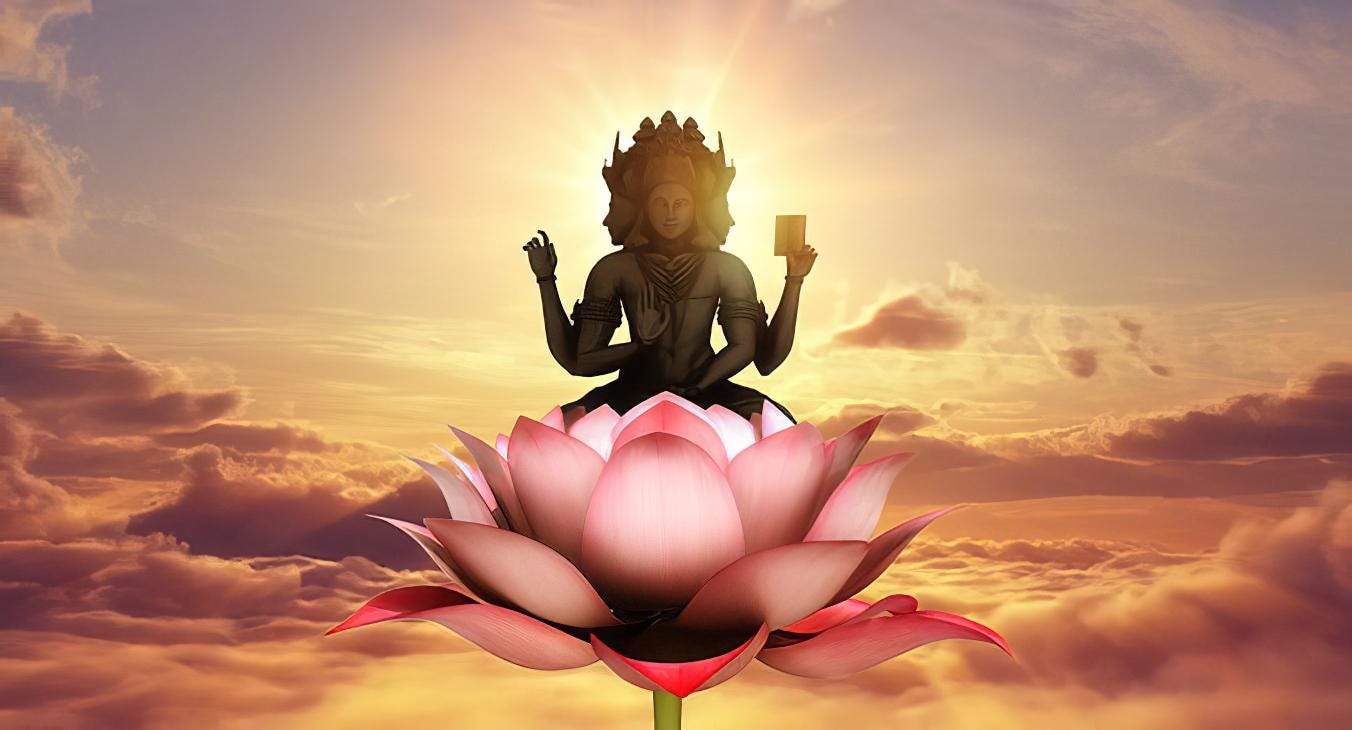
This is a preface for the book on Vedic cosmology we are about to publish. You can find a new manuscript of the book, already on the stage of revision, on the page with upcoming books (available for patrons).
I will be posting more topics and eventually the final book when it is ready.
Preface: Deep spiritual knowledge, but incoherent cosmology?
The spiritual value of the Vedas is undeniable. Hundreds of millions of people seek guidance from books such as the Bhagavad-gītā, Mahābhārata, Rāmāyaṇa, and the Purāṇas, receiving from them practical wisdom about the soul, our relationship with God, the purpose of life, and the path of self-realization. No other literature offers such a deep and systematic exploration of these themes.
At the same time, however, the Vedic cosmological model can be bewildering. For many modern readers, the descriptions of Bhū-maṇḍala, Mount Sumeru, the higher and lower planetary systems, the movements of the sun, and so on, appear at first glance strange, inaccessible, or incompatible with the picture of the universe offered by contemporary science. In other words, the same scriptures that describe the deepest spiritual knowledge also describe a universe that may seem incoherent.
Nowhere is this contrast more evident than in the Śrīmad-Bhāgavatam, a book that simultaneously offers the most in-depth exposition of spiritual knowledge in the Vedic scriptures and the most difficult elaborations on Vedic cosmology, especially in the Fifth Canto. As a result, these cosmological sections are often neglected, reduced to symbolism, or treated as remnants of an ancient worldview with little relevance in the modern world. Others collapse this knowledge into conspiracy theories, forcing the descriptions into crude literalism and turning profound cosmological teachings into claims about a flat earth, hidden continents, and similar misunderstandings.
This book begins from a different perspective. It is not an apologetic work written to defend the Vedic model against modern scientific conclusions through forced harmonizations, nor does it start from the assumption that the Bhāgavatam’s cosmology is a problem requiring rescue. On the contrary, it begins from the understanding that the Vedic cosmological model is coherent and meaningful, and from there tries to present the richness of this knowledge. It does not ignore modern findings or dismiss them as hoaxes. Rather, it considers recent discoveries carefully, but does so from a particular standpoint: not by accepting science as the final tribunal before which the scriptures must justify themselves, but by asking whether recent discoveries may actually help us better appreciate the Vedic description of reality.
In most cases, modern discoveries do not weaken the Vedic model, but instead offer unexpected support for it, checking our tendency to flatten and misunderstand the scriptural description of the universe. The Vedic model then shines in its own light, helping us understand that reality is far more complex, layered, and counterintuitive than a narrow materialistic framework allows. It offers the higher philosophical system that saves us from the mechanistic conclusion of a universe created by chance and a life devoid of purpose.
The difficulty in studying Vedic cosmology is that its true meaning was lost over time. The descriptions were preserved in the scriptures, but the keys for properly understanding the structure and purpose went missing. As a result, later readers were often left either with literalism devoid of philosophical depth or with symbolic readings that dissolved the meaning into allegory. In either case, the integrated vision of the original model was no longer available.
This is yet another field in which we may not yet fully appreciate the contribution left by Śrīla Prabhupāda. He is the one who restored the essential framework for understanding it. Through his translations, purports, conversations, and letters, he identified the central principles necessary for approaching the Fifth Canto and the Vedic universe as a whole. In other words, he gave us the keys that allow us to open this lost vault. He repeatedly emphasized that the cosmology of the Bhāgavatam should not be dismissed, that it describes a real structure of the universe, and that it must be understood according to its own logic and structure. More than that, he gave us the conceptual keys by which the whole model begins to make sense.
This book is an attempt to expand these conclusions into a complete and systematic model. It is not meant to replace Prabhupāda’s explanations, but to unfold them. In other words, this is an effort to take the foundational insights given by him and develop them into a coherent working framework that can be used not only for study and reflection, but also as the basis for constructing a working Vedic cosmological model.
In this sense, the present work is both interpretive and constructive. It is interpretive, because we try to understand the cosmological descriptions of the Bhāgavatam in light of the keys given by Prabhupāda. It is not a flattened literal interpretation that concludes that the planet we live on is a dish floating in space. At the same time, it is constructive, because it seeks to assemble these conclusions into a complete model that can be visualized and represented.
The central question here is not merely cosmographic. It is also philosophical and theological, having to do with our very concept of identity. Who I am defines where I should go, and therefore a mistaken view of the universe can easily result in a misguided view of life itself.
Modern science has achieved great success in examining the measurable features of the gross universe, but at the same time it has failed spectacularly in translating this success into a meaningful model of reality. On the contrary, it produced a model in which matter organizes itself within the fabric of space and time by chance, where complex life forms emerge from a primordial soup, where there is no soul, and where life serves no ultimate purpose.
The Vedic texts describe a cosmos that is metaphysical, hierarchical, and inhabited at many levels. They speak of dimensions of existence that are inaccessible to ordinary perception and relationships between the gross, the subtle, and the transcendental that don’t fit easily into modern categories. The Vedic cosmological model appears to be so different from the universe conceived by modern astronomy, not because it is false, but because the two systems are rarely operating on the same descriptive plane. Most of us learned the basics of the scientific model in school, and some of us studied it more thoroughly. Because of this, we have already molded our perception around it, and we need a paradigm shift to get into the Vedic model. That’s what we hope to provide.
For devotees, this book is meant as an invitation to revisit the cosmological model of the Vedas with renewed seriousness and confidence. The Fifth Canto describes a real structure, but that’s a description we no longer know how to read. We hope to show you in this book that the model is not only coherent, but it is key to understanding the universe we live in light of the spiritual knowledge given in the scriptures.
For other readers, it is offered as an invitation to reconsider assumptions that may otherwise lead to premature dismissal. The Vedic sages were describing a reality broader than the one we can ordinarily experience with our current senses. This metaphysical reality may not fit neatly within our conceptual limits, but this is precisely what makes it valuable. It forces us to get outside the box and acknowledge that the universe is more complex than we originally thought and that our understanding of reality may not be as complete as we may like to believe.
In this book, we start with a general description of the universe and the process of creation, as described in the first three cantos of Śrīmad-Bhāgavatam, and then continue with a detailed commentary on the second part of the Fifth Canto, going through it verse by verse, breaking down the explanations concept by concept, and revealing the richness of the text.
The goal of this study is not only to recover the lost structure of the Vedic universe, but also to awaken the deeper vision of reality that it is meant to inspire.
« The Universe of the Vedas
This is a publication for thoughtful readers who want to go deeper into Kṛṣṇa consciousness. I publish daily, trying to offer high-quality spiritual content, and all posts are available to free subscribers. If you wish, you can also choose a paid subscription to support this work.
You can also receive the updates on WhatsApp or Telegram.
If you would like to contribute further, you can find the donation links here.