

Subscribe to receive new articles by e-mail. It’s free, but if you like, you can pledge a donation:
🔉 Audio of the lesson »
🎙Podcast (Search for “Mysteries of the Vedas” on Spotify, iTunes, etc. to hear all the lessons
Check this post if you would like to join the live lessons. This course is maintained with your donations. Click here to donate.
💬 Text of the lesson
Priyavrata’s family life: The perfect example of a saintly king
“Thereafter, Mahārāja Priyavrata married Barhiṣmatī, the daughter of the prajāpati named Viśvakarmā. In her he begot ten sons equal to him in beauty, character, magnanimity and other qualities. He also begot a daughter, the youngest of all, named Ūrjasvatī.” (SB 5.1.24)
One could argue that since Priyavrata was free of material desire, why did he get married and get involved in sexual life? Why not just remain as a Brahmacārī king? Prabhupāda discusses this point in his purport:
“Since Mahārāja Priyavrata was fully trained in transcendental knowledge, he could have returned home and conducted the business of government as a brahmacārī. Instead, however, when he returned to household life, he accepted a wife also. The principle is that when one becomes a gṛhastha he must live perfectly in that order, which means he must live peacefully with a wife and children. When Caitanya Mahāprabhu’s first wife died, His mother requested Him to marry for a second time. He was twenty years old and was going to take sannyāsa at the age of twenty-four, yet by the request of His mother, He married. “As long as I am in household life,” He told His mother, “I must have a wife, for household life does not mean staying in a house. Real household life means living in a house with a wife.”
Many of the duties of a king can’t be performed by a celibate. A king has to perform many fruitive sacrifices that demand the presence of a wife, and he has to produce descendants that can continue the lineage. Because Priyavrata was so qualified, he didn’t need a wife for inspiration in performing his duties, like most men, but still, without a wife, he would not be properly situated in the āśrama. Vedic culture encourages us to be properly situated in one of the āśramas instead of trying to mix up their functions. By definition, a king is supposed to be a married man, and therefore, when he accepted the post, Priyavrata decided to also accept a wife and beget children.
His rule and family life are described in text 5.1.29:
“Whenever he was determined to fix his arrow upon his bowstring with his two powerful arms, all opponents of the regulative principles of religious life would flee from his presence in fear of the unparalleled prowess he displayed in ruling the universe. He greatly loved his wife Barhiṣmatī, and with the increase of days, their exchange of nuptial love also increased. By her feminine behavior as she dressed herself, walked, got up, smiled, laughed, and glanced about, Queen Barhiṣmatī increased his energy. Thus although he was a great soul, he appeared lost in the feminine conduct of his wife. He behaved with her just like an ordinary man, but actually he was a great soul.”
Priyavrata was so powerful that he didn’t have to fight. His mere presence would make his enemies flee in fear. It is said that behind every great man there is a great woman, and this was certainly the case with Priyavrata and many other great kings. By behaving in favorable ways, his wife Barhiṣmatī assisted him and served as a source of inspiration. As Prabhupāda explains in his purport:
“To maintain such a life of strict vigilance, one needs encouragement from his wife. In the varṇāśrama-dharma system, certain classes, such as the brāhmaṇas and sannyāsīs, do not need encouragement from the opposite sex. Kṣatriyas and gṛhasthas, however, actually need the encouragement of their wives in order to execute their duties. Indeed, a gṛhastha or kṣatriya cannot properly execute his responsibilities without the association of his wife. Śrī Caitanya Mahāprabhu personally admitted that a gṛhastha must live with a wife. Kṣatriyas were even allowed to have many wives to encourage them in discharging the duties of government. The association of a good wife is necessary in a life of karma and political affairs. To execute his duties properly, therefore, Mahārāja Priyavrata took advantage of his good wife Barhiṣmatī, who was always very expert in pleasing her great husband by properly dressing herself, smiling, and exhibiting her feminine bodily features. Queen Barhiṣmatī always kept Mahārāja Priyavrata very encouraged, and thus he executed his governmental duty very properly. In this verse iva has twice been used to indicate that Mahārāja Priyavrata acted exactly like a henpecked husband and thereby seemed to have lost his sense of human responsibility. Actually, however, he was fully conscious of his position as a spirit soul, although he seemingly behaved like an acquiescent karmī husband.”
For properly executing his family duties, a man needs to have a source of inspiration in his wife. If a wife does not act femininely, does not dress up well, doesn’t show interest and admiration for what he does, nor act in pleasing ways, even the most dutiful man will tend to become gradually disinterested in family affairs. Men without good spiritual culture will become apathetic, losing time in useless distractions and vices, while enlightened men will start thinking about renunciation. In any case, the result may not be in his wife’s best interest.
The behavior of Priyavrata is also exemplary. Although he was internally renounced, he didn’t refuse the affection of his wife. Instead, he reciprocated it, acting as an affectionate husband. In this way, being affectionate to one another, their marital love increased over time, and in this way, they were able to continue to cooperate peacefully for a very long period.
In previous ages, both men and women knew this art, and would thus be able to get the most out of their marriages. This would also be positive for society at large, since a harmonious and dutiful couple can offer all kinds of useful services to the whole community. When Prabhupāda speaks about reestablishing Varnāśrama, this includes this type of scientific understanding of human psychology that is essential for obtaining good results in our different spheres of activities and is absent nowadays.
The descendants of Priyavrata and his rule of 1.1 billion years
From the ten sons that Priyavrata had with Barhiṣmatī, the first three, Kavi, Mahāvīra, and Savana, were trained as perfect Brahmacārīs, just as Priyavrata himself was trained under Nārada Muni. Maintaining celibacy since the beginning of life, they became great paramahaṁsas. The other seven sons, Āgnīdhra, Idhmajihva, Yajñabāhu, Hiraṇyaretā, Ghṛtapṛṣṭha, Medhātithi, and Vītihotra, became kings, each one receiving sovereignty over one of the seven islands.
He also had a daughter, called Ūrjasvatī, who was married to Śukrācārya, and gave birth to Devayānī, whose story is described in the Ninth Canto.
Priyavrata also had a second wife (whose name is not mentioned in the description). With her, he had three more sons: Uttama, and the twin-brothers Tāmasa, and Raivata. All three became Manus in subsequent Manvantaras, assuming, respectively, the posts of 3rd, 4th, and 5th Manus.
It’s important to remember that all these events happened in the first Manvantara. Priyavrata reigned under the supervision of Svāyambhuva Manu, just as Dhruva, Pṛthu, and others. However, three of his sons achieved the position of Manus, just like their grandfather.
After Svāyambhuva came Svārociṣa, who took charge of the second Manvantara. Svārociṣa is not related to Svāyambhuva Manu; he is the son of Svarocis, or Agni. Uttama, Tāmasa, and Raivata assumed their posts in the sequential Manvantaras after him.
One could question how they could live so long. Raivata was born in the first Manvantara and reigned only in the 5th Manvantara, which started more than one billion years afterwards! It’s important to keep in mind that these are not regular human beings, but great sages who are almost completely purified of the influence of the lower modes. Even demigods, who are involved in sense gratification, can live for a whole Manvantara; therefore, it is not surprising that such great souls can live for even longer.
In fact, outside of the lower, intermediate, and celestial planets, very long life expectancies are actually the norm. Sages living in Maharloka live for 4.32 billion years, until the end of the day of Brahma, while sages living in Janaloka and higher can live for trillions of years, up to the end of the universe. Great sages who attain a similar level of purity can live very long lives even while living in Bhu-Mandala.
Text 5.1.29 mentions that Mahārāja Priyavrata ruled the universe for eleven arbudas of years. As Prabhupāda explains, one arbuda equals 100 million years; therefore, according to this description, Priyavrata ruled the universe for 1.1 billion years. Again, one could question how it is possible, since it corresponds to a period of more than three Manvantaras. It’s described that Svārociṣa assumed the post of Manu after Svāyambhuva, and he was succeeded by Uttama, Tāmasa, and Raivata. How are they supposed to have assumed their posts if Priyavrata remained in power for such a long period?
It makes more sense when we consider the concept of different levels of rulership we discussed in the previous topic.
At first, Svāyambhuva Manu accumulated the responsibilities of Manu, ruler of Bhu-Mandala and ruler of the universe. He quickly passed the rulership of Bhu-Mandala to Uttānapāda and his descendants, keeping the other two responsibilities. Later, Priyavrata received both the rulership of Bhu-Mandala and the rulership of the whole universe. It may appear that ruling the universe includes ruling Bhu-Mandala, but these two are not exactly the same. It would be similar to someone being simultaneously the president and the governor of one of the states that compose the country. These are two different executive functions.
It appears that later Priyavrata relinquished the ruling of Bhu-Mandala to his sons and kept the post of ruler of the universe, which he maintained for 1.1 billion years, assisted by his wife. Priyavrata was never Manu; this post was presided by Svāyambhuva, and later transmitted to Svārociṣa and the others. As we can see, this follows the idea of different personalities taking charge of different executive functions simultaneously, just like a president, governors, and mayors ruling all at the same time.
One small contradiction, however, is that on SB 5.2.1 it is mentioned that Priyavrata retired after transmitting the rule of Bhu-Mandala to his sons (pitari sampravṛtte tad-anuśāsane) to practice austerities. This appears to contradict the idea he ruled for eleven arbudas of years. This is a detail that still needs to be reconciled.
Priyavrata divides Bhu-Mandala and creates a second sun
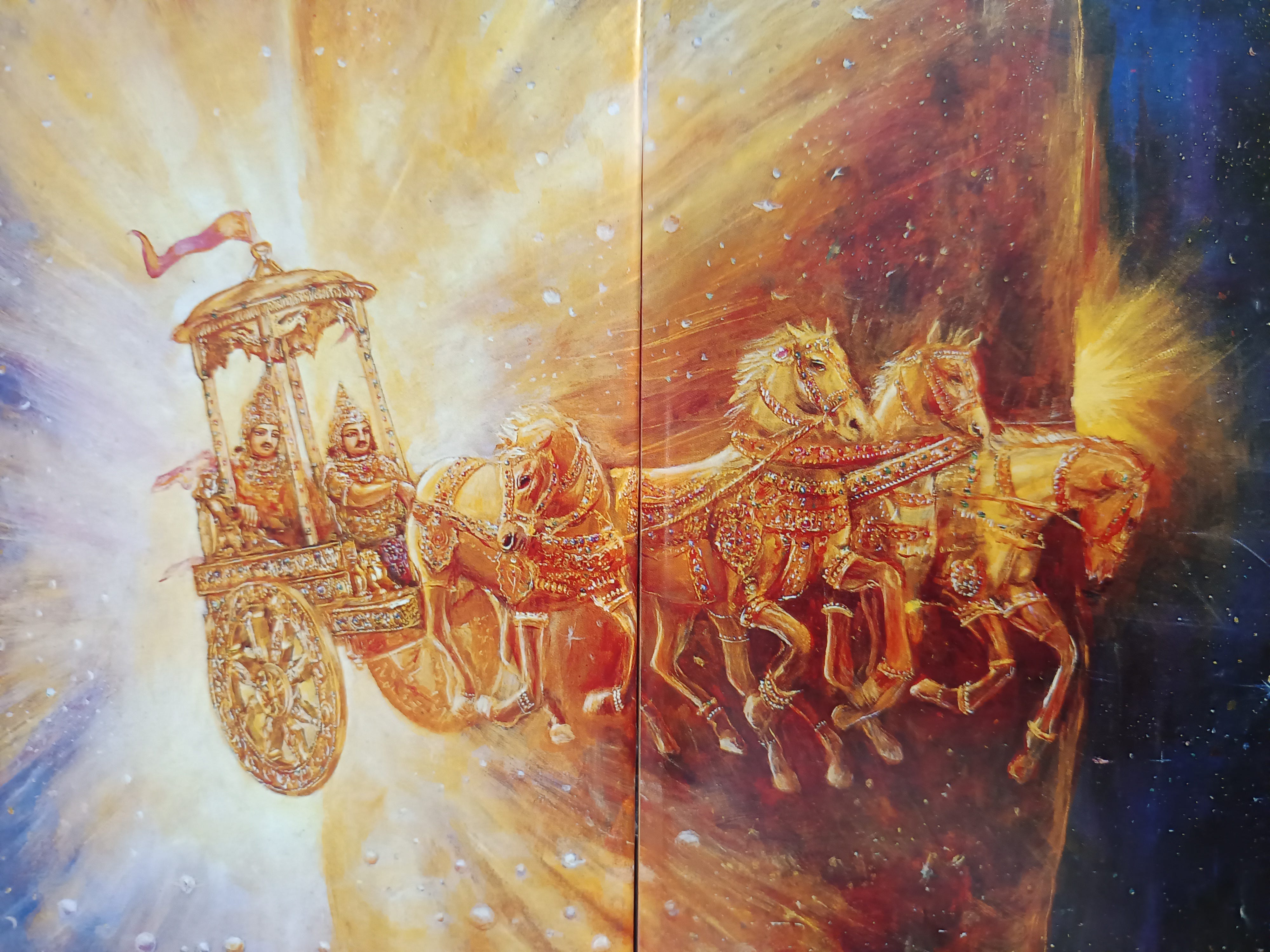
“While so excellently ruling the universe, King Priyavrata once became dissatisfied with the circumambulation of the most powerful sun-god. Encircling Sumeru Hill on his chariot, the sun-god illuminates all the surrounding planetary systems. However, when the sun is on the northern side of the hill, the south receives less light, and when the sun is in the south, the north receives less. King Priyavrata disliked this situation and therefore decided to make daylight in the part of the universe where there was night. He followed the orbit of the sun-god on a brilliant chariot and thus fulfilled his desire. He could perform such wonderful activities because of the power he had achieved by worshiping the Supreme Personality of Godhead.” (SB 5.1.30)
As it will be explained in more detail later in the 5th canto, the sun travels around Bhu-Mandala in a circular orbit that takes a whole year to complete. This orbit results in the cycles of days and nights for the demigods, for whom a day corresponds to a whole year for us.
Prabhupāda gives us an overview of the Vedic description of the orbit of the sun in his purport to text 30:
“From the description in this verse, it appears that the sun moves. According to modern astronomers, the sun is fixed in one place, surrounded by the solar system, but here we find that the sun is not stationary: it is rotating in a prescribed orbit. This fact is corroborated by Brahma-saṁhitā (5.52). Yasyājñayā bhramati saṁbhṛta-kāla-cakraḥ: the sun is rotating in its fixed orbit in accordance with the order of the Supreme Personality of Godhead. According to Jyotir Veda, the science of astronomy in the Vedic literature, the sun moves for six months on the northern side of the Sumeru Hill and for six months on the southern side. We have practical experience on this planet that when there is summer in the north there is winter in the south and vice versa. Modern materialistic scientists sometimes present themselves as knowing all the ingredients of the sun, yet they are unable to offer a second sun like Mahārāja Priyavrata’s.”
In modern astronomy, it is believed that the sun is much larger than our planet, and therefore, the sun is fixed, and Earth orbits around it. In Vedic cosmology, however, it is described that our planet is part of Bhu-mandala, a much larger, fixed structure. Although also described as very massive, the sun is much smaller than this gigantic structure, and has its fixed orbit circling above it, spending six months on the southern side and six months on the northern side.
There is a great mountain in the center of Bhu-mandala called Sumeru, and it is described that the sun circumambulates it in this annual rotation. This annual rotation of the sun results in the passage of the seasons on our planet. It goes simultaneously with the daily rotation of the sun around Dhruvaloka that results in the passage of days and nights. This is another delicate detail that will be explained in the later chapters of the Fifth Canto.
From the perspective of the inhabitants of the different islands of Bhu-Mandala, there is always light, because the sun circles overhead (similar to what we can observe on our planet at the north pole). However, there is less light when the sun orbits the other side of the island. The inhabitants of Bhu-Mandala have thus sometimes more light, and sometimes less light. Priyavrata became dissatisfied with this and decided to fix the situation by creating a second sun.
For this, he created a special chariot that was as brilliant as the sun. This may sound mythical to us, but again, we must consider that there are many things we don’t know. In the Third Canto, we studied how Kardama Muni built a flying castle, as big as a city, that could travel all over the universe, and now we hear that Priyavrata created a chariot that not only could travel around the cosmos, but was as brilliant as the sun. Just as we may build a plane or a computer, these great personalities can build interplanetary castles and chariots that are so powerful. The verse gives the key for understanding that with the words “bhagavad-upāsanopacitāti-puruṣa-prabhāvas”: Priyavrata became so powerful due to being empowered by the Supreme Lord, who was fully satisfied with His service. Since the Lord can create countless universes out of His breath, it is not difficult to imagine that He can empower his devotees to create such wonders.
How did Priyavrata use his chariot? He drove it around Bhu-Mandala on the opposite side of the sun, illuminating the whole planetary system. In the hot months of the year, the chariot provided a form of cooling light, similar to the rays of the moon, and it provided extra heat in the winter months, increasing the comfort of all inhabitants.
As Prabhupāda mentions in his purport:
“Although Mahārāja Priyavrata devised a very powerful chariot as brilliant as the sun, he had no desire to compete with the sun-god, for a Vaiṣṇava never wants to supersede another Vaiṣṇava. His purpose was to give abundant benefits in material existence. Śrīla Viśvanātha Cakravartī Ṭhākura remarks that in the months of April and May the rays of Mahārāja Priyavrata’s brilliant sun were as pleasing as the rays of the moon, and in October and November, both morning and evening, that sun provided more warmth than the sunshine. In short, Mahārāja Priyavrata was extremely powerful, and his actions extended his power in all directions.”
Did the throne become vacant while Priyavrata was performing his pastime of supplementing the light of the sun? According to Śrīla Viśvanātha Cakravartī, he expanded himself into two bodies by yogic perfection, one as the king, and another driving the chariot, and thus performed the two activities simultaneously. This is also not surprising, as yogis can produce up to eight forms, and Kardama Muni was able to divide himself into nine.
Verse 31 continues the description:
“When Priyavrata drove his chariot behind the sun, the rims of his chariot wheels created impressions that later became seven oceans, dividing the planetary system known as Bhū-maṇḍala into seven islands.” (SB 5.1.31)
Not only was his chariot capable of illuminating the whole planetary system, but it also changed its structure. By circumambulating Bhu-mandala repeatedly, the wheels created impressions that later became seven great oceans, dividing Bhū-mandala into seven islands.
Again, a chariot that can move around outer space, changing the structure of a planetary system, may sound mythological, but if the chariot was so powerful that it could produce heat and light rivaling the sun, it is not such a stretch of imagination to imagine it could rearrange the whole planetary system by using gravity or other forces unknown to us. In modern astronomy, there is a similar concept, the idea that the planets of the solar system were formed from the combination of smaller particles due to the action of gravity. According to this theory, the solar system was initially a mass of gas and dust that gradually collapsed into planets, separated by vast lengths of space.
The description of Priyavrata is different because it describes the evolution of Bhu-mandala, described as the whole intermediate planetary system, which appears to be different from our solar system (the other planets of the solar system, including the Sun and the Moon, are described as celestial planets that are higher than Bhu-mandala in the cosmic hierarchy and have their separate orbits, as will be explained in the following chapters). However, the parallel between Priyavrata dividing Bhu-mandala into separate islands and oceans, and the modern theory of the formation of the planets out of a cloud of dust and gas can help us to understand the description offered in the Śrīmad Bhāgavatam.
In his purport to text 31, Prabhupāda explains:
“Sometimes the planets in outer space are called islands. We have experience of various types of islands in the ocean, and similarly the various planets, divided into fourteen lokas, are islands in the ocean of space. As Priyavrata drove his chariot behind the sun, he created seven different types of oceans and planetary systems, which altogether are known as Bhū-maṇḍala, or Bhūloka. In the Gāyatrī mantra, we chant, om bhūr bhuvaḥ svaḥ tat savitur vareṇyam. Above the Bhūloka planetary system is Bhuvarloka, and above that is Svargaloka, the heavenly planetary system. All these planetary systems are controlled by Savitā, the sun-god. By chanting the Gāyatrī mantra just after rising early in the morning, one worships the sun-god.”
We tend to imagine Bhu-mandala as a series of solid concentric islands surrounded by oceans, just like the islands of our planet, but we can observe that Prabhupāda describes it as a planetary system, explaining how planets are called “islands” (dvīpas) in Vedic literature. This makes the point that there are more details about Bhu-mandala than the simplified model of solid islands and oceans may suggest.
The orbit of the sun is one of the most complicated aspects of the cosmological description of the Śrīmad Bhāgavatam, because it describes our universe from the point of view of the demigods, a view that is different from what is seen from our perspective. Throughout the study of this fifth canto, we will gradually try to understand these descriptions.
Texts 32 and 33 give a preliminary description of the seven islands, which will be discussed in more detail in later chapters. Priyavrata delegated the administration of these islands to his sons:
“The names of the islands are Jambū, Plakṣa, Śālmali, Kuśa, Krauñca, Śāka and Puṣkara. Each island is twice as large as the one preceding it, and each is surrounded by a liquid substance, beyond which is the next island.
The seven oceans respectively contain salt water, sugarcane juice, liquor, clarified butter, milk, emulsified yogurt, and sweet drinking water. All the islands are completely surrounded by these oceans, and each ocean is equal in breadth to the island it surrounds. Mahārāja Priyavrata, the husband of Queen Barhiṣmatī, gave sovereignty over these islands to his respective sons, namely Āgnīdhra, Idhmajihva, Yajñabāhu, Hiraṇyaretā, Ghṛtapṛṣṭha, Medhātithi and Vītihotra. Thus they all became kings by the order of their father.” (SB 5.1.32-33)
Priyavrata attains perfection
Hearing about all these wonderful activities of Priyavrata, one could become skeptical, considering how all of this could be possible, even for a great king. Śukadeva Goswami counters this in text 35:
“My dear King, a devotee who has taken shelter of the dust from the lotus feet of the Lord can transcend the influence of the six material waves — namely hunger, thirst, lamentation, illusion, old age and death — and he can conquer the mind and five senses. However, this is not very wonderful for a pure devotee of the Lord because even a person beyond the jurisdiction of the four castes — in other words, an untouchable — is immediately relieved of bondage to material existence if he utters the holy name of the Lord even once.”
The Lord is unlimitedly powerful and can perform many miraculous activities, such as piercing the coverings of the universe with his feet as Vāmanadeva. Similarly, He can empower His devotees to perform similarly uncommon activities. The greatest miracle, however, is not to create a second sun, but the process of purification catalyzed by the chanting of the holy names of the Lord. The chanting is so powerful that one can destroy the karma accumulated in unlimited lives by just sincerely chanting the holy names once (as it will be exemplified in the pastime of Ajāmila in the Sixth Canto). The transformative power is so great that even an untouchable can become pure to the point of becoming qualified to perform Vedic sacrifices.
Previously, Maharaja Parīkṣit had argued that a person in materialistic life cannot take up Krsna consciousness at any stage. Śukadeva agreed that this is generally true, but then explained that by the chanting of the holy names, everything is possible. Just like Priyavrata could create a second sun, a materialist can become a pure devotee. With this, the main message of the Śrimad Bhagavatam is again made clear.
With this, we come to the conclusion of the story of Priyavrata.
He was so advanced that he could reign for such a long time without becoming old. However, in due time, he remembered the life of renunciation he had left behind, and lamented having become involved in so many material activities.
“While enjoying his material opulences with full strength and influence, Mahārāja Priyavrata once began to consider that although he had fully surrendered to the great saint Nārada and was actually on the path of Kṛṣṇa consciousness, he had somehow become again entangled in material activities. Thus his mind now became restless, and he began to speak in a spirit of renunciation.
The King thus began criticizing himself: Alas, how condemned I have become because of my sense gratification! I have now fallen into material enjoyment, which is exactly like a covered well. I have had enough! I am not going to enjoy any more. Just see how I have become like a dancing monkey in the hands of my wife. Because of this, I am condemned.
By the grace of the Supreme Personality of Godhead, Mahārāja Priyavrata reawakened to his senses. He divided all his earthly possessions among his obedient sons. He gave up everything, including his wife, with whom he had enjoyed so much sense gratification, and his great and opulent kingdom, and he completely renounced all attachment. His heart, having been cleansed, became a place of pastimes for the Supreme Personality of Godhead. Thus he was able to return to the path of Kṛṣṇa consciousness, spiritual life, and resume the position he had attained by the grace of the great saint Nārada.” (SB 5.1.36-38)
Ultimately, the story of Priyavrata makes the point that even if a Krsna Conscious person becomes again involved in material affairs, his success is still guaranteed, because any amount of practice in Krsna Consciousness becomes a permanent asset. One may forget for some time, but the Lord in the heart remembers him or her in the appropriate moment, so one can return to spiritual practice. Therefore, we should not be afraid of trying. If failure in Krsna Consciousness is rewarded with a good birth in a wealthy or pious family (śucīnāṁ śrīmatāṁ gehe yoga-bhraṣṭo ’bhijāyate), we can only imagine what the reward for success is.
Prabhupāda also connects this verse with SB 1.5.17: “One who has forsaken his material occupations to engage in the devotional service of the Lord may sometimes fall down while in an immature stage, yet there is no danger of his being unsuccessful. On the other hand, a nondevotee, though fully engaged in occupational duties, does not gain anything.”
Priyavrata did not fall at any point, but he played the role of a devotee who falls into materialistic life, but later comes back to serious Krsna Consciousness practice and ultimately achieves perfection. The assurance of success for a devotee, even if facing reverses in one’s spiritual practice, contrasts with the guarantee of failure for a non-devotee, who always loses everything at the end, no matter how dutiful one may be in performing material duties. Even if facing difficulties, a devotee remains under the protection of the Lord.
On the other hand, we should not use the guarantee of the Lord as an excuse for not being serious in our spiritual practice. As Prabhupāda explains in his purport to text 38:
“Our hearts are meant for the pastimes of the Supreme Personality of Godhead. This means that one should be fully Kṛṣṇa conscious, thinking of Kṛṣṇa, as He Himself advises (man-manā bhava mad-bhakto mad-yājī māṁ namaskuru). This should be our only business. One whose heart is not clean cannot think of the transcendental pastimes of the Supreme Lord, but if one can once again place the Supreme Personality of Godhead in his heart, he very easily becomes qualified to renounce material attachment. Māyāvādī philosophers, yogīs and jñānīs try to give up this material world simply by saying, brahma satyaṁ jagan mithyā: “This world is false. There is no use of it. Let us take to Brahman.” Such theoretical knowledge will not help us. If we believe that Brahman is the real truth, we have to place within our hearts the lotus feet of Śrī Kṛṣṇa, as Mahārāja Ambarīṣa did (sa vai manaḥ kṛṣṇa-padāravindayoḥ). One has to fix the lotus feet of the Lord within his heart. Then he gets the strength to be freed from material entanglement.”
The chapter ends with two famous verses glorifying Maharaja Priyavrata:
“No one but the Supreme Personality of Godhead could do what Mahārāja Priyavrata has done. Mahārāja Priyavrata dissipated the darkness of night, and with the rims of his great chariot, he excavated seven oceans.”
“To stop the quarreling among different peoples, Mahārāja Priyavrata marked boundaries at rivers and at the edges of mountains and forests so that no one would trespass upon another’s property.” (SB 5.1.40-41)
Priyavrata was extremely successful as a king, being able to maintain perfect order and improve the living standards in his kingdom. He also performed many other wonderful activities, such as creating a second sun. At the same time, however, because he achieved a higher taste as a result of his devotional practice, he was not bewildered by such material achievements. He performed his activities as a matter of duty, and when his duties were completed, he resumed his spiritual practice and went back home, back to Godhead.
As Prabhupāda explains, sometimes yogīs and jñānīs give up all material opulences to try to attain liberation, but they still frequently fall down. A devotee, however, achieves a higher taste in his service to Krsna and thus remains disinterested in this material world even if living surrounded by opulence, like in the case of Priyavrata. This again establishes the supremacy of devotional service.
You can also donate using Buy Me a Coffee, PayPal, Wise, Revolut, or bank transfers. There is a separate page with all the links. This helps me enormously to have time to write instead of doing other things to make a living. Thanks!
This is so clear and understandable. Thank you for sharing this clarity.