

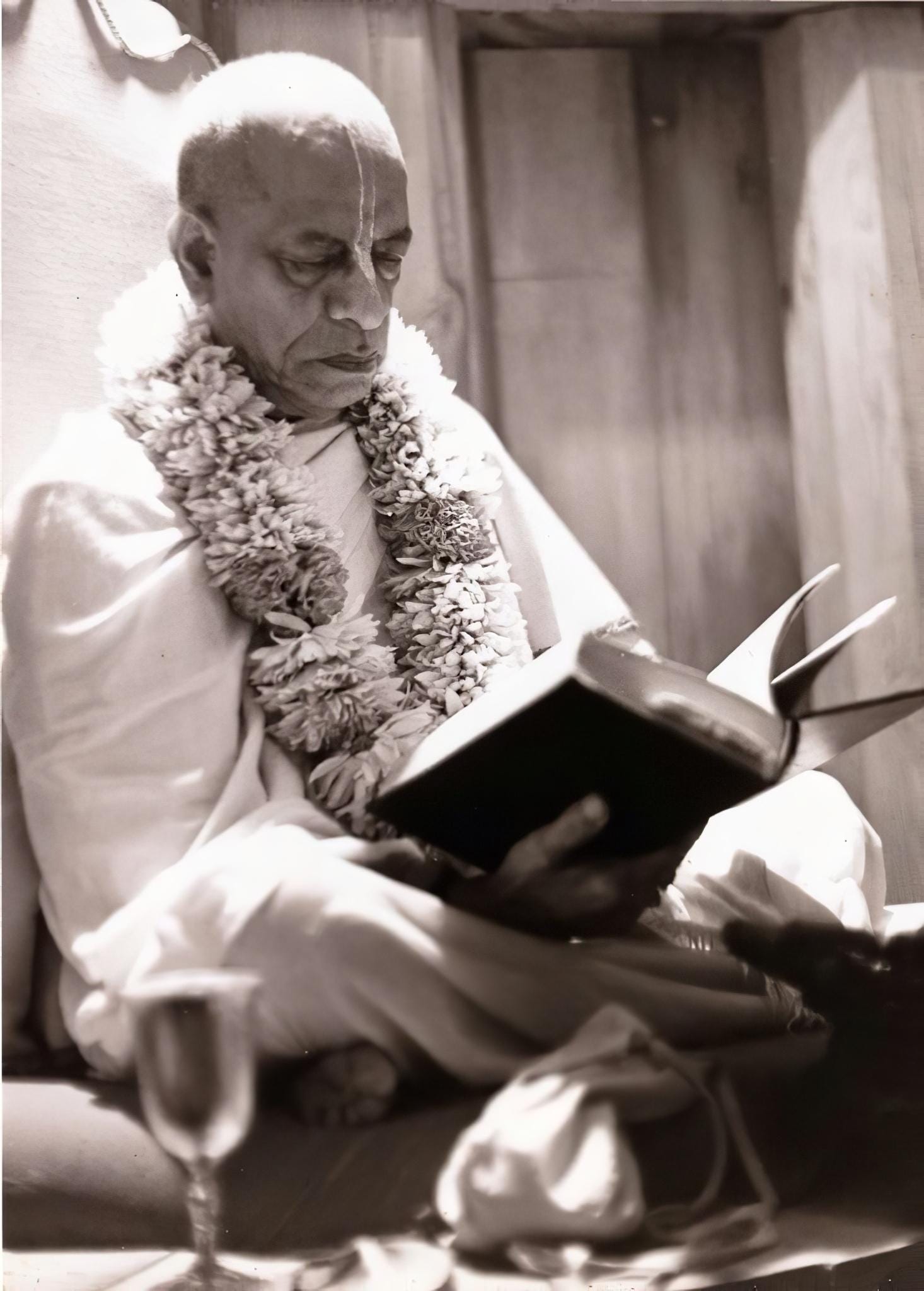
From the books of Śrīla Prabhupāda, we hear that the Vedas are the source of all knowledge. Thus, it is not a surprise that many of us will have a desire to study different books from the Vedas in search of knowledge, including the different Purāṇas, Upaniṣads, and so on. We then get in contact with the many translations of such works done by different scholars, both from India and the West. Some of these publications even contain commentaries of our Vaiṣnava ācāryas, such as Madhva and Ramanuja, which reassures us.
There is, however, a catch.
Sanskrit verses, especially verses from the Puranas and Upaniṣads, are highly metaphorical and difficult to translate. Unless one understands the meaning and conclusion of the text, just being a Sanskrit scholar is not sufficient to provide a bona fide translation.
Madhvācārya emphasizes this point in his commentary on the Mundaka Upanisad, explaining the difference between aparā-vidyā and parā-vidyā.
The word aparā literally means “lower” or “inferior”. In his commentary, Śrila Madhvācārya explains that passages in the Vedas are considered inferior, or aparā, when they do not designate Viṣnu but are employed in a ritualistic sense. However, they become parā-vidyā when they directly express Lord Viṣnu and service to Him. The same verses have thus at least two entirely different meanings, and we can capture one or the other according to our consciousness and qualifications. Apart from these two, there are unlimited speculations we can fall into.
The whole Vedic literature exists with the sole purpose of glorifying the Lord and bringing us to the platform of devotional service to Him, as Kṛṣṇa Himself explains in the Bhagavad-gītā: “By all the Vedas, I am to be known.” When we miss this purpose and instead focus on material knowledge included in the Vedas, using it to improve our position in this material world, be it by performing fruitive activities or simply accumulating knowledge about mundane topics, we deal with inferior knowledge. Thus, the distinction between aparā-vidyā and parā-vidyā is also related to the mentality and understanding of the student.
Madhvācārya also explains that in Satya-Yuga, the Vedas were one. This single and undivided Veda revealed a single ultimate truth: Lord Viṣnu as the Supreme Lord, without a second. During this era, all names we now associate with demigods (Indra, Brahmā, Rudra, etc.) applied solely to Viṣnu, who was understood as the only deity. This higher understanding of the meaning of the Vedas is revealed by Vyāsadeva in the Vedanta-sūtras (1.4.28) by the words: etena sarve vyākhyātā vyākhyātāḥ, “The Supreme Lord is the original cause of everything. All words of the scriptures should be interpreted according to this explanation.”
The division between parā-vidyā and aparā-vidyā started in Treta-yuga, when intelligence declined, and people manifested the desire for fruitive activities. The Vedas were then divided into three: Ṛg, Yajur, and Sāma, and people began to worship through these divisions by performing Vedic ceremonies. The Pañcarātra system of worship was also introduced. Due to the decline in spiritual focus, the worship of demigods was introduced, and thus the division of superior and inferior knowledge inside the Vedas became manifested due to people not being able to understand the deeper meaning of the verses.
In the Mundaka Upanisad, 1.1.3, Saunaka asked Aṅgirasa: “Knowing what does all become known?” In other words, he asks about one science, one subject, by knowing which everything becomes known. From understanding this one science, all other sciences can be deduced. Madhvācārya defines this science as Akṣara-Vidyā, the unifying knowledge that is the essence of all understanding. This knowledge is the understanding of Kṛṣṇa, His energy, and our eternal relationship with Him. When the syllables of the Vedas are studied with this understanding, the real meaning is revealed. Otherwise, one receives only the superficial meaning.
In other words, the real meaning of the scriptures, parā-vidyā, is the linking process of devotional service that connects us with Kṛṣṇa. When one studies the scriptures starting from the conclusion that all verses describe Kṛṣṇa and our relationship with Him, armed with the proper philosophical conclusions received through the Paramparā, one can understand the deep meaning of the verses, parā-vidyā. Otherwise, one gets just the superficial meaning and has the impression that the verses describe other subjects apart from Kṛṣṇa, aparā-vidyā. This illustrates the importance of the work of Śrīla Prabhupāda in his books, condensing the teachings of the previous ācāryas in his purports and giving us the conclusions by which we can understand the scriptures.
Before Śrila Bhaktivinoda Thākura, our ācāryas did not give translations of the Sanskrit verses in their commentaries. They would just include the original verse, followed by a (usually) short commentary, often also in Sanskrit. Therefore, even when we read a translation of a commentary from Madhvācārya or Ramanujacarya, the English translation of the verse still comes from the scholar who is doing the translation, and thus doesn’t necessarily transmit the ideas of the text.
Just to give you a small example, let’s take verse 1.1.8 from the Mundaka Upanisad:
tapasā cīyate brahma tato ’nnam abhijāyate
annāt prāṇo manaḥ satyaṁ lokāḥ karmasu cāmṛtam
Madhvācārya, Ranga Ramanuja, and Sankaracarya all agree in their commentaries that this verse describes the process of creation of the universe (Mahā-Viṣnu impregnating Prakrit with the souls, generating the mahat-tattva, the universes, Brahma, and then the planets and living beings). When we study the verse, each word indicates a stage in this creation. Tapasā cīyate indicates the creative potency of the Lord, annam means the mahat-tattva, prana the hiranyagarba, satyaṁ the physical elements, and so on.
However, although this is clearly indicated in the commentaries, most scholars will still translate the verse according to the literal meaning of the words, arriving at really interesting depictions.
One example: “By tapas Brahman increases in size and from it food is produced; from food the prana, the mind, the Bhutas the worlds, karma and with it, its fruits.”
Another: “The Brahman united with Tapas (the root of Matter and Thought), and thence arose the Matter, from the Matter arose the Breath, the Manas, and the True, as well as the worlds (and karmas) and in the Karmas the immortality itself.”
A third one: “Through heat brahman is built up; thereby food is produced. From food comes breath, mind, truth, and worlds, and immortality in rites.”
In his translations, Prabhupāda teaches us how to avoid such crude translations. Instead of focusing on the literal meaning of the words, he teaches us to go for the deep meaning of the verses, and especially to focus on the conclusions, focusing on clarity. We can see that often Prabhupāda gives a long translation to a short verse, because he tries to transmit all the ideas in an understandable way, instead of giving a literal translation that would barely make sense. The system Prabhupāda gives in his works, with the original Sanskrit verses, word for word, and then the translation, is thus a course on how to translate the scriptures.
When we apply these concepts to the verse from the Mundaka Upanisad, we would arrive at something quite different from the literal meaning, but that would much better transmit the ideas of the text:
“Brahman, desiring to create, manifested the material creation. First, pradhāna, the sun total of material energy was manifested, which is seen by the souls as an object of their enjoyment (anna). Agitated by the time energy of the Lord and inseminated by the innumerable souls, pradhāna produced the Hiranyagarbha, the golden egg which is the collective, cosmic entity holding Brahman’s power of creation. From this Hiranyagarbha, innumerable material universes were produced, and in each of them, the Lord manifested as the universal form, the subtle cosmic manifestation of the universe. From the Lord, Brahma appeared, creating the planetary systems and the bodies of the different living beings. Inside this material manifestation, these living beings perform material actions and receive the results, but by the development of Kṛṣṇa consciousness, one can finally become free.”
This is a publication for thoughtful readers who want to go deeper into Kṛṣṇa consciousness. I publish daily, and all posts are available to free subscribers. If you wish, you can also choose a paid subscription to support this work.
If you would like to contribute further, you can find the donation links here.
Thank you, Prabhuji, for helping us understand the importance of scriptures and the depths of Srila Prabhupada's works. I receive depth and clarity every time I read your blogs. Srila Prabhupada ki Jai, Hare Krishna 🙏