

Subscribe to receive new articles by e-mail. It’s free, but if you like, you can pledge a donation:
King Pṛthu appeared at a time when the world was in peril. After the reign of the sinful Vena, the rains had completely stopped, crops failed, and people were starving. The earth, which had been prosperous under the reign of saintly kings, was now in disarray. We normally connect scenes of mass starvation, drought, and other calamities with Kali-yuga, but the reign of the sinful Vena was so disastrous that the same was happening in Treta-yuga, an age where everyone was supposed to be happy and live for 10,000 years.
Through his leadership and governance, Pṛthu was able to quickly reverse the situation and extract all forms of opulence for the earth, satisfying not only the citizens but even the demigods with everything desirable.
After restoring the earth to its original, opulent state, Pṛthu started performing sacrifices for the satisfaction of the Lord. It is described that all one’s excess wealth should be used to perform sacrifices, and Pṛthu exemplified this by performing one aśvamedha-yajña after the other, until he completed 99 sacrifices.
Pṛthu was an incarnation of the Lord, and his activities benefited all. The demigods were also benefiting from these sacrifices by receiving the prasāda from the Lord, just as all inhabitants of the universe.
This, however, made Indra envious. He had ascended to his post by performing 100 aśvamedha-yajñas, and now, seeing Pṛthu close to the same number, he couldn’t tolerate the idea that soon Pṛthu would equal his feat. He then tried to stop the last sacrifice by dressing as many different types of false sannyasis to steal the horse intended to be sacrificed. Pṛthu was not very disturbed by his stopping the sacrifice, but he was alarmed that Indra was introducing many false religious orders that would be adopted by unscrupulous persons in the future, creating havoc. He thus prepared to punish Indra by killing him.
At this moment, Lord Brahmā himself intervened, advising that since Indra was so determined, Pṛthu could be satisfied in performing just 99 sacrifices and let Indra keep his pride in performing 100.
At this moment, however, the Lord appeared to bless Pṛthu and make peace between these two great devotees and cosmic leaders. This is a great lesson on how devotion to the Lord can help us to rise above rivalry and practice forgiveness, even when we are attacked without any reason, and how such pure-hearted behavior is satisfying to the Lord.
How was the situation solved?
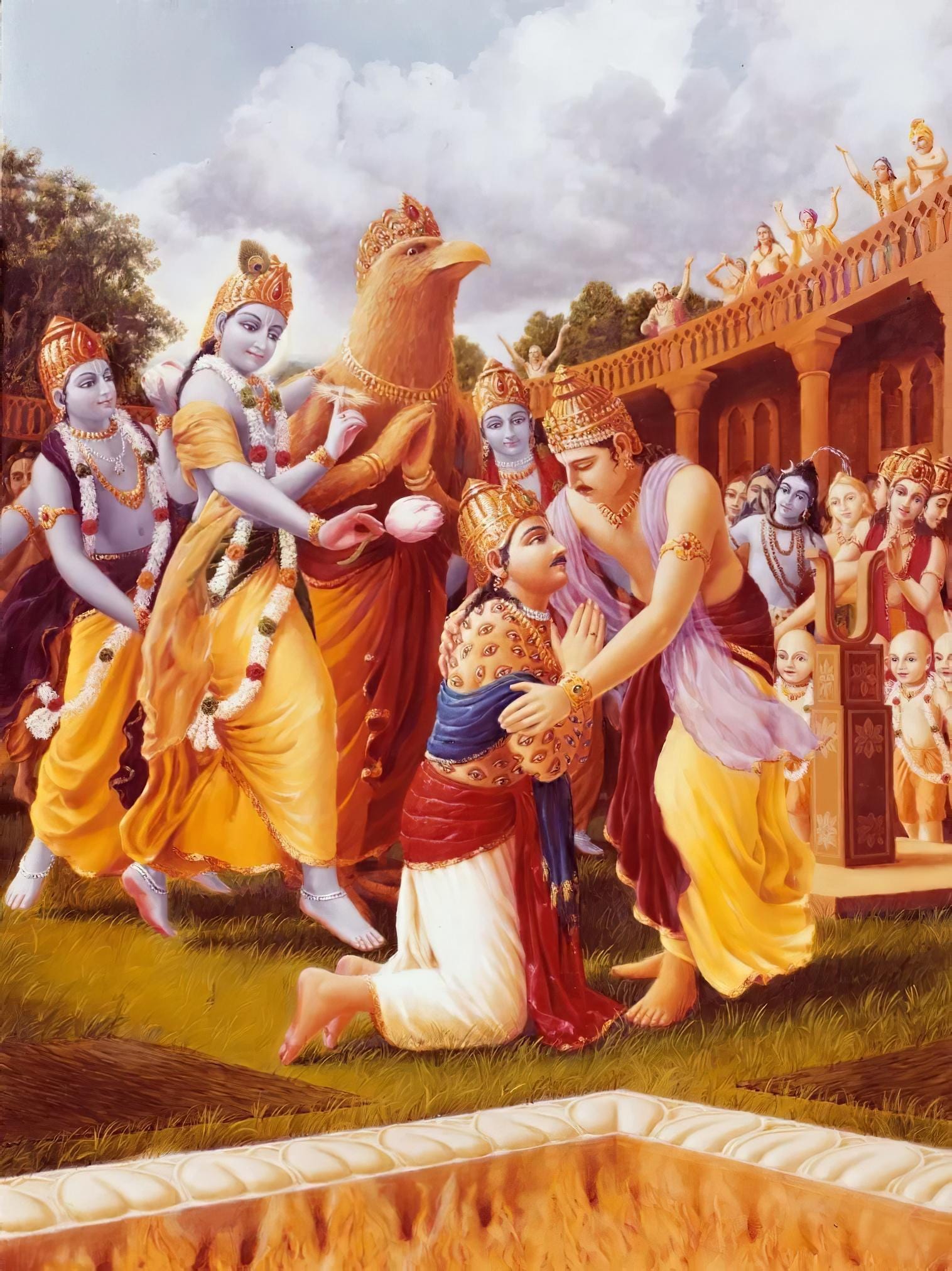
After Brahma instructed Pṛthu to stop after the 99th sacrifice, the conflict with Indra was solved. However, there was still the issue of the offenses committed by the demigod. Pṛthu was not at all concerned about that, such as his magnanimity, but committing such serious offenses against a great personality like Pṛthu was something extremely serious, even for a great demigod like Indra. To solve the problem, Lord Viṣnu Himself appeared in the arena of sacrifice.
First, he instructed Pṛthu, giving instructions that were received by the King just like nectar. The Lord had brought Indra with Him, and he was standing there the whole time while the Lord spoke.
After the Lord concluded His speech, Indra fell before Pṛthu Maharaja to touch his feet, but the king immediately embraced him and gave up all envy against him. This shows the exemplary behavior of two great Vaiṣnavas, which can easily solve all disputes. As Prabhupāda mentions in his purport to text 4.20.18, “This is also a first-class example of cooperative behavior between Vaiṣṇavas. In the present days, however, because people are not Vaiṣṇavas, they fight perpetually among one another and are vanquished without finishing the mission of human life. There is a great need to propagate the Kṛṣṇa consciousness movement in the world so that even though people sometimes become angry and malicious toward one another, because of their being Kṛṣṇa conscious such rivalry, competition and envy can be adjusted without difficulty.”
Pṛthu Maharaja used the opportunity to offer prayers to the Lord, which go from text 4.20.23 to 4.20.31. Here is a summary of these beautiful prayers:
4.20.23-24: The Lord is infinitely powerful and can offer any benediction. Just as it doesn’t make sense to go to a rich person to ask for ashes, it doesn’t make sense to approach the Lord to ask for insignificant material benefits, or even for liberation, which, for a devotee, is just like hell. Instead, Pṛthu Maharaja wanted to live for at least a million years, having a million ears to hear the glories of the Lord chanted by pure devotees, speaking from the cores of their hearts.
4.20.25: Why does Pṛthu Maharaja want to hear about the glories of the Lord? The lotus feet of the Lord are just like a flower, full of saffron particles. The voice of pure devotees carries these transcendental saffron particles in the form of transcendental vibration. What is the effect of receiving these transcendental particles through the auditory sense? Smṛtiṁ punar vismṛta-tattva: The forgetful living entity gradually remembers his eternal relationship with the Lord.
4.20.26: As soon as one starts reviving his eternal spiritual nature, the chanting of the holy names becomes very attractive. When a person is afflicted by jaundice, sugar tastes bitter, and he will tend to reject it, but according to classical Ayurveda, ingesting the “bitter” sugar regularly helps one to be cured from his jaundice. As the disease subsides, he is again able to taste the sweetness.
4.20.27-28: In the material world, there is a hierarchy of material positions, going from plants and animals all the way to the demigods. A dog or another animal may follow a human being, just as a human being may worship a demigod, for example. However, the Lord is pūruṣottama, the highest person, and should thus be worshiped by everyone.
King Pṛthu was anxious to be engaged in the service of the Supreme Lord. He just worries that there may be some quarrel with the goddess of fortune, who is engaged in the same service. However, he is hopeful that, being so affectionate with His devotees, the Lord will take his part even if such disagreement occurs. Everything that exists in the material world is a perverted reflection of something that exists in the spiritual world. Competition also exists in the spiritual world, with different devotees and groups each trying their best to satisfy the Lord, and sometimes disagreeing in details. However, different from competition in the material world, such competition is pure, without malice.
4.20.29: What to say about demigods, even liberated souls take to the devotional service of the Lord. If they are already liberated, what is the need for practicing devotional service? Vyudasta-māyā-guṇa-vibhramodayam: only devotional service can completely dispel all misconceptions that appear from contact with matter. In other words, only devotional service can fully revive the original nature of the soul.
4.20.30-31: Material benefits, even when offered in the Vedas, are not suitable for pure devotees, but for common people who are materially entangled, forgotten of their original nature as eternal servants of the Lord. Therefore, Pṛthu refused to ask for any material benefit when the Lord ordered him to ask for a benediction. Instead, he asked the Lord to give him whatever he thinks is best.
Being very satisfied with the meaningful prayers of the king, the Lord blessed him:
“My dear King, may you always be blessed by engaging in My devotional service. Only by such purity of purpose, as you yourself very intelligently express, can one cross over the insurmountable illusory energy of māyā. My dear King, O protector of the citizens, henceforward be very careful to execute My orders and not be misled by anything. Anyone who lives in that way, simply carrying out My orders faithfully, will always find good fortune all over the world.” (SB 4.20.32-33)
You can also donate using Buy Me a Coffee, PayPal, Wise, Revolut, or bank transfers. There is a separate page with all the links. This helps me enormously to have time to write instead of doing other things to make a living. Thanks!