

Subscribe to receive new articles by e-mail. It’s free, but if you like, you can pledge a donation:
Join the Telegram group if you would like to join the live lessons. This course is maintained with your donations. Click here to donate.
💬 Text of the lesson
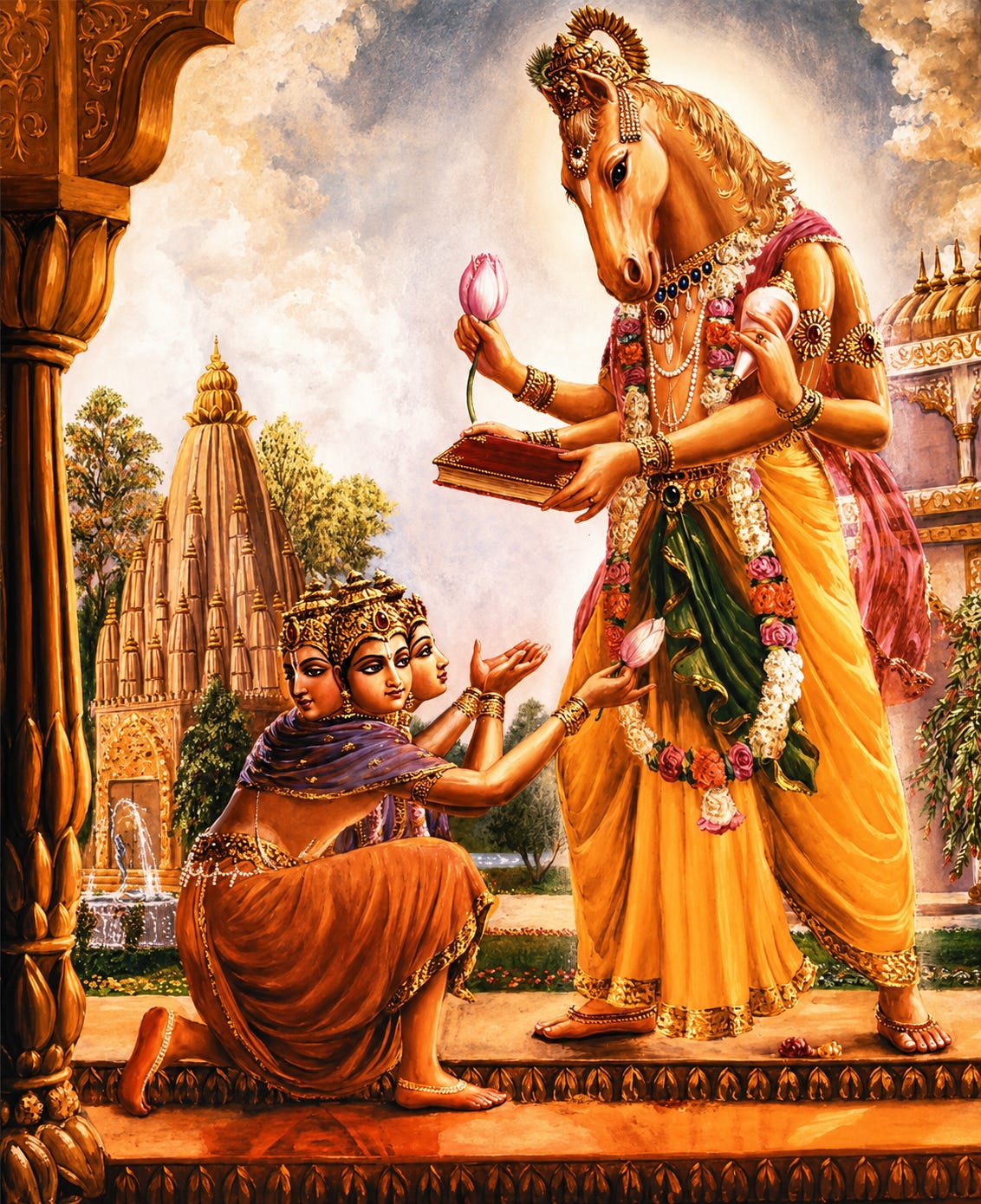
Recovering the Vedas: Bhadraśravā worships Hayaśīrṣa in Bhadrāśva-varṣa
Bhadrāśva-varṣa is the tract of land east of Ilāvṛta-varṣa, ruled by Bhadraśravā, the son of Yamarāja. The Lord is present there in His form of Hayaśīrṣa (or Hayagrīva), the director of all religious principles and protector of the Vedas.
At the end of each day of Brahmā, the Vedas are stolen by ignorance personified, who hides them in the lower planetary systems. Normally, the Lord, who is present as Matsya, acting as the maintainer of all living beings, fights with the demon and saves the Vedas, transmitting them again to Brahmā at the beginning of his next day.
At the end of the previous day, however, the Lord appeared as Hayagrīva (the horse-headed incarnation) to fight with the demon and save the Vedas. This appears to be connected with the universal destruction at the end of the first half of the life of Brahma, which is a special event, different from the end of the other days of Brahmā.
How is it that the Vedas can be stolen by a demon? In his purport, Prabhupāda connects it with the Vedas being forgotten and then transmitted again at the beginning of the next cycle of creation:
“Although Vedic knowledge is imperishable, within this material world it is sometimes manifest and sometimes not. When the people of this material world become too absorbed in ignorance, the Vedic knowledge disappears. Lord Hayagrīva or Lord Matsya, however, always protects the Vedic knowledge, and in due course of time it is again distributed through the medium of Lord Brahmā. Brahmā is the trustworthy representative of the Supreme Lord. Therefore when he again asked for the treasure of Vedic knowledge, the Lord fulfilled his desire.”
A demon doesn’t necessarily have to assume a form with two hands and legs to cause harm. Just as Tṛṇāvarta had the form of a whirlwind, Tamasā (the demon of ignorance personified) made everyone forget the knowledge of the Vedas.
This same Lord Hayagrīva, who preserved the Vedas during the whole period of the night of Brahmā, is present in His deity form in Bhadrāśva-varṣa, where He is worshiped by His devotees, who offer him respectful obeisances and offer Him prayers in devotional trance.
“The ruler Bhadraśravā and his intimate associates utter the following prayer: We offer our respectful obeisances unto the Supreme Personality of Godhead, the reservoir of all religious principles, who cleanses the heart of the conditioned soul in this material world. Again and again we offer our respectful obeisances unto Him.
Alas! How wonderful it is that the foolish materialist does not heed the great danger of impending death! He knows that death will surely come, yet he is nevertheless callous and neglectful. If his father dies, he wants to enjoy his father’s property, and if his son dies, he wants to enjoy his son’s possessions as well. In either case, he heedlessly tries to enjoy material happiness with the acquired money.
O unborn one, learned Vedic scholars who are advanced in spiritual knowledge certainly know that this material world is perishable, as do other logicians and philosophers. In trance they realize the factual position of this world, and they preach the truth as well. Yet even they are sometimes bewildered by Your illusory energy. This is Your own wonderful pastime. Therefore, I can understand that Your illusory energy is very wonderful, and I offer my respectful obeisances unto You.
O Lord, although You are completely detached from the creation, maintenance and annihilation of this material world and are not directly affected by these activities, they are all attributed to You. We do not wonder at this, for Your inconceivable energies perfectly qualify You to be the cause of all causes. You are the active principle in everything, although You are separate from everything. Thus we can realize that everything is happening because of Your inconceivable energy.
At the end of the millennium, ignorance personified assumed the form of a demon, stole all the Vedas and took them down to the planet of Rasātala. The Supreme Lord, however, in His form of Hayagrīva retrieved the Vedas and returned them to Lord Brahmā when he begged for them. I offer my respectful obeisances unto the Supreme Lord, whose determination never fails.” (SB 5.18.2-6)
In his purport to text two, Prabhupāda reinforces the point that the purpose of human life is to purify our existence, which is achieved by worshiping the Supreme Lord and performing penances and austerities. Human life is not meant for blind indulgence in sense gratification.
As students of the Śrīmad Bhāgavatam, we are already familiar with that conclusion by now, but this conclusion is missed by 99% of the population. Bewildered by the illusory energy, they continue their materialistic life day after day, without considering the impending danger of death. People simply get absorbed in momentary sense gratification, without considering the future. If my father dies, this is a very clear warning that I’m the next. A materialist, however, simply takes the inheritance and continues his process of enjoyment without a second thought. Often, people lack even basic decency; a father who loses his son may sometimes take away his possessions and start an affair with the widow. From this, we can see how the fixation on sense gratification makes one gradually lose all good qualities.
What materialists don’t realize, however, is that even to enjoy their senses, they need the cooperation of the Lord. If Paramātmā doesn’t give them sanction and empower them to perform their actions, materialists can’t act at all, as it happens sometimes at the end of life, when one becomes paralyzed or falls into a coma. In this way, both devotees and materialists depend on the mercy of the Lord. The difference is that a devotee is guided and empowered by the Lord to attain success in human life and go back home, back to Godhead, while a materialist is allowed to act sinfully for some time, as he desires, but later has to deal with the karmic consequences.
As Prabhupāda explains in his purport to text three:
“In other words, materialistic persons want to commit all kinds of sinful activities, but without the sanction of the Supreme Personality of Godhead, no one can do anything. Why does the Supreme Personality of Godhead permit sinful activities? The Supreme Lord does not want any living being to act sinfully, and He begs him through his good conscience to refrain from sin. But when someone insists upon acting sinfully, the Supreme Lord gives him the sanction to act at his own risk (mattaḥ smṛtir jñānam apohanaṁ ca). No one can do anything without the sanction of the Lord, but He is so kind that when the conditioned soul persists in doing something, the Lord permits the individual soul to act at his own risk.”
Different from the materialists, who are simply deep into ignorance, others study the Vedas and understand the temporality of this material world. By practicing this knowledge, they become detached from the bodily concept of life. In other words, they become liberated souls.
However, the illusory energy is so powerful that even such great scholars can fall back into illusion. How is that possible? Prabhupāda explains that, “A liberated soul is a person who has sufficient knowledge of this material world and is therefore unattached to the bodily conception of life. But because of association with the modes of material nature for a very long time, even liberated souls sometimes become captivated by the illusory energy due to inattentiveness in the transcendental position. Therefore Lord Kṛṣṇa says in Bhagavad-gītā (7.14), mām eva ye prapadyante māyām etāṁ taranti te: “Only those who surrender unto Me can overcome the influence of the material energy.”
Because we are in contact with the material energy for a very long time, there is still a tendency to become illusioned, even in advanced stages of knowledge. Being a Vedic scholar is thus not sufficient; one has to become a devotee of the Lord.
Even when we come to the devotional platform, however, we need to remain vigilant. The pastime of Bharata Maharaja shows that even in the devotional path, inattention can create havoc. As Prabhupāda explains:
“Everyone should very cautiously execute devotional service by rigidly following regulative principles. Thus he will remain fixed at the lotus feet of the Lord. Otherwise, a little inattention will create havoc. We have already seen an example of this in the case of Mahārāja Bharata. Mahārāja Bharata was undoubtedly a great devotee, but because he turned his attention slightly toward a small deer, he had to suffer two more births, one as a deer and another as the brāhmaṇa Jaḍa Bharata. Afterward he was liberated and went back home, back to Godhead.”
As soon as we surrender to Kṛṣṇa, He protects us and is ready to forgive our mistakes. However, if we insist on the same mistake over and over, He may allow us to fall into illusion again for some time so we can again get a taste of the suffering of the material world and become serious again in our practice.
In summary, the prayers of the inhabitants of Bhadrāśva-varṣa teach us that:
a) The goal of life is purification, not just blind sense gratification.
b) Despite the mercy of the Lord being available to everyone, most of the population remains under the spell of Māyā.
c) How to escape? Ultimately, one has to become a devotee. Even being a Vedic scholar is not sufficient.
d) Because the material energy is the divine potency of the Lord, it can be overcome only when we come back to our original position of service, sheltered at His lotus feet.
e) The Lord is the cause of everything, but still He remains separate from everything. Because He remains transcendental, He is the one who can save us from the material ocean. No one can become free by his own power.
Destroying our material desires: Prahlāda Mahārāja worships Nṛsiṁhadeva in Hari-varṣa
Prahlāda Maharaja’s father, Hiraṇyakaśipu, was originally the ruler of Sutala-loka, one of the subterranean heavens. After practicing his austerities and receiving the boons of Brahmā, he defeated the demigods and became the ruler of the three worlds. This happened in the sixth Manvantara, after Hiranyākṣa was defeated by Lord Varāha. When he became inimical to Prahlāda and tried to kill him, the Lord appeared as Nṛsiṁhadeva from the pillar to put an end to his life.
The celestial planets were then returned to the demigods, and Prahlāda Maharaja was installed as the ruler of the demons, ruling over the lower planetary systems as a saintly king until the end of the 6th Manvantara (as described on SB 7.10.11). Later, he passed the rulership to his son, Virocana, and eventually to Bali Maharaja, his grandson.
Bali Maharaja was able to defeat the demigods during the current Manvantara (the 7th), which led to the appearance of Vāmanadeva, who took everything from him, under the pretext of begging for three steps of land. Bali Maharaja was a disciple of Śukrācārya, the guru of the demons, who is more of a caste brāhmana. However, because of the association of Prahlāda, he was a pure devotee, and rejected Śukrācārya when he instructed him not to give the three planetary systems to the Lord when He asked.
After covering the three planetary systems with His first two steps and piercing the coverings of the universe, the Lord blessed Bali Maharaja by placing His third step on his head. A settlement was thus reached: the rule of the celestial planets was returned to Purandara (the current Indra), and Bali Maharaja was again installed as the king of the lower planetary systems, ruling from Sutala. Being so satisfied with him, the Lord remains as his doorman, protecting him from all danger. When Rāvana tried to invade the lower planetary system, for example, the Lord kicked him, sending him very far away.
Because Bali Maharaja had the desire to be the ruler of the three planetary systems, the Lord decided that he will become Indra in the next Manvantara (the 8th), succeeding Purandara, the current one. In this way, a settlement was reached, satisfying everyone.
What about Prahlāda Maharaja? On SB 7.10.12, Lord Nṛsiṁhadeva instructed him that:
“It does not matter that you are in the material world. You should always, continuously, hear the instructions and messages given by Me and always be absorbed in thought of Me, for I am the Supersoul existing in the core of everyone’s heart. Therefore, give up fruitive activities and worship Me.”
Prahlāda was surely worshiping the Lord while ruling the lower planetary systems, giving his association to the demons, so they could also be delivered. We can see that not only is Bali a pure devotee, but other members of the family also came to eventually attain a platform of pure devotional service. The Garga-saṁhitā, for example, reveals that Pūtanā was, in her previous life, Ratnamālā, the daughter of Bali Maharaja. It is described that she felt affection for Lord Vāmana when he entered the assembly of Bali Maharaja, and desired to be his mother, but angered by the Lord taking all the possessions of her father, she vowed to kill Him if she would become his mother. This mixture of devotion and anger led her to take her next birth as the demoness Pūtanā, coming to Kṛṣṇa with the purpose of killing Him, but ending up being accepted as His mother because she fed Him with her breast. The Lord thus freed her from her demoniac nature by killing her, allowing her devotional maternal attitude to manifest, and granting her a position in Goloka Vṛndāvana as one of the assistants of mother Yaśodā.
What happened to Prahlāda after he relinquished the rulership of the lower planets at the end of the previous Manvantara? Text 5.18.7 explains that he continues to worship the Lord in Hari-varṣa, along with his servants and all inhabitants, where the Lord is present in His deity form as Nṛsiṁhadeva.
His devotional sentiments are also described in the Bṛhad-bhāgavatāmṛta, where he meets with Nārada Muni and reacts to his praise:
“I have never performed any real service for the Lord like Hanumān and others. I have only remembered the Lord sometimes, when my mind was troubled.
You praise me because He caressed me and showed other signs of affection. But some consider such affectionate behavior merely a false show of Māyā, and others just a display of His pastimes.” (BB 1.4.20-21)
We can say that by your mercy the Supreme Lord developed some love for me and so I appear glorious. But my greatness is just like a tiny speck before the heaps of mercy the Lord bestows on His newer devotees.
O Nārada, your heart overflows with causeless compassion. Why should I go on describing all my misfortunes, which simply make you unhappy? Instead please consider the Lord’s mercy on Hanumān of the Kimpuruṣas. (BB 1.4.36-37)
Prahlāda Maharaja is the topmost devotee, but in his humility, he refuses to be acknowledged as the recipient of the Lord’s mercy, and instead sends Nārada to meet Hanumān in Kimpuruṣa‑varṣa, who in turn sends him to the Pāṇḍavas in Hastināpura. In this way, Nārada traveled all over the universe to finally understand the excellence of the selfless devotional mood of the inhabitants of Vṛndāvana, especially the supreme devotion of the Gopis.
The prayers of Prahlāda Maharaja and other inhabitants of Hari-varṣa are described in verses 5.18.8 to 14:
“I offer my respectful obeisances unto Lord Nṛsiṁhadeva, the source of all power. O my Lord who possess nails and teeth just like thunderbolts, kindly vanquish our demonlike desires for fruitive activity in this material world. Please appear in our hearts and drive away our ignorance so that by Your mercy we may become fearless in the struggle for existence in this material world.
May there be good fortune throughout the universe, and may all envious persons be pacified. May all living entities become calm by practicing bhakti-yoga, for by accepting devotional service they will think of each other’s welfare. Therefore let us all engage in the service of the supreme transcendence, Lord Śrī Kṛṣṇa, and always remain absorbed in thought of Him. (SB 5.18.8-9)
In his purport to text eight, Prabhupāda mentions:
“One should render transcendental loving service to the Supreme Lord Kṛṣṇa favorably and without desire for material profit or gain through fruitive activities or philosophical speculation. That is called pure devotional service.” Unless one is completely freed of all material desires, which are caused by the dense darkness of ignorance, one cannot fully engage in the devotional service of the Lord. Therefore we should always offer our prayers to Lord Nṛsiṁhadeva, who killed Hiraṇyakaśipu, the personification of material desire. Hiraṇya means “gold,” and kaśipu means “a soft cushion or bed.” Materialistic persons always desire to make the body comfortable, and for this they require huge amounts of gold. Thus Hiraṇyakaśipu was the perfect representative of materialistic life. He was therefore the cause of great disturbance to the topmost devotee, Prahlāda Mahārāja, until Lord Nṛsiṁhadeva killed him. Any devotee aspiring to be free of material desires should offer his respectful prayers to Nṛsiṁhadeva as Prahlāda Mahārāja did in this verse.”
Prabhupāda emphasized that the descriptions of the Śrīmad Bhāgavatam should be taken as real historical facts, and not simply as allegorical descriptions. In this way, Hiraṇyakaśipu was a real, historical figure who lived in the 6th Manvantara and tormented his son Prahlāda. At the same time, however, all these pastimes carry lots of symbolism.
Hiraṇyakaśipu is the personification of material desire and materialistic life. He symbolizes our attraction to money, material comfort, and the desire to enjoy the opposite sex. The idea of being comfortable in this material world leads us to try to accumulate lots of money, which in turn forces us to work hard and be involved with the other spheres of materialistic life, wasting our opportunity of developing our devotional service to the Lord. A materialist thinks he or she is the body and mind, and thus identifies with the desires of the mind, thinking these are his or her desires. From the Śrīmad Bhāgavatam, however, we learn that these material desires have nothing to do with our real self. It is just that because we are associating with material nature for a very long time, this attraction is not very easy to give up.
We are trying to be devotees, but our material desires often get in the way. These material desires are compared with Hiraṇyakaśipu tormenting Prahlāda Maharaja. Therefore, understanding that these desires are something external to our real self, and contrary to our real interest, we should pray to Lord Nṛsiṁhadeva to free us from these material desires and protect our devotional service, just as He protected Prahlāda Maharaja by killing his vicious father.
The characteristic of pure devotion is the desire for pleasing Kṛṣṇa, while material life is based on the desire to satisfy our senses. In any case, we have to serve because this is our constitutional position, but we can choose who or what to serve.
As Prabhupāda explains, unless we become freed of all material desires, we cannot fully engage in the devotional service of the Lord, since our remaining material desires will always get in the way. Also, we cannot stop the repetition of birth and death without being completely desireless. Therefore, once the problem is identified, we can sincerely pray to Lord Nṛsiṁhadeva to save us from the torment of our Hiraṇyakaśipu-like desires, so we can be fully engaged in His devotional service.
Śrīla Viśvanātha Cakravartī Ṭhākura mentions that whenever one offers a prayer to the Supreme Lord, one asks some benediction from Him. We can see that Prahlāda Maharaja follows this, even though a pure devotee and completely free from all material desire. What does he pray for?
First, he prays for the well-being of all people. The desire for material gratification leads to fruitive activity and envy, two formidable obstacles to one’s spiritual advancement. Real happiness comes from connection with Kṛṣṇa, the eternal nature of the soul, and thus material desires are the root cause of all miseries. He goes thus directly to the root cause of the problem, praying that Lord Nṛsiṁhadeva may destroy their material desires and contamination, so they may become peaceful devotees who think of others’ welfare.
As Prabhupāda explains in his purport:
“Anyone who takes up Kṛṣṇa consciousness and engages himself completely in the service of the Lord cleanses his mind of all envy (manaś ca bhadraṁ bhajatād adhokṣaje). Therefore we should pray to Lord Nṛsiṁhadeva to sit in our hearts. We should pray, bahir nṛsiṁho hṛdaye nṛsiṁhaḥ: “Let Lord Nṛsiṁhadeva sit in the core of my heart, killing all my bad propensities. Let my mind become clean so that I may peacefully worship the Lord and bring peace to the entire world.”
He also touches on another intriguing subject:
“Some people argue that if everyone thought of Kṛṣṇa in that way, the whole universe would be vacated because everyone would go back home, back to Godhead. However, Śrīla Viśvanātha Cakravartī Ṭhākura says that this is impossible because the living entities are innumerable. If one set of living entities is actually delivered by the Kṛṣṇa consciousness movement, another set will fill the entire universe.”
There are countless souls in each universe, and from these, only a small percentage are active at any given time. Even if all these active souls who are awakened in different types of bodies are liberated, others will replace them, and the universe will continue. In fact, it is mentioned that this happened at the time of the appearance of Śrī Caitanya Mahāprabhu (as discussed in CC Antya-lila, chapter 3). Apart from this, there are many universes and unlimited souls residing in the causal ocean; therefore, we should not think that it is a problem for the Lord if all souls of the universe were liberated. In fact, that’s precisely what He wants. Jails are a necessity in any country to contain the criminal population, but no one becomes unhappy when a prison is closed due to a lack of prisoners.
“My dear Lord, we pray that we may never feel attraction for the prison of family life, consisting of home, wife, children, friends, bank balance, relatives and so on. If we do have some attachment, let it be for devotees, whose only dear friend is Kṛṣṇa. A person who is actually self-realized and who has controlled his mind is perfectly satisfied with the bare necessities of life. He does not try to gratify his senses. Such a person quickly advances in Kṛṣṇa consciousness, whereas others, who are too attached to material things, find advancement very difficult.
By associating with persons for whom the Supreme Personality of Godhead, Mukunda, is the all in all, one can hear of His powerful activities and soon come to understand them. The activities of Mukunda are so potent that simply by hearing of them one immediately associates with the Lord. For a person who constantly and very eagerly hears narrations of the Lord’s powerful activities, the Absolute Truth, the Personality of Godhead in the form of sound vibrations, enters within his heart and cleanses it of all contamination. On the other hand, although bathing in the Ganges diminishes bodily contaminations and infections, this process and the process of visiting holy places can cleanse the heart only after a long time. Therefore who is the sane man who will not associate with devotees to quickly perfect his life?” (SB 5.18.10-11)
It is very difficult for anyone to remain without association. Liberated souls in the spiritual world associate with Kṛṣṇa and His devotees, while conditioned souls forge many temporary relationships in this material world. The only positions in which there is no association whatsoever are the causal ocean and the impersonal Brahmajyoti, which are not completely stable positions and are not desirable for Vaiṣnavas. We don’t want to remain conditioned souls; therefore, mundane relationships are not helpful. On the other hand, we also don’t want to become impersonalists. In this way, the extinction of all relationships is also not desirable.
Prahlāda thus teaches us the way: Instead of feeling attraction to mundane friends and family members, we should transfer this affection to Kṛṣṇa and His devotees. Just as by associating with materialists we become more entangled in material desires, by associating with devotees who want exclusively to serve Kṛṣṇa, we get immersed in the same attitude of pure service and love for Kṛṣṇa. As a result, the mind finally becomes peaceful, and we become satisfied with what we have, instead of hankering for more. Losing the attraction for the satisfaction of the senses, we quickly advance. Without such a saintly association, however, we will tend to go back to the association of materialists, or we may start going in the direction of impersonalism, which will also not help us.
As long as we remain in the association of pure devotees, maintenance is very easy by just accepting kṛṣṇa-prasāda. As Prabhupāda mentions:
“Why should the menu be unnecessarily increased for the satisfaction of the tongue? Devotees should eat as simply as possible. Otherwise, attachment for material things will gradually increase, and the senses, being very strong, will soon require more and more material enjoyment. Then the real business of life — to advance in Kṛṣṇa consciousness — will stop.”
Nowadays, we often mix the practice of devotional service with materialistic life, diluting the whole process and making things complicated, but when we go for a simple life, with good association and good spiritual practice, things become simpler.
To reinforce this point, Prabhupāda invokes SB 1.2.18, a verse we already studied: naṣṭa-prāyeṣv abhadreṣu, nityaṁ bhāgavata-sevayā, bhagavaty uttama-śloke, bhaktir bhavati naiṣṭhikī, “By regularly hearing the Bhāgavatam and rendering service unto the pure devotee, all that is troublesome to the heart is practically destroyed, and loving service unto the glorious Lord, who is praised with transcendental songs, is established as an irrevocable fact.”
Everything starts by somehow coming in contact with devotees. We then start the process of chanting and hearing transcendental literature, and just by faithfully hearing, we can become, at least for the time being, almost free from material contamination. This gives us a chance of being engaged in devotional service, and by following the process, the contamination of the modes of passion and ignorance diminishes. Eventually, we become fixed in the mode of goodness. At this stage, the symptoms of material hankering and attachment subside, and we become happy and fixed in devotional service, offering us a platform for advancing further.
In his purport, Prabhupāda explains that:
“All the great ācāryas strongly recommend that people be given a chance to hear about the Supreme Lord. Then success is assured. The more we cleanse the dirt of material attachment from our hearts, the more we will be attracted by Kṛṣṇa’s name, form, qualities, paraphernalia and activities. This is the sum and substance of the Kṛṣṇa consciousness movement.”
The best way to keep our Kṛṣṇa Consciousness alive is by working to bring it to others. That’s why Prabhupāda organized his whole movement around this goal. Conversely, when we lose this enthusiasm, the tendency is that we gradually go back into materialism and bad association.
“All the demigods and their exalted qualities, such as religion, knowledge and renunciation, become manifest in the body of one who has developed unalloyed devotion for the Supreme Personality of Godhead, Vāsudeva. On the other hand, a person devoid of devotional service and engaged in material activities has no good qualities. Even if he is adept at the practice of mystic yoga or the honest endeavor of maintaining his family and relatives, he must be driven by his own mental speculations and must engage in the service of the Lord’s external energy. How can there be any good qualities in such a man?
Just as aquatics always desire to remain in the vast mass of water, all conditioned living entities naturally desire to remain in the vast existence of the Supreme Lord. Therefore if someone very great by material calculations fails to take shelter of the Supreme Soul but instead becomes attached to material household life, his greatness is like that of a young, low-class couple. One who is too attached to material life loses all good spiritual qualities.
Therefore, O demons, give up the so-called happiness of family life and simply take shelter of the lotus feet of Lord Nṛsiṁhadeva, which are the actual shelter of fearlessness. Entanglement in family life is the root cause of material attachment, indefatigable desires, moroseness, anger, despair, fear and the desire for false prestige, all of which result in the repetition of birth and death.” (SB 5.18.12-14)
In text twelve, Prahlāda Maharaja touches on the point of good qualities. Kṛṣṇa is the source of all good qualities, which are embodied in the demigods. The demigods manifest in the body of a devotee who developed unalloyed devotion. Conversely, a materialist who is disconnected from Kṛṣṇa shows no good qualities.
It could be argued, however, that it can be practically observed that often materialists show good qualities, such as kindness, cleanliness, truthfulness, and so on, qualities that a number of devotees appear to lack.
There are a series of points to be noted in this connection, however. The first is that, in any case, these qualities come from some form of proximity with Kṛṣṇa, even if indirect. Demons in the lower planetary systems often exhibit good material qualities, such as charity, but these come from them following brāhminical culture, under the guidance of their guru, Śukrācārya. Similarly, materialists on this planet may follow moral codes, give charity, or practice habits connected with the mode of goodness. All of this is indirectly connected with Kṛṣṇa, and this indirect connection is the source of their good qualities. They may also be coming from an environment of piety in previous lives, and still display some good qualities connected with this past birth. However, because they are now associating with the modes of passion and ignorance, which are the source of all bad qualities, whatever good qualities they may have now will be gradually covered up to the point one becomes a dog or a pig.
A devotee, on the other hand, is on the ascending path. Even if coming from a sinful birth, one is learning to cultivate good habits and reform oneself through the devotional process. More than that, by getting closer to Kṛṣṇa, one gradually ascends to the mode of goodness and from there gets closer to the transcendental platform. Eventually, one becomes an unalloyed devotee who displays all the good qualities described by Prahlāda Maharaja.
Kṛṣṇadāsa Kavirāja mentions that all good qualities become manifest in the body of a Vaiṣṇava, while Jīva Goswami concludes (Śrī Kṛṣṇa-sandarbha, 190.4) that all good qualities take shelter of bhakti. A devotee may not exhibit good qualities while still struggling to surpass the beginning stages of the devotional process, but as one advances, qualities such as kindness, truthfulness, equality, faultlessness, magnanimity, cleanliness, peacefulness, working for others’ benefit, steadiness, sense control, etc., become automatically manifest. Darkness is nothing but the absence of light. When the supreme light of Kṛṣṇa becomes manifest in our lives, all darkness is automatically dissipated.
Another side to this question is explored by Prabhupāda in his purport to text 13. Just as aquatic animals such as crocodiles can’t exhibit their original power while on land, a soul can’t exhibit his original spiritual power if not engaged in spiritual activities. A materialist, therefore, exalted as he may be by material standards, can’t really exhibit any good quality at all. All he may possess are temporary material imitations, coming from interactions of the three modes. As Prabhupāda comments,
“Their greatness is like that of a young husband and wife who, though uneducated, praise one another and become attracted to their own temporary beauty. This kind of greatness is appreciated only by low-class men with no qualifications.”
Traditionally, materialistic life is cultivated by gṛhamedhīs, who remain attached to family life as a source of enjoyment, while remaining blind to self-realization. Nowadays, many do even worse, by not accepting even the sacred vows of marriage, and just practicing promiscuous sex and other forms of sin without any regulation, but this does not make the situation of the gṛhamedhīs good. Their life is full of material attachment, tireless desires, moroseness, anger, despair, fear, and false prestige, all of this simply to acquire a new birth at the end.
Prahlāda Maharaja thus urges all demons and materialists to give up this abominable life of sense gratification and simply take shelter of the lotus feet of Lord Nṛsiṁhadeva. By surrendering unto Him, we attain fearlessness.
This is a publication for thoughtful readers who want to go deeper into Kṛṣṇa consciousness. I publish daily, and all posts are available to free subscribers. If you wish, you can also choose a paid subscription to support this work. By subscribing, you also gain access to the manuscripts of the books I’m currently working on.
If you would like to contribute further, you can find the donation links here.