

« The ‘Fall’ of the Jīva, as Explained by Śrīla Prabhupāda
Reviving our original Kṛṣṇa Consciousness
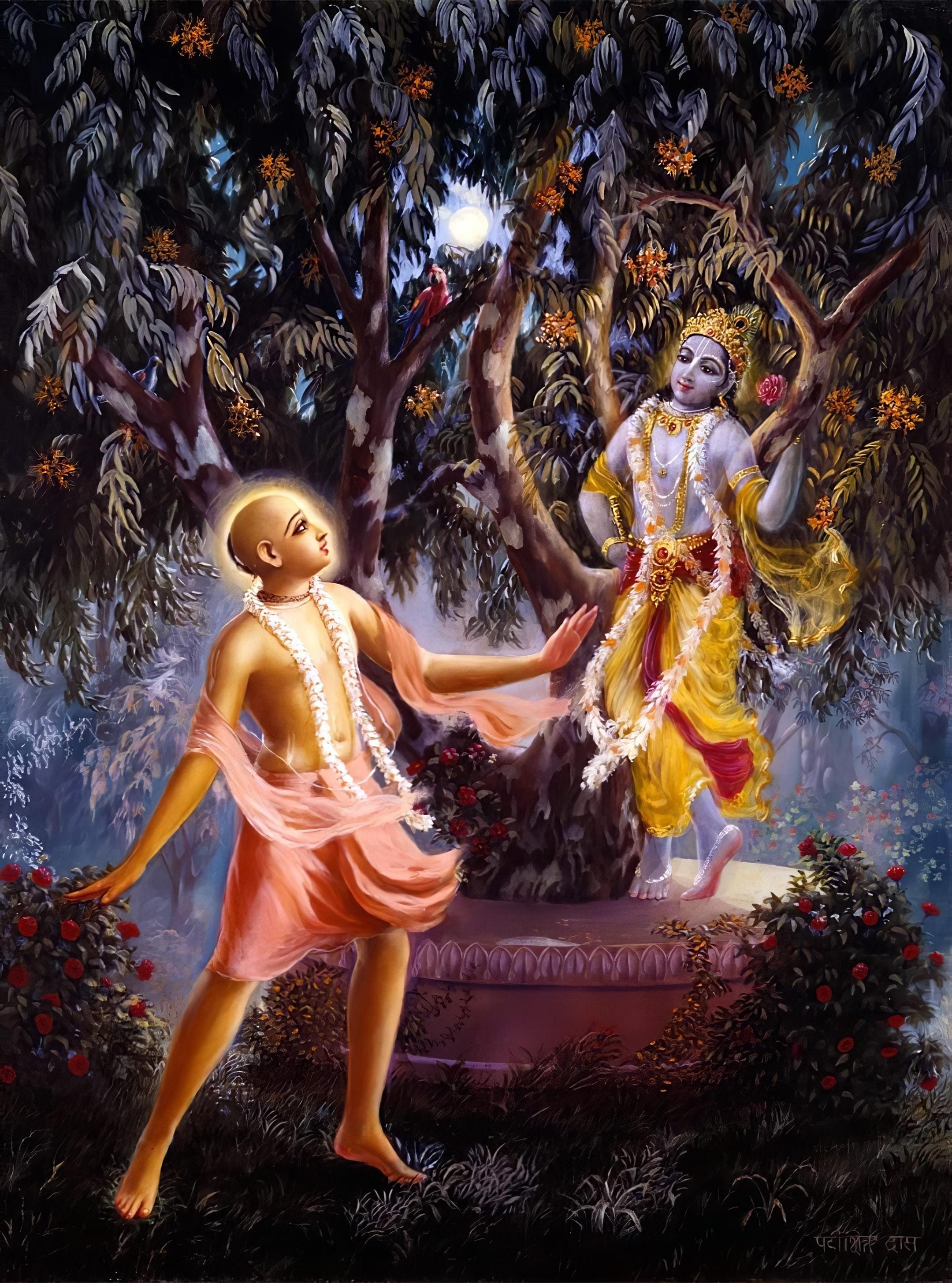
From this point on, the main narration of the pastime, described in the verses, and the purports of Prabhupāda appear to diverge. The main narration describes Purañjana returning to the castle and reconciling himself with the Queen, who represents his good intelligence, returning to the path of pious enjoyment (according to the prescriptions of the Vedas), and refraining from further animal killing and woman-hunting. In his purports, however, Prabhupāda sticks with the deeper meaning of the text: a sinful man meeting with a saintly person and reviving his original Kṛṣṇa Consciousness. Both meanings are present in the original verses, and indicate two different possibilities for the redemption of a sinful person, and also illustrate the difference between ordinary pious intelligence, and the same intelligence when purified by the instructions of a self-realized person.
It’s quite common for passages in the scriptures to have multiple meanings simultaneously, with the deeper meanings being exposed in the commentaries of our ācāryas. In this case, the superficial meaning is directly indicated in the text, while the deeper meaning is revealed in the purports of Śrīla Prabhupāda. Let’s thus delve into the deeper meaning revealed by him, connecting this passage with a sinful man coming in contact with a saintly person, or a devotee trying to revive his Kṛṣṇa Consciousness after a fall.
As he comments on text 4.26.11:
“King Purañjana’s coming home, taking bath and having an appropriate dinner indicate that a materialistic person must retire from sinful activities and become purified by accepting a spiritual master and hearing from him about the values of life. If one would do this, he would feel completely refreshed, just as one feels after taking a bath. After receiving initiation from a bona fide spiritual master, one must abandon all kinds of sinful activities, namely illicit sex, intoxication, gambling and meat-eating.”
Later, in the same purport, he states: “King Purañjana’s returning home is indicative of man’s returning to his original consciousness, known as Kṛṣṇa Consciousness. Kṛṣṇa Consciousness is absolutely necessary for one who has committed a lot of sinful activities, especially killing animals or hunting in the forest.”
The allegory describes Purañjana becoming fatigued from his hunting, becoming hungry and thirsty, returning to the palace, taking a bath, and having an appropriate dinner. This describes a man who becomes somehow mindful of his mistakes and meets a self-realized soul, being trained in the regulative principles, taking initiation, and becoming properly situated in one’s practice of Kṛṣṇa Consciousness. As explained in other passages of the Śrīmad-Bhāgavatam, this is the proper process of purification for all types of sinners, since it is the only process that not only destroys the results of one’s sinful activities, but also destroys the desire to commit new sins.
The king searching for the Queen is compared by Śrīla Prabhupāda to a person who, after being decorated with knowledge received from saintly persons, searches out his original consciousness, Kṛṣṇa Consciousness. In other words, it describes the situation of a person who meets devotees and is trained in the process of devotional service. The material desires in the heart are thus cleansed, and one is elevated to the platform of love of Godhead.
However, Purañjana didn’t follow the process to the end. The description of him being captivated by Cupid and searching for his wife in text 4.26.13 to have sexual enjoyment is compared with a devotee who, after adopting the process and practicing for some time, falls from regulative principles due to past bad habits, weakness, or accident.
The verse mentions that Purañjana took his dinner, and instead of being elevated to a higher consciousness, became captivated by Cupid. Prabhupāda connects this with the situation of a neophyte who eats more than necessary and thus ends up falling from regulative principles. In the allegory, this gluttony is pointed out as the main factor for the fall of Purañjana from the platform of Kṛṣṇa Consciousness, leading to his next birth.
Despite having adopted the process of devotional service at a certain point in his life, approaching a spiritual master, etc., Purañjana fell back into his materialistic life after a short time and continued to practice sinful activities, becoming again addicted to sex life and so on. This trajectory is similar to the life of Ajāmila, who also practiced Kṛṣṇa Consciousness in his youth, but later forgot everything due to his association with the prostitute. There are, however, two crucial differences. The first is that Ajāmila practiced Kṛṣṇa Consciousness on a much higher level than Purañjana. His practice was not casual: he was seriously following the regulative principles and worshiping the deity for many years. His fall was also mainly accidental, a young man being seduced by a woman of dubious character. Because of these two factors, the Lord made a transcendental arrangement to make him name his youngest son Narāyana, so he would be chanting the holy name and, especially, chant the name of the Lord inoffensively at the time of death, which instantly purified him of a life of sin and made him eligible to be rescued by the Viṣṇudutas.
Purañjana, on the other hand, never attained an advanced stage of devotional practice. He approached a spiritual master in a moment of bewilderment, after a spree of meat eating and woman-hunting, and heard spiritual instructions, but after recovering a little, he again became absorbed in sense enjoyment, associating with his material intelligence (the Queen), forgetting everything else. Crucially, he never came back to his practice and didn’t remember Kṛṣṇa at the time of death.
It’s true that simply by chanting the holy names once, one can destroy all his sinful activities, but this applies only for one who chants inoffensively. Another point is that chanting the holy names frees us from our past activities, but if we return to a life of sin, new karma accumulates and we are eligible to be punished for it, especially if we stop our practice, as in the case of Purañjana. This makes the point that we should be serious in our practice. Human life is a life of responsibility. We have lots of facilities, but we have to answer for our choices.
Still, even though he ended up going to hell to pay for his mistakes, Purañjana took his next birth in a very exalted family and had the opportunity to continue his devotional practice, exactly as Kṛṣṇa promises in the Bhagavad-gītā (śucīnām śrīmatām gehe, yoga-bhraṣṭo ’bhijāyate). This shows how even a lapse devotee is in a much better position than an ordinary materialist.
Purañjana becomes princess Vaidarbhī in his next life
According to the descriptions of the Purānas, with the exception of devotees, everyone has to face the judgment of Yamarāja and suffer punishment according to the gravity of their sins. Even if a materialist is very pious, he will still commit some sins, and because of them, he will still be eligible for punishment, even if for a short term. After being purified from sinful reactions, one is then free to proceed to one’s next body, which, in the case of a pious person, will probably be human. As explained in the Sixth Canto of Śrīmad-Bhāgavatam, however, devotees who sincerely chant the holy names are saved from this and are brought to their next bodies by the Viṣṇudūtas, who are always traveling through the material universes in many missions to rescue and help devotees all over the material creation.
Nārada Muni uses the allegory to reveal Prācīnabarhi’s future if he were to continue in the same direction. Just as Purañjana, he was materially pious, but at the same time, he was excessively attached to sex life and had killed many animals. Nārada already had shown how the animals he killed in his improper sacrifices were waiting to attack him on the road to hell, and now he reveals his destiny after that: a new material body.
“King Purañjana gave up his body while remembering his wife, and consequently in his next life he became a very beautiful and well-situated woman. He took his next birth as the daughter of King Vidarbha in the very house of the King. It was fixed that Vaidarbhī, daughter of King Vidarbha, was to be married to a very powerful man, Malayadhvaja, an inhabitant of the Pāṇḍu country. After conquering other princes, he married the daughter of King Vidarbha. King Malayadhvaja fathered one daughter, who had very black eyes. He also had seven sons, who later became rulers of that tract of land known as Draviḍa. Thus there were seven kings in that land.” (SB 4.28.28-30)
Because of mutual attachment, men tend to become women in the next life, and women tend to come back as men. Whatever we are attached to, that’s what we remember at the time of death, and this thought makes us assume that very form in our next life. A man thus has the opportunity to associate with a feminine body in the most intimate way possible, by wearing it, together with the opportunity of associating freely with other women, but now in a harmless way. Similarly, a woman becomes a man and can thus associate freely with other men. One who is attached to dogs may have the opportunity of taking birth in a dog family and so on.
The type of body is thus determined by desire, but the quality is determined by one’s piety. A common man may take birth as an ordinary woman, but because Purañjana had executed many pious fruitive activities, he took birth in a very high-class woman’s body, as Vaidarbhī, a princess who was married to Malayadhvaja, a handsome king, who defeated many rivals to take her hand. Nothing happens by chance; our next birth is determined by superior authorities taking all factors into consideration.
Prabhupāda also connects the elevated birth of Purañjana with the destination of a devotee who is not capable of completing his practice. As Kṛṣṇa explains in the Gītā, prāpya puṇya-kṛtām lokān, uṣitvā śāśvatīḥ samāḥ, śucīnām śrīmatām gehe, yoga-bhraṣṭo ’bhijāyate: The devotee who tries, but falls after a short time of practice, has the opportunity of satisfying his material desires in the celestial planets, and then takes birth in a pious or rich family. Not only that, but in this next birth, the Lord tries to guide us, both from inside the heart and from the outside, appearing as the spiritual master and speaking to us through other people. Even though the material ocean is such a dangerous place, the devotee is secure under the protection of the Lord.
As Prabhupāda explains, “The conclusion is that all our activities are taken into consideration before we are awarded another body. Nārada Muni therefore advised Vyāsadeva that one should take to Kṛṣṇa Consciousness, devotional service, and abandon all ordinary occupational duties. This advice was also given by Lord Kṛṣṇa Himself. Although a devotee may fall from the path of spiritual consciousness, he will nonetheless attain a human body in the home of a devotee or a rich man. In this way one can resume his devotional service.”
The dynasty of Malayadhvaja is described by Nārada Muni:
“My dear King Prācīnabarhiṣat, the sons of Malayadhvaja gave birth to many thousands and thousands of sons, and all of these have been protecting the entire world up to the end of one Manu’s life span and even afterward. The great sage named Agastya married the first-born daughter of Malayadhvaja, the avowed devotee of Lord Kṛṣṇa. From her, one son was born, whose name was Dṛḍhacyuta, and from him another son was born, whose name was Idhmavāha. After this, the great saintly King Malayadhvaja divided his entire kingdom among his sons. Then, in order to worship Lord Kṛṣṇa with full attention, he went to a solitary place known as Kulācala. Just as the moonshine follows the moon at night, immediately after King Malayadhvaja departed for Kulācala, his devoted wife, whose eyes were very enchanting, followed him, giving up all homely happiness, despite family and children.” (SB 4.28.31-34)
The allegory continues, with the seven sons becoming kings and fathering many thousands of sons, who protected the whole world, until the end of the manvantara, and even afterwards. The daughter, on the other hand, married the sage Agastya, who also fathered a son. Being thus successful in his family life, Malayadhvaja divided his kingdom between his sons and departed to a hermitage in the Kulā mountain to practice austerities in the final stage of his life. The devoted Vaidarbhī followed him, determined to continue her service to her husband up to the end.
There is, however, a deeper meaning in this passage that is revealed by Śrīla Prabhupāda in his purports. Just as in the first part of the allegory, he adds a completely new layer of understanding to the passage of Purañjana taking his next birth as a woman.
From verse 4.28.29 to 4.28.34, Prabhupāda shows how the allegory describes the spread of the cult of bhakti, and how Vaidarbhī became involved in it as a result of her short devotional practice in her previous life as Purañjana. This meaning was first revealed by Śrīla Baladeva Vidyābhūṣaṇa in his commentary, and Prabhupāda further expanded it to our contemporary context.
According to his explanation, Malayadhvaja was not just a powerful king, but also a great devotee. Text 4.28.29 reads:
upayeme vīrya-paṇām, vaidarbhīm malayadhvajaḥ
yudhi nirjitya rājanyān, pāṇḍyaḥ para-purañjayaḥ
Śrīla Baladeva Vidyābhūṣaṇa reads the word malayadhvajaḥ as the combination of Malaya (the mountain range famous for the sandalwood trees) and dhvaja (war-flag). He thus depicts Malayadhvaja as a mahā-bhāgavata preacher, the learned devotee (pāṇḍyaḥ) who defeats non-devotional doctrines and conquers the transcendental city (Vaikuṇṭha) by the power of his devotional love (vīrya-paṇām). Malayadhvaja is thus the emblem of the supremacy of bhakti over karma and jñāna.
Śrīla Prabhupāda translates the verse in the direct meaning, but adds the explanation of Śrīla Baladeva Vidyābhūṣaṇa in his purport:
“The name Malayadhvaja signifies a great devotee who stands as firm as Malaya Hill and, through his propaganda, makes other devotees similarly as firm. Such a mahā-bhāgavata can prevail over the opinions of all others. A strong devotee makes propaganda against all other spiritual conceptions, namely jñāna, karma and yoga. With his devotional flag unfurled, he always stands fast to conquer other conceptions of transcendental realization. Whenever there is an argument between a devotee and a nondevotee, the pure, strong devotee comes out victorious.
The word pāṇḍya comes from the word paṇḍā, meaning “knowledge.” Unless one is highly learned, he cannot conquer nondevotional conceptions. The word para means “transcendental,” and pura means “city.” The para-pura is Vaikuṇṭha, the kingdom of God, and the word jaya refers to one who can conquer. This means that a pure devotee, who is strong in devotional service and who has conquered all nondevotional conceptions, can also conquer the kingdom of God. In other words, one can conquer the kingdom of God, Vaikuṇṭha, only by rendering devotional service. The Supreme Personality of Godhead is called ajita, meaning that no one can conquer Him, but a devotee, by strong devotional service and sincere attachment to the Supreme Personality of Godhead, can easily conquer Him. Lord Kṛṣṇa is fear personified for everyone, but He voluntarily agreed to fear the stick of mother Yaśodā. Kṛṣṇa, God, cannot be conquered by anyone but His devotee. Such a devotee kindly married the daughter of King Vidarbha.”
We can see that Prabhupāda was able to capture the essence of the commentary of Śrīla Baladeva Vidyābhūṣaṇa, and expand it, adding details and making it easy to understand. That’s the same magic he does in other purports. From here, he continues to follow the explanation of Sri Baladeva and further expands it.
Text 30 reads:
tasyām sa janayām cakra, ātmajām asitekṣaṇām
yavīyasaḥ sapta sutān, sapta draviḍa-bhūbhṛtaḥ
The daughter fathered by Malayadhvaja had very black eyes (asitekṣaṇām). This means that her eyes were always fixed on Kṛṣṇa. Apart from this girl, they had seven very powerful sons (yavīyasaḥ sapta sutān), who represent seven of the nine processes of devotional service (hearing, chanting, remembering, offering worship, offering prayers, rendering transcendental loving service, and serving the lotus feet of the Lord). This indicates that by the association with the king and surrounded by devoted children, Purañjana, now as Vaidarbhī, practiced devotional service. The other two processes (friendship and surrendering everything to the Lord) come later, as one perfects the first seven processes. This also comes from the commentary of Śrīla Baladeva Vidyābhūṣaṇa, with Prabhupāda expanding his explanation.
Prabhupāda explains all these ideas in detail in his purport:
“King Malayadhvaja was a great devotee, and after he married the daughter of King Vidarbha, he gave her one nice daughter, whose eyes were black. Figuratively this means that the daughter of King Malayadhvaja was also bestowed with devotional service, for her eyes were always fixed on Kṛṣṇa. A devotee has no vision in his life other than Kṛṣṇa. The seven sons are the seven processes of devotional service — hearing, chanting, remembering, offering worship, offering prayers, rendering transcendental loving service and serving the lotus feet of the Lord. Of the nine types of devotional service, only seven were immediately given. The balance — friendship and surrendering everything — were to be developed later. In other words, devotional service is divided into two categories, namely vidhi-mārga and rāga-mārga. The process of becoming friends with the Lord and sacrificing everything for Him belongs to the category of rāga-mārga, the stage of developed devotional service. For the neophyte, the important processes are those of hearing and chanting (śravaṇam kīrtanam), remembering Kṛṣṇa, worshiping the Deity in the temple, offering prayers, always engaging in the service of the Lord, and worshiping the lotus feet of the Lord.
The word yavīyasaḥ indicates that these processes are very powerful. After a devotee engages in the processes of śravaṇam kīrtanam viṣṇoḥ smaraṇam pāda-sevanam/ arcanam vandanam dāsyam, and is able to secure these processes, he can later become a devotee capable of rendering spontaneous devotional service, namely sakhyam and ātma-nivedanam. Generally the great ācāryas who preach devotional service all over the world belong to the category of sakhyam ātma-nivedanam. A neophyte devotee cannot actually become a preacher. The neophyte is advised to execute devotional service in the seven other fields (śravaṇam kīrtanam, etc.). If one can successfully execute the preliminary seven items, he can in the future be situated on the platform of sakhyam ātma-nivedanam.”
The verse also describes that these seven sons became rulers of the Draviḍa province (South India). Prabhupāda connects this with the recent history of South India, with the appearance of many great ācāryas, and generations of devotees in many different sampradāyas very strongly practicing the seven preliminary processes of bhakti, paving thus the way for the appearance of Sri Caitanya Mahāprabhu, who made available the final two processes.
“The specific mention of Draviḍa-deśa refers to the five Draviḍa-deśas in South India. All are very strong in rendering the preliminary devotional processes (śravaṇam kīrtanam). Some great ācāryas, like Rāmānujācārya and Madhvācārya, also came from Draviḍa-deśa and became great preachers. They were all situated on the platform of sakhyam ātma-nivedanam.”
This interpretation is later confirmed by Śukadeva Goswāmī on SB 11.5.38-40:
“My dear King, the inhabitants of Satya-yuga and other ages eagerly desire to take birth in this Age of Kali, since in this age there will be many devotees of the Supreme Lord, Nārāyaṇa. These devotees will appear in various places but will be especially numerous in South India. O master of men, in the Age of Kali those persons who drink the waters of the holy rivers of Draviḍa-deśa, such as the Tāmraparṇī, Krtamālā, Payasvinī, the extremely pious Kāverī and the Pratīcī Mahānadī, will almost all be purehearted devotees of the Supreme Personality of Godhead, Vāsudeva.”
And, of course, the appearance of Śrī Caitanya Mahāprabhu is predicted on SB 11.5.32, 36, and 37:
“In the Age of Kali, intelligent persons perform congregational chanting to worship the incarnation of Godhead who constantly sings the names of Kṛṣṇa. Although His complexion is not blackish, He is Kṛṣṇa Himself. He is accompanied by His associates, servants, weapons and confidential companions.
Those who are actually advanced in knowledge are able to appreciate the essential value of this Age of Kali. Such enlightened persons worship Kali-yuga because in this fallen age all perfection of life can easily be achieved by the performance of sankīrtana.
Indeed, there is no higher possible gain for embodied souls forced to wander throughout the material world than the Supreme Lord’s sankīrtana movement, by which one can attain the supreme peace and free oneself from the cycle of repeated birth and death.”
Just as in this passage from the Eleventh Canto, texts 4.28.29-34 of the allegory of Purañjana predict the spread of Vaiṣṇavism in South India, the appearance of Sri Caitanya Mahāprabhu, the spread of His sankīrtana movement, and the distribution of the fruits of love of Godhead.
This is yet another example of how the verses of the scriptures hide meanings that are revealed only by self-realized ācāryas. The ones who reject these conclusions and want instead to find direct quotes of everything remain stuck in a very primitive understanding of the scriptures.
Text 4.26.31 continues the description:
ekaikasyābhavat teṣām, rājann arbudam arbudam
bhokṣyate yad-vamśa-dharair, mahī manvantaram param
Malayadhvaja was a great preacher who enforced the supremacy of bhakti over the processes of fruitive activity and mental speculation. He had seven sons (or disciples) who propagated the process of devotional service in South India. Each of them had millions of other descendants (ekaikasyābhavat teṣām, rājann arbudam arbudam, each one produced ten million descendants), who have been protecting the whole world, or in other words, spreading the process of devotional service up to the end of the manvantara, and beyond (bhokṣyate yad-vamśa-dharair, mahī manvantaram param).
Prabhupāda connects the mention of the Manus and Manvantaras in the text with the continuous process of devotional service being spread by the Manus and their descendants throughout the universe (“As one Manu follows another, the cult of Kṛṣṇa Consciousness is being imparted”). The seven sons becoming the kings of South India was already connected with our previous ācāryas spreading Vaiṣṇavism and the process of worship of the Lord, and now the spread of the sankīrtana movement out of India, and its continuation, not only on Earth, but in other parts of the cosmos, is predicted. One may think this is too far out, but again, these same details are also described in the Eleventh Canto and in other scriptures. Prabhupāda is thus just making apparent the deeper meaning of the text.
As he explains in his purport to the same verse:
“Among Vaiṣṇavas there may be some difference of opinion due to everyone’s personal identity, but despite all personal differences, the cult of Kṛṣṇa Consciousness must go on. We can see that under the instructions of Śrīla Bhaktivinoda Ṭhākura, Śrīla Bhaktisiddhānta Sarasvatī Gosvāmī Mahārāja began preaching the Kṛṣṇa Consciousness movement in an organized way within the past hundred years. The disciples of Śrīla Bhaktisiddhānta Sarasvatī Gosvāmī Mahārāja are all godbrothers, and although there are some differences of opinion, and although we are not acting conjointly, every one of us is spreading this Kṛṣṇa Consciousness movement according to his own capacity and producing many disciples to spread it all over the world. As far as we are concerned, we have already started the International Society for Krishna Consciousness, and many thousands of Europeans and Americans have joined this movement. Indeed, it is spreading like wildfire. The cult of Kṛṣṇa Consciousness, based on the nine principles of devotional service (śravaṇam kīrtanam viṣṇoḥ smaraṇam pāda-sevanam/ arcanam vandanam dāsyam sakhyam ātma-nivedanam), will never be stopped. It will go on without distinction of caste, creed, color or country. No one can check it.
The word bhokṣyate is very important in this verse. Just as a king gives protection to his citizens, these devotees, following the principles of devotional service, will give protection to all the people of the world. The people of the world are very much harassed by so-called religious-principled svāmīs, yogīs, karmīs and jñānīs, but none of these can show the right way to become elevated to the spiritual platform. There are primarily four parties spreading devotional service all over the universe. These are the Rāmānuja sampradāya, the Madhva sampradāya, the Viṣṇusvāmi sampradāya and the Nimbārka sampradāya. The Madhva-Gauḍīya sampradāya in particular comes from Lord Caitanya Mahāprabhu. All these devotees are spreading this Kṛṣṇa Consciousness movement very widely and giving protection to innocent people who are being so much embarrassed by pseudo-avatāras,-svāmīs, -yogīs and others.”
Malayadhvaja retires to the forest
Text 4.26.32 reads:
agastyaḥ prāg duhitaram, upayeme dhṛta-vratām
yasyām dṛḍhacyuto jāta, idhmavāhātmajo muniḥ
In the allegory, the daughter of Malayadhvaja represents the very plant of bhakti, the bhakti-latā-bīja, which sprouts in the heart of the king, and grows supported by the seven brothers, the seven processes of devotional service practiced by him. The girl married Agastya, who is defined by Baladeva Vidyābhūṣaṇa as the mind, illustrating how devotion conquered the very mind of the king, making him fully fixed in the service of the Lord.
The girl later gave birth to a son called Dṛḍhacyuta, from whom a grandson called Idhmavāha, which means disciples who gather sacrificial wood (idhmavāha) for burning in sacrifices when approaching a spiritual master. This indicates that due to the devotion of Malayadhvaja, all his descendants were also great devotees. As Prabhupāda explains:
“The name Agastya Muni is very significant. Agastya Muni represents the mind. The word agastya indicates that the senses do not act independently, and the word muni means “mind.” The mind is the center of all the senses, and thus the senses cannot work independent of the mind. When the mind takes to the cult of bhakti, it engages in devotional service. The cult of bhakti (bhakti-latā) is the first daughter of Malayadhvaja, and as previously described, her eyes are always upon Kṛṣṇa (asitekṣaṇām). One cannot render bhakti to any demigod. Bhakti can be rendered only to Viṣṇu (śravaṇam kīrtanam viṣṇoḥ). Thinking the Absolute Truth to be without form, the Māyāvādīs say that the word bhakti can apply to any form of worship. If this were the case, a devotee could imagine any demigod or any godly form and worship it. This, however, is not the real fact. The real fact is that bhakti can be applied only to Lord Viṣṇu and His expansions. Therefore bhakti-latā is dṛḍha-vrata, the great vow, for when the mind is completely engaged in devotional service, the mind does not fall down. If one tries to advance by other means — by karma-yoga or jñāna-yoga — one will fall down, but if one is fixed in bhakti, he never falls down.
Thus from bhakti-latā the son Dṛḍhacyuta is born, and from Dṛḍhacyuta the next son, Idhmavāha, is born. The word idhma-vāha refers to one who carries wood for burning in a sacrifice when approaching a spiritual master. The point is that bhakti-latā, the cult of devotion, fixes one in his spiritual position. One so fixed never comes down, and he begets children who are strict followers of the śāstric injunctions.”
Text 4.26.33 reads:
vibhajya tanayebhyaḥ kṣmām, rājarṣir malayadhvajaḥ
ārirādhayiṣuḥ kṛṣṇam, sa jagāma kulācalam
This last verse describes the process of retirement of the king, who divided his kingdom amongst his sons (vibhajya tanayebhyaḥ kṣmām) and retired to a secluded place, desiring to worship the Lord in full attention. This is connected by both Baladeva Vidyābhūṣaṇa and Śrīla Prabhupāda with the retirement of the spiritual master when his disciples are mature, and the duty of the disciples in continuing the mission of the spiritual master in spreading Kṛṣṇa Consciousness, instead of succumbing to an easy life of solitary superficial meditation, devoid of responsibility. As he wrote in his purport:
“Malayadhvaja, the great king, was certainly a mahā-bhāgavata, topmost devotee. By executing devotional service, he begot many sons and disciples for propagating the bhakti cult (śravaṇam kīrtanam viṣṇoḥ). Actually, the entire world should be divided among such disciples; everyone should be engaged in preaching the cult of Kṛṣṇa Consciousness. In other words, when disciples are grown up and are able to preach, the spiritual master should retire and sit down in a solitary place to write and execute nirjana-bhajana. This means sitting silently in a solitary place and executing devotional service. This nirjana-bhajana, which is the silent worship of the Supreme Lord, is not possible for a neophyte devotee. Śrīla Bhaktisiddhānta Sarasvatī Ṭhākura never advised a neophyte devotee to go to a solitary place to engage in devotional service.”
The passage is concluded on text 4.26.34, which reads:
hitvā gṛhān sutān bhogān, vaidarbhī madirekṣaṇā
anvadhāvata pāṇḍyeśam, jyotsneva rajanī-karam
When Malayadhvaja retired to the forest, Vaidarbhī also left home to serve him. The verse describes her as madira-īkṣaṇā (with enchanting eyes). Prabhupāda explains that another meaning of madira is “intoxicating”, which means that her eyes were enchanting because, due to the association of such an exalted Vaiṣnava, she would become intoxicated in love of Godhead upon seeing the Deity. In other words, by this stage, she had become an exalted devotee, just like her husband. Vaidarbhī thus represents the disciple, who advances by association and service to the spiritual master.
In the previous verse, the seven sons of Malayadhvaja represent the senior disciples who preach, and thus inherit the mission of spreading Kṛṣṇa Consciousness, after the guru, in his old age, retires to fix his mind on the Lord, while Vaidarbhī represents the disciples who stay with the spiritual master to serve him at the last stage.
As Prabhupāda explains: “Just as in the vānaprastha stage the wife follows the husband, similarly when the spiritual master retires for nirjana-bhajana, some of his advanced devotees follow him and engage in his personal service. In other words, those who are very fond of family life should come forward in the service of the spiritual master and abandon so-called happiness afforded by society, friendship and love. A verse by Śrīla Viśvanātha Cakravartī Ṭhākura in his Gurv-aṣṭaka is significant in this regard: yasya prasādād bhagavat-prasādaḥ. A disciple should always remember that by serving the spiritual master he can easily advance in Kṛṣṇa Consciousness. All the scriptures recommend that it is by pleasing the spiritual master and serving him directly that one can attain the highest perfectional stage of devotional service.”
Malayadhvaja is described as a king living in Satya-yuga, who achieved self-realization through the process of aṣṭānga-yoga, by meditating for 36,000 years (100 celestial years). The verses, however, make clear that he was not an impersonalist. Verse 38, for example, directly mentions the words vāsudeve bhagavati (he fixed his meditation upon Vāsudeva, the Supreme Personality of Godhead). Devotees may use different processes, but the goal is always the same: to fix our mind in unbreakable meditation on the Supreme Lord, in devotional trance.
In his meditation, Malayadhvaja realized his transcendental identity, separated from the body, and started to see himself, as the soul, as a mere witness of the body. He also saw himself as being present together with the Supersoul inside the heart, but at the same time distinct from the Lord. In this way, he attained perfect realization, avoiding all traps on the way.
As Prabhupāda explains: “The conditioned soul is often frustrated in trying to understand the distinctions between the material body, the Supersoul and the individual soul. There are two types of Māyāvādī philosophers: the followers of the Buddhist philosophy and the followers of the Śankara philosophy. The followers of Buddha do not recognize that there is anything beyond the body. The followers of Śankara conclude that there is no separate existence of the Paramātmā, the Supersoul; they believe that the individual soul is identical with the Paramātmā in the ultimate analysis. But the Vaiṣṇava philosopher, who is perfect in knowledge, knows that the body is made of the external energy and that the Supersoul, the Paramātmā, the Supreme Personality of Godhead, is sitting with the individual soul and is distinct from him.”
Usually, a soul has to spend many lives going from one philosophic misunderstanding to another, but when we finally find a self-realized soul who can give us the perfect understanding, we are finally situated on a platform of proper knowledge (sambandha) and from there can practice appropriately and attain the ultimate goal. Prabhupāda put all the correct conclusions in his books, and even repeated the most essential concepts in many passages to make it impossible to miss them. If we just accept the conclusions he gives, the path becomes open for us.
As he explains in his purport to text 41: “The Lord is the Supersoul seated in everyone’s heart, and He acts as the caitya-guru, the spiritual master within. However, He gives direct instructions only to the advanced, pure devotees. In the beginning, when a devotee is serious and sincere, the Lord gives him directions from within to approach a bona fide spiritual master. When one is trained by the spiritual master according to the regulative principles of devotional service and is situated on the platform of spontaneous attachment for the Lord (rāga-bhakti), the Lord also gives instructions from within (teṣām satata-yuktānām bhajatām prīti-pūrvakam/ dadāmi buddhi-yogam tam). This distinct advantage is obtained by a liberated soul. Having attained this stage, King Malayadhvaja was directly in touch with the Supreme Lord and was receiving instructions from Him directly.”
The Lord guides us from both the inside, as Paramātmā, the caitya-guru (inner guide), and externally as the spiritual master. The word guru is often used in the plural (gurūn) because different spiritual masters guide us at different stages of life. There should be just one dīkṣā guru, but the instructing spiritual masters can be many. They are, however, one in the sense that they speak the same message. We study the teachings of Prabhupāda under the supervision of all these spiritual masters. By this process, we can be elevated to the platform of rāga-bhakti.
“King Malayadhvaja could thus observe that the Supersoul was sitting by his side, and that he, as the individual soul, was sitting by the side of the Supersoul. Since both were together, there was no need for separate interests; thus he ceased from such activities.” (SB 4.28.42)
What does it mean? Prabhupāda liked to use the word “dovetail”, which means to connect in a seamless way. It comes from carpentry, when two wooden boards are chipped on the borders and connected in a very strong and elegant way, acting like one unit, even though clearly distinct. Kṛṣṇa Consciousness means to dovetail our desires and goals with the desires of Kṛṣṇa, and thus cease to have separate interests from Him. In other words, it means to discard our selfish and materialistic goals and instead cooperate in the service of the Lord. A harmonious relationship happens when two people have similar goals and interests, and can thus work together in the same direction. To have such a deep relationship with Kṛṣṇa is the goal of life. We may feel we are very distant from it right now, but this is due to our current material contamination. This dovetailing of one’s desires with Kṛṣṇa is our natural position, and as this original nature is uncovered by the practice of bhakti, we become absorbed in the service of the Lord and cease having any separate interest from Him.
As Prabhupāda explains in his purport to the same text:
“In the advanced stage of devotional service, the devotee does not see anything separate between his own interests and those of the Supreme Personality of Godhead. Both interests become one, for the devotee does not act for a separate interest. Whatever he does, he does in the interest of the Supreme Personality of Godhead. At that time he sees everything in the Supreme Personality of Godhead and the Supreme Personality of Godhead in everything. Having attained this stage of understanding, he sees no distinction between the spiritual and material worlds. In perfect vision, the material world becomes the spiritual world due to its being the external energy of the Supreme Lord. For the perfect devotee, the energy and the energetic are nondifferent. Thus the so-called material world becomes spiritual (sarvam khalv idam brahma). Everything is intended for the service of the Supreme Lord, and the expert devotee can utilize any so-called material thing for the Lord’s service. One cannot serve the Lord without being situated on the spiritual platform; thus if a so-called material thing is dovetailed in the service of the Lord, it is no longer to be considered material. This is how the pure devotee, in his perfect vision, sees from all angles.”
The material creation is only really “material” to the extent we see it as separated from Kṛṣṇa. He directly explains that on SB 2.9.34, and Prabhupāda repeats the idea in several of his purports. A pure devotee sees the so-called material world as the energy of Kṛṣṇa, and thus no different from the Lord. A materialist questions if there is a God, since he can’t see Him, but a pure devotee sees that there is nothing apart from Kṛṣṇa.
You can also donate using Buy Me a Coffee, PayPal, Wise, Revolut, or bank transfers. There is a separate page with all the links. This helps me enormously to have time to write instead of doing other things to make a living. Thanks!