

Subscribe to receive new articles by e-mail. It’s free, but if you like, you can pledge a donation:
As a movement, we are expected to form an exemplary society that can serve as an example for the general public to follow. We are supposed to be the embryo of a future perfect society.
The idea of varnāśrama is not so much about women covering their heads as it is about engaging people according to their natural talents, teaching them how to perform their activities as an offering to the Lord, living under a ruling system that protects the members of society instead of exploiting them.
Unfortunately, so far we have not been so successful in fulfilling this goal. Not only is this framework of a society where devotees are properly engaged and protected not there, but there where many disheartening cases of scandals and cases of exploitation involving leaders in our history.
A verse from the Śrīmad Bhāgavatam about the enthronement of Ṛṣabhadeva gives us some clues about why this happened, and how it can be prevented from repeating in the future:
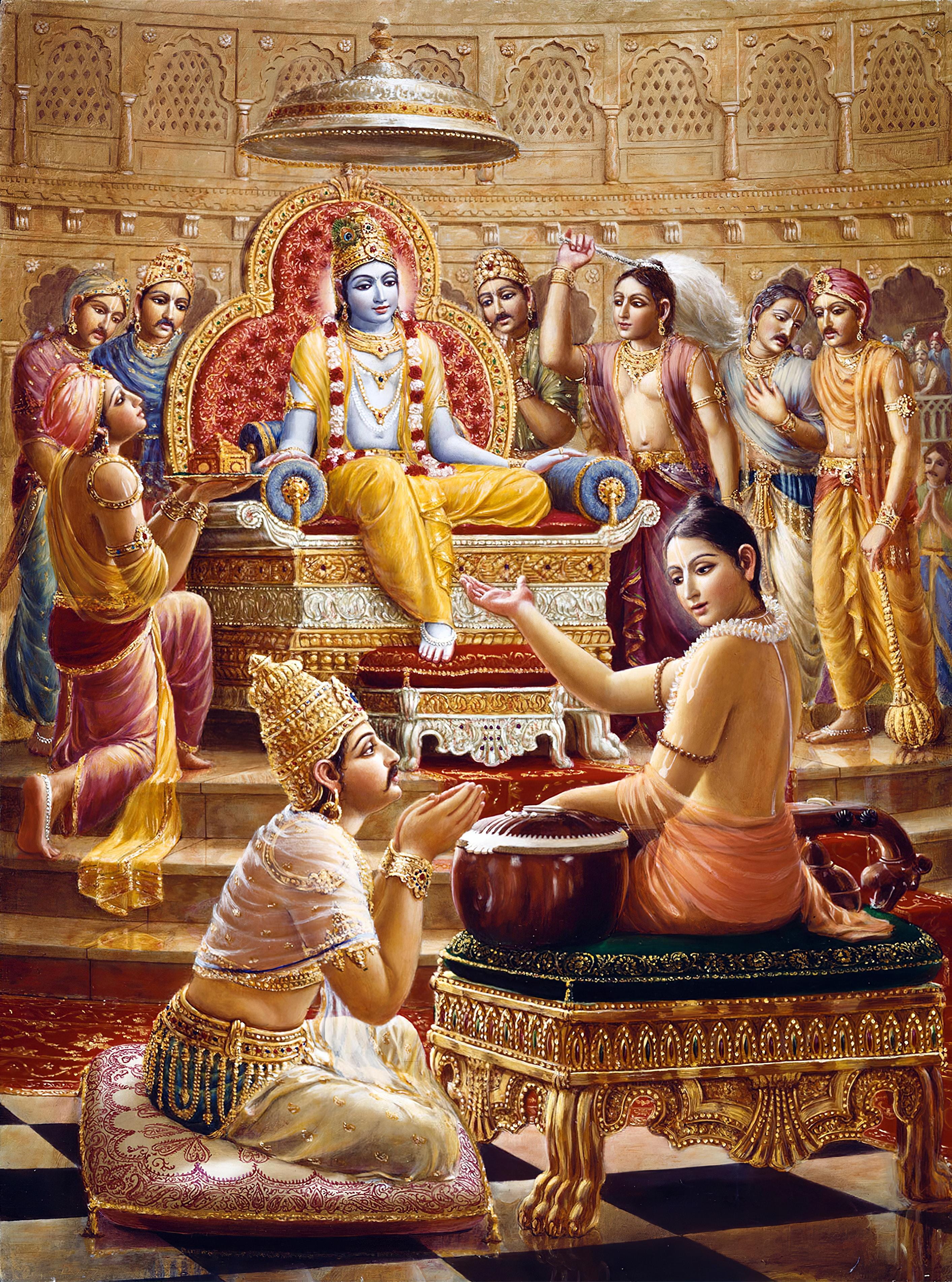
“King Nābhi understood that his son, Ṛṣabhadeva, was very popular among the citizens and among government officers and ministers. Understanding the popularity of his son, Mahārāja Nābhi enthroned Him as the emperor of the world to give protection to the general populace in terms of the Vedic religious system. To do this, he entrusted Him into the hands of learned brāhmaṇas, who would guide Him in administrating the government. Then Mahārāja Nābhi and his wife, Merudevī, went to Badarīkāśrama in the Himālaya Mountains, where the King engaged Himself very expertly in austerities and penances with great jubilation. In full samādhi he worshiped the Supreme Personality of Godhead, Nara-Nārāyaṇa, who is Kṛṣṇa in His plenary expansion. By doing so, in course of time Mahārāja Nābhi was elevated to the spiritual world known as Vaikuṇṭha.” (SB 5.3.5)
Ṛṣabhadeva is an incarnation of Viṣṇu. He is not an empowered incarnation (śaktyāveśa), but God Himself, appearing in his original spiritual body. Being God, he was certainly infallible, but still, he governed according to the advice of a council of brāhmanas.
In the varnāśrama system, the king acts as the executive power, but the real authority resides with the brāhmaṇas, who guide his actions. There are many reasons for that, but one of them is that kṣatriyas have to be influenced by the mode of passion to properly execute their functions. A ruler who is too much in goodness will not be able to fight and apply justice as it is supposed to be. The problem with the mode of passion is that it can easily blind us and lead to mistakes. To avoid that, the king would always be supervised by the brāhmanas, who would guide his actions and step in when necessary. We can see the example of Vena: when the king became irreligious and refused to take advice, the brāhmanas killed him with a curse.
In this way, the real authority would reside with the brāhmanas, who would maintain their position in the mode of goodness, and thus be able to guide the functions of the executive power according to the principles of dharma. Even when the king is a pure devotee, like in the case of Yudhistira, this system is still followed.
In fact, even when God himself appears as a ruler, He follows this system to set the example, as it can be observed in the case of Rāma, and of Krsna Himself ruling in Dvārakā, who regularly consulted brāhmanas and ministers on matters of dharma, governance, and justice. In fact, even demoniac kings usually follow the advice of brāhmanas, who are led in the lower planets by Śukrācārya. By contrast, systems in which absolute power is concentrated in a single individual without higher oversight are considered profoundly adharmic, and are typically found only among the lowest demons and rākṣasas – on the level of Rāvaṇa and Hiraṇyakaśipu – or among degraded rulers in Kali-yuga, who completely abandon religious principles.
How is this connected with the history of our movement?
The point is that in many periods of our history, and especially in the periods in which the worst abuses were committed, this system of dharmic governance of a leader ruling under the council of brāhmanas was replaced by the figure of an absolute ruler, who concentrated absolute power.
We can see that both Srila Bhaktisiddhānta Sarasvatī Thākura and Srila Prabhupāda acted as absolute rulers within their respective societies for a certain period, but there were nuances to that. The first point is that they were, in fact, pure devotees who were acting without personal motives. The second is that in both cases, there was an emergency, where they had to literally start from scratch. We can also see that Srila Prabhupāda tried to transfer the executive power to disciples, acting as temple presidents and local authorities as soon as possible, establishing a governing council to supervise their actions. We can thus see the blueprint of executive leaders dealing with day-to-day problems ruling under the council of a collegiate of brāhmanas being formed. That was his idea for how our movement should be conducted, his implementation of the traditional dharmic system.
We can also observe that Prabhupāda did not invent this system himself. He established it following the instructions given by Srila Bhaktisiddhānta Sarasvatī Thākura at the end of his life, when he urged his disciples to form a governing body and make decisions collectively, instead of electing a single ācārya. In fact, that is the system that was originally envisioned by Srila Bhaktivinoda Thākura as the only viable option for a worldwide movement. As we can see, that was simply an application of the classic Vedic system.
The system where a single ācārya rules with absolute authority is a system of governance fit for an āsrama or gurukula, that deals with just spiritual training, and not for a worldwide society that works more like a state than a school. It is possible temporarily when a society is still in its embryonic state (as in the case of the early days of our movement, with Prabhupada acting as the absolute authority), but it is not viable as a system after that.
One of the reasons we faced so many serious problems in our recent history is that this system was often put aside in favor of absolute rulers being seen as all-perfect and infallible by their followers, governing without any form of higher council. Absolute power can corrupt absolutely, as we could observe in many dark periods of our history.
We can observe that many yatras that passed through difficulties and matured migrated to systems where a temple president and other local authorities are subordinated to a constitution and a council of seniors. This system often makes decisions very slow, but we can see that it is an implementation of the correct system. The fundamental framework is there; the system just needs to be refined and adjusted.
In comparison, many newer yatras still operate under the system of absolute rulers, and that’s where usually the mistakes of the past tend to be repeated. Not even God himself rules without the advice of a council of brāhmanas, exactly to set the example. When we refuse to listen, mistakes are repeated.
You can also donate using Buy Me a Coffee, PayPal, Wise, Revolut, or bank transfers. There is a separate page with all the links. This helps me enormously to have time to write instead of doing other things to make a living. Thanks!