

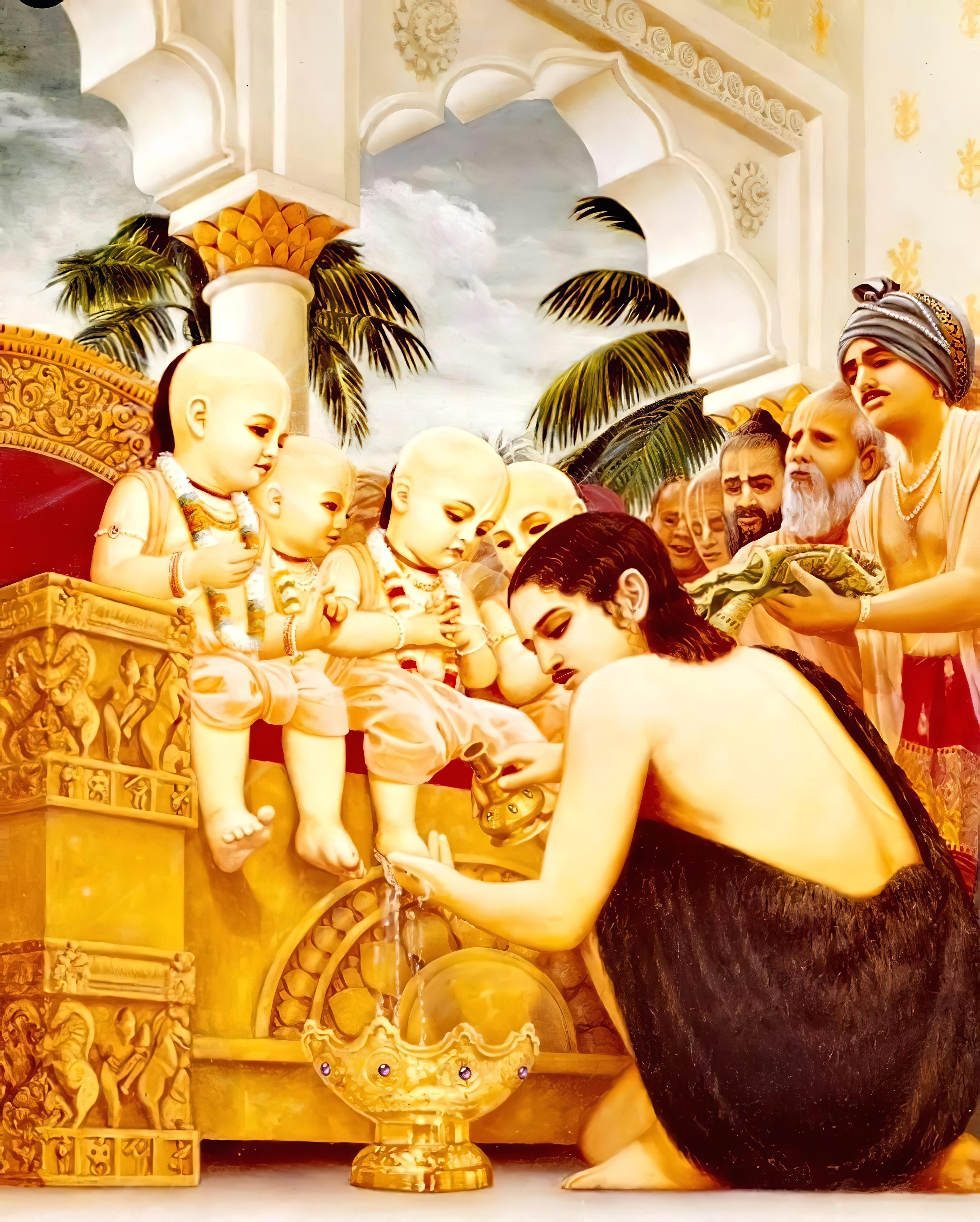
The four Kumāras are among the most exalted personalities of the universe. The reason they look like small boys is that they choose so. As children, they have no lust and can thus roam freely without having to spend energy restricting their senses as adults have to do.
They were initially instructed by Brahma on the path of jñana, but they were promoted to the perfection of the path of bhakti when they came in contact with the Lord in Vaikuṇṭha. Even while still Brahmavādīs, they were so pure that they could visit Vaikuṇṭhaloka and curse the Lord’s eternal associates, so we can only imagine their perfection after becoming perfect devotees. Because they have experience of both paths, they can speak knowledge relevant to both jñanis and devotees, which can elevate both to the platform of pure devotional service.
In the conclusion of his teachings in the Fourth Canto, Sanat-kumāra makes a stark warning for all transcendentalists:
“There is no stronger obstruction to one’s self-interest than thinking other subject matters to be more pleasing than one’s self-realization. For human society, constantly thinking of how to earn money and apply it for sense gratification brings about the destruction of everyone’s interests. When one becomes devoid of knowledge and devotional service, he enters into species of life like those of trees and stones.” (SB 4.22.32-33)
Sense gratification is the enemy of self-realization, just like a drug for the conditioned soul, to which we have been hooked since time immemorial. To cure an addiction, we need to avoid it or at least restrict its use. Because of this, the scriptures prescribe many rules to restrict sense gratification even inside family life. In text 32, Sanat-kumāra emphasizes the danger, and then, in text 33, he describes the consequences. Unrestricted sense gratification makes one devoid of knowledge and devotional service, making one glide down into the lowest forms, down to trees and stones.
Most forms of life lack high intelligence, such as animals and trees. That’s what living in the material world really is: an irrational struggle for sense gratification, where the soul remains practically eternally, going from one animal or plant species to the other, forgetful of one’s real self.
In this great ocean, human life is offered as an opportunity where the soul finally becomes a little awakened and can cultivate knowledge, coming to the position of knowledge about the self (jñāna) and realized spiritual knowledge (vijñāna). If we properly use this opportunity by accepting a spiritual master, controlling our senses, and developing our Krsna consciousness, we can progress further in the direction of the spiritual platform. However, if we transform our human life into a royal version of animal life, repeating the same script of mindless sense gratification, we fall back into the animal or plant species for another long term of imprisonment, devoid of higher intelligence.
What exactly does it mean to avoid sense gratification to live a progressive life? In the paths of jñāna and dhyāna (meditation), sense gratification is completely avoided. Traditionally, householders are not even accepted until they become renunciants. On the path of bhakti, however, there is no objection for one to practice as a householder, as long as one follows the basic regulative principles. Even if one is sinful, one can still advance by practicing devotional service. It’s not that the path of bhakti is lower and thus has lower standards, as some insinuate, but precisely the opposite. Because the paths of jñāna and dhyāna are indirect, their potency is limited, while the path of bhakti is supremely powerful and thus capable of gradually purifying even the most sinful person. However, as one practices, one has to give up one’s previous bad habits, or one’s progress will be stalled.
The real meaning of mokṣa
By following the principles of pious material enjoyment prescribed in the Vedas, one avoids falling into the lower species, but ultimately, it doesn’t solve anything, because one will continue in this material world. Apart from avoiding the negative, a positive is needed. This is indicated in text 35:
“Out of the four principles — namely religion, economic development, sense gratification and liberation — liberation has to be taken very seriously. The other three are subject to destruction by the stringent law of nature — death.” (SB 4.22.35)
The word mokṣa is often associated with impersonal liberation, but ultimately, mokṣa means to attain devotional service to the Lord.
The first of the four puruṣārthas is dharma. There is dharma in the sense of the original nature of the soul (nitya-dharma), the essential characteristic that can’t be changed. However, in the context of the four puruṣārthas, dharma refers to temporary duties connected with one’s position in the varṇāśrama system. While these are important, they are temporary, since they apply to the body and not the soul. This is the type of dharma Krsna recommends Arjuna to give up in the Gītā and instead directly surrender unto Him, which is the true dharma, the eternal dharma.
If even dharma is fit to be abandoned as one advances, what can we say about artha and kāma? These are offered just to attract materialists to the path of the Vedas. As long as we are conditioned, the need for sense gratification will always be present, but we should minimize it as far as possible and instead focus on mokṣa, in the sense of pure devotional service to the Lord and elevation to the spiritual planets.
The real blessing
Because life in this material world is always so difficult, we are anxious to improve our material condition, hankering for a position that will be safer and more comfortable. If we obtain these things, we accept them as a great blessing, and if we don’t, we feel morose. This struggle in the material duality keeps us bound in the material world, struggling to maintain one temporary situation after another. By calling our attention to this, Sanat-kumāra brings us to the inevitable conclusion that we should seek something eternal.
Krsna tends to give material opulences easily to neophyte devotees in order to strengthen their faith. However, in the case of advanced devotees who are getting closer to the ultimate goal, he often does the opposite, frustrating their material attempts so they can easily surrender unto Him.
Both the Lord and the soul are living inside the heart, just as two birds residing in the same tree. The difference is that we become attracted to the fruits of the tree and thus become involved in material actions and reactions. The Lord, on the other hand, always remains in His transcendental position, and He can thus help us to become free. He is called the caitya-guru, the spiritual master within the heart. Sometimes He helps us from within, and sometimes He manifests externally as the spiritual master to give us instructions so we may finish our material activities and go back home, back to Godhead. In this way, this verse also reinforces the instruction of approaching a bona fide spiritual master and learning the transcendental science from him. Understanding the Lord means joining the paramparā, following the footsteps of the previous ācāryas, not trying to understand Him by speculation.
The last snare of Māyā
However, when one finally becomes sincere in inquiring about the Lord, he is faced with the last snare of Maya: impersonalism. One can come in contact with the idea that the form of the Lord is material, existing under the influence of the mode of goodness, and that the impersonal Brahman behind this material form is supreme. Under this false conception, one fails to understand the different potencies of the Lord and falls under the false conception that everything is one and that there is no individuality once freed from the illusion of this material world. One then claims to be God and sees devotional service as just a stair that can be used to achieve the stage of liberation and then be rejected, together with the spiritual master and everything else.
Sanat-kumāra warns against this calamity, encouraging us to reject the misconceptions of impersonalism, understanding that the form of the Lord is eternal and transcendental, that we are separated individuals (although sharing the same spiritual nature), and that we should thus surrender unto the Lord.
This is a publication for thoughtful readers who want to go deeper into Kṛṣṇa consciousness. I publish daily, and all posts are available to free subscribers. If you wish, you can also choose a paid subscription to support this work.
You can also receive the updates on WhatsApp or Telegram.
If you would like to contribute further, you can find the donation links here.
Awesome article
Hare krishna
Hari bol ..... .............