

Subscribe to receive new articles by e-mail. It’s free, but if you like, you can pledge a donation:
Join the Telegram group if you would like to join the live lessons. This course is maintained with your donations. Click here to donate.
💬 Text of the lesson
Understanding the structure of Bhū-mandala
“The great sage Śukadeva Gosvāmī said: Hereafter I shall describe the dimensions, characteristics and forms of the six islands beginning with the island of Plakṣa.” (SB 5.20.1)
After concluding the description of the central island of Jambūdvīpa, Śukadeva Gosvāmī starts the description of the other six islands that form the planetary system of Bhū-mandala. Each island is described following the same basic formula: its extent, distinguishing characteristics, and its place in the structure.
Priyavrata’s chariot
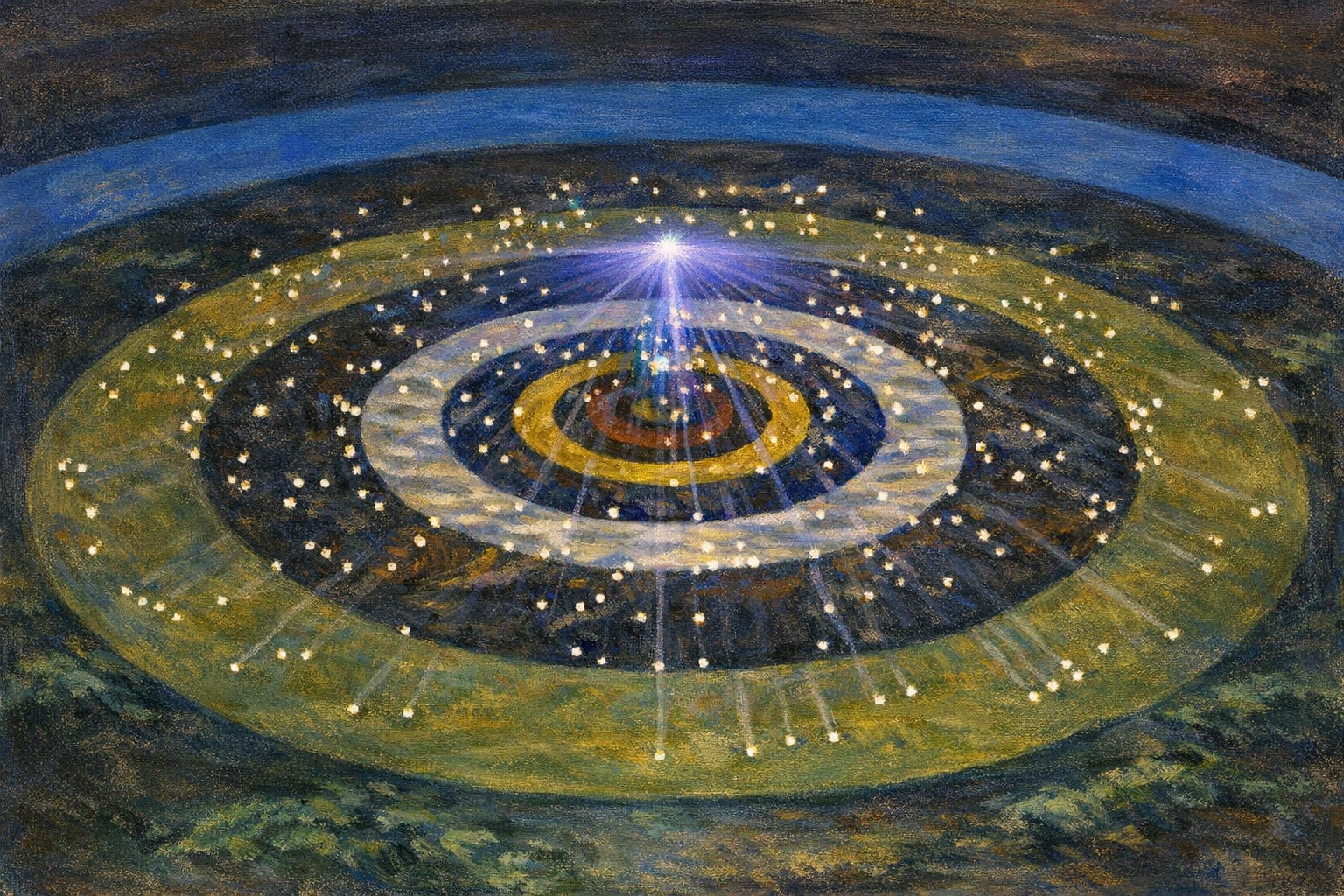
As described in the Fourth Canto, Priyavrata Maharaja divided the planetary system of Bhū-Mandala into seven concentric islands using his mystic sun-chariot. After the ocean of salt water that surrounds Jambūdvīpa, there are six other islands: Plakṣadvīpa, Śālmalīdvīpa, Kuśadvīpa, Krauñcadvīpa, Śākadvīpa, and Puṣkaradvīpa. Each island is exponentially larger than the previous one, subdivided into separate tracts of land and surrounded by its own ocean.
Maharaja Priyavrata gave the rulership of each of these islands to one of his sons. Mahārāja Āgnīdhra took charge of Jambūdvīpa and passed the rule to his sons, leading to the succession of kings that culminated with King Virajā, as described in the first part of the Fifth Canto. The other islands, however, remained under the rule of the descendants of the other sons of Priyavrata.
How can this description be understood? In his letter with his conclusions about the cosmological model of the Vedas, Prabhupāda mentions that:
“The planets have their fixed orbits, but still they are turning with the turning of the great tree. There are pathways leading from one planet to another made of gold, copper, etc., and these are like the branches.”
This describes the idea that both the nine varṣas of Jambūdvīpa, as well as the different tracts of land that form the other islands of Bhū-mandala, appear as separate planets, and not literally a sequence of concentric islands around Earth. This is also supported by the analogy of Bhū-mandala being compared to a lotus flower. There are different rings of petals in a lotus, but each ring is constituted of separate petals.
It is also interesting to consider that, by definition, a mandala is not a simple arrangement of concentric rings, but a radial–concentric structure where each ring is segmented into discrete, evenly arranged units, like petals radiating from the center of a flower.
The real form of Bhū-mandala
Bhū-mandala is often depicted as a series of concentric rings, but this is just a simplified model, a visual aid to understand the disposition of the islands. The usage of the term “mandala” and the comparison with a lotus flower make the point that it is, in reality, not a simple sequence of concentric rings, but a much more nuanced structure, composed of planets and subtle passages connecting them, just as Prabhupāda concluded. When it is accepted like that, the emphasis changes from geographical proximity in our observable universe to proximity in terms of accessibility and experience of the respective inhabitants. Bhū-mandala describes thus the intermediate planetary system and the experience of the inhabitants, and not simply a cartographic map.
How can it be that planets that appear distant in our gross reality may appear close together in a higher dimension? Ashish Dalela makes an interesting point in his book Mystic Universe, making the point that distance in the Vedic model is not only geometric but can also be semantic or hierarchical. In other words, different planets may appear to be far from each other in terms of geometry, and at the same time be close together in terms of similarity and hierarchy, just as different words may appear far from each other in a dictionary, but close together in a sentence.
For example, Kṛṣṇa is, in one sense, very distant, situated in Goloka Vṛndāvana, the highest planet in the spiritual sky, inaccessible even for someone able to travel for millions of years at the speed of the mind. In another sense, however, He is inside our hearts and can be seen by persons who have the proper vision. What is this proper vision? Kṛṣṇa is completely pure and spiritual. One who can attain a similar platform, acquiring a pure and spiritual consciousness, can see Him as very near, while someone with a gross, material consciousness sees Him as very distant. Similarly, different planets and other structures of the universe appear closer to people at a similar level of consciousness.
In the Vedic cosmological model, the universe is described as a combination of 14 different planetary systems forming a hierarchical structure. We tend to imagine it as a sequence of disks, one on top of the other, but in practice it works more like 14 different levels of consciousness. To us, the stars and planets that form these different planetary systems appear spread around the cosmos, and we can’t reach any of them, but for their inhabitants, the other planets that compose their respective planetary systems appear to be near and connected, just as we have different countries on our planet, connected by roads, shipping routes, airways, etc. Going from the United States to Japan on one’s own feet may appear impossible, but for one who takes a plane, following the proper process of visas and security checks, it is not a difficult trip at all.
Subtle pathways
Another way to understand it is to see the universe as an inverted tree, as Kṛṣṇa describes in the Bhagavad-gītā.
Imagine a tree where the branches are invisible. In this case, the leaves and fruits appear to be floating in the air, disconnected from each other. However, when the branches are revealed, we see they are all connected. Similarly, in our gross dimension, we can see only the gross elements of our universe, and thus all planets and stars appear to be very distant from each other, floating in the vastness of space. When the subtle structures are revealed, however, not only many more structures become visible, but it can also be noted that they are all connected. That’s what Prabhupāda describes as “pathways leading from one planet to another made of gold, copper, etc.,” which are like the branches.
In our gross dimension, even the closest stars are light-years away, and according to the theory of special relativity, nothing can travel faster than light. However, both the matter we interact with and the light we see are gross representations of the five material elements. The same elements exist in subtler forms of matter that form the bodies of demigods and other higher beings, as well as their abodes. These subtle forms of matter are not necessarily subject to the same physical laws.
Another point is that traveling through these subtle pathways is not like traveling through a long straight line through our ordinary metric, but a trip through a different structure. It is thus not necessarily about traveling faster. Imagine a small insect traveling through a book. One way to travel from one page to another is going to the border of the page, and from there making the turn to the next page. Going from page 1 to page 100 by this process would be a long path, it would need to travel about 20 cm per page. However, if one can just travel vertically, passing through the pages, the distance would be of just a few millimeters.
In this way, in the Vedic model interplanetary travel is completely natural for advanced beings who can travel through the branches that join the different planets, while directly jumping from one leaf to the other, as we try to do in our space exploration programs, is extremely difficult.
The Vedas explain how yogis are capable of traveling all over the universe by elevating their consciousness and thus acquiring bodies suitable to live in the planetary systems they desire. Interplanetary travel thus involves changing the level of consciousness and perception, which leads one to acquire an appropriate body, and not just moving a certain number of physical miles. In this way, the yogī himself (as the combination of soul and subtle body) can easily travel from one planet to another, but his gross body will remain on this planet, left to be cremated or buried.
In conclusion, we receive a gross body in our planet because that’s the level of existence that matches our consciousness at the end of our previous life. With the senses we receive in this body, we can only perceive gross matter, and thus the cosmos appear as an almost empty vastness of space, and other planets are stars almost unreachable. This also apply to the different instruments we use to study it (such as telescopes) which are made using the same type of gross matter. in this context, traveling using a spaceship is useless, because not only jumping from one leaf to the other takes too much time, but also because even if we reach other stars and planets, we can’t interact with the inhabitants there, who will have subtler types of bodies. What is the point of traveling somewhere just to sit on a desert?
The idea of the universe being composed of different dimensions, and different species of celestial beings having subtler types of bodies may seen implausible at first, but we have something similar even in our planet. It is well know among different groups of spiritualists that there is a subtle dimension around us that is inhabited by ghosts and spirits. According to the Vedas, ghosts are souls who wander in their subtle bodies, without a gross body. They remain chained to our gross reality because of their attachment, but because they have now a different type of body, they are invisible to us and can’t interact with us or with the objects of our dimension. Although not yet accepted in mainstream science, there are many studies about this. Unless we want to be completely skeptical and believe only in what we can direct see, we have to admit that there are other beings around us and can’t see and different levels of abodes we can’t perceive. As soon as we admit that the multidimensional universe of the Vedas start making sense.
Instead of thinking of interplanetary travel in terms of spaceships and years-light, we need to use our time here to purify and elevate our consciousness. This process leads us to a new body, higher in the multidimensional tree, where we have access to more aspects of the universe. When we become situated higher in the tree, different levels of planetary systems and the subtle branches that connect them become accessible, and as a result we become free to move between them.
A higher perspective
Back to the model of Bhū-mandala, instead of trying to find ways to explain these sequences of islands as visible structures around our planet, it is more productive to focus on understanding it as a description of other intermediate planets and how their inhabitants live and worship the Lord. In our gross reality, these planets may be spread around the cosmos, but they somehow appear close together in a higher dimension, forming a mandala-like structure.
In the second and third cantos of Śrīmad Bhāgavatam, it is described how the material universes are originally conceived by Mahā-Viṣnu, who creates them in a subtle form (the primary creation) and then physically built by Brahmā (the secondary creation). In this way, our universe is described as an ordered place created by a superior intelligence with an artistic sense, and not as a chaotic space governed by mechanical forces as commonly assumed in modern scientific accounts. Seen in this light, the idea of the intermediate planetary system forming a mandala-like structure resembling a cosmic lotus flower does not seem so far-fetched.
“As Sumeru Mountain is surrounded by Jambūdvīpa, Jambūdvīpa is also surrounded by an ocean of salt water. The breadth of Jambūdvīpa is 100,000 yojanas [800,000 miles], and the breadth of the saltwater ocean is the same. As a moat around a fort is sometimes surrounded by gardenlike forest, the saltwater ocean surrounding Jambūdvīpa is itself surrounded by Plakṣadvīpa. The breadth of Plakṣadvīpa is twice that of the saltwater ocean — in other words 200,000 yojanas [1,600,000 miles]. On Plakṣadvīpa there is a tree shining like gold and as tall as the jambū tree on Jambūdvīpa. At its root is a fire with seven flames. It is because this tree is a plakṣa tree that the island is called Plakṣadvīpa. Plakṣadvīpa was governed by Idhmajihva, one of the sons of Mahārāja Priyavrata. He endowed the seven islands with the names of his seven sons, divided the islands among the sons, and then retired from active life to engage in the devotional service of the Lord.” (SB 5.20.2)
Jambūdvīpa forms the center of the mandala, with the varṣas positioned around Mount Sumeru. The central island, Ilāvṛta-varṣa, is just like the structure of filaments surrounding the whorl of a lotus flower, and the other eight varṣas around it (Ketumāla, Bhadraśravā, etc.) are like the first circle of petals. These tracts of land are surrounded by an ocean of salt water, just like the continents of our planet are surrounded by the ocean.
The next level is Plakṣadvīpa, which is named after a gigantic plakṣa tree present there that shines like gold and has seven flames at its roots. Just as in our solar system, we have planets of different diameters, starting with small mercury, all the way to giant Jupiter, each of the seven islands has two times the breadth of the previous and is surrounded by an ocean of the same breadth as the island itself.
In this way, we have:
Jambūdvīpa: 100,000 yojanas
Plakṣadvīpa: 200,000 yojanas
Śālmalīdvīpa: 400,000 yojanas
Kuśadvīpa: 800,000 yojanas
Krauñcadvīpa: 1,600,000 yojanas
Śākadvīpa: 3,200,000 yojanas
Puṣkaradvīpa: 6,400,000 yojanas
I suggest that you simply come back to this table each time you need to remember the names or breadths of the islands, and instead focus on their distinctive characteristics.
This whole structure is surrounded by the Loka-loka mountains, which mark the boundaries of the area illuminated by the light of the sun. Beyond that is aloka-varṣa, an uninhabited, dark wasteland that doesn’t receive any light.
A description of the inhabitants of Plakṣadvīpa
“The seven islands [varṣas] are named according to the names of those seven sons — Śiva, Yavasa, Subhadra, Śānta, Kṣema, Amṛta and Abhaya. In those seven tracts of land, there are seven mountains and seven rivers. The mountains are named Maṇikūṭa, Vajrakūṭa, Indrasena, Jyotiṣmān, Suparṇa, Hiraṇyaṣṭhīva and Meghamāla, and the rivers are named Aruṇā, Nṛmṇā, Āṅgirasī, Sāvitrī, Suptabhātā, Ṛtambharā and Satyambharā. One can immediately be free from material contamination by touching or bathing in those rivers, and the four castes of people who live in Plakṣadvīpa — the Haṁsas, Pataṅgas, Ūrdhvāyanas and Satyāṅgas — purify themselves in that way. The inhabitants of Plakṣadvīpa live for one thousand years. They are beautiful like the demigods, and they also beget children like the demigods. By completely performing the ritualistic ceremonies mentioned in the Vedas and by worshiping the Supreme Personality of Godhead as represented by the sun-god, they attain the sun, which is a heavenly planet.
[This is the mantra by which the inhabitants of Plakṣadvīpa worship the Supreme Lord.] Let us take shelter of the sun-god, who is a reflection of Lord Viṣṇu, the all-expanding Supreme Personality of Godhead, the oldest of all persons. Viṣṇu is the only worshipable Lord. He is the Vedas, He is religion, and He is the origin of all auspicious and inauspicious results.
O King, longevity, sensory prowess, physical and mental strength, intelligence and bravery are naturally and equally manifested in all the inhabitants of the five islands headed by Plakṣadvīpa.” (SB 5.20.3-6)
Plakṣadvīpa is subdivided into seven varṣas, or tracts of land. It was originally ruled by Idhmajihva, who gave each of the seven islands to one of his sons before retiring into renounced life. The text does not describe a long succession of descendants, like in the case of Āgnīdhra, but we can presume that they have been passed to a sequence of saintly kings.
Apart from the literal meaning, the names of the sons of Idhmajihva, which also became the names of the seven varṣas that compose Plakṣadvīpa, also have a symbolic meaning, representing auspicious qualities cultivated by the inhabitants of the island through their practice of dharma and Vedic culture, qualities that are supported by the auspiciousness of the land and rivers.
The names of the seven tracts of land are: Śiva (auspicious), Yavasa (nourishing), Subhadra (blessed), Śānta (peaceful), Kṣema (prosperous), Amṛta (deathless) and Abhaya (fearless).
These tracts of land are divided by seven great mountains, which add further qualities: Maṇikūṭa (the jewel-like peak), Vajrakūṭa (the peak of invincible strength), Indrasena (the power of Indra), Jyotiṣmān (self-luminous), Suparṇa (divine abode), Hiraṇyaṣṭhīva (overflowing with gold) and Meghamāla (garlanded with clouds, indicating spiritual sublimity).
These tracts of land are cut by seven great rivers: Aruṇā (gentle stream, invoking the mode of goodness), Nṛmṇā (noble-minded stream, invoking humility), Āṅgirasī (brahminical purity), Sāvitrī (life-giving, in the sense of spiritual strength), Suptabhātā (reawakening of spiritual consciousness, Ṛtambharā (truth-bearing stream), and Satyambharā (carrier of the absolute truth).
Just as the inhabitants of Jambūdvīpa are purified by the Ganges, the text describes that the inhabitants of Plakṣadvīpa are purified from material contamination by touching or bathing in those rivers.
The inhabitants of the island are divided into four classes: Haṁsa (the pure), Pataṅga (devotional aspirants), Ūrdhvāyana (ascending transcendentalists), and Satyāṅga (truth-bearers). These four divisions are similar to the divisions of brāhmaṇa–kṣatriya–vaiśya–śūdra of the varnāśrama system, but not as a hierarchical structure. Instead, these divisions resemble the varnāśrama system in its higher purpose, with different classes of transcendentalists cultivating different sets of qualities according to their natural inclinations and cooperating in the service of the Lord. Similar divisions are also found in the other islands.
How to understand that the inhabitants of Plakṣadvīpa are worshipers of the sun-god? The main point of these verses, as emphasized by Śrila Prabhupāda in his purport to text three, is the supremacy of Lord Viṣnu over different demigods. As in other passages of the Śrīmad Bhāgavatam, a real place and real people are described to make a philosophical point, helping us to see it through the eyes of the people described.
The inhabitants of Plakṣadvīpa worship the sun-god. However, he is not seen as a demigod, but as the Lord Himself. This may be sound contradictory, but that’s the proper understanding of passages in the Vedas that recommend the worship of demigods. The Muṇḍaka Upaniṣad (1.2.1), for example, declares:
tad etat satyam
mantreṣu karmāṇi kavayo yāny apaśyams
tāni tretāyām bahudhā santatāni
tāny ācaratha niyatam satya-kāmāḥ
eṣa vaḥ panthāḥ sukṛtasya loke“Brahman is the Supreme Truth! The original understanding of sacrifice expanded into many forms in Treta-yuga. O great sages anxious to please the Lord, practice sacrifices steadily and regularly, in their original understanding, for the satisfaction of the Lord. This is your path back to Godhead.”
The whole Vedic literature exists with the sole purpose of glorifying the Lord and bringing us to the platform of devotional service to Him. In his commentary to the Muṇḍaka Upaniṣad 1.1.5, Madhvācārya explains that during Satya-yuga the Vedas are one. This single and undivided Veda reveals a single ultimate truth: Lord Viṣnu as the Supreme Lord, without a second. All names we now associate with demigods (Indra, Brahmā, Rudra, etc.) apply thus solely to Viṣnu, who is understood as the only deity. This higher understanding of the meaning of the Vedas is also revealed by Vyāsadeva in the Vedanta-sūtra (1.4.28) by the words:
etena sarve vyākhyātā vyākhyātāḥ
“The Supreme Lord is the original cause of everything. All words of the scriptures should be interpreted according to this explanation.”
Worship of demigods as separate deities, with the goal of obtaining fruitive results starts in Treta-yuga, when intelligence declines, and people manifest the desire for fruitive activities. The Vedas are then divided into three: Ṛg, Yajur, and Sāma, and people begin to worship through these divisions by performing Vedic ceremonies. Due to the decline in spiritual focus, the worship of demigods is introduced, and thus the division of aparā-vidyā (lower knowledge, which includes the worship of demigods and material activities) and parā-vidyā (higher knowledge about devotional service and worship of the Lord) inside the Vedas became manifested due to people not being able to understand the deeper meaning of the verses.
Inhabitants of Satya-yuga respect the demigods, but not as separate deities. They are seen as guardians, propagators of Vedic knowledge, and as representations or representatives of the Lord. Because during this time there is no worship apart from the worship of the Lord, there is no concept of higher and lower Vedic knowledge. During Satya-yuga, all Vedic knowledge is understood as a direct expression of the absolute truth, with each verse directly describing the Lord. This original understanding is followed by the inhabitants of Plakṣadvīpa and the other great islands of Bhū-mandala.
Still, the idea of worshiping a demigod as Lord Viṣnu may sound strange, as something close to pantheism or impersonalism. It is, however, not like that. Just like we find the Lord residing together with the soul in a human body, similarly, the Lord resides in the sun together with Vivasvān, the demigod. Superficially, it may appear that the sun shines because of the potency of the demigod, but in reality, all the potency comes from the Lord, who empowers both the demigod and the sun globe. One who is advanced in knowledge, therefore, sees the Lord residing in the sun. The same applies to the stars and all other luminous objects we see in the sky.
Prabhupāda explains this process of worship in more detail in his purport to text five:
“As described in this chapter, the inhabitants of the five islands beginning with Plakṣadvīpa worship the sun-god, the moon-god, the fire-god, the air-god and Lord Brahmā respectively. Although they engage in the worship of these five demigods, however, they actually worship Lord Viṣṇu, the Supersoul of all living entities, as indicated in this verse by the words pratnasya viṣṇo rūpam. Viṣṇu is brahma, amṛta, mṛtyu — the Supreme Brahman and the origin of everything, auspicious and inauspicious. He is situated in the heart of everyone, including all the demigods. As stated in Bhagavad-gītā (7.20), kāmais tais tair hṛta-jñānāḥ prapadyante ’nya devatāḥ: those whose minds are distorted by material desires surrender unto the demigods. People who are almost blind because of lusty desires are recommended to worship the demigods to have their material desires fulfilled, but actually those desires are not fulfilled by the material demigods. Whatever the demigods do is done with the sanction of Lord Viṣṇu. People who are too lusty worship various demigods instead of worshiping Lord Viṣṇu, the Supersoul of all living entities, but ultimately it is Lord Viṣṇu they worship because He is the Supersoul of all demigods.”
This form of indirect worship followed by the inhabitants of these islands, however, does not award the same result as the direct worship of the different forms of the Lord performed by the inhabitants of Jambūdvīpa.
The inhabitants of Plakṣadvīpa live for one thousand years and are beautiful like the demigods. However, they don’t go back to Godhead, attaining the sun at the end of their lives. This type of worship practiced by them (as well as the inhabitants of the other four great islands of Bhū-mandala) is, however, of a much higher grade than the ordinary worship of demigods as independent deities practiced by less intelligent people. Śukadeva Goswami describes thus the opulences they receive in text six (sensory prowess, physical and mental strength, intelligence, and bravery) as a way to encourage ordinary worshipers of demigods to move to this higher understanding.
This is a publication for thoughtful readers who want to go deeper into Kṛṣṇa consciousness. I publish daily, and all posts are available to free subscribers. If you wish, you can also choose a paid subscription to support this work. By subscribing, you also gain access to the manuscripts of the books I’m currently working on.
If you would like to contribute further, you can find the donation links here.