

Subscribe to receive new articles by e-mail. It’s free, but if you like, you can pledge a donation:
Examples of Devahūti living in the forest and dressing in an old sari, or Sītā dressing in tree barks and leaves while in exile, are quite striking. At the time I joined the movement, many were of the opinion that, indeed, ladies should follow these examples and dress like sages, becoming free from any trace of care for their appearance.
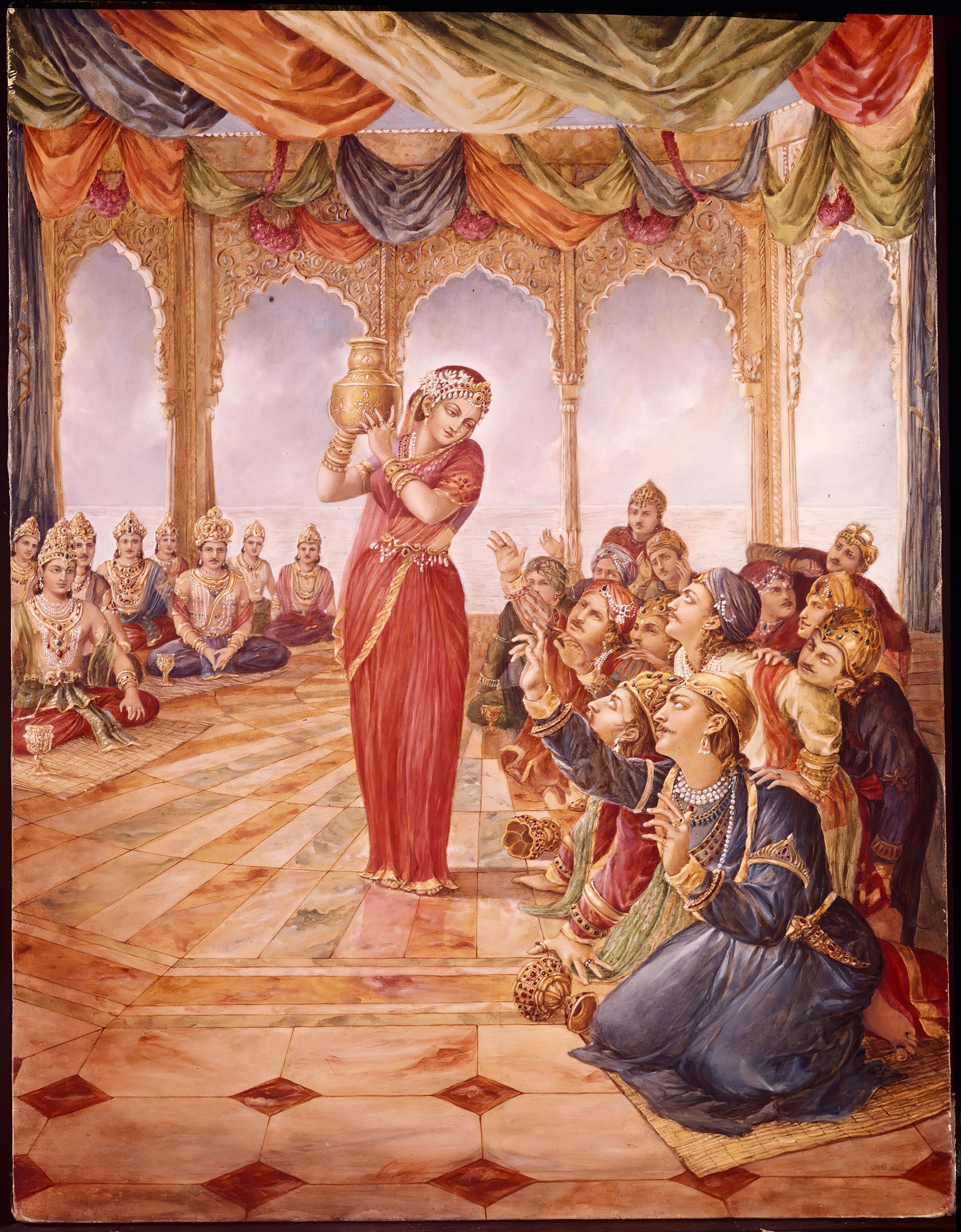
In reality, both ideas are present in the scriptures. Ladies who would be ascetics would dress like ascetics, like in the example of Devahūti when she was performing austerities following the vows of her husband. At that time, she was using torn clothes, her hair became matted, and she looked emaciated and unattractive. Ladies who desire to be ascetics may follow this example. However, it’s also described that ladies in family life would dress very beautifully for different social functions, and this would create a happy and beneficial situation. It’s also mentioned that ladies would dress well at home, with clean and attractive clothes with the purpose of keeping their husbands’ minds in good order, so they could properly execute their family duties.
Prabhupāda makes a very important point in his purport to SB 1.9.27:
“As far as the women class are concerned, they are accepted as a power of inspiration for men. As such, women are more powerful than men. Mighty Julius Caesar was controlled by a Cleopatra. Such powerful women are controlled by shyness. Therefore, shyness is important for women. Once this control valve is loosened, women can create havoc in society by adultery. Adultery means production of unwanted children known as varṇa-saṅkara, who disturb the world.”
Although men are usually strong, materially speaking, women are stronger because they can use their femininity to control men. A powerful man like a Julius Caesar can be controlled by a Cleopatra. However, who controls such a Cleopatra? Shyness is the control valve, which will make her use her power at home, where it is useful, and not outside, where it can be destructive.
As in other points, it comes down to one’s position in society and in life. The varnāśrama institution is based on acting in ways that are appropriate according to our spiritual and social position, using natural inclinations in positive ways, and not in trying to fit entire sections of society into stereotypes, which is more akin to communism.
When one becomes an ascetic, the idea is to remove one's attention from the body to spiritual practice; therefore, dressing in a very simple way becomes the norm. If a woman is helping her husband during his practice of austerities, for example, like in the case of Devahūti, dressing in an overly attractive way just to distract him would be counterproductive.
On the other hand, when we are in family life, the priorities are different. A young lady who identifies herself as a woman will have a natural tendency to want to look beautiful, and the scriptures thus recommend that she exert this tendency in situations where it is appropriate.
When a lady disciple wrote to Śrila Prabhupāda asking if she should shave her head like the men, Prabhupāda answered that Kṛṣṇa doesn’t like ugly gopīs. This doesn’t mean she was to think she was a gopī, but made the point that in her position it was more useful to try to look beautiful for Kṛṣṇa than to try to artificially become renounced.
In modern societies, ladies often have the idea that they can be pajama queens at home, and dress when they go out, but the Vedic concept is the opposite, that a lady should put more effort into dressing well at home, to keep her husband’s mind in good order, than in dressing for outside. It makes sense when we think about it: her whole family life is based on the relationship with her husband, while unknown people from outside give her nothing.
Very few men enter into family life just as a matter of duty. They normally get married because they are attracted to ladies, and especially to the lady they choose. The Vedic idea is thus that a lady should nourish this attraction, so the man remains satisfied in family life and doesn’t have any ideas connected with other ladies. Attachment is a useful tool in family life because it makes men act dutifully, taking better care of their families. Attraction goes away naturally with time, but a lady should try to keep it as far as possible, until it is agreed that it is time to enter retired life.
There is, however, a difference in the concept of attractiveness in Vedic societies and what is attractive in modern societies. When the scriptures mention ladies dressing in an attractive way, this means dresses in the mode of goodness, that look clean and beautiful, but not in a sexual sense. The sari (when correctly used) is a good example since it is a cloth that covers the body properly and at the same time looks beautiful and elegant. This type of beauty is very favorable for ladies in family life because it inspires the men in a positive sense. One may use other styles of clothing that may be suitable; the main point is the substance, not the form.
The problem in modern societies is that attractive usually implies a sexual sense, with ladies dressed in provocative ways. This type of dress inspires an exploitative attitude in men that is not very favorable for anyone. If a lady starts showing her body outside, she starts to attract the wrong type of man, lusty men that are interested in exploiting her, instead of protecting her inside marriage. This also contributes to cases of infidelity, illicit affairs, and other problems. Usually, what causes problems in our communities is not men being overly attracted to their wives, but becoming attracted to others, which leads to extra-conjugal affairs. If a lady can avoid it by keeping her husband attracted to her, it can be positive not only for her family but for society at large.
You can also donate using Buy Me a Coffee, PayPal, Wise, Revolut, or bank transfers. There is a separate page with all the links. This helps me enormously to have time to write instead of doing other things to make a living. Thanks!
Good points,, keep posting, Hare Krishna
Good points prabhu