


You can receive new articles directly in your inbox. Subscription is free; donations are welcome.
Some say that we should pray to Kṛṣṇa when we face material difficulties and even when we want particular material things, since it’s better to pray to Kṛṣṇa than to anyone else. However, others say that we should pray to Him strictly to ask for pure devotional service. What should we do?
It depends on which platform we are on. Śrila Prabhupāda explains this in detail in his purport to SB 6.9.40. This is part of the pastime when demigods approach Lord Viṣnu to ask for help in fighting the demon Vritrasura, who had defeated them and expelled them from the celestial planets:
“There are two kinds of devotees, known as sakāma and akāma. Pure devotees are akāma, whereas devotees in the upper planetary systems, such as the demigods, are called sakāma because they still want to enjoy material opulence.”
“The difference between sakāma and akāma devotees is that when sakāma devotees, like the demigods, fall into difficulty, they approach the Supreme Personality of Godhead for relief, whereas akāma devotees, even in the greatest danger, never disturb the Lord for material benefits. Even if an akāma devotee is suffering, he thinks this is due to his past impious activities and agrees to suffer the consequences. He never disturbs the Lord. Sakāma devotees immediately pray to the Lord as soon as they are in difficulty, but they are regarded as pious because they consider themselves fully dependent on the mercy of the Lord.”
“Even while suffering in the midst of difficulties, devotees simply offer their prayers and service more enthusiastically. In this way they become firmly fixed in devotional service and eligible to return home, back to Godhead, without a doubt. Sakāma devotees, of course, achieve from the Lord the results they desire from their prayers, but they do not immediately become fit to return to Godhead.”
As Śrila Prabhupāda explains, there are two classes of devotees, sakāma (with material desires) and akāma (pure devotees, without material desires). Pure devotees by definition have no material desires, and thus they don’t pray to Kṛṣṇa for that. They fully understand that the Lord knows everything and are completely surrendered to His will; therefore, they don’t see the need to disturb the Lord by praying for protection either. Such pure devotees pray only for achieving pure devotional service.
However, not all of us are on such an elevated platform. As a consequence, we often fear for our own security; we desire to obtain different things; we have many material desires, and so on. The point the scriptures make is that although it’s better to pray to the Lord exclusively for devotional service, if we are going to ask someone, it’s much better to ask the Lord.
In the Bhagavad-gītā, Kṛṣṇa reveals that most people start on the path of devotional service by praying for material things. However, the Lord is not angry about that. On the contrary, He describes these materialistic devotees as “su-kṛtino”, or pious people:
“O best among the Bhāratas, four kinds of pious men begin to render devotional service unto Me – the distressed, the desirer of wealth, the inquisitive, and he who is searching for knowledge of the Absolute.” (Bg 7.16)
However, He also explains that there is a difference in quality between them and a pure devotee who approaches Him with a completely pure heart:
“Of these, the one who is in full knowledge and who is always engaged in pure devotional service is the best. For I am very dear to him, and he is dear to Me. All these devotees are undoubtedly magnanimous souls, but he who is situated in knowledge of Me I consider to be just like My own self. Being engaged in My transcendental service, he is sure to attain Me, the highest and most perfect goal.” (Bg 7.17-18)
As we can see, both sides are correct to a certain extent. If we are going to pray for someone, we should pray to Kṛṣṇa, instead of praying to some demigod or begging to some rich person. By bringing our material anxieties to Kṛṣṇa, we gradually become purified and eventually realize that all these things are illusory, something that doesn’t happen when we pray to demigods.
As Śrila Prabhupāda explains:
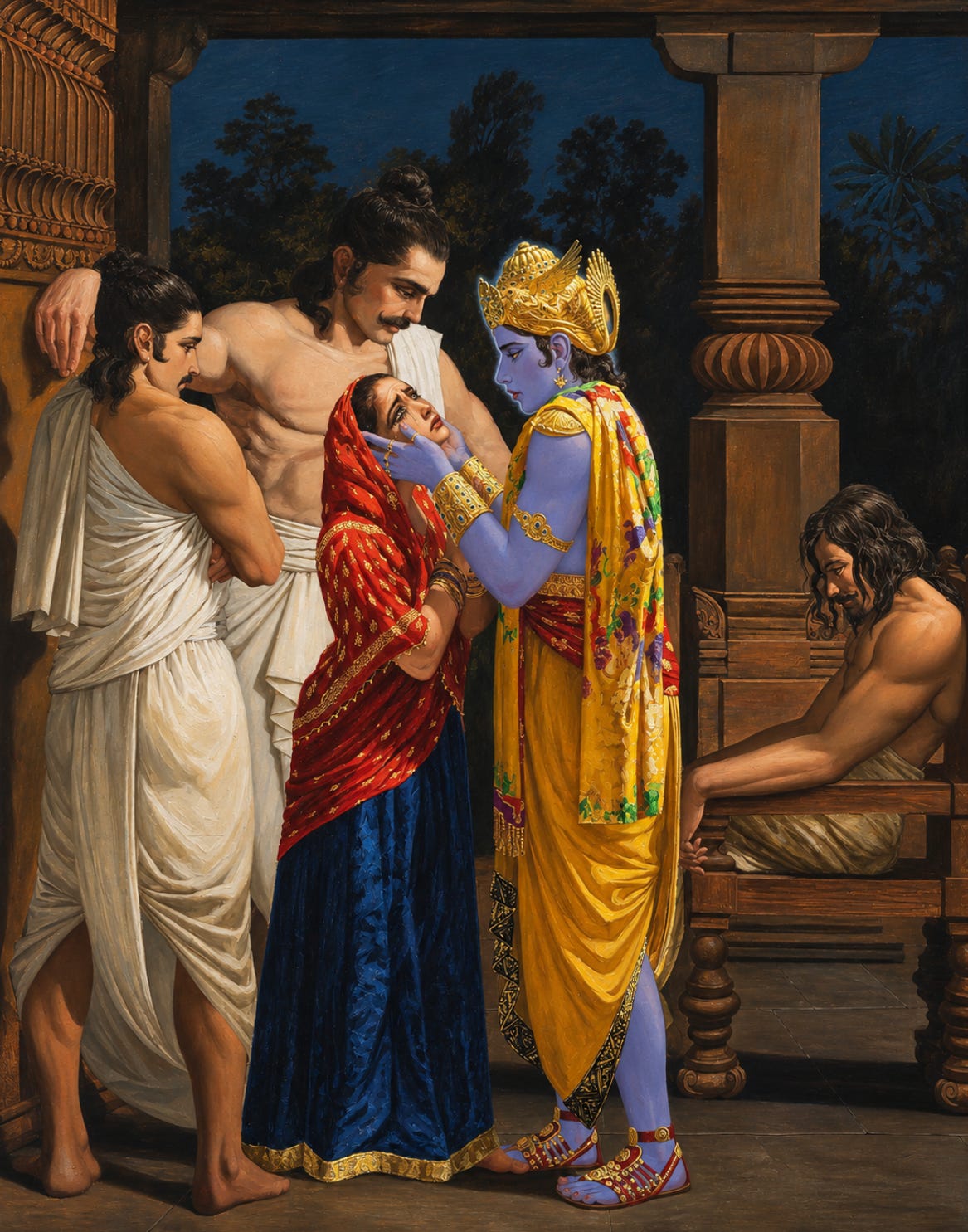
“The four classes of neophyte devotees who approach the Supreme Personality of Godhead to offer devotional service because of material motives are not pure devotees, but the advantage for such materialistic devotees is that they sometimes give up their material desires and become pure. When the demigods are utterly helpless, they approach the Supreme Personality of Godhead in grief and with tears in their eyes, praying to the Lord, and thus they become almost pure devotees, free from material desires. Admitting that they have forgotten pure devotional service because of extensive material opportunities, they fully surrender to the Lord, leaving to His consideration whether to maintain them or annihilate them. Such surrender is necessary.” (SB 6.9.44)
Apart from that, Kṛṣṇa is the only one who can really give us material relief, as Śrila Prabhupāda also explains:
“One need only seek shelter of the shade of the Lord’s lotus feet. Then all the material tribulations that disturb him will be subdued, just as when one comes under the shadow of a big tree, the disturbances caused by the heat of the scorching sun are immediately mitigated, without one’s asking for relief. Therefore the whole concern of the conditioned soul should be the lotus feet of the Lord. The conditioned soul suffering from various tribulations because of existing in this material world can be relieved only when he seeks shelter at the Lord’s lotus feet.” (SB 6.9.43)
Although Kṛṣṇa generally gives what devotees ask for, in certain circumstances He gives His special mercy, helping the devotee to break with his attachments and go back to Godhead. Of course, this special mercy is reserved only for special devotees, who are almost ready to return. Śrila Prabhupāda explains how he himself became the recipient of this special mercy when he had problems with his business and lost all his material possessions. Initially, he had the idea of becoming a rich man and then using these resources to preach in the West, but Kṛṣṇa had a different plan.
Prabhupāda also explains this point in his purports in the same chapter:
“Not knowing how to utilize his human or demigod life, a kṛpaṇa is attracted by things created by the material modes of nature. The kṛpaṇas, who always desire material benefits, are foolish, whereas brāhmaṇas, who always desire spiritual benefits, are intelligent. If a kṛpaṇa, not knowing his self-interest, foolishly asks for something material, one who awards it to him is also foolish. Kṛṣṇa, however, is not a foolish person; He is supremely intelligent. If someone comes to Kṛṣṇa asking for material benefits, Kṛṣṇa does not award him the material things he desires. Instead, the Lord gives him intelligence so that he will forget his material desires and become attached to the Lord’s lotus feet. In such cases, although the kṛpaṇa offers prayers to Lord Kṛṣṇa for material things, the Lord takes away whatever material possessions the kṛpaṇa has and gives him the sense to become a devotee.” (6.9.49)
By understanding that, we can see yet another advantage in praying to Kṛṣṇa: our prayers never go unanswered. Or we get what we are praying for, or we get something better. Kṛṣṇa is infinitely intelligent, and He understands what is better for us better than anyone else. More than that, He can understand our heart and thus give us something that is going to solve the underlying problems, instead of just mechanically giving us what we ask for, as demigods would do.
If a person prays to a demigod for four meters of rope, a demigod will just give him that, without knowing that he intends to use this rope to hang himself. However, if he prays to Kṛṣṇa, He will understand what the underlying problem is. Instead of giving him the means to kill himself, He will give him a solution for his real issues, so he doesn’t need to rope in the first place. Above all that, Kṛṣṇa also gives us things in ways that don’t become an impediment to our devotional service.
In a nutshell, if we are free from material desires and can pray to Kṛṣṇa solely for pure devotional service, that’s the best. However, if we are not on such an elevated platform, we should pray to Kṛṣṇa for whatever we think we need, instead of asking someone else. One who approaches Kṛṣṇa never loses. It may take more or less time, but everyone who comes closer to Him eventually goes back to Godhead.
Read more:


This is a publication for thoughtful readers who want to go deeper into Kṛṣṇa consciousness. I publish daily, trying to offer high-quality spiritual content, and all posts are available to free subscribers. If you wish, you can support this work with a monthly contribution. When you subscribe, you can choose between a free subscription and a monthly contribution, and you can switch from a free subscriber to a supporter at any time.
You can also receive updates on WhatsApp or Telegram.
If you would like to contribute further, you can find the donation links here.
Amazing Article.
A quick question -
If we pray for pure devotion for those who are dear to us, such as family members or friends or some people who touch our hearts in some way does that fall as material desire since we are praying for them identifying them as our relatives instead of asking for mercy for all living entities. 😶