

« Things I Wish Someone Had Taught Me When I Started Krishna Consciousness
Simplicity makes us rich
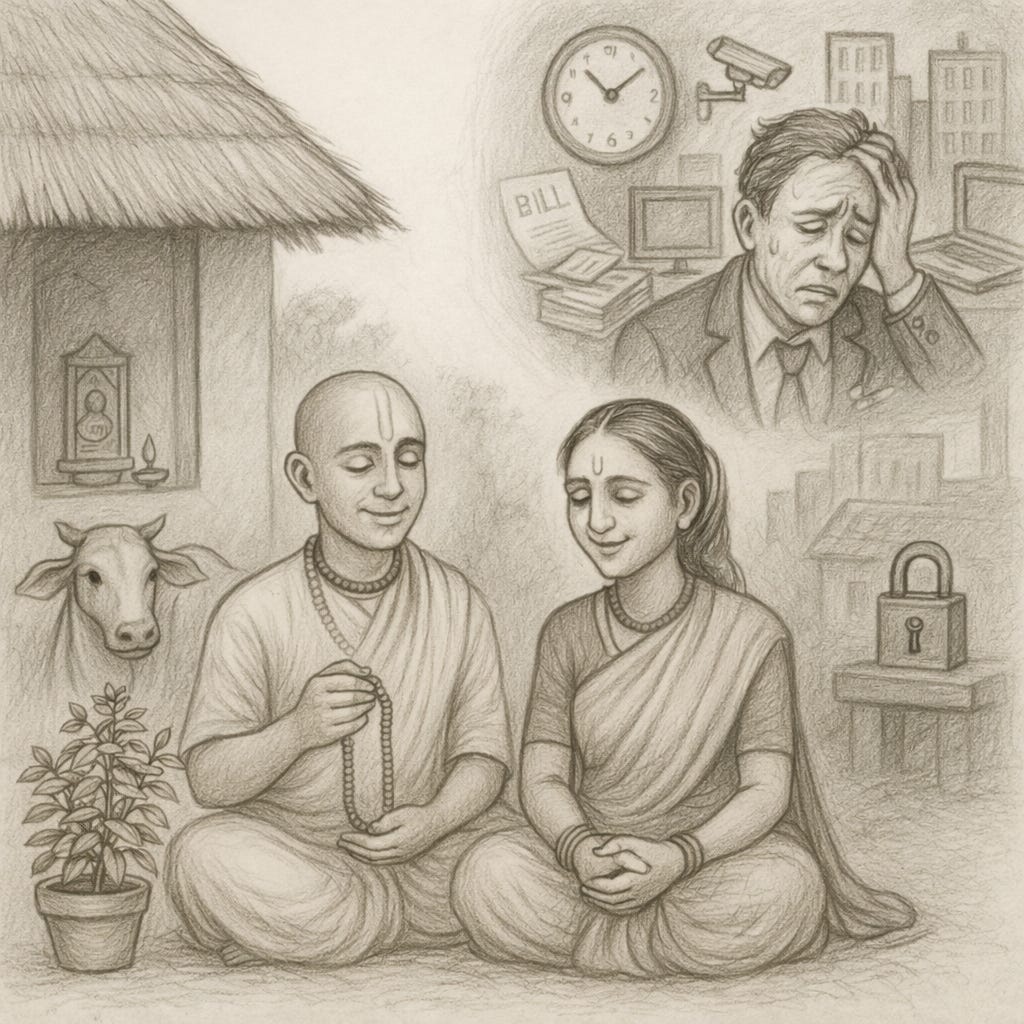
Śrila Prabhupāda wrote much about the concept of simple and spiritually progressive life in his books, conveying the idea that happiness is not in material acquisitions but in regaining our eternal relationship with Kṛṣṇa. However, we may think that the concept of achieving pure devotional service is very distant, and meanwhile, we still have to satisfy our material desires. Most of our desires are connected with money, and thus we often think that we need more money to achieve material happiness, and to get money, we need to spend our time working more, learning to make investments, etc. However, this is a mistaken conclusion.
Even materially speaking, happiness is not so much about how much we have but the proportion between what we need and the resources that are available to us. This is where the idea of simple living can help us attain happiness even before we attain the stage of high thinking, i.e., spiritual realization.
How does it work?
Imagine a person who makes 10,000 euros per month. For most of us, this is more than we can dream of, but if he needs 100,000 euros per month to maintain his lifestyle, he will be completely miserable with these 10,000. He will feel poor because he will be making just 10% of what he needs to be happy.
On the other hand, a person who needs just 500 euros per month and makes 1,000 will feel perfectly happy, even making just 1/10 of the first example. He will have enough money to live and even some extra for savings or other plans. He will feel rich.
To make 100,000 euros, one will have to work extremely hard, sacrifice relationships, and probably sell his soul to immoral activities, and even then, it may not be enough. On the other hand, living with less, we can make our living without so much effort. We may not even have to maintain a crushing full-time job for that. Instead, we can invest our time in our spiritual practice, in cultivating relationships, and so on, which are the things that factually bring happiness.
Another problem with having more material needs is that things demand not only money but also time. Even if we have the money, we still need to search and buy things, deal with delivery, replacements, repairs, warranties, insurance, taxes, unscrupulous salespersons, robbers, and so on. One who lives a simple life may sleep peacefully at night, knowing that no one will try to rob him, but a millionaire living an extravagant lifestyle will have to maintain an apparatus of security guards, alarms, insurance, and so on. All these things not only cost a lot of money, but also consume a lot of time. Therefore, apart from working hard to make the money to obtain these luxuries, one will also have to work extra to maintain them. Another problem is that the more money we have, the more difficult it is to maintain sincere relationships, which is a problem in itself. The idea of being rich doesn’t sound so attractive if it means ending up as anxious, depressed, and lonely workaholics.
In the Gītā (2.66), Kṛṣṇa mentions that, “One who is not connected with the Supreme [in Kṛṣṇa consciousness] can have neither transcendental intelligence nor a steady mind, without which there is no possibility of peace. And how can there be any happiness without peace?”
Why does Kṛṣṇa speak about not having a steady mind? The point is that when we sacrifice our spiritual practice to try to increase our material prosperity, we act on the desires and plans of the mind. These desires have no end, and thus the more we act on them, the more they grow. This growth leads to even more desires, which makes the mind progressively more agitated, which goes against the foundation of happiness, which is peace. This peace can be obtained only when we calm the mind, which can be obtained only through spiritual practice, which in turn demands time. To have time, we need a simple and peaceful lifestyle.
In his purport to the same verse, Prabhupāda explains, “Unless one is in Kṛṣṇa consciousness, there is no possibility of peace. So it is confirmed in the Fifth Chapter (5.29) that when one understands that Kṛṣṇa is the only enjoyer of all the good results of sacrifice and penance, that He is the proprietor of all universal manifestations, and that He is the real friend of all living entities, then only can one have real peace. Therefore, if one is not in Kṛṣṇa consciousness, there cannot be a final goal for the mind. Disturbance is due to want of an ultimate goal, and when one is certain that Kṛṣṇa is the enjoyer, proprietor and friend of everyone and everything, then one can, with a steady mind, bring about peace. Therefore, one who is engaged without a relationship with Kṛṣṇa is certainly always in distress and is without peace, however much he may make a show of peace and spiritual advancement in life. Kṛṣṇa consciousness is a self-manifested peaceful condition which can be achieved only in relationship with Kṛṣṇa.”
Without peace, we may live in an opulent situation, but this will not be happiness; it will be anxiety. On the other hand, a simple and progressive life gives us the opportunity to cultivate the factors that bring real happiness. This includes not only material factors, such as having sufficient time to cultivate relationships and hobbies, but also the main spiritual goal, which is to revive our eternal relationship with Kṛṣṇa. We can thus see that this process of simplifying our lives on the material side and using the time to increase our spiritual practice, as suggested by Śrila Prabhupāda, is the path for lasting happiness.
In the Gītā, Kṛṣṇa mentions that a person free from all attachment and aversion and able to control his senses through spiritual practice can obtain the mercy of the Lord. When this is attained, the threefold miseries of material existence no longer exist, and in such satisfied consciousness, one’s intelligence is soon well established.
We don’t necessarily need to give up all material goals and desires, but we should focus on just one or a few things that are really important and use the balance of time to cultivate our spiritual practice, going in the direction of gradually achieving a steady mind, as Kṛṣṇa explains. Above that, we should be able to be satisfied with what comes on its own accord and not get into the rat race of desiring more than we are entitled to.
As described in the Īśopaniṣad, each of us has a certain quota of material resources that is reserved for us according to our needs and past activities. This particular quota comes to us automatically by just performing our basic duties, just like both the elephant and the ant get the food they need by the mercy of the Lord. On the other hand, when we desire more, we have to work very hard, and even then, the results are uncertain. Most people work very hard in modern societies, but not many of them become millionaires. The easy way to become rich is not by increasing our income, but by decreasing our material needs. By halving our needs, we not only double our income in practice, but also free up lots of time.
Apart from material calculations, real happiness is found internally, not in matter. In reality, happiness is the very nature of the soul, but to connect with this unlimited happiness, we need to stop paying so much attention to the outside. Kṛṣṇa explains this point in the Gita: “One whose happiness is within, who is active and rejoices within, and whose aim is inward is actually the perfect mystic. He is liberated in the Supreme, and ultimately he attains the Supreme.” (Bg 5.24)
The more we try to find happiness in different material assets, the harder it is to find and maintain this happiness, because happiness will be present only as long as all this material paraphernalia is around us. As soon as something is lost or broken, this happiness is disturbed. However, someone who finds happiness within can go anywhere and feel perfectly happy in any situation, because one is carrying the source of one’s happiness inside oneself whenever he or she goes.
More than that, material happiness is connected with the body, and thus is taken away from us at the time of death. Even if we come, after much effort, to a situation we can consider happy, we will have to start again from scratch in our next life, in a perpetual struggle. Spiritual happiness, on the other hand, is permanent. Not only do we never lose it, but it is constantly increasing.
« Things I Wish Someone Had Taught Me When I Started Krishna Consciousness
You can also donate using Buy Me a Coffee, PayPal, Wise, Revolut, or bank transfers. There is a separate page with all the links. This helps me enormously to have time to write instead of doing other things to make a living. Thanks!
Thank you for this.