

Subscribe to receive new articles by e-mail. It’s free, but if you like, you can pledge a donation:
Join the Telegram group if you would like to join the live lessons. This course is maintained with your donations. Click here to donate.
💬 Text of the lesson
“This great machine, consisting of the stars and planets, resembles the form of a śiśumāra [dolphin] in the water. It is sometimes considered an incarnation of Kṛṣṇa, Vāsudeva. Great yogīs meditate upon Vāsudeva in this form because it is actually visible.
This form of the śiśumāra has its head downward and its body coiled. On the end of its tail is the planet of Dhruva, on the body of its tail are the planets of the demigods Prajāpati, Agni, Indra and Dharma, and at the base of its tail are the planets of the demigods Dhātā and Vidhātā. Where the hips might be on the śiśumāra are the seven saintly sages like Vasiṣṭha and Aṅgirā. The coiled body of the Śiśumāra-cakra turns toward its right side, on which the fourteen constellations from Abhijit to Punarvasu are located. On its left side are the fourteen stars from Puṣyā to Uttarāṣāḍhā. Thus its body is balanced because its sides are occupied by an equal number of stars. On the back of the śiśumāra is the group of stars known as Ajavīthī, and on its abdomen is the Ganges that flows in the sky [the Milky Way].
On the right and left sides of where the loins might be on the Śiśumāra-cakra are the stars named Punarvasu and Puṣyā. Ārdrā and Aśleṣā are on its right and left feet, Abhijit and Uttarāṣāḍhā are on its right and left nostrils, Śravaṇā and Pūrvāṣāḍhā are at its right and left eyes, and Dhaniṣṭhā and Mūlā are on its right and left ears. The eight stars from Maghā to Anurādhā, which mark the southern course, are on the ribs of the left of its body, and the eight stars from Mṛgaśīrṣā to Pūrvabhādra, which mark the northern course, are on the ribs on the right side. Śatabhiṣā and Jyeṣṭhā are on the right and left shoulders.
On the upper chin of the śiśumāra is Agasti; on its lower chin, Yamarāja; on its mouth, Mars; on its genitals, Saturn; on the back of its neck, Jupiter; on its chest, the sun; and within the core of its heart, Nārāyaṇa. Within its mind is the moon; on its navel, Venus; and on its breasts, the Aśvinī-kumāras. Within its life air, which is known as prāṇāpāna, is Mercury; on its neck is Rāhu, all over its body are comets, and in its pores are the numerous stars.” (SB 5.23.4-7)
The Śiśumāra is an aid for meditation, much like the universal form, described in the Second Canto. A yogi observes the path of stars in the sky, and conceives a celestial dolphin that is head down. The end of the tail is connected with the polestar, and other parts of the body are connected with other prominent stars. The purpose of this process is to understand the presence of the Lord behind the cosmic manifestation and fix one’s mind on Him. Many can’t really conceive the personal form of the Lord, and prefer thus to meditate on something they can directly see.
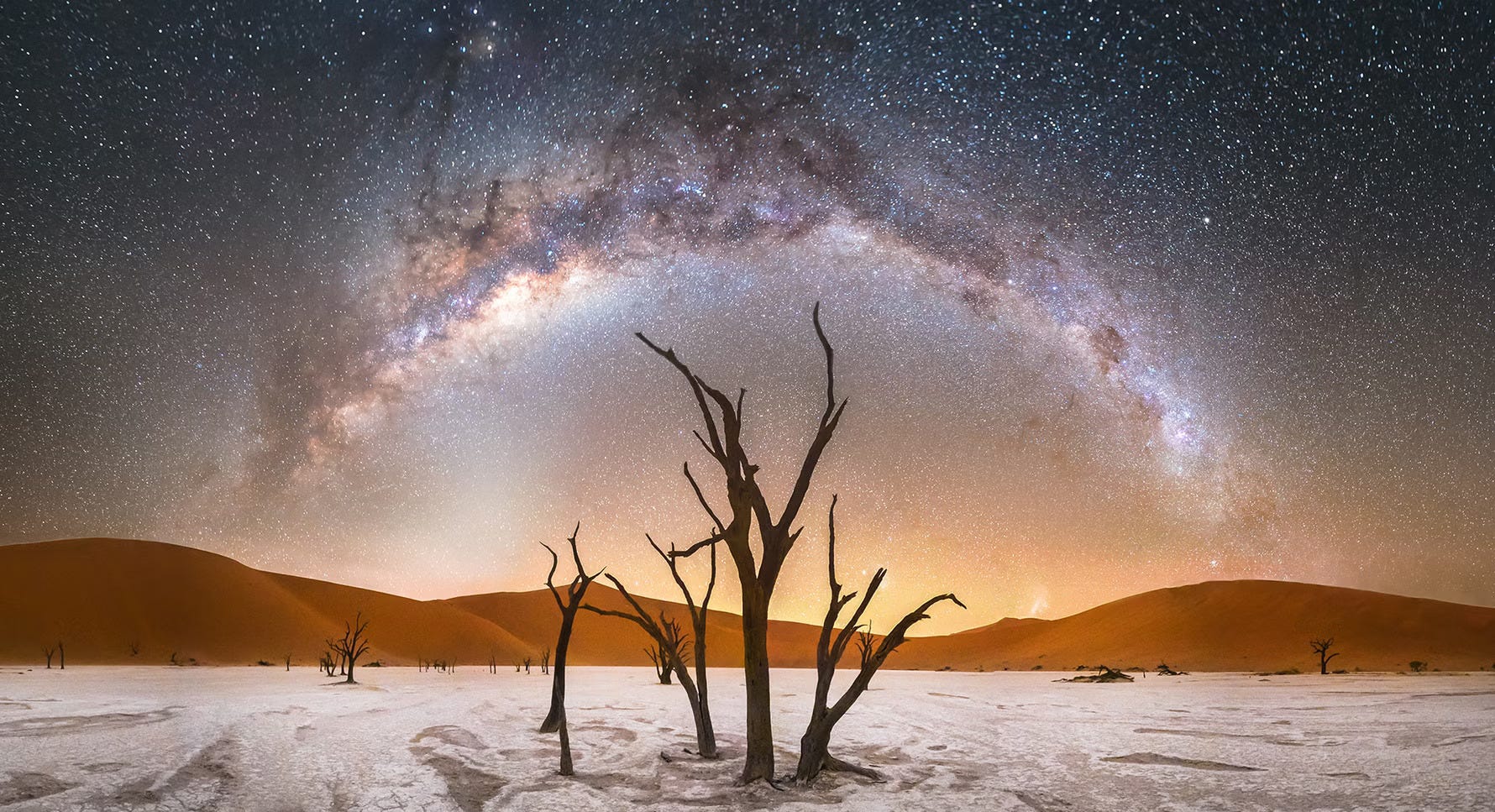
The śiśumāra is also taken, in a more general sense, as the path of the milky way extending through the sky, the millions of stars all the way to the polestar. In the model, the Milky Way is the path of the Ganges flowing in the sky, which forms the abdomen of śiśumāra.
In his description of the chapter, Prabhupāda explains:
“Those who worship the virāṭ-puruṣa, the universal form of the Lord, conceive of this entire rotating system of planets as an animal known as śiśumāra. This imaginary śiśumāra is another form of the Lord. The head of the śiśumāra form is downward, and its body appears like that of a coiled snake. On the end of its tail is Dhruvaloka, on the body of the tail are Prajāpati, Agni, Indra and Dharma, and on the root of the tail are Dhātā and Vidhātā. On its waist are the seven great sages. The entire body of the śiśumāra faces toward its right and appears like a coil of stars. On the right side of this coil are the fourteen prominent stars from Abhijit to Punarvasu, and on the left side are the fourteen prominent stars from Puṣyā to Uttarāṣāḍhā. The stars known as Punarvasu and Puṣyā are on the right and left hips of the śiśumāra, and the stars known as Ārdrā and Aśleṣā are on the right and left feet of the śiśumāra. Other stars are also fixed on different sides of the Śiśumāra planetary system according to the calculations of Vedic astronomers. To concentrate their minds, yogīs worship the Śiśumāra planetary system, which is technically known as the kuṇḍalini-cakra.”
The next verses continue:
“My dear King, the body of the śiśumāra, as thus described, should be considered the external form of Lord Viṣṇu, the Supreme Personality of Godhead. Morning, noon and evening, one should silently observe the form of the Lord as the Śiśumāra-cakra and worship Him with this mantra: “O Lord who have assumed the form of time! O resting place of all the planets moving in different orbits! O master of all demigods, O Supreme Person, I offer my respectful obeisances unto You and meditate upon You.”
The body of the Supreme Lord, Viṣṇu, which forms the Śiśumāra-cakra, is the resting place of all the demigods and all the stars and planets. One who chants this mantra to worship that Supreme Person three times a day — morning, noon and evening — will surely be freed from all sinful reactions. If one simply offers his obeisances to this form or remembers this form three times a day, all his recent sinful activities will be destroyed.” (SB 5.23.8-9)
These two verses summarize the description of the process of meditation on the śiśumāra, observing the path of stars in the sky as a form of Lord Viṣnu. A yogī following this process worships the Lord three times per day, meditating on His form as the wheel of time, moving the whole cosmic manifestation, with the mantra: namo jyotir-lokāya kālāyanāyānimiṣāṁ pataye mahā-puruṣāyābhidhīmahīti.
The śiśumāra-cakra is not a substitute for Viṣnu; it is seen as Lord Viṣnu’s external body, as Him present in the cosmic manifestation. This is not a form of pantheism, but a process of personal worship that helps the worshipers to gradually advance to a platform of worship of the spiritual form of the Lord.
This again emphasizes the main point of this description: do not just analyze the cosmos, worship the Lord who is the source and maintainer of the whole cosmic apparatus. This is the missing link in modern science, and the key to properly understanding the cosmos. Without this understanding, the study of the cosmos becomes fruitless, a mere exercise of speculation that just brings one further away from the goal of human life.
The whole cosmological model pushes people in the direction of atheism. By properly understanding the theistic model offered in the Śrīmad Bhāgavatam, we can offer people an alternative. If people can look to the sky and see the hand of the Lord behind its workings, this will be the first step for them to become full-fledged Vaiṣnavas.
Prabhupāda concludes his commentary by giving us a summary of the distances to the higher planetary systems according to the numbers given by Śrīla Viśvanātha Cakravartī Ṭhākura:
Sun to Dhruvaloka (Polestar): 3,800,000 yojanas
Sun to Maharloka: 13,800,000 yojanas (+10,000,000)
Sun to Janaloka: 33,800,000 yojanas (+20,000,000)
Sun to Tapoloka: 113,800,000 yojanas (+80,000,000)
Sun to Satyaloka: 233,800,000 yojanas (+120,000,000)
Sun to beginning of the coverings: 260,000,000 yojanas (+26,200,000)
Downward from the Sun:
Sun to Earth: 100,000 yojanas
Sun to the bottom of the lower planetary systems: 170,000 yojanas (+70,000)
Sun to Lord Śeṣa: 200,000 yojanas (+30,000)
Below Lord Śeṣa is the Garbhodaka Ocean, which occupies almost half of the universe.
We can observe that the distance to Dhruvaloka, which in the model is the furthest star that we can directly see with the naked eye is quite small compared with the total length of the universe. After the polestar, there is the whole planetary system of Svargaloka, then Maharloka, Janaloka, Tapoloka and Satyaloka, which is positioned close to the border of the universe.
The size of the whole universe is supposed to be smaller than believed in modern cosmology, because the Bhāgavatam insists that the stars are not like the sun, and thus emit less light than believed in modern models, but it is still huge, comprising everything we see in the sky. The final, practical size will depend on the interpretation you give for the yojana, as previously discussed.
Outside of it, there are millions of other universes, the Causal Ocean, Lord Mahā-Viṣnu, the impersonal Brahmajyoti, and then all the other three quarters of creation, comprised of the Vaikuṇṭha planets. We are free to go anywhere in this unlimited creation, as long as we abandon our empiric, speculative approach, and focus instead in the process of elevating our consciousness, as explained in the pages of the Śrīmad Bhāgavatam.
The orbit of Rāhu, the dark planet
After describing the upper portion of the universe, covering the path of stars that go all the way to Svargaloka, Śukadeva Goswami now shifts into describing the lower parts of the universe, starting with Rāhu and the abodes of the lower demigods, all the way to the lower planets, where the asuras live.
“Śrī Śukadeva Gosvāmī said: My dear King, some historians, the speakers of the Purāṇas, say that 10,000 yojanas [80,000 miles] below the sun is the planet known as Rāhu, which moves like one of the stars. The presiding deity of that planet, who is the son of Siṁhikā, is the most abominable of all asuras, but although he is completely unfit to assume the position of a demigod or planetary deity, he has achieved that position by the grace of the Supreme Personality of Godhead. Later I shall speak further about him.
The sun globe, which is a source of heat, extends for 10,000 yojanas [80,000 miles]. The moon extends for 20,000 yojanas [160,000 miles], and Rāhu extends for 30,000 yojanas [240,000 miles]. Formerly, when nectar was being distributed, Rāhu tried to create dissension between the sun and moon by interposing himself between them. Rāhu is inimical toward both the sun and the moon, and therefore he always tries to cover the sunshine and moonshine on the dark-moon day and full-moon night.
After hearing from the sun and moon demigods about Rāhu’s attack, the Supreme Personality of Godhead, Viṣṇu, engages His disc, known as the Sudarśana cakra, to protect them. The Sudarśana cakra is the Lord’s most beloved devotee and is favored by the Lord. The intense heat of its effulgence, meant for killing non-Vaiṣṇavas, is unbearable to Rāhu, and he therefore flees in fear of it. During the time Rāhu disturbs the sun or moon, there occurs what people commonly know as an eclipse.” (SB 5.24.1-3)
These verses clarify the disposition of the sun and the moon. The celestial moon has two times the diameter of the sun and is situated farther away from us. In the Vedic model, therefore, solar eclipses are not caused by the moon passing in front of the sun, but by the orbit of Rāhu, a dark planet positioned between the sun and the earth, that is larger than the moon, and sometimes blocks the light of the sun, and sometimes the light of the moon.
The story of Rāhu is described in the Eighth Canto, in the pastime of the churning of the Milk Ocean. When nectar was finally produced, the demons quickly took it and started discussing who should drink it first. The Lord then appeared as Mohinī-mūrti to bewilder them and bring the nectar to the demigods. Rāhu, however, could understand the plan and slipped into the line, sitting between Soma and Surya. To show the potency of the nectar that had been produced, the Lord allowed him to take a sip of the nectar before cutting his head with His Sudarśana cakra. Because his lips had touched the nectar, he didn’t die, becoming instead a giant dark planet that can exert his envy toward the sun and the moon by periodically covering them.
This, however, also happens due to the will of the Lord, who allows Rāhu to perform his activities as part of the universal arrangement, but quickly sends his Sudarśana cakra to make sure Rāhu doesn’t spend even a minute more in front of the sun or the moon than he is supposed to. Faced with the cakra, Rāhu is forced to retreat.
Just as with Rāhu, there are many other universal forces controlled by demonic or adharmic forces, like Kali-yuga, for example, presided over by Kali, who dressed as a king and was chastised by Parīkṣit Maharaja. However, even they are not outside the control of the Lord. It is just that there is a time for everything.
Dualistic philosophies, such as Zoroastrianism, put forward the idea of a dichotomy between God and evil, but this view is not supported in the Vedas. There is only one Supreme Controller, who is in charge of everything. He controls not only the demigods, but also the demons and other cosmic forces. The reason there is evil is not that there is something out of His control, but just as an instrument for the fulfillment of karma. We bring evil to our lives by performing impious actions. Evil doesn’t come due to negligence or lack of control on Kṛṣṇa’s part, but because we turn our backs to Him.
How to reconcile the existence of Rāhu with the modern cosmological model, of the moon close to the earth and their orbits causing the eclipses?
If we accept both the sun and the moon we see in the sky as gross representations of the celestial bodies described in the Śrīmad Bhāgavatam, the two explanations don’t sound contradictory. Modern cosmology studies how the phenomenon looks from our gross dimension, while the Bhāgavatam describes the subtle phenomenon behind it, which is observable by the inhabitants of the subtle abodes of Bhū-mandala. These are two levels of reality, and one can choose which he or she wants to focus on.
In any case, Rāhu is described as a dark planet that can’t be directly observed. It influences us, just as the other planets, but its position can be inferred only indirectly, by calculations and by its passing in front of the sun and the moon. It is a disruptive force, but still operates under the divine government of the Lord, who can engage even unqualified agents to fulfill certain purposes. However, devotees who are constantly chanting the holy names are always free from their influence.
“Below Rāhu by 10,000 yojanas [80,000 miles] are the planets known as Siddhaloka, Cāraṇaloka and Vidyādhara-loka. Beneath Vidyādhara-loka, Cāraṇaloka and Siddhaloka, in the sky called antarikṣa, are the places of enjoyment for the Yakṣas, Rākṣasas, Piśācas, ghosts and so on. Antarikṣa extends as far as the wind blows and the clouds float in the sky. Above this there is no more air. Below the abodes of the Yakṣas and Rākṣasas by a distance of 100 yojanas [800 miles] is the planet earth. Its upper limits extend as high as swans, hawks, eagles and similar large birds can fly.” (SB 5.24.4-6)
Below Rāhu, there are planetary abodes of the Siddhas, Cāraṇas and Vidyādharas, three types of lower demigods, who are also described as regular visitors of the celestial varṣas of Jambūdvīpa. The Siddhas can travel at will, without the need of spaceships, while the Vidyādharas are described as traveling in their vimānas. These planets are very close to us in the Vedic model, less than 10,000 yojanas above is, but they are invisible to us, just like the rest of Bhū-mandala.
Between these abodes and our planet are the subtle realms of the Yakṣas, Rākṣasas, Piśācas and evil spirits. In the model of the Śrīmad Bhāgavatam, these abodes constitute the area around Mount Sumeru, which is the abode of Kuvera. The existence of these abodes so close to us, but still invisible, gives us insight on the nature of the rest of Bhū-mandala, and also reinforces the idea that the sun and moon we see in the sky are not directly the celestial abodes described in the Bhāgavatam, but just gross representations of them in our physical reality.
Bila-svarga: The subterranean Heavens
“My dear King, beneath this earth are seven other planets, known as Atala, Vitala, Sutala, Talātala, Mahātala, Rasātala and Pātāla. I have already explained the situation of the planetary systems of earth. The width and length of the seven lower planetary systems are calculated to be exactly the same as those of earth.In these seven planetary systems, which are also known as the subterranean heavens [bila-svarga], there are very beautiful houses, gardens and places of sense enjoyment, which are even more opulent than those in the higher planets because the demons have a very high standard of sensual pleasure, wealth and influence. Most of the residents of these planets, who are known as Daityas, Dānavas and Nāgas, live as householders. Their wives, children, friends and society are all fully engaged in illusory material happiness. The sense enjoyment of the demigods is sometimes disturbed, but the residents of these planets enjoy life without disturbances. Thus they are understood to be very attached to illusory happiness.” (SB 5.24.7-8)
Below the surface of Bhū-mandala lie seven other planetary systems, described as the abodes of the asuras. Just as Svargaloka is a disk of the same diameter as Bhū-mandala itself, each of these abodes is again of the same diameter, positioned one below the other. This explanation suggests that they are also planetary systems composed of thousands of planets each.
Different from the abodes of human beings and demigods, however, these are subterranean abodes where inhabitants have no access to the light of the sun. Their abodes are thus very opulent and materially beautiful but artificially illuminated.
Because they can’t see the sun, they don’t notice the passage of the days and nights. They live in a continuous night, both literal and figurative, not only living under artificial lights but also completely blind to self-realization. The kāla-cakra continues to rotate, diminishing their life expectancy, but they fail to notice it, being continuously involved in sense gratification.
In the Gītā, Kṛṣṇa mentions,
“Those who are envious and mischievous, who are the lowest among men, I perpetually cast into the ocean of material existence, into various demoniac species of life. Attaining repeated birth amongst the species of demoniac life, O son of Kuntī, such persons can never approach Me. Gradually they sink down to the most abominable type of existence.”
These two verses describe precisely the existence in the lower planetary systems. Atheists who are somehow pious usually have the opportunity of taking birth there and enjoying sense gratification in the company of other atheists. Because they want to turn their back to Him, Kṛṣṇa organizes a situation in which they can enjoy without being disturbed, and even arranges for some of His pure devotees, such as Prahlāda and Bali, to take birth there and give them the opportunity of getting their association.
As the text mentions, even the demigods are sometimes disturbed in their sense enjoyment by the attacks of the demons and other occurrences, and this helps them to return to their proper consciousness and take shelter of the Lord. The demons, however, are never disturbed (there is no one to attack them). In this way, they are free to enjoy until their pious merits are completely exhausted. After that, they usually go to the lower species of life and have to go through the evolutionary cycle. After millions of births, they eventually take birth as human beings in Kali-yuga, and because of their previous habits, usually engage again in sinful activities and thus glide back down into the lower heavens or animal life. Kṛṣṇa uses the word “ajasram” (perpetually, forever), giving the idea of a practically eternal cycle. In this way, such atheists remain in darkness for an incalculably long time. Since they want to enjoy without being disturbed by thoughts of a God, Kṛṣṇa gives them the opportunity of doing so.
In his purport, Prabhupāda brings our attention to our role in this cosmic system: We are not supposed just to sit and wait, observing as such souls remain perpetually in darkness. Devotees are the way out of this system. If an atheist meets with devotees in the rare opportunity of taking a human birth on our planet and can be, somehow or other, induced to perform any devotional act, smallest as it may be, he can start his devotional path and be eventually saved. For us, it may appear as a small act, such as giving someone a book, a sweet ball, or inducing one to chant Hare Kṛṣṇa and so on, but for them, it can be the moment that turns their existence.
“According to the statements of Prahlāda Mahārāja, material enjoyment is māyā-sukha, illusory enjoyment. A Vaiṣṇava is full of anxieties for the deliverance of all living entities from such false enjoyment. Prahlāda Mahārāja says, māyā-sukhāya bharam udvahato vimūḍhān: these fools (vimūḍhas) are engaged in material happiness, which is surely temporary. Whether in the heavenly planets, the lower planets or the earthly planets, people are engrossed in temporary, material happiness, forgetting that in due course of time they have to change their bodies according to the material laws and suffer the repetition of birth, death, old age and disease. Not caring what will happen in the next birth, gross materialists are simply busy enjoying during the present short span of life. A Vaiṣṇava is always anxious to give all such bewildered materialists the real happiness of spiritual bliss.” (SB 5.24.8 purport)
The cities of the demons
A personality very connected with the subterranean heavens is Maya Dānava, the great architect of the demons. He is an atheist, but he had the good fortune of meeting Arjuna during the pastime of the burning of the Khāṇḍava forest. Being threatened by the fire on one side and the Sudarśana cakra of the Lord on the other, he surrendered to Arjuna and was saved by him. Out of gratitude, he built the assembly hall of Maharaja Yudhiṣṭhira in Indraprastha. This is yet another instance of a demon being saved by a Vaiṣnava and being engaged in devotional service.
The Śrīmad Bhāgavatam describes that this same Maya Dānava builds many opulent cities in the lower planetary systems. All these cities contain gardens, parks, roads, and so on, as well as different types of birds and other animals. Demons travel from one city to another and stay in specially constructed hotels and guest houses. Apart from demons, many nāgas (celestial serpents) live in these cities, and the mystical gems on their heads emit light that illuminates them, replacing the light of the sun. It’s also described that their cities contain temples, but these are not temples of Viṣnu. Demons usually worship Lord Śiva or Durgā.
Their cities are described as more opulent than even the cities of the demigods. Just as the inhabitants of the earthly heavens in Bhū-mandala have access to rivers of different substances that grant them health, beauty, and vitality, the demons also have access to medicinal juices and elixirs that keep them free from old age and other bodily inconveniences. They can thus enjoy unrestricted for a long time, but eventually the Sudarśana cakra of the Lord (in the form of time) catches them. Like all materialists, they are terrified of that.
“My dear King, in the imitation heavens known as bila-svarga there is a great demon named Maya Dānava, who is an expert artist and architect. He has constructed many brilliantly decorated cities. There are many wonderful houses, walls, gates, assembly houses, temples, yards and temple compounds, as well as many hotels serving as residential quarters for foreigners. The houses for the leaders of these planets are constructed with the most valuable jewels, and they are always crowded with living entities known as Nāgas and Asuras, as well as many pigeons, parrots and similar birds. All in all, these imitation heavenly cities are most beautifully situated and attractively decorated.
The parks and gardens in the artificial heavens surpass in beauty those of the upper heavenly planets. The trees in those gardens, embraced by creepers, bend with a heavy burden of twigs with fruits and flowers, and therefore they appear extraordinarily beautiful. That beauty could attract anyone and make his mind fully blossom in the pleasure of sense gratification. There are many lakes and reservoirs with clear, transparent water, agitated by jumping fish and decorated with many flowers such as lilies, kuvalayas, kahlāras and blue and red lotuses. Pairs of cakravākas and many other water birds nest in the lakes and always enjoy in a happy mood, making sweet, pleasing vibrations that are very satisfying and conducive to enjoyment of the senses.
Since there is no sunshine in those subterranean planets, time is not divided into days and nights, and consequently fear produced by time does not exist.
Many great serpents reside there with gems on their hoods, and the effulgence of these gems dissipates the darkness in all directions.
Since the residents of these planets drink and bathe in juices and elixirs made from wonderful herbs, they are freed from all anxieties and physical diseases. They have no experience of grey hair, wrinkles or invalidity, their bodily lusters do not fade, their perspiration does not cause a bad smell, and they are not troubled by fatigue or by lack of energy or enthusiasm due to old age. They live very auspiciously and do not fear death from anything but death’s established time, which is the effulgence of the Sudarśana cakra of the Supreme Personality of Godhead. When the Sudarśana disc enters those provinces, the pregnant wives of the demons all have miscarriages due to fear of its effulgence.” (SB 5.24.9-15)
Just as our planet is connected to the higher abodes through subtle passages in the Himalayas, we are connected to these lower abodes through caves and subterranean passages. There are many stories in the folklore of different cultures of men going through these passages and finding very opulent places with beautiful women, etc. Based on these old folk stories, many believe these subterranean heavens exist under the surface of our planet, but that’s not exactly true. These planetary systems exist under the plane of Bhū-mandala, and not literally inside our planet. They are just connected to our planet through these subtle subterranean passages.
In his purport to text 14, Prabhupāda connects these lower heavens with the shortcomings of a materialistic civilization. That’s something important to reflect upon:
“This is the defect of material existence. Everything in the subterranean heavens is very nicely arranged. There are well situated residential quarters, there is a pleasing atmosphere, and there are no bodily inconveniences or mental anxieties, but nevertheless those who live there have to take another birth according to karma. Persons whose minds are dull cannot understand this defect of a materialistic civilization aiming at material comforts. One may make his living conditions very pleasing for the senses, but despite all favorable conditions, one must in due course of time meet death. The members of a demoniac civilization endeavor to make their living conditions very comfortable, but they cannot check death. The influence of the Sudarśana cakra will not allow their so-called material happiness to endure.”
Modern civilization is based on the same principles as the lifestyle of the asuras. We can see that most people in the cities imitate even the patterns of being more active during the night. Modern cities are thus replicas of the cities of the demons in the lower planets, with the same basic lifestyle. Trying to practice devotional service and develop the mode of goodness in such environments is surely challenging. Prabhupāda envisioned an alternative, based on small communities, where devotees could live in a more natural setting and practice spiritual life while keeping contact with the land and cows, two factors that strongly push us in the direction of the mode of goodness. Technically, one can practice devotional service in any circumstance, but as long as we are not situated on a perfect platform, the environment we live in surely plays an important role.
For someone trying to develop love of Godhead, living in a materialistic city, like the demons in the lower planets, may not be the most favorable environment.
This is a publication for thoughtful readers who want to go deeper into Kṛṣṇa consciousness. I publish daily, trying to offer high-quality spiritual content, and all posts are available to free subscribers. If you wish, you can support this work with a monthly contribution. When you subscribe, you can choose between a free subscription and a monthly contribution, and you can switch from a free subscriber to a supporter at any time.
If you would like to contribute further, you can find the donation links here.