

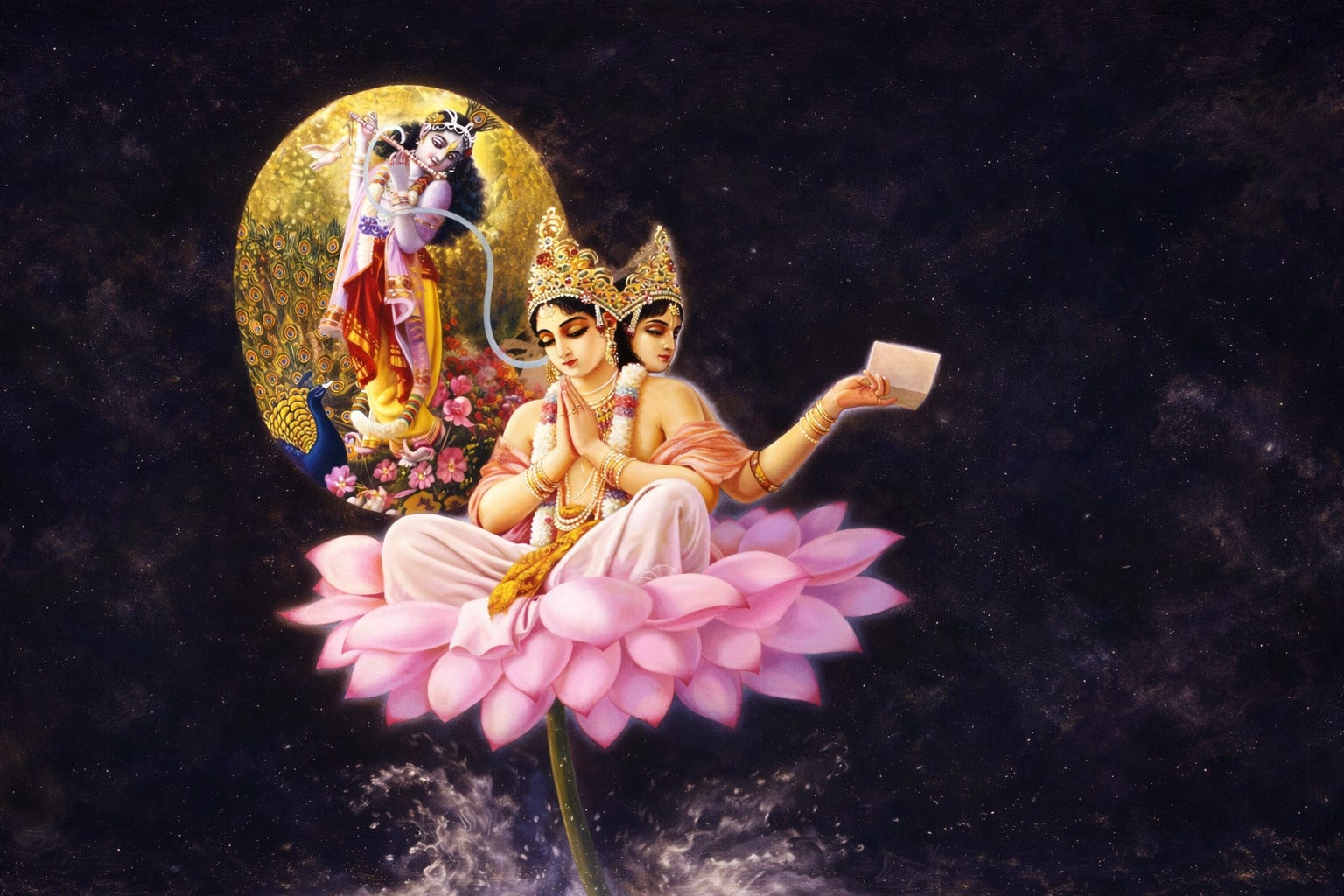
The Śrīmad-Bhāgavatam describes how Brahmā meditated on the Lord at the beginning of his day and was thus empowered to create the universe.
However, an attentive reader of Śrīmad-Bhāgavatam can notice an apparent contradiction between text 2.9.8, where it is mentioned that Brahma meditated for 1,000 years of the demigods (divyaṁ sahasrābdam) before creating the universe, text SB 3.8.22, where it is mentioned that Brahma meditated for one hundred of his years (puruṣāyuṣābhi-pravṛtta-yogena), and text 3.10.4, where it is mentioned he meditated for 100 celestial years (divyaṁ varṣa-śataṁ). It’s common for differences in details to appear in different descriptions of the same pastimes in different Purānas because they often include different accounts of the same pastimes, which mention different details or describe them from different perspectives, but these are complementary details, not contradictions.
When it comes to the life of Brahmā, we are on the first day of the second half of his life. In other words, our Brahmā is already 50 years old according to his calculation. From our perspective, however, more than 155 trillion years have passed since the birth of Brahmā. Such is the difference in the perception of time between Satyaloka and our plane. What is one day there is 8.64 billion years for us.
The first day of Brahmā is called the Brahmā-kalpa (when Brahma was born), and the second day is the Padma-kalpa (when the universe was first manifested). The current day is called the Varāha kalpa, because it is the day when Lord Varāha appears. It is sometimes also called Padma kalpa (just as the second day) because on the current day, Brahmā emerged again from the cosmic lotus flower after the complete devastation that occurred at the end of the first half of his life.
Brahma meditates before starting his process of creation at the beginning of each of his days. However, the current day is special because that’s the day when Kṛṣṇa personally manifested to Him, and he could see the whole spiritual world. After experiencing this wonderful vision, Brahmā then spoke the verses of the Brahma-saṁhitā.
In the Second Canto, in the description of Śukadeva Gosvāmī to Parīkṣit of the meeting of Brahmā with the Lord, it is mentioned:
“Lord Brahmā underwent penances for one thousand years by the calculations of the demigods. He heard this transcendental vibration from the sky, and he accepted it as divine. Thus he controlled his mind and senses, and the penances he executed were a great lesson for the living entities. Thus he is known as the greatest of all ascetics.
The Personality of Godhead, being thus very much satisfied with the penance of Lord Brahmā, was pleased to manifest His personal abode, Vaikuṇṭha, the supreme planet above all others. This transcendental abode of the Lord is adored by all self-realized persons freed from all kinds of miseries and fear of illusory existence.” (SB 2.9.8-9)
By the description in SB 2.9.8, it’s clear that this verse describes the meditation of Brahma at the beginning of the current day, before having the darśana of the Lord and hearing the four original verses of the Śrīmad-Bhāgavatam from Him. The whole passage describes their meeting and how Brahmā subsequently transmitted the Śrīmad-Bhāgavatam to his son, Nārada Muni, beginning our disciplic succession.
Up to here, everything is clear.
Then, we have chapter 3.8 (part of the instructions of Lord Saṅkarṣaṇa to the four Kumāras on the creation of the universe), where it is mentioned:
“Thereafter, being unable to achieve the desired destination, he retired from such searching and came back again to the top of the lotus. Thus, controlling all objectives, he concentrated his mind on the Supreme Lord.
At the end of Brahmā’s one hundred years, when his meditation was complete, he developed the required knowledge, and as a result he could see in his heart the Supreme within himself, whom he could not see before with the greatest endeavor.” (SB 3.8.21-22)
This description in chapter 3.8 appears to combine elements from the first day of Brahma and the current day. We can see that it is mentioned:
“Brahmā, born out of the lotus flower, could not see the world, although he was situated in the whorl. He therefore circumambulated all of space, and while moving his eyes in all directions he achieved four heads in terms of the four directions.
Lord Brahmā, situated in that lotus, could not perfectly understand the creation, the lotus or himself. At the end of the millennium the air of devastation began to move the water and the lotus in great circular waves. Lord Brahmā, in his ignorance, contemplated: Who am I that am situated on the top of this lotus? Wherefrom has it sprouted? There must be something downwards, and that from which this lotus has grown must be within the water. Lord Brahmā, thus contemplating, entered the water through the channel of the stem of the lotus. But in spite of entering the stem and going nearer to the navel of Viṣṇu, he could not trace out the root. O Vidura, while searching in that way about his existence, Brahmā reached his ultimate time, which is the eternal wheel in the hand of Viṣṇu and which generates fear in the mind of the living entity like the fear of death.” (SB 3.8.16-21)
We can see that this description includes elements from the first day of Brahmā, like him looking around and achieving four heads, sitting on top of the lotus without being able to create until the cycle of destruction at the end of his day is activated, trying to go down the lotus flower, and so on. This matches the beginning of the life of Brahmā, when creation happened only on his second day.
This leads to the description of SB 3.8.21-22, mentioning his meditation for 100 years. It is clear from the description that this was his meditation previous to the first creation, on the second day of his life.
SB 2.9.8 thus describes a meditation for 1,000 years of the demigods at the beginning of the current day, and SB 3.8.22 describes a meditation of 100 years before creating the universe for the first time in the second day of his life. We can see thus that these are two separate descriptions and there is no contradiction between them.
Another apparent contradiction
We then have another apparent contradiction between the purports on 3.8.22 by Śrīla Prabhupāda and Śrila Viśvanātha Cakravartī Thākura.
In his purport, Prabhupāda mentions that:
“The age of Brahmā is calculated in terms of divya years, which are distinct from the solar years of human beings. The divya years are calculated in Bhagavad-gītā (8.17): sahasra-yuga-paryantam ahar yad brahmaṇo viduḥ. Brahmā’s one day is equal to one thousand times the aggregate of the four yugas (calculated to be 4,300,000 years). On that basis, Brahmā meditated for one hundred years before he could understand the supreme cause of all causes, and then he wrote the Brahma-saṁhitā, which is approved and recognized by Lord Caitanya and in which he sings, govindam ādi-puruṣaṁ tam ahaṁ bhajāmi. One has to wait for the mercy of the Lord before one can either render service unto Him or know Him as He is.”
The words puruṣa-āyuṣā in text 3.8.22 can be interpreted as a lifetime of a human being (100 years) or a lifetime of Brahma, which is a much longer period. We can see that in both the verse and the purport, Śrīla Prabhupāda goes with the second interpretation.
Viśvanātha Cakravartī, however, appears to disagree with this interpretation on his commentary to the text, where he mentions that puruṣa-āyuṣā should be interpreted as one hundred years according to the calculations of human time in Kali-yuga, at the time Maitreya is speaking.
In this way, Śrīla Prabhupāda argues that Brahmā meditated for one hundred years according to his perception of time (an extremely long period), and Śrila Viśvanātha Cakravartī Thākura concludes that he meditated for one hundred years according to our perception (which is an extremely short period from the point of view of Brahmā).
If we analyze it using just logic, both views appear problematic: Brahmā lives for 100 years, so, if he spent this whole time meditating, how could he create the universe at all? And, if we accept he meditated for just 100 years of our time, this meditation would equal just 0.001 seconds of his time, which would not be meaningful at all. No one is glorified for meditating for 0.001 seconds. In both cases, the passage appears not to make sense.
There is, however, another way to see it that reconciles both views and gives meaning to the passage. Time is perceived differently in different parts of the cosmos. What is 100 years for us is 100 days for the demigods, and 0.001 seconds in Satyaloka. When a person moves from one place to another, their perception of time also changes accordingly. When Arjuna visited the celestial planets in his mission of collecting celestial weapons, he stayed for just a few days there. However, from the perspective of his brothers, who stayed on earth, several years passed.
Brahmā has access to all the dimensional levels of the universe; therefore, he could move from his dimensional level to the human dimensional level and then meditate for 100 years. In this way, he meditated for 100 years in his perception, and still, only 100 human years passed. Upon returning to his own dimension (where just 0.001 seconds had passed), he could resume his process of creation. When we consider from this point of view, there is no contradiction in the commentaries of Prabhupāda and Viśvanātha Cakravartī.
There is, however, another meaning that is hinted at in Prabhupāda’s purport, which appears to be the key to gaining access to the higher meaning of the whole passage.
In his purport to verse 3.8.26, Śrila Prabhupāda mentions a verse of the Gopāla-tāpanī Upaniṣad (Purva Khanda, Verse 17):
brāhmaṇo ’sāv anavarataṁ me dhyātaḥ stutaḥ
parārdhānte so ’budhyata
gopa-veśo me purastāt āvirbabhūva
In this verse, Lord Brahma describes how after constantly meditating and worshiping the Lord (brāhmaṇo ’sāv) for the first half of his life (parārdhānte), he finally realized (abudhyata) the Lord in His original form, as a cowherd boy (gopa-veśo).
In his commentary on this verse, Śrila Viśvanātha Cakravartī Thākura mentions that the personal encounter of Brahma with Krsna happened at the beginning of the Padma-kalpa after the first half of the life of Brahma was complete (in other words, at the beginning of the current day). This is also confirmed by Śrila Baladeva Vidyābhūṣaṇa, who mentions that after half of his life, the Lord became known to Lord Brahma, leading to the encounter described in the 2nd canto.
In his purport to 3.8.26, Śrīla Prabhupāda concludes that after meditating for many millions of years, Brahmā could understand the transcendental form of the Lord as Śrī Kṛṣṇa, in the dress of a cowherd boy, and he recorded his experience in the Brahma-saṁhitā.
It seems thus that SB 3.8.22 also describes this long process of Brahma serving the Lord during the first half of his life, and then finally meeting the Lord in His original form at the beginning of the current day. It seems that this is the interpretation Prabhupāda hints at in his purports on this whole section.
Further discussion
Both chapters 3.8 and 2.9 describe Brahmā meeting the Lord. However, one could argue that the meeting of Brahma with the Lord described in chapter 3.8 is not the same as Lord Brahma seeing the Lord in his original form in chapter 2.9. Could it be that chapter 3.8 describes Brahma meeting the Lord at the beginning of his life, while chapter 2.9 describes another meeting at the beginning of the current day? There are quite a few arguments against this idea:
a) Prabhupāda doesn’t appear to agree, mentioning the Gopāla-tāpanī Upaniṣad not just once but twice in his purports in chapter 3.9. This Upanisad directly describes the meeting of Brahma with Krsna. None of his purports in the chapter give the idea that there were two separate meetings; on the contrary. In his purport to verse 44, for example, he mentions: “Before his activity in creating the universe, Brahmā saw the Lord. That is the explanation of the catuḥ-ślokī Bhāgavatam. When the creation awaited Brahmā’s activity, Brahmā saw the Lord”. This indicates that both chapters speak about the same meeting.
b) The prayers of Lord Brahma, later in the chapter, indirectly mention aspects of Kṛṣṇa’s intimate pastimes in Vṛndāvana, which would not be possible if he hadn’t seen the spiritual world.
c) In verse 3.9.29, where the Lord tells Brahma that what he had asked for had already been granted before, indicating that this is not the first time Brahma created the universe. Verses 22 and 43 use the words “pūrva-vat” and “yathā-pūrvam”, which mean “as before”, confirming this.
d) Just like the description in chapter 3.8, the description in chapter 2.9 also gives the impression that Brahma met with Lord Narāyana. It’s only due to the explanations of our ācāryas, as well as the descriptions of other scriptures, such as the Brahma-saṁhitā and the Gopāla-tāpanī Upaniṣad (where Brahmā himself describes his experience), that we can understand that Brahma actually met with Kṛṣṇa in His original form.
e) When we take the point hinted at by Prabhupāda, of Brahmā serving by repeatedly creating the universe and performing austerities during the first half of his life, to gain the necessary spiritual realization to be able to see the Lord in the current day, then the description in chapter 3.8 makes perfect sense. SB 3.8.16 to 21 describe events from the first and second days of the life of Brahmā, when he gained four heads, got down through the stem of the lotus, etc., and eventually decided to meditate on the Supreme Lord. Text 3.8.22 then presents a dual meaning: Brahma meditated for one hundred years (which led him to perform the initial creation of the universe), and served for the whole first half of his life, which led him to personally meet the Lord in the current day (as described in chapter 2.9).
Next, we have the description of chapter 3.10, which describes what Brahmā did after the meeting with the Lord on the current day. He meditated again, this time for 100 celestial years, and then started the process of creation:
“Śrī Vidura said: O great sage, please let me know how Brahmā, the grandfather of the planetary inhabitants, created the bodies of the living entities from his own body and mind after the disappearance of the Supreme Personality of Godhead. O greatly learned one, kindly eradicate all my doubts, and let me know of all that I have inquired from you from the beginning to the end.
Sūta Gosvāmī said: O son of Bhṛgu, the great sage Maitreya Muni, thus hearing from Vidura, felt very much enlivened. Everything was in his heart, and thus he began to reply to the questions one after another.
The greatly learned sage Maitreya said: O Vidura, Brahmā thus engaged himself in penances for one hundred celestial years, as advised by the Personality of Godhead, and applied himself in devotional service to the Lord. Thereafter Brahmā saw that both the lotus on which he was situated and the water on which the lotus was growing were trembling due to a strong, violent wind.
Long penance and transcendental knowledge of self-realization had matured Brahmā in practical knowledge, and thus he drank the wind completely, along with the water.
Thereafter he saw that the lotus on which he was situated was spread throughout the universe, and he contemplated how to create all the planets, which were previously merged in that very same lotus. Thus engaged in the service of the Supreme Personality of Godhead, Lord Brahmā entered into the whorl of the lotus, and as it spread all over the universe he divided it into three divisions of worlds and later into fourteen divisions.” (SB 3.10.1-8)
This is a publication for thoughtful readers who want to go deeper into Kṛṣṇa consciousness. I publish daily, trying to offer high-quality spiritual content, and all posts are available to free subscribers. If you wish, you can also choose a paid subscription to support this work.
You can also receive the updates on WhatsApp or Telegram.
If you would like to contribute further, you can find the donation links here.