

« Things I Wish Someone Had Taught Me When I Started Krishna Consciousness
Some say Prabhupāda only taught the ABCD. They are wrong
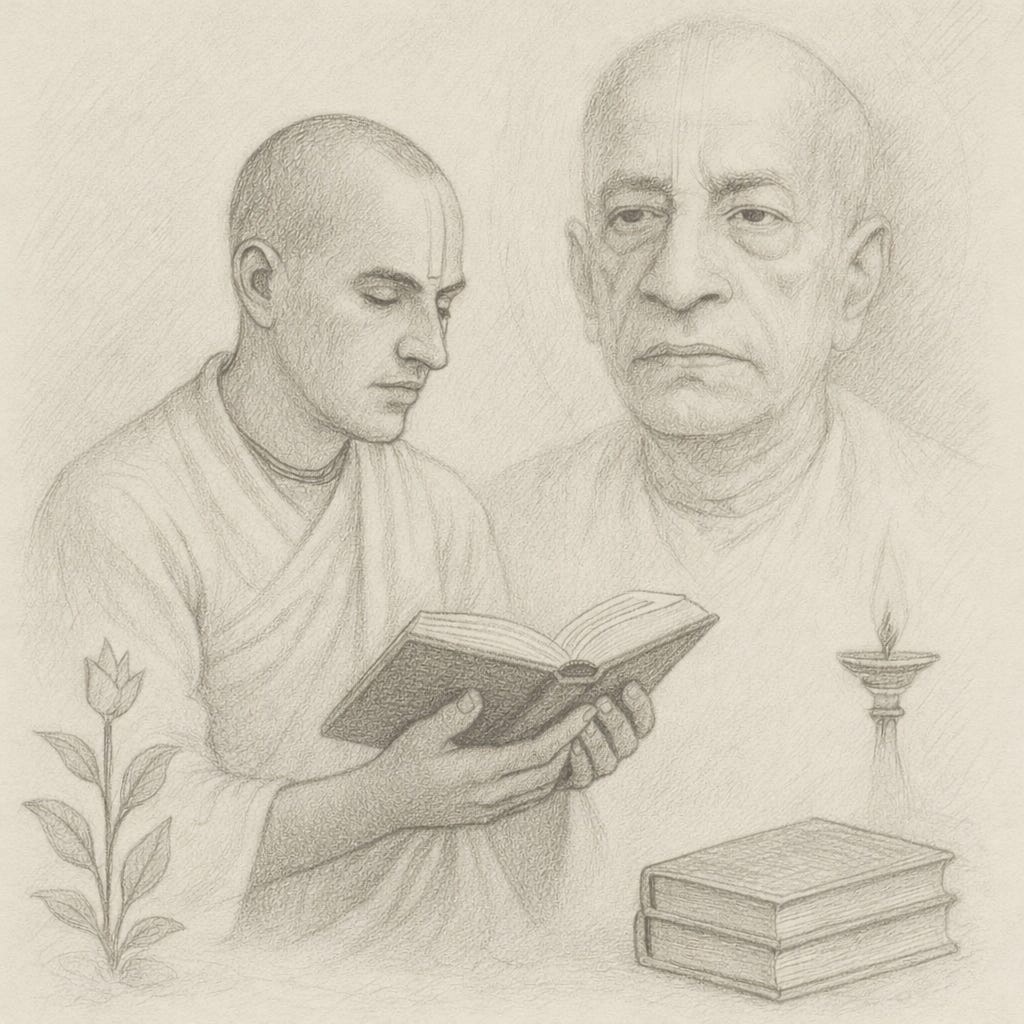
Some say that Śrila Prabhupāda taught just the ABCD in his books, but that’s not what I find when I read them. Instead, I find a very ingenious presentation of a philosophy that, although extraordinarily complex, is expressed in simple words, without shying away from all the esoteric details.
This sentence I just wrote may sound like a contradiction. How can someone write in a simple way, but at the same time convey all the details? Normally, these two ideas are exclusive. Or we explain something in a simple way, omitting details, or we explain all the details, but risk making the presentation incomprehensible. Indeed, this is generally true for ordinary authors, but sometimes a great genius is capable of offering explanations that are simple, but at the same time surprisingly rich in detail, that can be progressively understood as one’s comprehension of the subject increases.
What I observe when I read Prabhupāda’s books is exactly this stroke of genius, of being capable of explaining the intricate nature of Vaiṣnava philosophy in simple words, using examples that can be understood by the layman, but at the same time hiding in plain sight all the intricate details that readers can gain access to as they progress in their comprehension and spiritual realization. The first time we read Prabhupāda’s books, the text may seem simplistic, and at times even repetitive, but as we gradually advance in our studies, we start to notice how deep the explanations actually are.
Many senior devotees who have been studying Prabhupāda’s books for many decades give the advice of studying the same books repeatedly. As astonishing as it may seem, some devotees maintain a sādhana of reading the whole Srimad Bhagavatam once, every year, year after year. Some of these devotees already read the whole Bhagavatam dozens of times, and still, they continue finding new meanings every time they go through it again.
In fact, all transcendental literature is like that. It is not made to be read just once, like a romance, but structured in a way that the deeper our understanding is, the more details of the text we can understand when we read it. People in previous ages were apparently capable of grasping all the intricacies of the verses after hearing them just once or at most three times, but this happened because not only did they have much sharper memories and intelligence, but there was a system that a student would not be instructed in a certain text before accumulating the necessary qualification to understand it. People were thus forced to study the sastras under the spiritual masters for a long period, and in a certain order, different from today, where any layman can have immediate access to all kinds of esoteric books.
In the age we live in, therefore, the only way for us to fully understand a spiritual book is to read it repeatedly, while at the same time hearing from experienced devotees, asking questions, and so on. The first time we read, we may not get much out of it, due to our own lack of realization, but as we progress, we can understand progressively more as we read it again and again.
Here we have two traps. The first trap is the new devotee who tries to read Prabhupāda’s books, but loses his or her interest after some time, not finding them interesting. What happens here is that one gives up right in the initial stages, before one has enough realization to start being able to really understand and appreciate the books.
Another trap is that sometimes one reads a certain number of books once, and then comes to the conclusion that he already understands all the basics and that now is the time to move to more advanced books. He then stops reading Prabhupāda’s books (that he considers now as containing just the ABCD) and starts reading translations of all kinds of books. The problem is that this study of dubious translations without a very solid understanding of the philosophical foundation results in misunderstandings. As a result, although studying so many books, one remains confused about the most basic aspects of Vaiṣnava philosophy. I explain this point in more detail in my commentary on the Govinda Bhāṣya of Baladeva Vidyābhūṣaṇa. You can check there if you are interested.
Some may consider that Prabhupāda’s books contain just basic knowledge. I suspect, however, that a lot of it has to do with their own deficiencies preventing them from going very deep into the texts. The accusation that Prabhupāda explains only the ABCD in his books is thus a confession of their own lack of philosophical depth.
One thing I understood is that independence is an intrinsic characteristic of the soul, something that even Kṛṣṇa respects. According to Śrila Bhaktivinoda Thākura, independence is in fact what distinguishes the soul from inanimate matter. If independence were taken away from the soul, it would just become a thing, instead of a living being. It’s because of our inherent independence that we can cultivate relationships with Kṛṣṇa.
One may use his independence to study all kinds of books, accept all kinds of conclusions, and accuse Prabhupāda of being superficial in his writings, but as far as I’m concerned, I can’t agree with it.
The approach I personally take and that I consider the secret of whatever little success I have been able to make in my spiritual path is to start from the principle that Prabhupāda is speaking the truth from a transcendental, perfect perspective, and from this prism try to understand his teachings, and the world around me, including other philosophical treatises written by the previous ācāryas and other great teachers.
All the statements Prabhupāda makes in his books should be taken as part of a greater philosophical explanation. When two statements appear to be contradictory, they should be harmonized. In this process, one may ask the spiritual master, more learned Vaiṣnavas, or simply wait for Kṛṣṇa to give the knowledge from inside the heart, but one should not conclude that one statement is correct and the other is wrong. Spiritual topics are very complex and can be studied from many angles. The habit of cherry-picking, pitting one statement against the other, is part of our material conditioning and should be given up. It just imprisons us to the material duality and makes us see everything as black or white, good or bad, and makes us thus incapable of understanding spiritual topics that are always multidimensional.
Later, the same process should be used to harmonize statements from Śrila Prabhupāda with the writings of previous ācāryas, understanding that they are describing the same spiritual reality and are in agreement with each other. As stated in the Laghu-bhāgavatāmṛta (5.327), “When contradictions are found in the Vedic scripture, it is not that one statement is wrong. Rather, both statements should be seen in such a way that there is no contradiction.”
There are different statements from Śrila Prabhupāda spoken in different contexts, and even cases of statements that may appear contradictory. If one goes deeper, however, it will be revealed that they are just applications of different principles in different contexts.
When I study translations of works from previous ācāryas, I don’t presume I can directly understand the content of these books, nor do I presume that the translations are completely accurate. Although the original books are perfect, the translations are often done by devotees who are not completely familiar with all the intricacies of the language and often apply their own philosophical biases to the text. Unless a translation is done by a self-realized soul (like the works of Śrila Prabhupāda), everything should always be taken with a grain of salt.
Instead, I just try to understand the general logic of the text and interpret it according to the conclusions Prabhupāda gives in his books. I found that this method allows one to study even difficult books, such as the Vedānta-sūtra, as well as books compiled by conditioned souls, such as the Bible, in the light of the Vaiṣnava philosophy.
There is something else Prabhupada gives in his books that becomes essential over time: the word-for-word translations. Translations very rarely capture all the nuances of the text. After a certain point, we need to start working with the Sanskrit itself. How can one learn Sanskrit? You may ask. Here is the magic. By following the synonyms given by Prabhupada in his books, we can see the whole process of translations in the works, starting with the Sanskrit, then the isolated meaning of each word (Sanskrit words often have multiple meanings, so we can see how he picks the right meaning for each word according to the context) and then how these words are combined in the translation, as well as how the verse is interpreted in the context of the book. By reading everything that is in the book—Sanskrit, synonyms, and then the translations Prabhupada gives—we basically receive a free Sanskrit course. Once, Prabhupada said that if one attentively studies one entire chapter every day following this system (it is harder than it may look at first), after one year, one may reach a level equivalent to that of a Sanskrit scholar. It is not just a boast. Many prominent Sanskrit scholars in our movement learned exactly by following this process. If we learn the process and logic of translation, we can later do it ourselves with the help of a dictionary and a grammar book.
So far, I have been observing that it’s thanks to the philosophical conclusions I get from Prabhupāda’s books, complemented by the free Sanskrit course he includes, that I’m able to get a grasp on other philosophical books I have the opportunity to study. Without having spent time studying in detail the points that Prabhupāda makes in his books, I doubt I would be able to understand these books at all.
If a new devotee would ask me for advice about how to clearly understand the different details of Vaiṣnava philosophy, I would tell him or her to, apart from following a good sādhana and serving Vaiṣnavas, just study all Prabhupāda’s books repeatedly starting from the conviction that they contain an accurate description of the absolute truth and from this perspective try to understand the reality around us, including other books one may decide to study later. I found that devotees who practice under this prism are the ones who go the furthest in spiritual life.
I believe the whole idea of Paramparā is based on this principle, and the ones who start their spiritual lives by reading Prabhupāda’s books but later reject his teachings are missing the whole point and are thus sabotaging their own spiritual progress.
« Things I Wish Someone Had Taught Me When I Started Krishna Consciousness
You can also donate using Buy Me a Coffee, PayPal, Wise, Revolut, or bank transfers. There is a separate page with all the links. This helps me enormously to have time to write instead of doing other things to make a living. Thanks!
Amazing. So true
A beautiful article that every devotee should read.Srila Prabhupads books contain everything.Thank you prabhuji.
Hare krsna