

« Things I Wish Someone Had Taught Me When I Started Krishna Consciousness
Sometimes our spiritual progress depends on our mind and the false ego
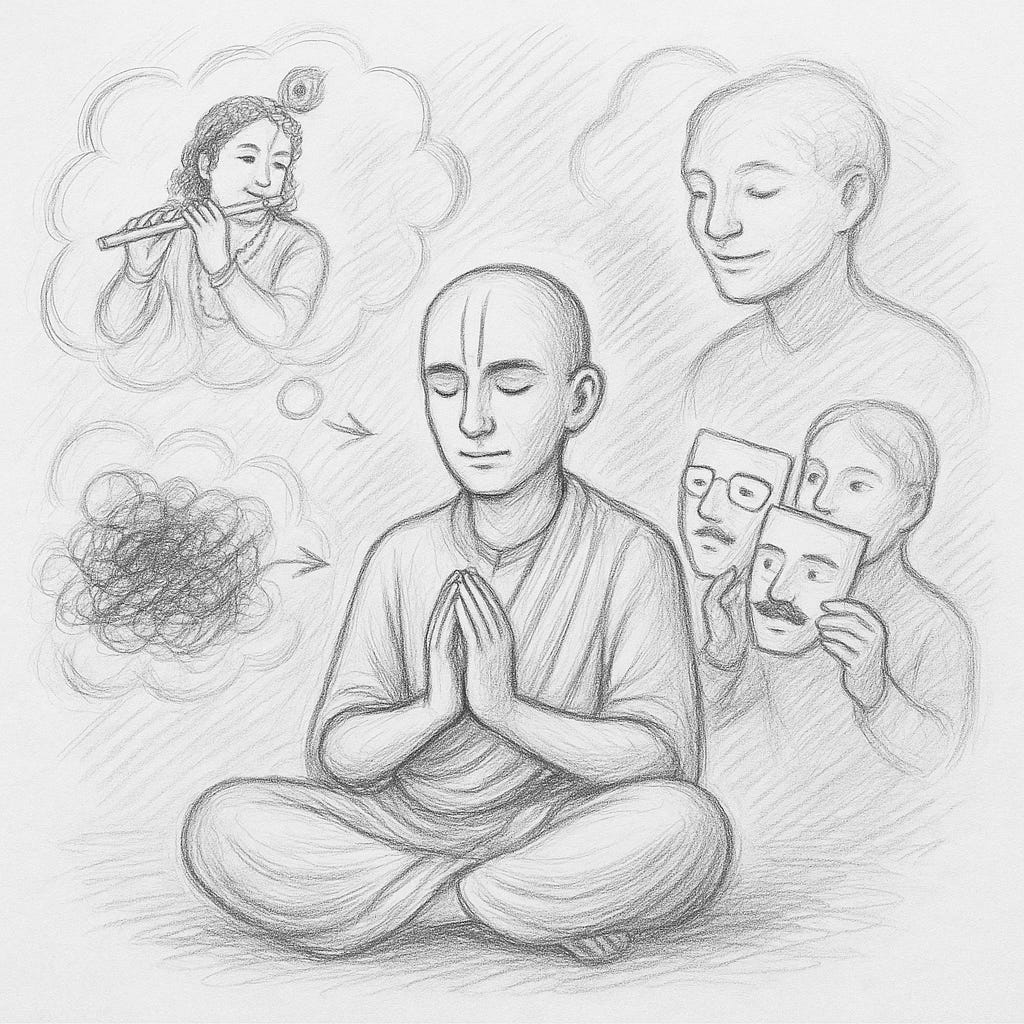
When we speak about the difficulties we face in our spiritual practice, we frequently focus on the mind. In the Gītā, Kṛṣṇa mentions that the mind is the greatest friend of the living entity, but his enemy as well. This means that when our desires are properly purified, the natural function of the mind to desire becomes positive for our development since we start to desire things connected with the service to Kṛṣṇa. However, when our desires are impure, the mind works against us, propelling us away in the direction of material activity and forgetfulness of Kṛṣṇa.
Although the voices inside our heads may suggest that the mind is some kind of conscious being, that’s not exactly the case. The mind is more like a force that pushes us. As we see and experience things, the different desires are stored, and the mind pushes us in the direction of trying to satisfy them. Just as a physical force, such as fire or wind, the push of the mind can be very difficult to resist. Arjuna mentions that the mind is so obstinate that controlling it is harder than controlling the wind.
Artificially trying to stop the workings of the mind is not only extremely difficult; it can be even dangerous for our spiritual development. Without the push of the mind, the conditioned soul becomes just an inert and apathetic being, like a stone. This may sound like an attractive goal for an impersonalist or nihilist, but it is certainly not desirable for a devotee. We don’t want to extinguish all desires; we want to start desiring to serve Kṛṣṇa instead of matter. The path for us is thus to purify our desires and make the mind a friend. When the mind becomes a friend, it starts pushing us in the right direction, back to Godhead, just like favorable winds propelling a sailboat. Until we can awaken our spiritual body, complete with spiritual mind, spiritual intelligence, and spiritual ego, the material mind is the tool we have to work with.
There is, however, another tool that is no less important than the mind, which is the false ego. Just like the mind, the false ego is not a personal being, but a material energy that pushes us in different directions. Although subtle, the false ego is a tangible thing, described as one of the material elements, just like earth or water.
The false ego is quite important for us in conditioned life because it creates our sense of identity. When we come to the material world, our true ego, or our real sense of identity (as an eternal servant of Kṛṣṇa), is forgotten, and we start to assume different temporary identities under the influence of the false ego. In one life, I may be a demigod, in another an ant, and in each life, I identify equally strongly with the temporary identity I receive.
When we hear about that, our first reaction may be to want to extinguish the false ego, but in our current stage, this is not very wise. Destroying the false ego before awakening our true ego can be highly destructive, also putting us in an apathetic, dysfunctional state. Until we can reawaken our true ego, situating ourselves once again in our real sense of identity as eternal servants of Kṛṣṇa, the false ego is the tool we have to work with, just like the mind.
From the scriptures, we understand that there are two platforms in which one can practice spiritual life: rāgānugā-bhakti and sādhana-bhakti. Rāgānugā-bhakti, or spontaneous devotional service, can be practiced only by someone who is already on a transcendental platform. Only someone who has awakened his spiritual mind, intelligence, senses, and true ego can practice it, because anyone else will take the voices of the mind as spiritual emotions and do strange things in the name of devotion. For ordinary conditioned souls, the only feasible process to get there is the process of sādhana-bhakti, regularly chanting and performing other spiritual activities.
The process of sādhana-bhakti, in turn, is heavily based on a sense of duty, on following a daily spiritual routine of spiritual practice, which is in turn heavily dependent on our concept of identity. For example, when one accepts the identity of a book distributor, he will work hard to try to distribute books for Kṛṣṇa, and thus be gradually purified. If a man accepts the duty of a husband and father, the head of a spiritual family, he will work dutifully and thus advance, and similarly, if a lady accepts the identity of a housewife, she will try to take care of her husband and children, understanding that they are servants of the Lord, and in this way also progress. If one accepts the identity of a cook, he will diligently work in feeding devotees or preparing offerings for the deities, and so on.
All these identities are still based on the false ego. Being a book distributor or a housewife is not our eternal spiritual identity. However, such identities are essential because they allow us to practice devotional service, purify ourselves, and gradually connect ourselves to our true spiritual identity.
The problem is that the modern world is so dangerous and oppressive that often people have their concept of identity destroyed by abuse, bullying, loneliness, aggression, depression, and so on. When this happens, a person may just fall into a depressive and dysfunctional state, incapable of focusing on anything, including devotional service. When this happens, a person needs to first find a new concept of identity, and from there, be able to start the path of regulated devotional service. This can only be done through empowerment and encouragement.
We often hear that the false ego has to be curbed so a person can become humble and thus be able to follow the process of devotional service. This is necessary when someone is very proud. We can see that many devotees are used to training others in this way, because they themselves were taught in this style, censoring, and chastising or even belittling and mocking, humbling one and curbing one’s false ego in order to bring them to a balanced state. When a person is very proud, confident, but reckless, this process works, because when the impudence is taken away, one is ready to act in a balanced and disciplined way. Many times, however, the problem is that we have a broken ego. This is important to identify because when the ego is broken, the process to reach equilibrium is the opposite. Instead of being chastised, one has to be praised, trusted, and empowered, and thus gain some confidence to be able to reach a state where one can start the process of learning and acting for Kṛṣṇa.
When we apply the model of chastisement and humiliation to someone who already has a broken ego, the result is often a zombie that can act only under the direct command of the teacher, lacking the confidence to do anything on his or her own, emotionally dependent, so broken in one’s self-confidence that one needs confirmation at every step. This can be confused with humility and surrender, but it is actually a process of depersonalization and manipulation that can have negative consequences. When the followers of a certain teacher are like that, this can be taken as a big red light.
When our concept of identity is broken, and we feel worthless and without purpose, the way to be helped is to understand that we have value and we can be useful in life. Everyone has certain talents, and to learn how our natural talents can be used for Kṛṣṇa can be extremely empowering.
This process of learning to use our natural talents and propensities to serve Kṛṣṇa helps us to find a new sense of identity, where we can develop confidence in our value, and find a balanced state where we feel loved and needed, and thus come to a functional state where we can be happy and productive, confidently practicing the spiritual process.
The difficulty is that often we are good at chastising people, but not so good at encouraging and nourishing, perhaps because we often struggle to truly care about the people around us. Chastising someone doesn’t demand that we really care about them; nourishing does. When we don’t care about the people we’re trying to help or who are entrusted to us, we often do more harm than good. Criticism is easy, but compassion takes effort. True guidance begins with connection.
Understanding this process can be a very important factor in spiritual life. When we can find the right spiritual teacher and learn to operate under the right spiritual principles, the process of navigating through all the difficulties and issues connected with the material mind, intelligence, and ego, and finding our true spiritual selves becomes much easier.
« Things I Wish Someone Had Taught Me When I Started Krishna Consciousness
You can also donate using Buy Me a Coffee, PayPal, Wise, Revolut, or bank transfers. There is a separate page with all the links. This helps me enormously to have time to write instead of doing other things to make a living. Thanks!
Mongolian version:
https://krishna.mn/burhanlag-ahits-devshil-zarimdaa-bidnii-uhaan-bolon-huuramch-egonoos-hamaardag-IwUdal