

« Things I Wish Someone Had Taught Me When I Started Krishna Consciousness
Struggling with spiritual principles is not a reason to leave Kṛṣṇa Consciousness
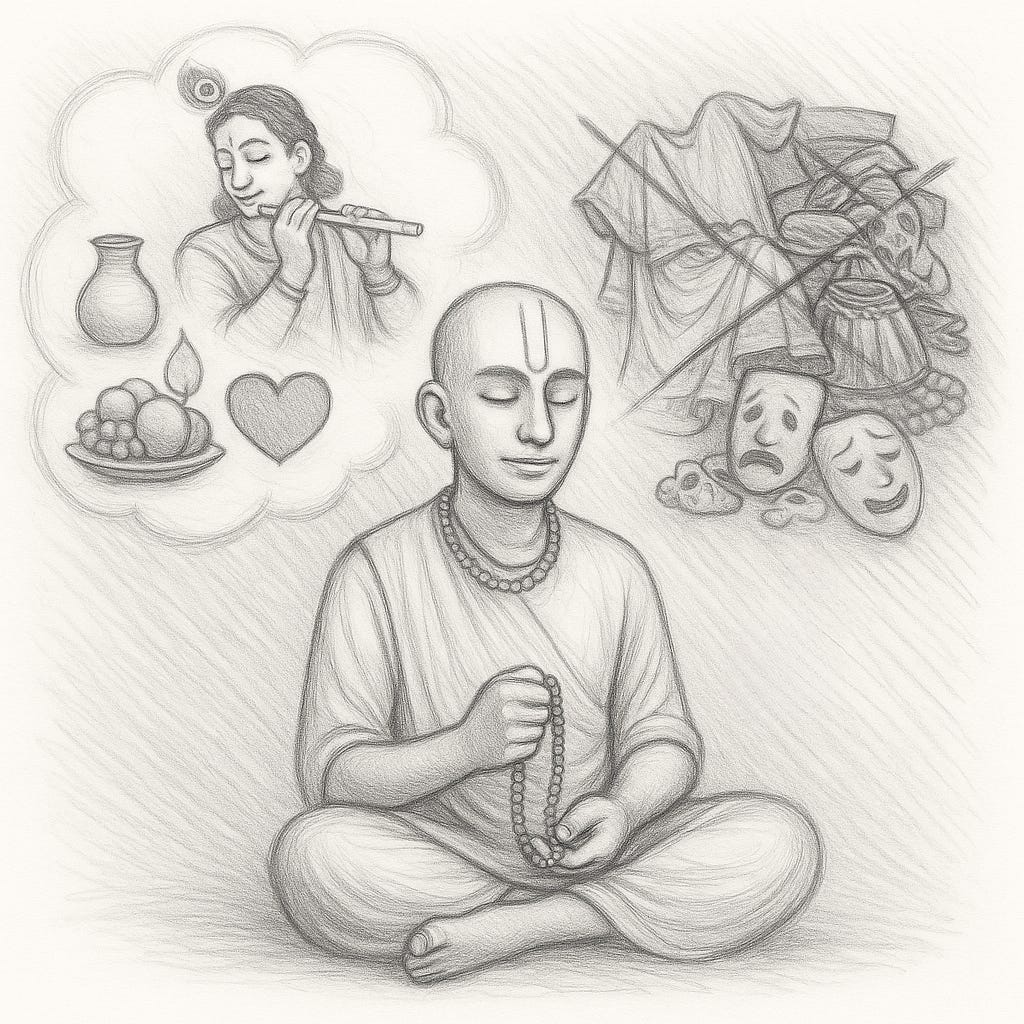
There are many rules we are supposed to follow in the spiritual process and a whole culture we are often taught, including a new way to dress, to eat, to behave towards others, and so on. There are whole books written on Vaiṣnava etiquette, detailing all the small rules in dealing with fellow devotees, and even detailed instructions on how one’s sexual life is supposed to be conducted. All of this may seem overwhelming, and often it indeed is.
One point to observe is that when we go to Prabhupāda’s teachings, these points are often made much simpler. Prabhupāda would focus on the principle, while we often focus on the details. Instead of endless rituals, he would emphasize general principles such as cleanliness; instead of unlimited sets of rules, he would emphasize consideration and care for others, and often he would dismiss entire sets of rules that are taken very seriously by other groups of Vaiṣnavas as “not important”.
This practical approach to the spiritual process, upholding the essential principle instead of detail, is something we can definitely learn from him. Prabhupāda was precisely dealing with people who were starting the process of Kṛṣṇa Consciousness coming from unrestrained or even licentious backgrounds, just like most of us nowadays, and the solutions he found can definitely teach us a lot.
There is a great difference between essential principles, such as cleanliness, modesty, consideration for others, and so on, and details. Details can be helpful when they help to uphold the principle, but they can also become useless or even negative when they distract us from the core principle behind them. Becoming too much concerned with details and forgetting the underlying principles puts us in the direction of caste brāhmanism, following rigid sets of rules while being completely clueless about their goals. That’s surely not where we want to go.
Saris, for example, find their way into the devotional process because they are a simple type of cloth that has a single size, and can be worn in an elegant way, which looks clean and modest. Saris can, however, also be misused, resulting in styles that are over-complicated and over-sensualized, which defeat the original purpose. When it comes to that, other types of clothes that are simple and modest can actually be more suitable.
Similarly, the diet many of us follow nowadays in the name of prasāda can be very problematic for our health, being often too rich in starches, sugar, and oils. It’s quite improbable that people in Vedic societies or even Vaiṣnavas in previous centuries were eating like us. Most probably not. Many devotees find that simpler, more wholesome diets are more supportive of their health, and if you are one of them, there is no fault in that.
It’s possible to follow Kṛṣṇa Consciousness without adopting most of the secondary rules and culture, but it is not possible to follow it without chanting and hearing about Kṛṣṇa. Therefore, if you are struggling to follow all the external rules and rituals, it’s often more productive to just focus on the basic process of hearing and chanting.
Once, when devotees obtained an old Christian church to use as a temple, Prabhupāda advised them to keep the benches, so people could come and sit comfortably to watch the functions. This showed how Śrila Prabhupāda envisioned a time when people from the outside, who would not necessarily identify with all external aspects of Vaiṣnava culture, would also come regularly to the temples to chant and hear about Kṛṣṇa, and he wanted to make it easier for them.
There is then another dimension, which is what to do if we can’t properly follow the four basic principles, or are struggling to chant 16 rounds.
The main principle of Kṛṣṇa Consciousness is to never stop serving Kṛṣṇa. Even one who falls and commits the most serious mistakes can still be saved if he continues to chant and pray to Kṛṣṇa, while even the most pious person by material standards can’t be saved without calling Kṛṣṇa’s name. It’s definitely much better when we can organize our lives in a way that allows us to chant regularly and properly follow all the rules, but if circumstances push us into a situation where we can’t, it is important not to feel discouraged. We should not stop chanting, thinking that we are failures, or have become unworthy of Kṛṣṇa’s mercy. Instead, we should continue doing what we can and be confident that by continuing to follow the parts of the process that are possible for us at the current moment, we may remain connected to Kṛṣṇa and draw from him the force to be able to improve things in the future.
Even if one is initiated but broke one’s vows, there is the possibility of redemption by simply coming back to the proper standard, starting from where one is now, and gradually improving. In the Bhakti-vṛkṣa system, for example, there are different standards one can follow, starting with just chanting a single round of japa every day, chanting four rounds, and being vegetarian, and so on. What is less known is that initiated devotees who stopped chanting and following the principles can also go through these different standards, taking vows in private. One can thus start chanting again, and gradually advance through the different levels, just as a new devotee, without being judged by it.
We can see that Ajāmila went quite far in his process of degradation, coming to the point of drinking wine, associating with a prostitute, and even kidnapping and killing to maintain his lifestyle. Still, he was saved at the time of death by chanting the holy name. This shows how the potency of the names can save us even in the most degraded situations; that’s the extent of the compassion and love of Kṛṣṇa for us. Therefore, even if everything else fails and we find ourselves in a situation similar to Ajāmila at a certain point, it is essential to never stop chanting and hearing about Kṛṣṇa. This is our lifeline, and as long as we hold on to it, Kṛṣṇa can help us. The essential part is to keep a humble attitude and keep praying to Him, instead of turning our backs and forgetting. We need to keep this conviction that, no matter what, we will never stop chanting and trying to serve Kṛṣṇa in whatever way we can.
« Things I Wish Someone Had Taught Me When I Started Krishna Consciousness
You can also donate using Buy Me a Coffee, PayPal, Wise, Revolut, or bank transfers. There is a separate page with all the links. This helps me enormously to have time to write instead of doing other things to make a living. Thanks!
Very kind and loving message. I can see why all the details of Vaishnava culture could be overwhelming for new devotees. They are being introduced to an entirely different civilization. Remembering to always move toward Lord Krishna and His love for us is very helpful.
Thank you!! I needed this... Krsna's mercy I see here. I was looking for some of the answers I found in this post.
Thank you!!!