


You can receive new articles directly in your inbox. Subscription is free; donations are welcome.
In the Bhagavad-gītā, Kṛṣṇa tells Arjuna to abandon all types of mundane religion and just surrender to Him. He promises that if one does that, he will be protected from the results of all past sins. Kṛṣṇa reinforces it by saying mā śucaḥ: “Do not fear”.
Philosophically, this means accepting Kṛṣṇa's instructions in the Bhagavad-gītā and embracing the process of devotional service to Him. People often have faith in different forms of mundane religion, such as worship of demigods and different types of rituals, believing that these will somehow save them, but Kṛṣṇa recommends that we abandon all these superficial forms of dharma and simply dedicate ourselves to serving Him, believing that He will save us from all sinful reactions and from all material entanglement.
However, what about the practical application? Where exactly should we go to learn to serve Kṛṣṇa?
Ideally, surrender is offered to the representative of Kṛṣṇa, the bona fide spiritual master, who can guide us according to the instructions of Kṛṣṇa. The guru can thus translate the instructions of Kṛṣṇa into practical action and help us to avoid all potential obstacles in developing our devotional service.
One problem, however, is when this idea of surrendering to the perfect representative of Kṛṣṇa is extrapolated into the idea of surrendering to an institution. This can be more problematic.
Often “surrendering to Kṛṣṇa” is taken in the sense of abandoning all one’s possessions, dropping one's academic education, and going to live in the temple, hoping that the temple will supply all one's necessities.
Surrender to Kṛṣṇa is obviously always good from the spiritual side, but this particular approach presents some challenges, which can cause difficulties for many devotees.
One issue with this approach is that often there is no “plan B”. Devotees just abandon everything and surrender to the temple authorities, frequently breaking up with their families, and face serious difficulties when things do not go as expected or when material desires start to knock on the door. A few challenges with this model:
a) There was frequently no clear agreement on what devotees are supposed to provide and expect from the temple or communities. This can lead to misunderstandings and disputes. Frequently, temples may just take the service of devotees, accepting them as volunteers, and use all the resources to expand the mission, without reserving money to care for devotees who would later become sick, for example. Devotees may then be welcomed as long as they can serve, but sent back home when they become sick or have other difficulties.
b) There is often no clear idea of what to do with devotees who later decide to enter family life. Frequently, the deal is that the temple may take one as long as one wants to be a brahmacārī or brahmacāriṇī, but those who decide to start a family later have to leave and fend for themselves.
c) Devotees may expect that temple authorities will care for their needs, but more often than not the authorities will not be able to properly care for their needs, be it due to lack of sufficient material resources or just due to lack of experience or expertise. This can also cause serious problems. There are very few leaders qualified enough to really care for people in the age we live in.
When we combine such challenges with the general lack of life experience devotees often have when they start practicing, it’s not surprising how many problems can appear and how many devotees may face difficulties in life due to dropping their material education to live in the temple, later feeling that society let them down for not supporting them when they decided to enter into family life or when they cease to be capable of accepting the rigors of renounced life.
Nowadays, this model of devotees abandoning everything and going to live in the temples is still applied in some situations, but we can say that it is in decline. In most places, it has been replaced by a model where devotees are encouraged to study and have professions, so they can be financially independent. In such a position, devotees can donate their time and money to spread Kṛṣṇa consciousness, without being dependent on the institution for their maintenance. As long as we don’t have leaders like Maharaja Yudhiṣṭhira, capable of really taking care of people at all levels, this is probably a better model for most, especially for the ones in family life.
There is also a difference between surrendering to Kṛṣṇa without expectation of return and surrendering to the institution, hoping that the institution will take care of one’s needs. The first is spiritual, but the second is more like a business deal that can be broken. One who surrenders to Kṛṣṇa will be protected, at least in the spiritual sense, but one who surrenders to the institution may not have such a guarantee.
Trouble in paradise
Another point we could discuss is the problems we have in the institution. If Kṛṣṇa is in control, why do problems happen? Why couldn’t Kṛṣṇa just create a perfect institution to which everyone could just surrender?
The short answer is that an institution is perfect only to the degree that its parts are perfect. Unfortunately, we are not all perfect; therefore, the institution can’t be perfect. Kṛṣṇa could create a perfect institution if all of us would perfectly cooperated with Him, but because not all of us are capable of doing it, Kṛṣṇa respects our free will. However, the result is still that, due to our imperfections, the sum of the parts is also imperfect.
A perfect institution would be possible only if it accepted only perfect people, but it would not be useful for us, because then we would not be accepted in it.
Another point is that any institution is an impersonal entity. We are not supposed to surrender to any impersonal entity but to Kṛṣṇa in the form of His representative. Surrender can only be offered to a person, and this person has to be a bona fide representative of Kṛṣṇa.
The next question is: how can Kṛṣṇa allow leaders to commit mistakes that can create so many problems for other devotees? We can better understand the situation by studying the pastime of Govardhana.
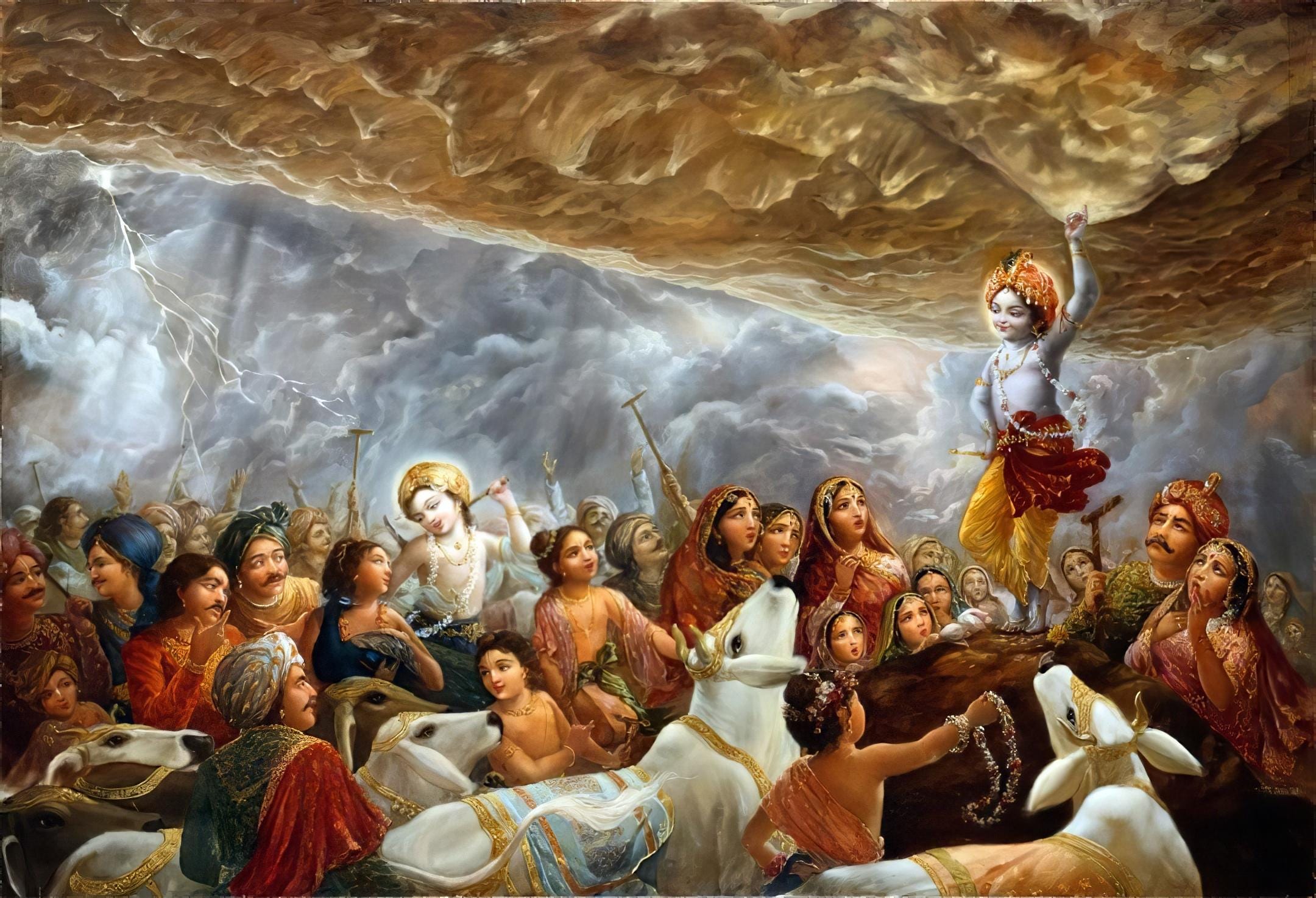
We can see that in Govardhana-lila we have Indra, who (although also a sincere servant of the Lord) was in a position of power and prestige and thus became arrogant due to it; we had the innocent cowherds, who were put into difficulties due to the wrath of Indra, and we had Kṛṣṇa. This situation is actually very similar to most cases of injustice involving devotees and leaders in the past, present, and future, and the way it was solved is a great lesson for all of us.
When Indra attacked Vṛndāvana, the cowherds did not try to fight him but instead took shelter in Kṛṣṇa. At this point, Indra had completely lost his intelligence and was trying to mass-murder all the inhabitants of Vṛndāvana just because they stopped worshiping him. Kṛṣṇa could just have killed Indra as he did with many demons, but since Indra was also a devotee, Kṛṣṇa opted for a peaceful solution, just lifting the mountain and protecting His devotees, letting Indra pour down the rains until he came to his senses. In the end, although the devotees were put in apparent difficulties, they were perfectly happy because they spent this time with Kṛṣṇa. Eventually, Indra came back to his senses and went to beg forgiveness for his mistakes. In other words, the cowherds were protected, and Indra learned his lesson simultaneously. Nobody was harmed on either side. That’s how Kṛṣṇa likes to act when His devotees are involved. Kṛṣṇa sees the good one does and overlooks the bad.
In the end, we see that, even after trying to commit genocide, Kṛṣṇa opted to maintain Indra in his post, understanding that his mentality was already corrected and he would not commit the same mistake in the future. As He said:
“Indra, you may now go. Execute My order and remain in your appointed position as King of heaven. But be sober, without false pride.” (SB 10.27.17)
So, when we see a situation where there is a leader mistreating other devotees, he should understand how Kṛṣṇa sees it. Kṛṣṇa does not like to harm His devotees; that’s His all-merciful nature. He does not forget the services one performs, even if later he commits mistakes. Instead, He usually prefers to rectify mistakes by different means.
Similarly, we see situations of leaders who commit serious mistakes, are caught, regret it, and, receiving the opportunity of continuing their services, end up serving for many years after that, this time with a more proper consciousness. Leaders who insist on their mistakes may receive more severe punishment, of course, but this is all in the hands of Kṛṣṇa.
The second point is that there are always difficulties in this material world. Sometimes they are caused by our own mind or body, sometimes by other people, and sometimes by superior forces. These are all agents of Kṛṣṇa who are there to make us understand that this material world is not a good place and to become more strongly connected with Him.
As long as one is devoted to Kṛṣṇa, he can be sure that Kṛṣṇa will protect him in all tribulations, whether they are caused by the forces of nature, police, thieves, or prideful leaders. The Pāndavas also went through so many tribulations, but in all crucial moments, Kṛṣṇa protected them, and they were triumphant in the end. The question thus is not how to stop the forces of nature that cause us trouble, but how to remain connected with Kṛṣṇa in all circumstances.
Read more:

This is a publication for thoughtful readers who want to go deeper into Kṛṣṇa consciousness. I publish daily, trying to offer high-quality spiritual content, and all posts are available to free subscribers. If you wish, you can support this work with a monthly contribution. When you subscribe, you can choose between a free subscription and a monthly contribution, and you can switch from a free subscriber to a supporter at any time.
You can also receive updates on WhatsApp or Telegram.
If you would like to contribute further, you can find the donation links here.
Why did Krsna reinstated Indra to the throne? How did he know that Indra won't go corrupt again?