

You can receive new articles directly in your inbox. Subscription is free; donations are welcome.
At a certain point, during the time Dhruva Maharaja ruled the earth as a king, Yakṣas killed his brother Uttama, which was a serious challenge to his authority. In response, he attacked Alakāpurī, the capital of the Yakṣas in the high-dimensional Himalayas. The Yakṣas had a powerful army and fought viciously, and Dhruva proceeded in cutting down their pride using his superior military power.
The attack of Dhruva against the Yakṣas of Alakāpurī happened due to valid reasons. It was his duty as the king to maintain order. It was his duty to punish the assassin of his brother, and since the Yakṣas offered resistance, it became his duty to pacify them. However, the battle went a little too far, with Dhruva almost exterminating the whole race due to the stubborn resistance of the Yakṣa warriors.
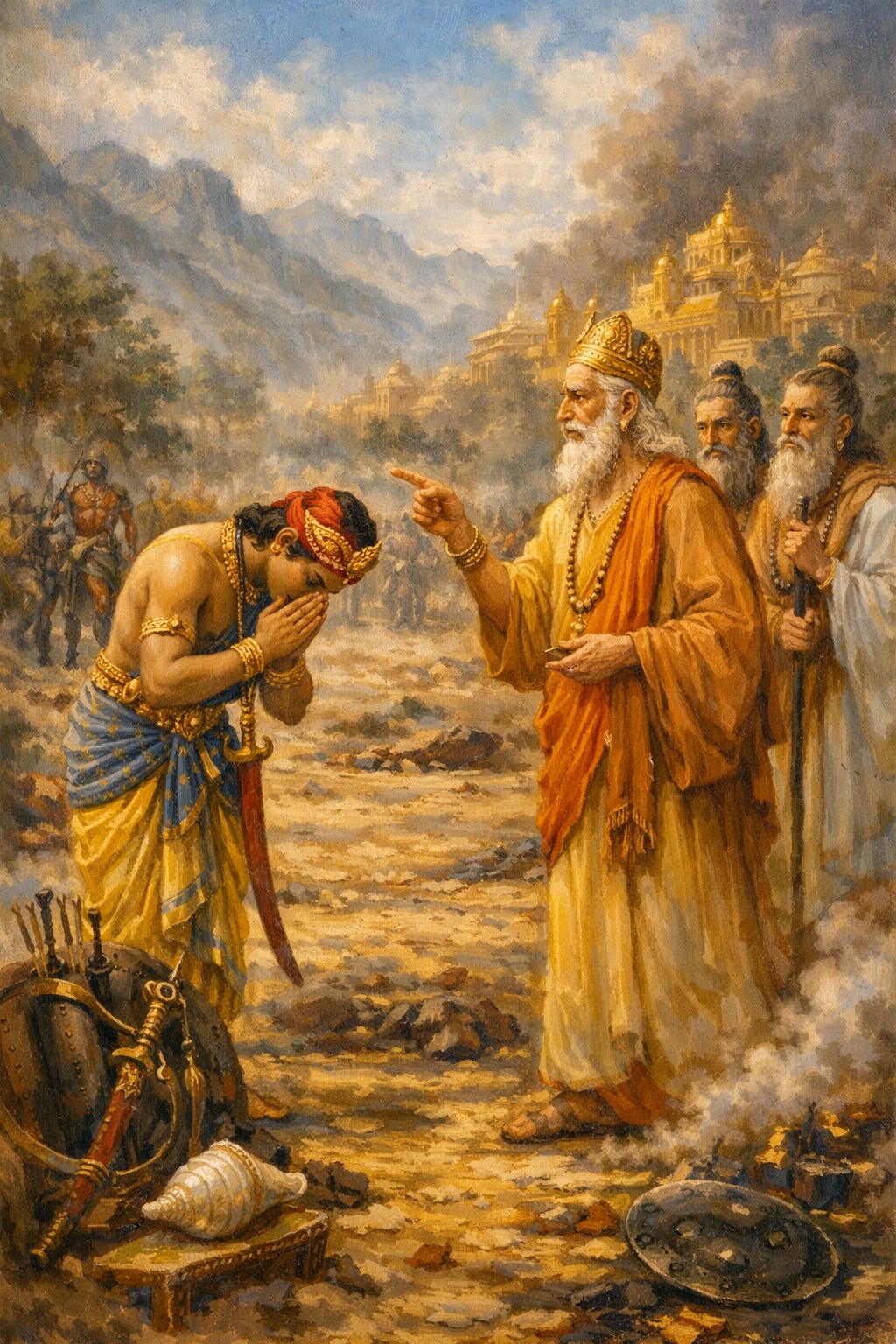
Seeing the scene, Svāyambhuva Manu became compassionate and came forward to pacify Dhruva, accompanied by great sages:
“Lord Manu said: My dear son, please stop. It is not good to become unnecessarily angry — it is the path to hellish life. Now you are going beyond the limit by killing Yakṣas who are actually not offenders.
My dear son, the killing of the sinless Yakṣas which you have undertaken is not at all approved by authorities, and it does not befit our family, which is supposed to know the laws of religion and irreligion.
My dear son, it has been proved that you are very much affectionate towards your brother and are greatly aggrieved at his being killed by the Yakṣas, but just consider: for one Yakṣa’s offense, you have killed many others, who are innocent.” (SB 4.11.7-9)
The Yakṣas were also subjects of Dhruva, living in a part of his kingdom. They were also protected by Kuvera. Dhruva had the duty of somehow punishing the culprit for the death of his brother and asserting his authority, but Svāyambhuva Manu argues that this wholesale killing of the Yakṣas was excessive. If Dhruva continued, he would exterminate the whole race, and this would not bring any positive outcome.
After urging Dhruva to stop his attack, Svāyambhuva Manu gives him instructions from verse 4.11.10 to 4.11.34. After receiving these instructions, Dhruva Maharaja immediately stopped fighting. The whole battle happened on the outskirts of Alakāpurī, the city of Kuvera, and thus, as soon as Dhruva stopped fighting, Kuvera heard the news and went to the spot to meet him.
Although a demigod living in great opulence, Kuvera is a greatly enlightened person and a devotee of the Lord. He regularly hears about self-realization from Lord Śiva, and thus, he is highly advanced in knowledge. Although he is the ruler and father of the Yakṣas, he was well aware of the great achievements of Dhruva and his position as a pure devotee of the Lord; therefore, he didn’t take his killing of the Yakṣas very seriously, understanding that they were also at fault.
Verse 4.12.1 describes that when Kuvera appeared, he was immediately worshiped not only by the remaining Yakṣas but also by Kinnaras and Cāraṇas, other inhabitants of Bhū-Mandala. Dhruva also showed all respect, standing before him with folded hands.
Kuvera immediately revealed his intentions, stating he was not at all displeased with Dhruva. On the contrary, he was happy to meet such an exalted devotee of the Lord, and pleased he was able to so easily control his senses and stop fighting following the instructions of Manu.
Dhruva, at this point, was considering himself responsible for killing so many Yakṣas, but Kuvera was quick to reassure him by addressing him as anagha (O sinless one). Mentioning that “Actually, you have not killed the Yakṣas, nor have they killed your brother, for the ultimate cause of generation and annihilation is the eternal time feature of the Supreme Lord.”
Dhruva’s brother was killed due to reactions to his own past activities, and therefore, the Yakṣas were just instruments in the realization of the results of his own karma. The Yakṣas, in turn, were killed as a reaction to their own activities, and Dhruva just acted as an instrument, following his duty as a king. Dhruva thus was not sinful, and simultaneously,y he had no reason to blame the Yakṣas for the death of his brother. Ultimately, no one died, because the soul is immortal and the body is never alive.
Apart from that, everyone just acts under the influence of material nature, which in turn acts under the influence of eternal time. Time is thus ultimately the cause of generation and annihilation. Time is not responsible, because it acts under the direction of the Lord, and the Lord, in turn, is also not responsible, since He is completely transcendental, creating the conditions for the existence of the material creation out of His desire to give conditions for the fallen souls to awaken their original transcendental consciousness.
The central mistake of material existence is that we identify the body as the self, and thus classify other people as “friends” or “enemies” based on their relationship with the body. Kuvera explains that this material concept is a product of ignorance. This type of identification leads to just more birth and death since it keeps us bound to this material world.
Dhruva, of course, understands this concept, but because he was acting like a king, he had to adjust his vision according to his duties, and thus was forced to make distinctions. Now, Kuvera is bringing him back to his original understanding, urging him to abandon all artificial distinctions and simply engage in the service of the Lord, seeing all living entities as one in quality, seeing all in their original position as servants of the Lord, and not according to the temporary material identification. By engaging in the service to the Lord, one offers the best service to everyone, just as watering the root, one offers the best service to the whole plant.
Kuvera is genuinely pleased with Dhruva Maharaja due to his devotional service to the Lord, and addresses him as vara-arhaḥ, “worthy to take benediction.” He thus urges Dhruva to ask for any benediction he desires. Kuvera is the treasurer of the demigods, and therefore, he is qualified to offer any amount of richness one may desire.
Kuvera, however, understands that Dhruva would not be interested in any kind of material opulence, and therefore, he mentions that he is always thinking of the lotus feet of the Lord. He already understands that Dhruva will not ask for anything apart from always remembering the lotus feet of the Lord.
Dhruva is described in this verse as mahā-matiḥ (most intelligent or thoughtful) because even when asked to take a benediction from the richest person, he didn’t desire anything material.
Being thoughtful, Dhruva asked to have unflinching faith in and remembrance of the Supreme Personality of Godhead, because this allows one to easily cross the ocean of material ignorance and attain the ultimate goal.
Although a devotee is not interested in material benedictions from anyone, accepting a blessing from a demigod that will help us in our devotional service is not contradictory to the principles of bhakti. Apart from that, when a senior person offers us a benediction, it is proper to accept it. A Vaishnava is respectful to anyone, what to say about well-wishers, and even if a person is not fully qualified to grant it, still, his well-wishes will help us.
Another side, explained by Śrila Jīva Gosvāmī, is that Dhruva was concerned that the offenses he committed to Kuvera by attacking his sons could hamper his meditation on the Lord, and therefore, by asking Kuvera for unflinching faith in and remembrance of the Lord, Dhruva wanted to clear it. Certainly, when Kuvera granted this benediction, any lingering resentment on his part was fully cleared. After granting this boon, Kuvera left, and Dhruva returned to his capital.
This is a publication for thoughtful readers who want to go deeper into Kṛṣṇa consciousness. I publish daily, and all posts are available to free subscribers. If you wish, you can also choose a paid subscription to support this work. By subscribing, you also gain access to the manuscripts of the books I’m currently working on.
If you would like to contribute further, you can find the donation links here.