

Subscribe to receive new articles by e-mail. It’s free, but if you like, you can pledge a donation:
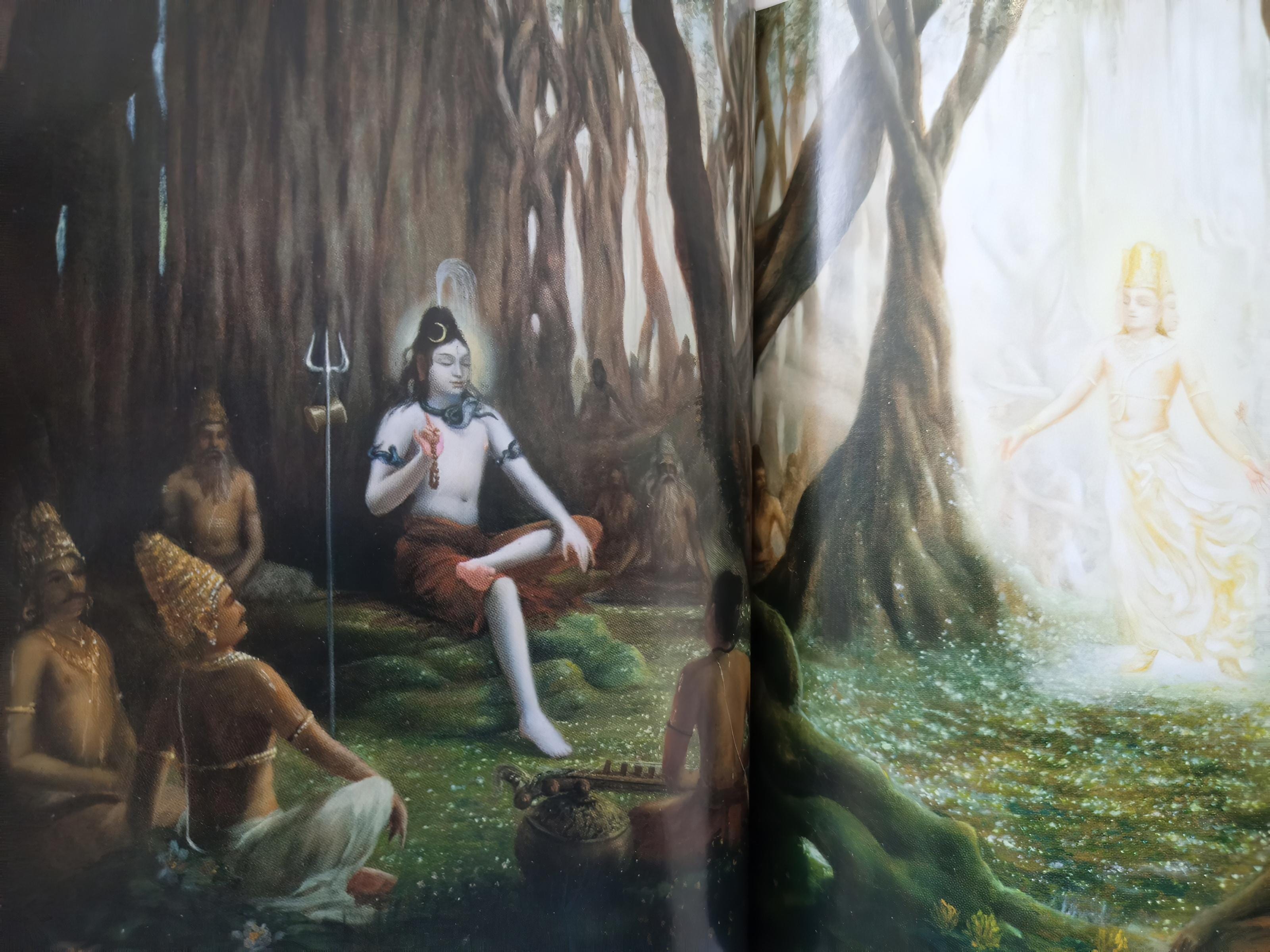
One of the eight sets of mountains surrounding Mount Sumeru, in Ilāvṛta-varṣa (the central tract of land of Jambūdvīpa), is Kailāsa, located to the south. This is the abode of Lord Śiva. This abode is described in the Fourth Canto of Śrīmad Bhāgavatam (chapter six), in the episode when the demigods go there to apologize to Lord Śiva after having offended him at the sacrifice organized by Daksa.
It is described as a paradisiacal place, with pristine nature and all natural opulences. In the middle of it, there is a very auspicious place where Lord Śiva sits under a great banyan tree, which is 100 yojanas high, with its branches spreading over 75 yojanas around. In other words, this tree alone is larger than Great Britain.
Lord Śiva is not interested in material enjoyment. He spends his time absorbed in meditation and in philosophical talks with associates such as Kuvera and the four Kumāras. Despite this, his wife, Pārvatī, is very eager to serve him, accompanied by her billions of servants.
This abode of Lord Śiva is off-limits for the inhabitants of the other eight varṣas. If any human man inadvertently tries to enter this sacred abode, he is immediately transformed into a woman, as described in the first chapter of the Ninth Canto, in the saga of King Sudyumna.
Some believe Lord Śiva is God Himself. This is not completely incorrect, since in fact, Lord Śiva (as Sadāśiva) appears as an expansion of Lord Sankarṣaṇa, manifesting in the material creation through Mahā-Viṣnu. However, when he appears inside the material universes and associates with the material energy, part of his qualities are covered, and he acts as a devotee, meditating on Lord Sankarṣaṇa and glorifying the Lord. Just as curd is nothing but milk, but can’t be used in place of milk in different recipes, Lord Śiva can’t be directly worshiped as the Supreme Lord. He assumes the functions of a guna-avatāra, controlling the bewildering force of the mode of ignorance, and acting as the greatest Vaiṣnava, helping the conditioned souls to get closer to the Lord.
Lord Śiva appears from Lord Sankarṣaṇa, whom He constantly worships through meditation and prayers. Lord Sankarṣaṇa, however, is described as tāmasī, the Lord’s form in the mode of ignorance, which can raise a few questions. How is that?
This is connected with Lord Sankarṣaṇa as the predominating deity of the false ego, or ahaṅkāra, the very source of the illusion that binds the conditioned souls to this world. As described by Lord Kapila, false ego is the subtlest of the material elements, but from it, all the other material elements and everything else manifest.
Some believe in a dichotomy between God and evil, but this view is not supported in Vaiṣnava philosophy. There is nothing apart from the Lord. Everything comes from Him, and everything is under His full control. When it comes to the need for manifesting a force that can bind the souls to this world and serve as the basis for the illusory material reality, the Lord creates it in the form of the false ego, through His own expansion. Sankarṣaṇa is thus the controller of the mode of ignorance, but He is completely aloof from its influence, just as Lord Śiva is.
Thus, Lord Śiva prays:
“We cannot control the force of our anger. Therefore when we look at material things, we cannot avoid feeling attraction or repulsion for them. But the Supreme Lord is never affected in this way. Although He glances over the material world for the purpose of creating, maintaining and destroying it, He is not affected, even to the slightest degree. Therefore, one who desires to conquer the force of the senses must take shelter of the lotus feet of the Lord. Then he will be victorious.
For persons with impure vision, the Supreme Lord’s eyes appear like those of someone who indiscriminately drinks intoxicating beverages. Thus bewildered, such unintelligent persons become angry at the Supreme Lord, and due to their angry mood the Lord Himself appears angry and very fearful. However, this is an illusion. When the wives of the serpent demon were agitated by the touch of the Lord’s lotus feet, due to shyness they could proceed no further in their worship of Him. Yet the Lord remained unagitated by their touch, for He is equipoised in all circumstances. Therefore who will not worship the Supreme Personality of Godhead?” (SB 5.17.19-20)
One of the reasons the Śrīmad Bhāgavatam includes so many prayers of exalted personalities is for us to learn the right devotional mood, the very foundation of our devotional practice. Lord Śiva is certainly not affected by attraction or repulsion to material objects, but we are. We live under the influence of lust and anger, and often fall into their control. We may sometimes think we are powerful enough to resist the influence of Māyā, but this is just another layer of illusion.
The Lord, however, is the controller of Māyā, completely free from her influence. The Mundaka Upaniṣad describes the Lord and the jīva as two birds living in the same tree. We become absorbed in eating the fruits of the tree, sometimes sweet, and sometimes bitter, but the Lord remains always transcendental in His original position. Exactly because He remains transcendental, He can help us to become free. We can’t resist the influence of Māyā by our own power, but when we take shelter on the Lord, surrendering at His feet, we are sheltered from her influence.
Māyāvādis believe that when the Lord appears in this world, He assumes a material body and performs material activities under the material mode of goodness. We, however, disagree with that. The Lord remains transcendental even while performing His pastimes in the material world. When He comes, He comes in His original spiritual body. He doesn’t assume a material form like us.
Materialists, however, can’t understand these pastimes and laugh at the Lord when He comes here, just as a prisoner laughs at the governor when he visits the prison, thinking he has become a prisoner like him. They project their own imperfections on Him, concluding that He acts under the influence of lust and anger, just like them. As Lord Śiva explains: “Thus bewildered, such unintelligent persons become angry at the Supreme Lord, and due to their angry mood the Lord Himself appears angry and very fearful. However, this is an illusion.”
There are many proofs that the Lord is transcendental, His body is fully spiritual, and His pastimes are free from the influence of the material modes. What to say about the Lord, even His pure devotees can remain aloof from material influence, even while living in this world. Understanding all of that, we should surrender unto Him.
Ultimately, the material illusion is just one of the potencies of the Lord. Because we desired to be involved in material activities, the Lord sent us here, in His form as Mahā-Viṣnu. Similarly, when we finally decide to get out, we can become free by His grace. In this way, the soul is eternally dependent on the Lord. In our healthy condition, we accept this dependent position and serve the Lord in a bond of love. In this original position, we are completely happy. When, however, we try to be independent, our problems start.
You can also donate using Buy Me a Coffee, PayPal, Wise, Revolut, or bank transfers. There is a separate page with all the links. This helps me enormously to have time to write instead of doing other things to make a living. Thanks! You can also receive the updates on Telegram.
Ilavrta is always described as a place at the center of the world, but what struck me is how often we externalize “center” as geography instead of consciousness. Maybe the myth isn’t pointing to a hidden landmass but to the axis inside perception itself.
If Siva abides where polarity dissolves, then the real question isn’t where that realm exists — it’s what in us still insists on standing outside it.
Sometimes sacred cartography reads like psychology written in mountain ranges.