

Subscribe to receive new articles by e-mail. It’s free, but if you like, you can pledge a donation:
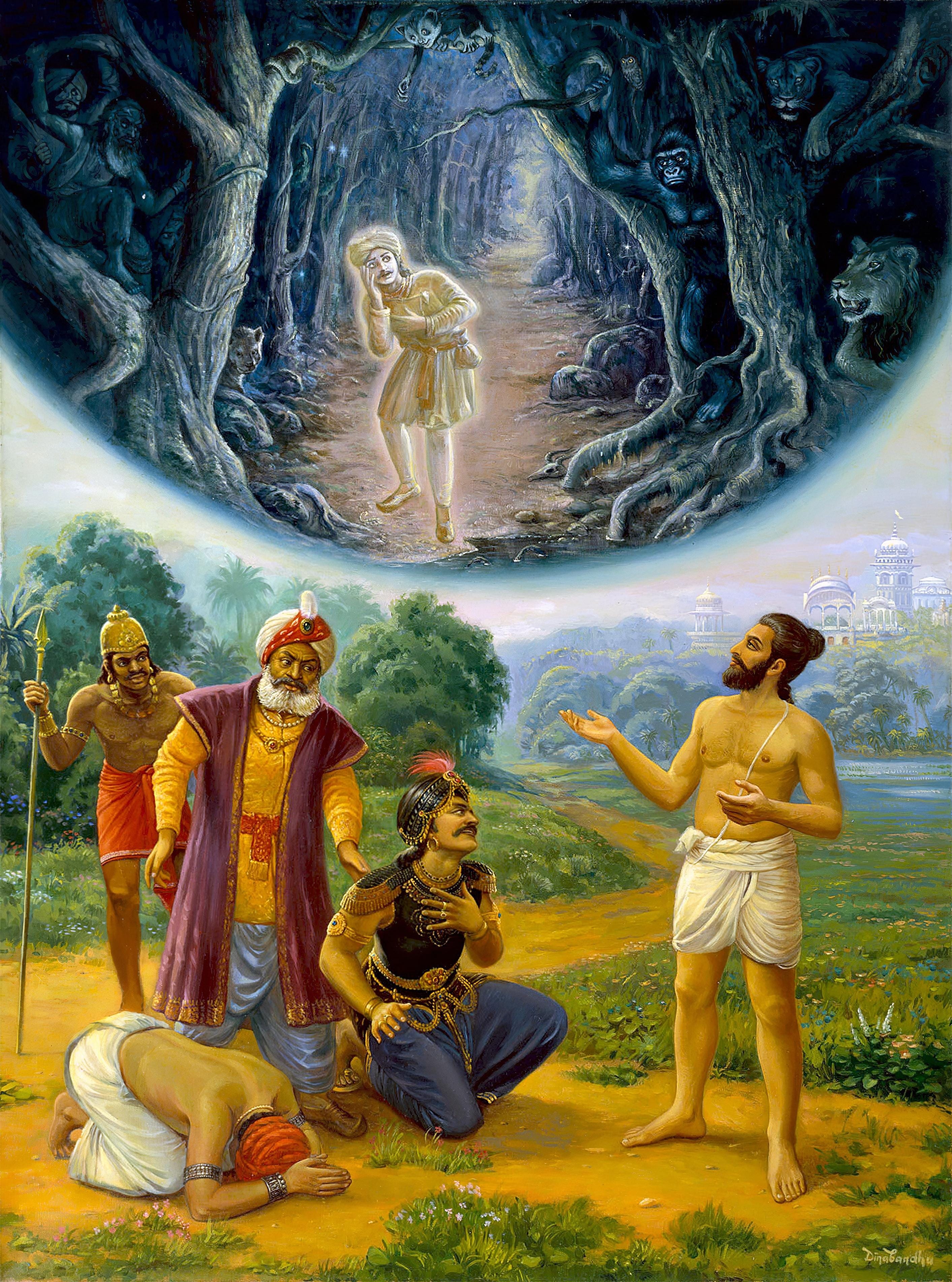
The 5th canto of Śrīmad Bhāgavatam, more specifically the 13th and 14th chapters, brings what some consider one of the heaviest parts of the text, where the material world is compared to a great forest, with wife and children compared to dangerous animals and so on. It describes our material reality in very negative ways.
One of the points is that this passage is quite cryptic, which leads to many misunderstandings. Here are a few elements of the analogy:
- The analogy of the merchant and the thieves
In the allegory, the conditioned soul is compared to a merchant who enters a forest in the hope of obtaining some valuable items to sell. When money and other material assets are used in Kṛṣṇa Consciousness, they can bring us to the goal of life. That’s the only proper use for material assets. However, the material forest is full of dangers that can take everything away.
First, there are six plunderers in the form of the senses and the mind that take away all the resources that are meant for the service of the Lord and force us to squander everything in sense gratification. Material facilities are acquired by executing pious deeds. When they are properly utilized, they can bring us further advancement, but uncontrolled senses take everything away. There is plenty of opportunity to enjoy our senses in Kṛṣṇa Consciousness, by tasting prasāda, hearing kīrtanas, and so on; we just need to do a little bit of austerity to adjust ourselves to these activities.
- Family members as dangerous animals
The second aspect of the allegory is the description of family members as dangerous animals that attack the merchant in the forest.
In materialistic life, a man becomes attached to dependents, such as wife and children. However, pure love is not found in this material world. It’s very rare to find a woman who serves a man simply out of love. Usually, a wife follows her husband based on his capacity to maintain her. The moment there is no money, no house, etc., the relationship breaks. Even children become rebellious when their parents cannot fulfill their wishes, and nowadays, the situation is so degraded that sometimes even men demand money from their wives. Family life is thus based on securing material resources to maintain the household. As soon as the money stops coming, family life is disturbed. Wife and children are thus compared to jackals who cry constantly, forcing a man to work hard in this material world to satisfy their desires.
In Kṛṣṇa Consciousness, we have the ideal of family life as a platform for cooperating in Kṛṣṇa’s service. When the attitude of service is present, money becomes secondary, and husband and wife can focus on living a simple life and developing their Kṛṣṇa Consciousness, as a sacrifice of the Lord, instead of simply demanding material resources from one another. In mundane relationships, however, one is advised to retire from family life at the age of fifty to dedicate his remaining years to developing his Kṛṣṇa Consciousness, since a materialistic family will always be an obstacle to his spiritual progress.
- Groves infested with mosquitoes
The bowers, or groves in the forest, are compared to different professions and trades where people can take shelter to try to earn their livelihood. However, even though they appear inviting from the outside, they are full of mosquitoes, which correspond to the many unkind and envious people we have to deal with daily in the course of our activities. Thus, we have to face so many inconveniences just to get basic resources to continue living.
- The castle in the sky
The whole material environment of home and family, which is centered around the material body, is compared to a gandharva-pura, an imaginary castle in the sky. We chase the illusion of building a permanent place in this material world, but this is not possible. However, because we become attached, we chase after these imaginary goals, just like a person chasing a mirage in the desert. It may sound overly pessimistic, but as time passes and we gain experience in life, we are eventually forced to admit it is true. Some rare people can fully realize the illusion of material existence by just hearing from the scriptures and observing others, but most of us have to go through the process of hope and frustration that comprises the material existence to eventually realize it.
- Gold compared to stool
The next component of the allegory is gold, or money. Money is very bewildering because it brings us the possibility of satisfying our material desires. Materialists are thus very attracted to it. However, its nature is fleeting; it comes and goes. Its presence or absence can take away our peace of mind, and it is thus compared to a bad spirit or a meteor in the sky.
Śukadeva Goswami compares gold with stool, because just like stool is the symbol of impurity, gold is the concentrated focus of sinful activities, such as illicit sex, intoxication, and gambling. These activities are rejected by pure devotees, but materialistic people are very attracted to them and to the golden metal facilitates it. In another verse, gold is also compared to a will-o’-the-wisp, the fluorescence that appears in marshlands that can be deadly to travelers who, feeling cold, confuse it with a source of heat and end up falling into the swamp.
- The whirlwind that blinds
Sexual attraction is compared to a whirlwind that can blind and confuse us. When a man becomes too agitated sexually, he loses all good sense. In general, materialistic life orbits around sexual attraction; that’s what makes people work hard day and night. Due to this whirlwind, people remain blinded, forgotten of the real goal of life.
Because sexual life is so bewildering, it is restricted in different ways in the scriptures. As long as one is engaged in material life, it is practically impossible to avoid attraction to sex life, since the whole material existence orbits around it. We can also see how it is very efficiently used in modern propaganda to sell all kinds of products and services. This makes people more inclined to act sinfully and skip all forms of regulation, engaging in different forms of illicit sex. This is, however, not a very wise choice, as these activities lead to karmic results that one has to suffer in future lives.
Considering that it is very difficult for people to rigidly follow Vedic principles, and the results of illicit sex are very negative, what is the solution? “All these things can be avoided by remaining on the transcendental platform of Kṛṣṇa consciousness. In this way, one does not commit sinful activity.” When we are able to fix ourselves in the practice of Kṛṣṇa Consciousness, we get the high taste that allows us to follow spiritual principles. Without this high taste, it is practically impossible. It is not by chance that Śrī Caitanya Mahāprabhu establishes His movement in Kali-yuga. That is the only solution in the age we live in.
- The cricket and the owl
The material world is the place for envious people. The constant backbiting and criticism are compared to the harsh sounds of an unseen cricket, and the direct words of enemies and opposing elements are compared to the fearful sounds of an owl. Nowadays, we tend to see the owl as a cute bird, but in Vedic culture, owls are connected with darkness, inauspicious omens, and fear. The hoot of an owl is a sound that brings anxiety.
- Impious trees and the mirage
In the allegory, one is already disturbed by the biting of mosquitoes, the attacks of ferocious animals, etc., and now becomes fearful and disheartened by the ominous sounds of owls. All of this adds to one’s suffering. Distressed and hungry, one then tries to take shelter of impious trees that give no fruit, which correspond to other sinful materialists, like political leaders, who can’t offer him any real relief and just engage him in further sinful activities.
One also looks for water (the relief of all these material pains), but unfortunately is illusioned by a mirage, and runs after it. This point is significant because water factually exists; the problem is that under illusion, we look for it in the wrong place. We hanker for real relief and shelter, and this is found in devotional service. The problem is that most refuse the real water, and instead go after many mirages, guided by the illusory potency.
- Jumping into a shallow river
Jumping into a shallow river is compared to going after atheistic philosophies, which simply add to our miseries. The relationship of a person with these spiritual cheaters is exploitative in both ways. One approaches such personalities in search of some material benefit, becoming attracted by displays of magic or power from the so-called guru. Believing the “guru” has supernatural powers, he worships him in the hope of obtaining material blessings or positions of prestige. This is very different from a proper guru/disciple relationship, which is based on love and service. The so-called guru, on the other hand, uses the follower to satisfy his own interests. Even if speaking about God, such persons are actually atheists who act against the principles of the scriptures.
- The forest fire
Another analogy is family life being compared to a forest fire. No one looks for fire, but it starts automatically from natural causes. “Family life” is used in many passages to mean worldly life, contrasted with renounced life. In this sense, living with or without a spouse doesn’t make much of a difference because the anxieties caused by bills, debts, unemployment, taxes, etc., are similar. No one is happy about having a quarter or more of one’s salary being taken away as income tax, on top of all the other taxes charged on day-to-day transactions.
If one is living a renounced life, without much of an income, taxes are not a big problem, but as soon as one has to maintain a household and is already struggling to pay rent and other necessities, excessive taxes become painful. In the Twelfth Canto, it is described that in the later stages of Kali-yuga, people will be so oppressed by taxation that, in desperation, they will leave their homes and seek shelter in forests.
You can also donate using Buy Me a Coffee, PayPal, Wise, Revolut, or bank transfers. There is a separate page with all the links. This helps me enormously to have time to write instead of doing other things to make a living. Thanks!