

Subscribe to receive new articles by e-mail. It’s free, but if you like, you can pledge a donation:
Join the Telegram group if you would like to join the live lessons. This course is maintained with your donations. Click here to donate.
💬 Text of the lesson
The annual orbit of the sun facing the constellations
“Śukadeva Gosvāmī said: My dear King, I have thus far described the diameter of the universe [fifty crores of yojanas, or four billion miles] and its general characteristics, according to the estimations of learned scholars.
As a grain of wheat is divided into two parts and one can estimate the size of the upper part by knowing that of the lower, so, expert geographers instruct, one can understand the measurements of the upper part of the universe by knowing those of the lower part. The sky between the earthly sphere and heavenly sphere is called antarikṣa, or outer space. It adjoins the top of the sphere of earth and the bottom of that of heaven.
In the midst of that region of outer space [antarikṣa] is the most opulent sun, the king of all the planets that emanate heat, such as the moon. By the influence of its radiation, the sun heats the universe and maintains its proper order. It also gives light to help all living entities see. While passing toward the north, toward the south or through the equator, in accordance with the order of the Supreme Personality of Godhead, it is said to move slowly, swiftly or moderately. According to its movements in rising above, going beneath or passing through the equator — and correspondingly coming in touch with various signs of the zodiac, headed by Makara [Capricorn] — days and nights are short, long or equal to one another.” (SB 5.21.1-3)
In the previous chapter, Śukadeva Goswami described Bhū-mandala, which is situated approximately in the vertical middle of the universe. Bhū-mandala forms the earthly sphere, or earthly realm, being composed of all intermediate planets. Below Bhū-mandala are the seven planetary systems of the asuras, and below these are the hellish planets. Sustaining the whole structure is Lord Ananta, who rests on the Garbhodaka ocean, maintaining all planets floating in their proper orbits. What we call “gravity”, is nothing more than His divine potency.
All of these together form the lower half of the universe. What about the upper half? Śukadeva Gosvāmī compares the universe with a grain of wheat. Just as a grain of wheat is divided into two symmetrical parts, the universe is also divided into two halves. The dimensions of the upper region may be inferred from the lower.
Just as the two parts of a grain of wheat are not directly glued together, but joined by a tiny layer of air, similarly, the universe is divided into a lower hemisphere and an upper hemisphere, joined by outer space, the antarikṣa. This is defined as the space between the upper atmosphere and the start of the region of Svargaloka.
When we hear the word “space,” we think in terms of the concept of empty space of modern cosmology, but the concept of the antarikṣa is different. First of all, there is no concept of empty space in the Vedic universe. What seems to be a vacuum is just another material element, ether, which is subtler than the others. Floating on this cosmic ether, the planets move in precise paths, governed not by mechanical laws, but by demigods who perform their functions in accordance to the will of the Lord.
The antarikṣa is thus the space where the sun, moon, and the planets of our solar system move, movements that will be explained in the following passages, starting with the movements of the sun.
This space is also the abode of the Yakṣas and Rākṣasas (Bhuvarloka), the servants of Kuvera. Their abode starts from the upper atmosphere. We can’t see it, because all structures are subtle, but from their perspective, their abodes are formed by lakes, gardens, and so on. In the model of Bhū-mandala, their abode fits the area around Mount Sumeru. In the Mahabharata, it is described that Bhima invaded this abode in search of the saugandhika lotus flower desired by Draupadī, fighting an army of Rākṣasas on the way.
The sūrya-mārga: north, south or through the equator
We then have the main topic of these three verses, which is the annual orbit of the sun.
It is described that the sun sometimes passes through the north, south, or through the equator. This refers to the sūrya-mārga, or the ecliptic circle, which is not identical with the celestial equator. This is also studied in regular astronomy.
The Vedic model is a little different, because the earth is not tilted, but the general concept is the same, with the orbit of the sun staying part of the year above the equator, part under it, and with the two lines crossing in two points of the year. You can see how this works in this diagram:
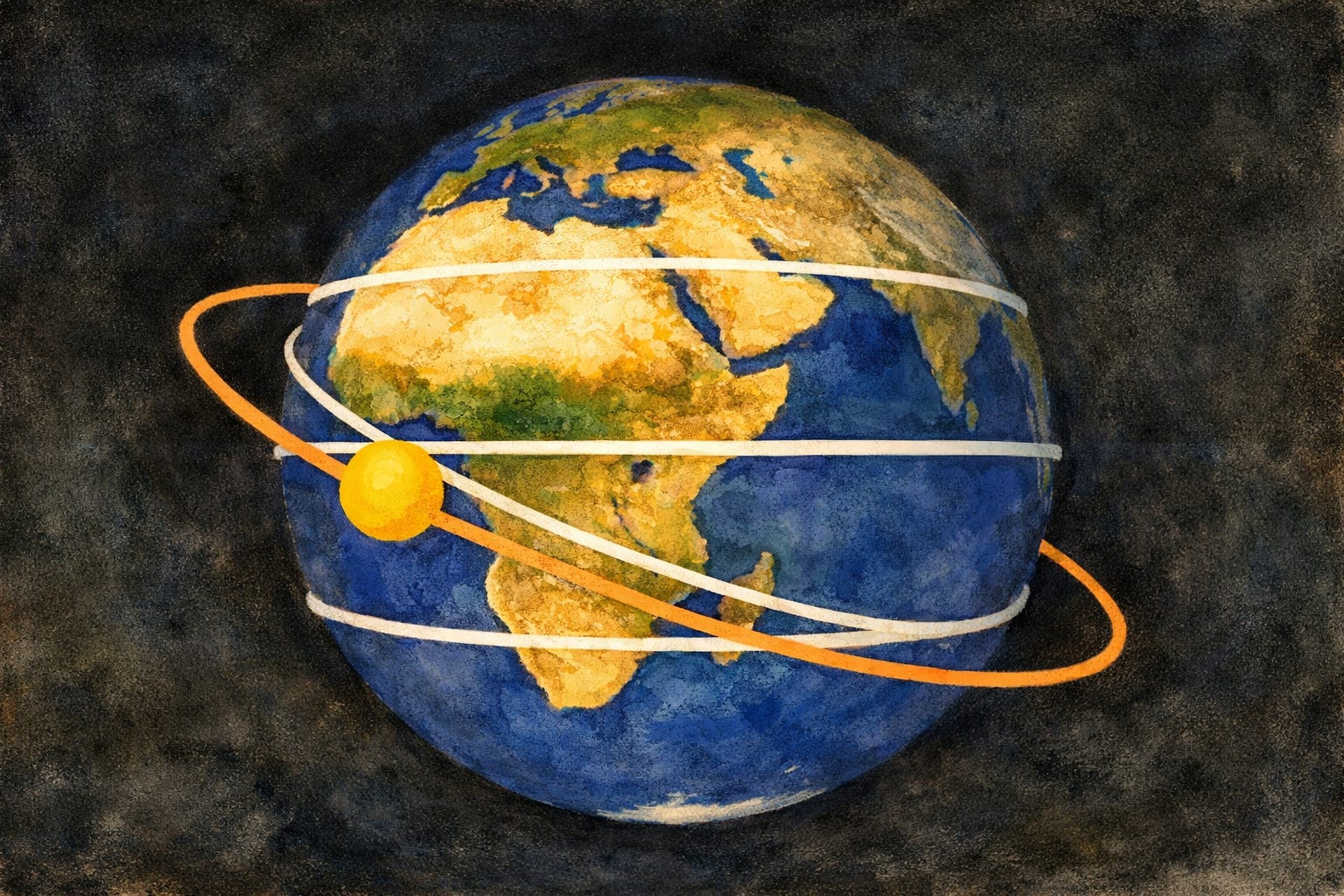
The central horizontal line is the equator, which divides our planet into two exact halves. In the model of the Bhāgavatam, this is also the equator of Bhū-mandala.
The upper horizontal line is the Tropic of Cancer, which marks the upper limit of the path of the sun, while the lower horizontal line is the Tropic of Capricorn, which marks the lower limit of its path.
Imagine someone standing exactly at the line of the equator, facing east. In this position, the line of the equator appears as the middle of the sky. However, the sun will rarely pass directly overhead. Half of the year, the sun will pass to the left of the sky (north, in the direction of the Tropic of Cancer), and the other half to the right (south, on the side of the Tropic of Capricorn). Only two days per year will the sun pass exactly directly overhead. This north-south shifting of the sun at noon is caused by the sun’s annual motion along the ecliptic, the path of the sun shown in the picture. That’s what Śukadeva Goswami describes in these verses as the sun traveling through the constellations (rāśis), sometimes to the north and sometimes to the south.
This is how he explains it:
As the sun goes through its annual path, it sometimes moves northward (udagayana), sometimes southward (dakṣiṇa-ayana), and sometimes (twice a year), it passes exactly through the middle line (vaiṣuvata). Just as in our example, all these movements of the sun are described from the perspective of someone standing on earth in the line of the equator and facing east.
This is one of the points that make Vedic astronomy attractive: it can be explained in very simple and practical way that perfectly matches what we see when we look into the sky. Here, the explanation may appear complicated, because I’m trying to reconcile it with modern observations to satisfy the scientifically minded amongst us. However, the Vedic system can also be explained in a simpler way, especially when one can visually see the model working.
The word yathā-savanam in text three is very significant for understanding this passage. The orbit of the sun is conducted according to the order of the Supreme Personality of Godhead. This understanding is the missing element in modern cosmology. The description of the orbit of the sun and the planets, thus, is not just a lesson in cosmology, but ultimately an aid to see the Lord behind all these functions, observing how the universe works in an ordered way, as an universal machine, and understanding that just each of the demigods has their particular functions, we also have certain functions that we should perform as an offering to the Lord. The description of the universe found in the Śrīmad Bhāgavatam helps us to reinforce both our devotional meditation and our concept of performing our prescribed duties.
The movement of the sun facing the constellations
“When the sun passes through Meṣa [Aries] and Tulā [Libra], the durations of day and night are equal. When it passes through the five signs headed by Vṛṣabha [Taurus], the duration of the days increases [until Cancer], and then it gradually decreases by half an hour each month, until day and night again become equal [in Libra].When the sun passes through the five signs beginning with Vṛścika [Scorpio], the duration of the days decreases [until Capricorn], and then gradually it increases month after month, until day and night become equal [in Aries].
Until the sun travels to the south the days grow longer, and until it travels to the north the nights grow longer.” (SB 5.21.4-6)
The movement of the sun around the zodiac (passing north or south of the celestial equator), results in the days becoming longer or shorter, as the seasons go by. The sun goes through the twelve signs during the year.
This explanation becomes easier to follow when we look to the wheel of the Zodiac:
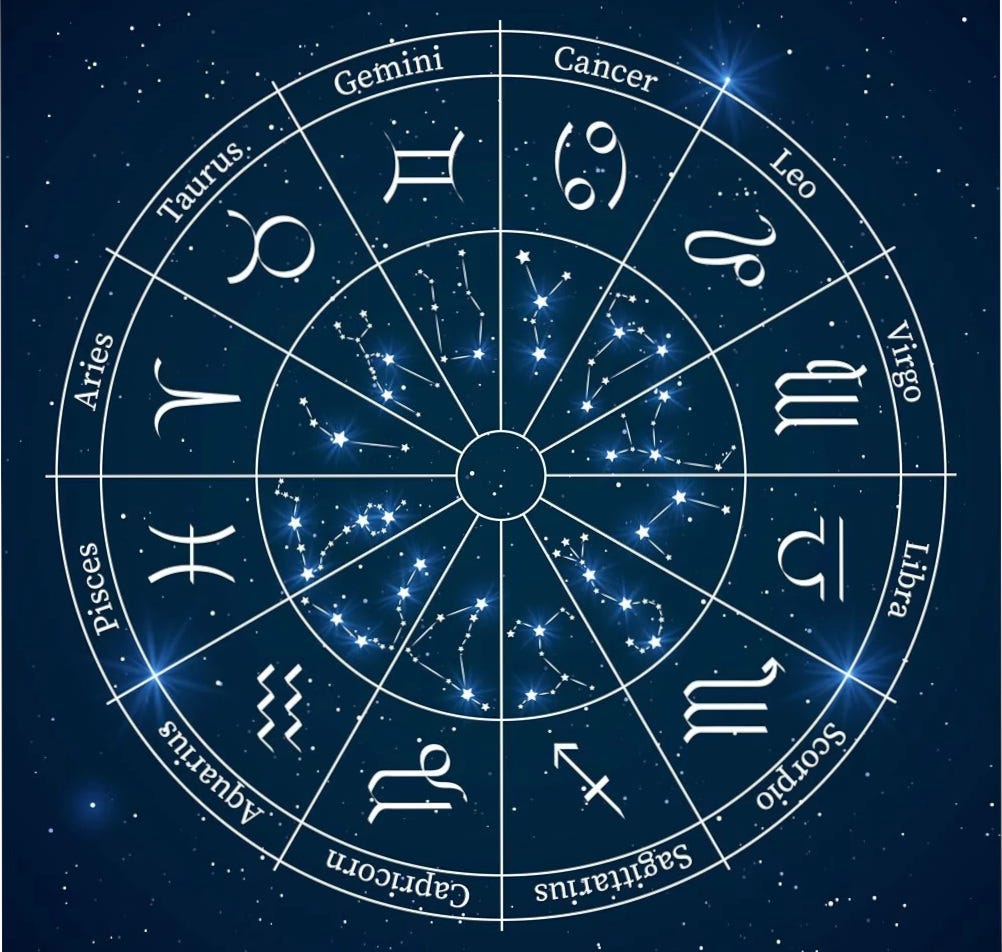
The text says: “When the sun passes through Meṣa [Aries] and Tulā [Libra], the durations of day and night are equal.”
These are the two equinoxes (vaiṣuvata), when the sun is aligned with the equatorial plane and the duration of the days and nights is approximately equal at most latitudes. This happens only two times per year, when the sun enters Meṣa (Aries) and Tulā (Libra). In the modern calendar, this corresponds approximately to March 20 and September 22.
In the model described in these verses, the equator of our planet corresponds also to the celestial equator of Bhū-maṇḍala, since in the Vedic model the Earth is not tilted. The same phenomenon should thus be observed in the other planets that compose the planetary system.
Let’s take Aries as the starting point. When the sun enters Aries (nine o’clock on the wheel of the zodiac in the illustration), the days and nights are approximately the same. From Aries, the sun goes to Taurus (Vṛṣabha) and then Gemini (Mithuna) and Cancer (Karkaṭa). Here the sun is moving northward of the equator (udagayana). The practical effect will be opposite in the two hemispheres and will vary according to the latitude. The Bhāgavatam explains it from the point of view of someone in central India (a latitude of about 24.2°N). At this latitude, the transition makes the days longer at a rate of approximately half an hour for each sign, with the sun’s daily arc becoming progressively longer.
When the sun enters Cancer, the days become very long in relation to the nights: approximately 13.5 hours for the days and 10.5 hours for the nights. This is the summer solstice.
After Cancer, there is a reversal. With the sun entering Leo, the days become shorter by about half an hour, and then half an hour more in Virgo. By the time the sun enters Libra, the days and nights are again approximately equal.
We then have the second half of the year, when the sun goes to the south hemisphere (dakṣiṇa-ayana) and the days become shorter, leading to the colder season. As the sun enters Scorpio and Capricorn, the days become progressively shorter, reaching their minimum duration when it enters Capricorn. That’s the winter solstice.
From there, there is again a reversal, with the days gradually increasing as the sun goes through Aquarius and Pisces, until they again become equal back in Aries.
This is also indicated in the text:
“When the sun passes through the five signs beginning with Vṛścika [Scorpio], the duration of the days decreases [until Capricorn], and then gradually it increases month after month, until day and night become equal [in Aries].”
In short, the northward movement results in longer days and the southward movement in shorter days. This is a concise explanation of how the movement of the sun results in seasonal change.
What about the sun moving slowly, swiftly, or moderately?
Śukadeva Goswami mentions that “While passing toward the north, toward the south or through the equator, in accordance with the order of the Supreme Personality of Godhead, it is said to move slowly, swiftly or moderately.” What does it mean?
In his commentary to this passage, Śrila Viśvanātha Cakravartī Ṭhākura explains that although the sun spends the same time in each sign (a little over one month), the speed of the change in the duration of the days and nights is not constant. At some points of the year, the duration of the days shortens quickly, and on others it increases slowly. This doesn’t mean the movement of the sun changes, it is just a practical phenomenon due to the shifts in the north–south position of the sun relative to Bhū-maṇḍala, which changes the arc of illumination.
During the uttarāyaṇa period (beginning with the winter solstice), the length of the days increases slowly as the sun moves through Capricorn, Aquarius, etc. from the minimum of the winter solstice. On the other half of the movement, starting from the summer solstice, as the sun moves through Cancer, Leo, etc. the length of the days shortens quickly. During the equinox periods, as the sun moves through Aries and Libra, the change happens at moderate speed.
This same phenomenon is also observed in modern astronomy; it is just explained differently. Modern models explain it through the elliptical orbit of the Earth around the sun, and the tilt of Earth’s axis.
The movement in relation to Bhū-mandala
In short, the movement of the sun facing the constellations, north and south of the equator, causes the variation in the lengths of the days and nights (explained in modern cosmology through the orbit of the earth around the sun), and also explains the variations on the rate of increase and decrease of the length of the days as the year goes by.
Once we understand how this phenomenon is observable from earth, the next question is: Is this applicable only to our planet? No. It is applicable to the whole Bhū-mandala. What an observer at the equator sees as the middle of the sky is the equator of Bhū-mandala. Imagining Bhū-mandala as a planetary system, where each varṣa is a separate planet, as Prabhupāda concluded, the orbit of the sun should be seen according to the same principle in all planets of the planetary system.
In this model, everywhere there is day and night, and the length of the days and nights shifts during the year, exactly as described in these verses. The explanation of Śukadeva Goswami thus works for the whole intermediate system. For the demigods, however, both on top of Mount Sumeru and in Svargaloka it works differently, as it will be explained in the next verses.
One question one could ask, is that this model implies that the sun moves north and south of the equator of Bhū-mandala. How is this possible? This is the logical conclusion from the description, since it fits the model, and is directly described in the text by the use of the terms uttarāyaṇa and dakṣiṇāyana (the sun travels “to the south” and “to the north,” producing long and short days, as described on SB 5.21.6) but since everything is possible in Kṛṣṇa’s creation, it can also be that there is some other explanation of how it occurs. However, if we accept Bhū-mandala as a planetary system, and not literally as a set of islands, then the idea of the sun moving south of the equator doesn’t sound too implausible, since it is not about crossing solid ground.
Having described the annual movement of the sun, in which it moves to the north and south, resulting in the variation of the lengths of days and nights and the passage of the seasons, Śukadeva Gosvāmī now explains the daily movement of the sun around Mānasottara Mountain.
The daily movement of the sun around the Mānasottara path
“Śukadeva Gosvāmī continued; My dear King, as stated before, the learned say that the sun travels over all sides of Mānasottara Mountain in a circle whose length is 95,100,000 yojanas [760,800,000 miles]. On Mānasottara Mountain, due east of Mount Sumeru, is a place known as Devadhānī, possessed by King Indra. Similarly, in the south is a place known as Saṁyamanī, possessed by Yamarāja, in the west is a place known as Nimlocanī, possessed by Varuṇa, and in the north is a place named Vibhāvarī, possessed by the moon-god. Sunrise, midday, sunset and midnight occur in all those places according to specific times, thus engaging all living entities in their various occupational duties and also making them cease such duties.” (SB 5.21.7)
The previous verses described the annual orbit of the sun, where it moves counterclockwise around Mount Sumeru, on a tilted path, keeping the mountain on its left side. This movement is produced by the chariot of the sun moving forward, facing the signs of the Zodiac, resulting in the passage of the seasons and the gradual shift in the duration of days and nights.
Now, text seven describes the daily orbit of the sun around Mānasottara Mountain, also circling Mount Sumeru, but now much faster and in a clockwise rotation, resulting in the passage of days and nights. In this daily movement, the sun moves in the opposite direction, keeping Mount Sumeru on its right.
This is exactly the point about the sun moving both clockwise and counterclockwise that confuses Maharaja Parīkṣit, leading him to ask on 5.22.1:
“How can we reasonably accept that the sun-god proceeds with Sumeru and Dhruvaloka on both his left and right simultaneously?”
Let’s try to understand how the model works.
At first, the idea of the sun moving clockwise and counterclockwise at the same time sounds absurd, but the model actually works. The point is that at the same time that the chariot of the sun moves in one direction, going north and south, facing the constellations, it is forced to move on a different direction by the movement of the whole sky around Dhruvaloka (the polestar). This movement is not produced by the sun itself, but by the rotation of the whole sky (kāla-cakra) established by the Lord. This is a mysterious but very important point to be understood in Vedic cosmology: all luminaries have similar dual movements, or two simultaneous movements: one that is independent, according to their orbits in relation to each other, and another caused by the daily rotation of the whole sky around Dhruvaloka. One example that can be given is a whirlwind, where all the particles of dust move following the movement of the wind, but at the same time they move in relation to each other. Another example is ants moving on top of a potter’s well rotating at great speed (an example Śukadeva Goswami will use later).
Again, it may sound implausible that the whole sky may move and circle Bhū-mandala daily (such great speeds transcends the assumptions of modern physics, to put it mildly) but that’s the whole point of the Vedic model. It is not about physics, but about the desire of the Lord. He is the one who makes the rules.
To make the explanation easier to follow, let’s jump to text 5.21.10-11, where the idea continues to be explored:
“When the sun travels from Devadhānī, the residence of Indra, to Saṁyamanī, the residence of Yamarāja, it travels 23,775,000 yojanas [190,200,000 miles] in fifteen ghaṭikās [six hours].
From the residence of Yamarāja the sun travels to Nimlocanī, the residence of Varuṇa, from there to Vibhāvarī, the residence of the moon-god, and from there again to the residence of Indra. In a similar way, the moon, along with the other stars and planets, becomes visible in the celestial sphere and then sets and again becomes invisible.” (SB 5.21.10-11)
Text seven describes that the circuit of the sun around Mānasottara Mountain is 95,100,000 yojanas in length. On each of the four directions of this circuit there is a different abode, ruled over by one of the principal demigods. In its daily rotation around Dhruvaloka, following the movement of the kāla-cakra, the sun takes six hours to travel the 23,775,000 yojanas from one point to the other, resulting in the four divisions of the day: sunrise, midday, sunset and midnight.
Thus, the Bhāgavatam gives us a map of the sun’s daily circuit around Mānasottara and how each stage is perceived by us:
Devadhānī (east – Indra): sunrise
Saṁyamanī (south – Yama): midday
Nimlocanī (west – Varuṇa): sunset
Vibhāvarī (north – Candra): midnight
Back to Devadhānī: sunrise
This is the Bhāgavatam explanation for the concept of timezones in the model of a spherical earth. People in different parts of the planet see the sun rising and setting at different times, and this same system affects not only our planet, but all the varṣas of Bhū-mandala. The passage of time is thus a continuous, unbroken cycle, connected with the kāla-cakra, the wheel of the Lord.
What about the mention of the moon, together with the other stars and planets? They all follow similar daily cycles, orbiting around Dhruvaloka, rising and setting at their allotted times. The sun is the chief, but all the others luminaries follow the same orderly procession.
For a modern astronomer, it may be more comfortable to presume that the cycles of days and nights happen because of the rotation of the earth, rather than imagine that the whole sky rotates, but again, the point made in the Śrīmad Bhāgavatam is that all of it happens by the order of the Lord. Kṛṣṇa is so powerful that when He orders the whole sky to rotate once a day around the planet of His pure devotee, Dhruva, the stars and planets have no choice but to obey.
Another meaning is that this passing of days and nights is the arrangement of the Lord to engage all living beings in their respective prescribed duties. Waking up at certain times, working at certain times, worshiping at certain times and so on.
In his purport to text eleven, Prabhupāda repeats a few important conclusions about the Vedic model of the universe that are offered in other passages:
“In Bhagavad-gītā (10.21) Kṛṣṇa says, nakṣatrāṇām ahaṁ śaśī: “Of stars I am the moon.” This indicates that the moon is similar to the other stars. The Vedic literature informs us that within this universe there is one sun, which is moving. The Western theory that all the luminaries in the sky are different suns is not confirmed in the Vedic literature. Nor can we assume that these luminaries are the suns of other universes, for each universe is covered by various layers of material elements, and therefore although the universes are clustered together, we cannot see from one universe to another. In other words, whatever we see is within this one universe. In each universe there is one Lord Brahmā, and there are other demigods on other planets, but there is only one sun.”
This can be summarized in three points:
a) The stars in the Vedic model have a different nature than believed in modern cosmology. They are not described as independent suns like in modern cosmology, but rather as reflecting the light of the sun, or emitting relatively modest amounts of light. The Vedic universe is still huge, but it is far smaller than believed in modern theories.
b) There is only one sun per universe, which somehow illuminates not only the earth, but all intermediate planets. Somehow, different planets appear to be far away to us, scattered around the cosmos, but in the higher-dimensional structure described in the Purāṇas, they somehow come close. Thus, their inhabitants see the sun rising and setting daily just as we do.
c) Everything we see in the sky is part of our own universe. Other universes are isolated from ours by dense coverings of elemental matter. This rejects the interpretation that each solar system may be a separate universe.
“Thus the chariot of the sun-god, which is trayīmaya, or worshiped by the words om bhūr bhuvaḥ svaḥ, travels through the four residences mentioned above at a speed of 3,400,800 yojanas [27,206,400 miles] in a muhūrta.” (SB 5.21.12)
The sun is not just a physical object (as believed by materialists), nor just the planet of a demigod (as believed by karma-kandis). Ultimately, the sun is a manifestation of the Supreme Lord, who pervades the sun as Surya-Narāyana. The sun, as a planet, is just His abode, and the demigod of the sun, His servant. When the Vedas describe the sun-god, they actually describe the Supreme Lord.
The special property of the sun is to reflect the light of the impersonal brahmajyoti, which appears in the form of visible light that illuminates the whole universe. As Prabhupāda concludes, there is just one sun per universe, because no other material planet or star has this properly. This also explains how stars which are extremely far away can still reflect the light of the sun. It is not about mere physical light.
“The chariot of the sun-god has only one wheel, which is known as Saṁvatsara. The twelve months are calculated to be its twelve spokes, the six seasons are the sections of its rim, and the three cātur-māsya periods are its three-sectioned hub. One side of the axle carrying the wheel rests upon the summit of Mount Sumeru, and the other rests upon Mānasottara Mountain. Affixed to the outer end of the axle, the wheel continuously rotates on Mānasottara Mountain like the wheel of an oil-pressing machine.
As in an oil-pressing machine, this first axle is attached to a second axle, which is one-fourth as long [3,937,500 yojanas, or 31,500,000 miles]. The upper end of this second axle is attached to Dhruvaloka by a rope of wind.” (SB 5.21.13)
The sun is described as a chariot in the sense of a carrier, or vehicle, and not as an earthen chariot made of wood. This vehicle is called trayīmaya (trayī = the three Vedas, maya = pervaded by). When we chant the gāyatrī mantra, starting with the words Om bhūr bhuvaḥ svaḥ, we worship this manifestation of the Supreme Lord which illuminates the three worlds and travels at great speeds around the cosmos.
The verse mentions that the sun travels 3,400,800 yojanas per muhūrta (48 minutes), which follows the same figures given on text seven. There are 30 muhūrtas in 24 hours, and thus, 3,400,800 yojanas multiplied by 30 results in the same 95,100,000 yojanas per day mentioned there.
As also mentioned previously, the axis of the sun is connected to Mount Sumeru on one side, and Mānasottara Mountain on the other. Following the analogy of the chariot, the annual movement of the sun is compared to a wheel, known as Saṁvatsara. Just as the sun is not literally a chariot made of wood, this wheel is not literally a wheel running on top of a mountain. The verse uses it as a metaphor to explain the solar year: “The twelve months are calculated to be its twelve spokes, the six seasons are the sections of its rim, and the three cātur-māsya periods are its three-sectioned hub.”
In this metaphor, the whole year is compared to a rotating wheel, with each rotation corresponding to one solar year (or one circle of the sun facing the constellations). The wheel has twelve spokes, which correspond to the twelve months, and the rim is divided into six connected sections, which correspond to the six seasons of the Vedic calendar: Vasanta (spring), Grīṣma (summer), Varṣā (rainy), Śarad (autumn), Hemanta (pre-winter), Śiśira (winter). The central hub is composed of three joined sections, which correspond to the three cāturmāsya periods of four months each.
In this way, the verse teaches that the movement of the sun is not random. It is aligned with the performance of dharma through the performance of one’s duties in agriculture, worship, etc. Just as the sun moves in the sky following the order of the Lord, we should also move, performing our duties according to the times of the day and seasons of the year according to the prescriptions of the scriptures.
The sun is thus called trayīmaya because its course embodies the structure of the Vedas, and we should also follow this structure by performing our prescribed duties.
This is a publication for thoughtful readers who want to go deeper into Kṛṣṇa consciousness. I publish daily, trying to offer high-quality spiritual content, and all posts are available to free subscribers. If you wish, you can support this work with a monthly contribution. When you subscribe, you can choose between a free subscription and a monthly contribution, and you can switch from a free subscriber to a supporter at any time.
If you would like to contribute further, you can find the donation links here.