

Subscribe to receive new articles by e-mail. It’s free, but if you like, you can pledge a donation:
🔉 Audio of the lesson »
🎙Podcast (Search for “Mysteries of the Vedas” on Spotify, iTunes, etc. to hear all the lessons
Check this post if you would like to join the live lessons. This course is maintained with your donations. Click here to donate.
💬 Text of the lesson
The devotee priests conclude their prayers to the Supreme Lord
“All of life’s goals and opulences are directly, self-sufficiently, unceasingly and unlimitedly increasing in You at every moment. Indeed, You are unlimited enjoyment and blissful existence itself. As far as we are concerned, O Lord, we are always after material enjoyment. You do not need all these sacrificial arrangements, but they are meant for us so that we may be benedicted by Your Lordship. All these sacrifices are performed for our fruitive results, and they are not actually needed by You.” (SB 5.3.8)
The Lord is not a hungry man who is dependent on our offerings, or a beggar who needs us to build a house for His residence. As Prabhupāda elaborates, “We may construct a gorgeous temple and spend thousands of dollars, but such a temple is not required by the Lord. The Lord has many millions of temples for His residence, and He does not need our attempt. He does not require opulent activity at all.”
If the Lord does not need our offerings, why do we endeavor to cook nice dishes and construct opulent temples for Him? This is precisely one of the challenges of devotional service. In material welfare, we work to satisfy the needs of people who have less than us, like the hungry and homeless. This gives us a sense of superiority, seeing ourselves as the providers and maintainers. This is part of the reason we are in this material world: we want to be the maintainers of others, the object of love and gratitude, which are positions that belong to the Lord.
When we come to devotional service, we are confronted with the idea of serving someone who has everything and is not in need of our offerings. The Lord is already served by millions of gopis and goddesses of fortune, and has no need for our offerings. He has already His abode in the spiritual world, full of kalpa-vṛkṣa trees and cintāmaṇi stones, and has no need for a temple made out of bricks. Instead of offering something as a favor, to satisfy one’s need, we offer something to the Lord as a way to try to attract His attention for our own benefit. We have to get rid of our false ego and situate ourselves in a position of humility.
In this spirit, we cook our offerings the best we can, and put all our attention and resources into building a house where we can invite the Lord to reside in the form of the deity. Not because He needs it, but because we are anxious for the opportunity to offer some service to Him. This is how devotional love is expressed.
As Prabhupāda concludes, “If we engage our money in constructing a gorgeous temple, we are freed from the reactions of our endeavors. This is for our benefit. In addition, if we attempt to do something nice for the Supreme Lord, He is pleased with us and gives us His benediction. In conclusion, the gorgeous arrangements are not for the Lord’s sake but for our own. If we somehow or other receive blessings and benedictions from the Lord, our consciousness can be purified and we can become eligible to return home, back to Godhead.”
The soul is eternally connected to the Lord in a bond of love. The key, however, is purification. To relate to the Lord, we need to become purified from material contamination, including the tendency to control. The process for becoming purified of these contaminations is serving the Lord in a humble spirit. In the platform of pure love, everything is possible. Sometimes the Lord becomes dependent on His devotee, and sometimes He is controlled by His devotee, but this is completely different from the contaminated material platform permeated by lust.
Examples of the mercy of the Lord
“O Lord of lords, we are completely ignorant of the execution of dharma, artha, kāma and mokṣa, the process of liberation, because we do not actually know the goal of life. You have appeared personally before us like a person soliciting worship, but actually You are present here just so we can see You. You have come out of Your abundant and causeless mercy in order to serve our purpose, our interest, and give us the benefit of Your personal glory called apavarga, liberation. You have come, although You are not properly worshiped by us due to our ignorance.” (SB 5.3.9)
The Brāhmanas don’t claim to be perfect performers of sacrifice. Instead, they give us the perfect example, confessing the faults and deficiencies in their performance and their lack of perfect knowledge, stating that despite this, the Lord appeared to them due to His causeless mercy. This perfectly describes our situation. Our knowledge is limited, and our offerings are full of faults. Yet, because the Lord is infinitely merciful, we can still be sure of His mercy. Devotional service is so powerful that it allows us to obtain a perfect result out of an imperfect offering. It is so because it involves the personal participation of the Lord, who is so powerful.
The Lord is so merciful that even though in our deep ignorance we are not able to see anything beyond stone, wood, and other material objects, He appears in a form made of these material elements, so we can see Him, and personally serve Him in the form of the deity. This is all just to save us from material entanglement and bring us back to our original, healthy position of service.
As Prabhupāda explains, “Since we have no transcendental vision, we cannot see the spiritual sac-cid-ānanda-vigraha of the Lord; therefore, out of His causeless mercy He comes in a form we can see. We can only see material things like stone and wood, and therefore He accepts a form of stone and wood and thus accepts our service in the temple. This is an exhibition of the Lord’s causeless mercy. Although He has no interest in such things, in order to receive our loving service He agrees to act as He does.”
This also helps us to accept our own personal imperfections. Sometimes, under the influence of the false ego, we think ourselves perfect, and others, under the pressure of the mind, we feel the worst. We thus oscillate between pride and depression. In reality, we are neither one nor the other. We are not perfect, but we have some capacity to serve the Lord. When we focus on what we can do for Him, little as it may be, without envying others who do more, we become again situated in our eternal position. The secret is humility. Even though the inhabitants of the spiritual world are eternally perfect, they see themselves as the humble servants of the Lord. This humility keeps them attentive and fixed in their service. This is the same spirit we should strive to develop.
The right mood of service
“O most worshipable of all, You are the best of all benefactors, and Your appearance at saintly King Nābhi’s sacrificial arena is meant for our benediction. Because You have been seen by us, You have bestowed upon us the most valuable benediction.
Dear Lord, all the great sages who are thoughtful and saintly persons incessantly recount Your spiritual qualities. These sages have already burned up all the unlimited dirty things and, by the fire of knowledge, strengthened their detachment from the material world. Thus they have attained Your qualities and are self-satisfied. Yet even for those who feel spiritual bliss in chanting Your attributes, Your personal presence is very rare.” (SB 5.3.10-11)
Sahajiyās often think that they have captured the Lord, or that they are already situated on a platform of pure devotion. In this way, they take the company of the Lord as something ordinary and spiritual practice as casual. Why would someone strive for something he thinks he already has?
This is, however, not the mood cultivated by our ācāryas. The six Gosvāmīs were always in the mood of searching for the Lord and trying to attract His mercy. Similarly, the gopis are always anxious for the company of the Lord, never presuming they have captured Him. When we cultivate this mood, we value the association of the Lord, understanding that this is the most valuable and rare opportunity. We feel ecstasy in the smallest gesture of reciprocation, and value every opportunity to see the Lord and His pure devotees and to perform any small service.
In this mood, the sages were very grateful for the presence of the Lord, understanding its value, and considering themselves unworthy of such a benediction. As Prabhupāda summarizes: “The priests in Mahārāja Nābhi’s sacrificial arena appreciated the personal presence of the Supreme Lord Viṣṇu, and they considered themselves very much obliged. The Lord’s appearance is rare even for great saintly persons who have become completely detached from this material world and whose hearts are clean due to constantly chanting the glories of the Lord. Such people are satisfied by chanting the transcendental qualities of the Lord. The Lord’s personal presence is not actually required. The priests are pointing out that the Lord’s personal presence is very rare even for such elevated sages but that He was so kind to them that now He was personally present. Therefore the priests were very much obliged.”
The priests then ask for a benediction
“Dear Lord, we may not be able to remember Your name, form and qualities due to stumbling, hunger, falling down, yawning or being in a miserable diseased condition at the time of death when there is a high fever. We therefore pray unto You, O Lord, for You are very affectionate to Your devotees. Please help us remember You and utter Your holy names, attributes and activities, which can dispel all the reactions of our sinful lives.” (SB 5.3.12)
All the spiritual practice we perform during our lives is tested at the time of death. Often, we think of death as something peaceful, but this is just something invented to make others feel better. Death is always painful and difficult, a precarious position, as phrased by Prabhupāda. Even if we practice during our lives, there is always the possibility that we may forget the Lord at the final moment due to acute suffering or mental confusion. This is thus another situation in which we should not take things for granted or think that our own strength is enough. Rather, we should see ourselves as dependent on the mercy of the Lord and always pray for Him to help us at this crucial moment. Again, the brāhmanas show us the way.
The shortsightedness of approaching the Lord for material blessings
“Dear Lord, here is the great King Nābhi, whose ultimate goal in life is to have a son like You. Your Lordship, his position is like that of a person approaching a very rich man and begging for a little grain. Mahārāja Nābhi is so desirous of having a son that he is worshiping You for a son, although You can offer him any exalted position, including elevation to the heavenly planets or liberation back to Godhead.” (SB 5.3.13)
Earlier in the Śrīmad Bhāgavatam, it was established that even if one has material desires, one should worship the Lord (akāmaḥ sarva-kāmo vā, mokṣa-kāma udāra-dhīḥ). The Lord is the ultimate bestower of all benedictions, and the only one who can give anything eternal; therefore, there is no need to worship anyone except Him.
However, as Lord Kapila explained in his teachings, worshiping the Lord and asking for material benedictions is a symptom that our devotional service is still contaminated by the material modes. Even asking for liberation is a result of the influence of the mode of goodness. A pure devotee simply asks to be constantly engaged in loving devotional service, understanding that this is the greatest benediction.
As Prabhupāda explains, the desire of King Nābhi in having a son like Viṣṇu was still a form of sense gratification, and therefore the priests showed regret in evoking the presence of the Lord to ask for it. They compared the position of the king to that of a poor person approaching the king to just ask for a handful of grains. The king can give him any amount of riches that would solve his financial problem for good, but lacking oversight, the poor man thinks only of the immediate problem of securing some grain for his next meal. As Prabhupada adds in his purport to text 14, “Everyone is subjected to the influence of māyā and entangled in all kinds of material desire, and Mahārāja Nābhi was no exception.”
The Lord, however, has an interesting policy: when He grants a benediction, He does it in such a way that one doesn’t have to ask for another material benediction again. In other words, He arranges for the devotee to attain the satisfaction of whatever material desires one may have, so he or she can become fixed in his practice and attain perfection. We saw this at work in the case of Dhruva Maharaja and in other examples. Now we will see it in the case of King Nābhi.
Still, as Prabhupāda explains, an intelligent devotee skips this whole process and asks directly for the ultimate goal of life:
“Śrī Caitanya Mahāprabhu has taught us how to approach the Supreme Lord and ask Him for the ultimate benediction. He said: na dhanaṁ na janaṁ na sundarīṁ kavitāṁ vā jagad-īśa kāmaye. He did not want to ask the Supreme Lord for anything material. Material opulence means riches, a nice family, a good wife and many followers, but an intelligent devotee doesn’t ask the Supreme Lord for anything material. His only prayer is: mama janmani janmanīśvare bhavatād bhaktir ahaitukī tvayi. He wants to be engaged perpetually in the loving service of the Lord.”
The brāhmanas continue:
“Dear Lord, unless one worships the lotus feet of great devotees, one will be conquered by the illusory energy, and his intelligence will be bewildered. Indeed, who has not been carried away by the waves of material enjoyment, which are like poison? Your illusory energy is unconquerable. No one can see the path of this material energy or tell how it is working.
O Lord, You perform many wonderful activities. Our only aim was to acquire a son by performing this great sacrifice; therefore our intelligence is not very sharp. We are not experienced in ascertaining life’s goal. By inviting You to this negligible sacrifice for some material motive, we have certainly committed a great offense at Your lotus feet. Therefore, O Lord of lords, please excuse our offense because of Your causeless mercy and equal mind.” (SB 5.3.14-15)
Material desires come from the influence of the material energy. Pure devotional service passes through becoming free from material desires, which means attaining the platform of liberation, becoming free from material influence. How can we do that? The brāhmanas answer that one has to worship great devotees, who are the bearers of the mercy of the Lord. For that, we should associate with them and be attentive to the opportunity of offering any form of service, small as it may seem. As Prabhupāda explains, pure devotees have no desire to enjoy the material world, and by taking shelter in such a pure devotee we gradually attain his qualities.
The priests conclude their prayers, again showing their regret in worshiping the Lord for material gain, but confident in the mercy of the Lord.
One could question why SB 2.3.10 tells us that everyone should worship the Lord, even with material desires, if this passage concludes very strongly that the Lord should not be worshiped for material gain? The answer is that these two passages refer to two different stages. One who is not on a platform of devotional service is advised to approach the Lord, even if to ask for material blessings, but a devotee who is already progressing in the devotional path is advised to aim for the goal of life. As Prabhupāda elaborates in his purport:
“Initiation into bhakti begins when one is in a distressed condition or in want of money, or when one is inquisitive to understand the Absolute Truth. Nonetheless, people who approach the Supreme Lord in this way are not actually devotees. They are accepted as pious (sukṛtinaḥ) due to their inquiring about the Absolute Truth, the Supreme Personality of Godhead. Not knowing the various activities and engagements of the Lord, such people unnecessarily disturb the Lord for material gain. However, the Lord is so kind that even though disturbed, He fulfills the desires of such beggars. The pure devotee is anyābhilāṣitā-śūnya; he has no motive behind his worship. He is not conducted by the influence of māyā in the form of karma or jñāna. The pure devotee is always prepared to execute the order of the Lord without personal consideration. The ṛtvijaḥ, the priests at the sacrifice, knew very well the distinction between karma and bhakti, and because they considered themselves under the influence of karma, fruitive activity, they begged the Lord’s pardon. They knew that the Lord had been invited to come for some paltry reason.”
The characteristics of Lord Ṛṣabhadeva (5.4)
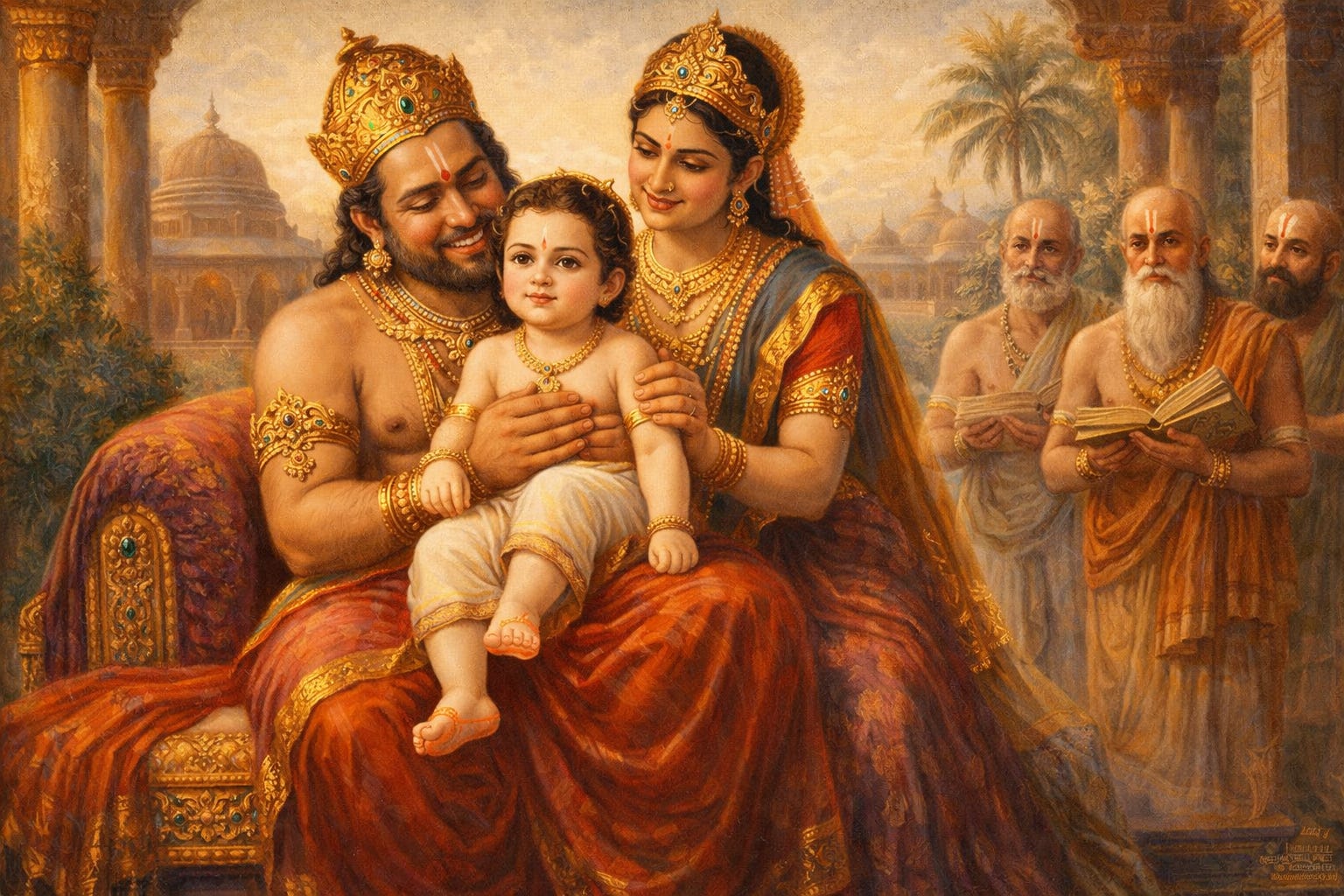
Since His birth, Ṛṣabhadeva manifested all the symptoms of the Supreme Lord, such as the marks of the flag, thunderbolt, etc., on the soles of His feet. He also showed all auspicious qualities, such as self-control, equanimity, etc., apart from prowess, strength, beauty, influence, and so on. Noting these qualities, Nābhi named his son Rṣabha, which means the best, or the supreme.
Maharaja Nābhi raised his transcendental son very carefully and affectionately, always overwhelmed with transcendental bliss. These feelings were coming from the influence of yoga-māyā, the internal potency of the Lord, and not from the illusory energy, like in the case of ordinary parents. It is not possible for someone to see the Supreme Lord as his son without being under illusion, but in this case, it was the same transcendental illusion that orchestrates the pastimes of the Lord in the spiritual world. As Prabhupada explains, “The Supreme Lord appears as the son of one of His devotees, just as Lord Kṛṣṇa appeared as the son of Yaśodā and Nanda Mahārāja. These devotees could never think of their son as the Supreme Personality of Godhead, for such appreciation would hamper their relationship of parental love.”
This is described in text 5.4.4:
“Due to getting a perfect son according to his desire, King Nābhi was always overwhelmed with transcendental bliss and was very affectionate to his son. It was with ecstasy and a faltering voice that he addressed Him, “My dear son, my darling.” This mentality was brought about by yoga-māyā, whereby he accepted the Supreme Lord, the supreme father, as his own son. Out of His supreme good will, the Lord became his son and dealt with everyone as if He were an ordinary human being. Thus King Nābhi began to raise his transcendental son with great affection, and he was overwhelmed with transcendental bliss, joy and devotion.”
The Lord appeared as Ṛṣabhadeva to display all the characteristics of a perfect rājarṣi, or a saintly king. Naturally, therefore, he became very popular amongst the citizens and ministers. Nābhi was very happy with that and, in due time, enthroned Him as the emperor.
“King Nābhi understood that his son, Ṛṣabhadeva, was very popular among the citizens and among government officers and ministers. Understanding the popularity of his son, Mahārāja Nābhi enthroned Him as the emperor of the world to give protection to the general populace in terms of the Vedic religious system. To do this, he entrusted Him into the hands of learned brāhmaṇas, who would guide Him in administrating the government. Then Mahārāja Nābhi and his wife, Merudevī, went to Badarīkāśrama in the Himālaya Mountains, where the King engaged Himself very expertly in austerities and penances with great jubilation. In full samādhi he worshiped the Supreme Personality of Godhead, Nara-Nārāyaṇa, who is Kṛṣṇa in His plenary expansion. By doing so, in course of time Mahārāja Nābhi was elevated to the spiritual world known as Vaikuṇṭha.” (SB 5.4.5)
In the higher-dimensional Bhu-Mandala, Badarīkāśrama is situated North of Bhārata-varṣa, somewhere in the Himālayas. That’s a place where many great sages reside, led by Nara-Narāyana. As an exemplary king, Nābhi didn’t hesitate to leave to perform austerities after transmitting the throne to his divine son. The queen, Merudevī, chose to follow her husband and also achieved perfection together with him.
It’s also significant that Ṛṣabhadeva ruled under a council of brāhmaṇas. In the varnāśrama system, the king acts as the executive power, but the real authority resides with the brāhmaṇas, who guide his actions. Even when God himself appears as a ruler, He follows this system to set the example, as it can be observed in the case of Rāma, and of Krsna Himself ruling in Dvārakā, who regularly consulted brāhmanas and ministers on matters of dharma, governance, and justice. In fact, even demoniac kings usually follow the advice of brāhmanas, who in the lower planets are led by Śukrācārya. By contrast, systems in which absolute power is concentrated in a single imperfect individual without higher oversight are considered profoundly adharmic, and are typically found only among the lowest demons and rākṣasas, on the level of Rāvaṇa and Hiraṇyakaśipu, or among degraded rulers in Kali-yuga, who completely abandon religious principles.
Just as in the case of Priyavrata, two special verses were composed to describe the activities of Mahārāja Nābhi:
ko nu tat karma rājarṣer, nābher anv ācaret pumān
apatyatām agād yasya, hariḥ śuddhena karmaṇā
brahmaṇyo ’nyaḥ kuto nābher, viprā maṅgala-pūjitāḥ
yasya barhiṣi yajñeśaṁ, darśayām āsur ojasā“Who can attain the perfection of Mahārāja Nābhi? Who can attain his activities? Because of his devotional service, the Supreme Personality of Godhead agreed to become his son.”
“Who is a better worshiper of brāhmaṇas than Mahārāja Nābhi? Because he worshiped the qualified brāhmaṇas to their full satisfaction, the brāhmaṇas, by their brahminical prowess, showed Mahārāja Nābhi the Supreme Personality of Godhead, Nārāyaṇa, in person.”
Ultimately, the goal of life for everyone is to come close to the Supreme Personality of Godhead. For this purpose, a political leader guides society according to the principles of dharma and the council of qualified brāhmanas, and for the same reason, all members of society follow his guidance.
Nābhi followed this system perfectly, and as a result, the Lord Himself appeared as his son, guaranteeing his path back home, back to Godhead. By following his saintly rule, the citizens lived peacefully, and later were guided by the Supreme Lord in person.
As Prabhupāda explains in his purport to text six, “The words śuddhena karmaṇā are significant in this verse. If work is not carried out in devotional service, it is contaminated by the modes of material nature. That is explained in Bhagavad-gītā: yajñārthāt karmaṇo ’nyatra loko ’yaṁ karma-bandhanaḥ. Activities performed only for the satisfaction of the Supreme Lord are pure and are not contaminated by the modes of material nature. All other activities are contaminated by the modes of ignorance and passion, as well as goodness.”
The true purpose of the varnāśrama system is to elevate all members of society to the position of unalloyed devotees of the Supreme Lord. Only a pure devotee can be a perfect king, a perfect father, and so on, and such pure devotees can produce other pure devotees by their example, gradually elevating the whole society. We often think of varnāśrama as a mere set of rules, but the essence of the system is to gradually elevate all members of society to the platform of devotional service.
It appears that Mahārāja Nābhi departed while Ṛṣabhadeva was still very young, since it is described that after receiving the rulership, he accepted brahmacārya and went to live in the gurukula, setting the example to be followed. After finishing his education, he remunerated the teachers following the system of guru-dakṣiṇā and accepted Jayantī as his wife, who had been offered to him by Indra. He then ruled as a perfect king, even though, as the Supreme Lord, He had nothing to do with state affairs.
Later, when the same Indra became envious of Ṛṣabhadeva’s rule and refused to send rain to Bhārata-varṣa, the Lord immediately understood the situation and simply used His own potency to bring sufficient rain. In this way, the citizens faced no difficulty. In his purport to text three, Prabhupāda makes the point that the Lord is the source of power for the demigods and can act without the help of His subordinates.
In the higher-dimensional cosmological model of Bhu-mandala described in the Śrīmad-Bhāgavatam, Bhārata-varṣa is a tract of land to the south of Jambūdvīpa (the central island) where human beings live. This place is also called puṇya-bhūmi, the place for executing religious and spiritual acts and advancing in the direction of the ultimate goal of life, by practicing Krsna Consciousness and teaching it to others.
Bhārata-varṣa is separated from the mainland by extremely tall mountains, which only highly elevated human beings can traverse to access the other varṣas. By studying the description, we may get the impression that we live on a flat island, but Prabhupāda consistently defines Bhārata-varṣa in his purports as a planet. This shows how the model of Bhū-mandala is much more complex than it may appear at first. We will study the model, as well as the conclusions given by Prabhupāda, later in this canto.
What about the descendants of Ṛṣabhadeva? He had 100 sons, of whom the eldest was Bharata. This is the original Bharata, who ruled during the first Manvantara. There are two other Bharatas: the brother of Rāma and the ancestor of Arjuna.
Of the 99 other sons, nine were prominent kṣatriyas who assisted Bharata in his rule. His names were: Kuśāvarta, Ilāvarta, Brahmāvarta, Malaya, Ketu, Bhadrasena, Indraspṛk, Vidarbha, and Kīkaṭa.
After these ten prominent kṣatriya sons, Ṛṣabhadeva had nine sons who were perfect devotees and great preachers of the Śrīmad-Bhāgavatam. Their names are: Kavi, Havi, Antarikṣa, Prabuddha, Pippalāyana, Āvirhotra, Drumila, Camasa, and Karabhājana. These are the nava-yogendras, whose teachings are described by Nārada to Vasudeva in the Eleventh Canto, chapters two to five.
The other 81 sons were brāhmanas, who were well-cultured, well-behaved, pure in their activities, and expert in Vedic knowledge and the performance of Vedic rituals.
In his purport to text 13, Prabhupāda uses this example as yet another support for the idea that the varnāśrama system is based on qualification, and not birth: “These are some practical examples of how one can become fit for a certain type of activity by qualification, not by birth. All the sons of Mahārāja Ṛṣabhadeva were kṣatriyas by birth, but by quality some of them became kṣatriyas, and some became brāhmaṇas. Nine became preachers of Śrīmad-Bhāgavatam (bhāgavata-dharma-darśanāḥ), which means that they were above the categories of kṣatriya and brāhmaṇa.”
As mentioned in the Gītā, “Whatever action is performed by a great man, common men follow.” Ṛṣabhadeva showed the perfect example by His activities, training both His sons and the general populace. His activities are described in more detail in texts 5.4.14 and 15:
“Being an incarnation of the Supreme Personality of Godhead, Lord Ṛṣabhadeva was fully independent because His form was spiritual, eternal and full of transcendental bliss. He eternally had nothing to do with the four principles of material misery [birth, death, old age and disease]. Nor was He materially attached. He was always equipoised, and He saw everyone on the same level. He was unhappy to see others unhappy, and He was the well-wisher of all living entities. Although He was a perfect personality, the Supreme Lord and controller of all, He nonetheless acted as if He were an ordinary conditioned soul. Therefore He strictly followed the principles of varṇāśrama-dharma and acted accordingly. In due course of time, the principles of varṇāśrama-dharma had become neglected; therefore through His personal characteristics and behavior, He taught the ignorant public how to perform duties within the varṇāśrama-dharma. In this way He regulated the general populace in householder life, enabling them to develop religion and economic well-being and to attain reputations, sons and daughters, material pleasure and finally eternal life. By His instructions, He showed how people could remain householders and at the same time become perfect by following the principles of varṇāśrama-dharma.
Although Lord Ṛṣabhadeva knew everything about confidential Vedic knowledge, which includes information about all types of occupational duties, He still maintained Himself as a kṣatriya and followed the instructions of the brāhmaṇas as they related to mind control, sense control, tolerance and so forth. Thus He ruled the people according to the system of varṇāśrama-dharma, which enjoins that the brāhmaṇas instruct the kṣatriyas and the kṣatriyas administer to the state through the vaiśyas and śūdras.”
To set the proper example, Ṛṣabhadeva also performed all kinds of Vedic sacrifices, as expected from a saintly king. As Prabhupāda explains, a Vaiṣnava does not disrespect the demigods, seeing them as the servants of the Lord. In proper sacrifices, Lord Viṣṇu is worshiped first, and then the prasāda is offered to all the demigods. This is the style of sacrifices that were executed by Ṛṣabhadeva, teaching the proper standard.
“No one likes to possess anything that is like a will-o’-the-wisp or a flower in the sky, for everyone knows very well that such things do not exist. When Lord Ṛṣabhadeva ruled this planet of Bhāratavarṣa, even common men did not want to ask for anything, at any time or by any means. No one ever asks for a will-o’-the-wisp. In other words, everyone was completely satisfied, and therefore there was no chance of anyone’s asking for anything. The people were absorbed in great affection for the King. Since this affection was always expanding, they were not inclined to ask for anything.” (SB 5.4.18)
The meaning of this verse is that during the reign of Ṛṣabhadeva people were Krsna Conscious, and thus not interested in illusory material pursuits for economic development, which are compared in the analogy with a will-o’-the-wisp, the ghostly light seen by travelers at night while traveling over swamps or marshes, that may look attractive at distance, but cause the traveler get lost if pursued. On the one side, they would receive everything necessary, and on the other, they were absorbed in great affection for the divine King.
You can also donate using Buy Me a Coffee, PayPal, Wise, Revolut, or bank transfers. There is a separate page with all the links. This helps me enormously to have time to write instead of doing other things to make a living. Thanks!