

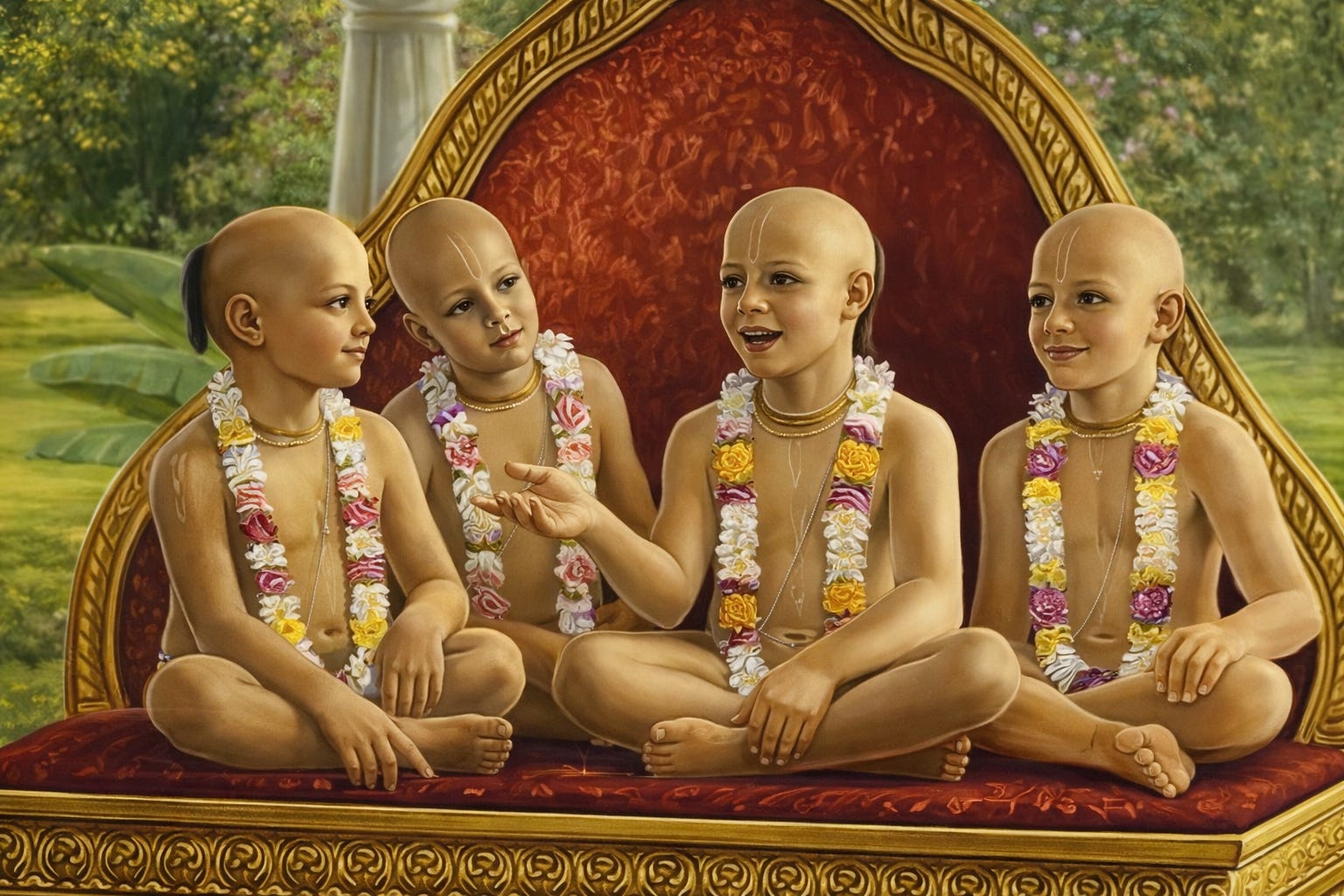
In his teachings to Pṛthu Maharaja, Sanat-kumāra, the great boy-sage, makes an interesting point:
“When a person becomes devoid of all material desires and liberated from all material qualities, he transcends distinctions between actions executed externally and internally. At that time the difference between the soul and the Supersoul, which was existing before self-realization, is annihilated. When a dream is over, there is no longer a distinction between the dream and the dreamer.”
He explains that the soul and the Supersoul are of the same nature and defines the material experience of the soul as svapne yathā, like in a dream. As explained by Śrī Caitanya Mahāprabhu, the soul is different from Kṛṣṇa in the sense of being infinitesimal, but at the same time is the same, in the sense of being transcendental. Both the Lord and the soul are equally pure and transcendental. The problem is that the soul has a tendency to fall under the control of the material energy. When this happens, the spiritual nature of the soul is covered, and they become different. However, this difference is temporary, and when the soul attains self-realization, this distinction ceases to exist.
If the soul is originally transcendental to matter, how can we become so entangled in it? Sanat-kumāra answers:
“When one’s mind and senses are attracted to sense objects for enjoyment, the mind becomes agitated. As a result of continually thinking of sense objects, one’s real consciousness almost becomes lost, like the water in a lake that is gradually sucked up by the big grass straws on its bank.” (SB 4.22.30)
In his purport, Prabhupāda explains how this verse reveals the basic dynamic of the conditioning of the soul. How the soul comes in contact with matter and how an inexperienced transcendentalist can become again attracted to sense gratification if the root cause is not destroyed:
“In this verse it is very nicely explained how our original Kṛṣṇa consciousness becomes polluted and we gradually become almost completely forgetful of our relationship with the Supreme Lord. In a previous verse it is recommended that we should always keep in touch with the devotional service of the Lord so that the blazing fire of devotional service can gradually burn into ashes material desires and we can become liberated from the repetition of birth and death. This is also how we can indirectly keep our staunch faith in the lotus feet of the Supreme Personality of Godhead. When the mind is allowed to think of sense gratification continuously, it becomes the cause of our material bondage. If our mind is simply filled with sense gratification, even though we want Kṛṣṇa consciousness, by continuous practice we cannot forget the subject matter of sense gratification. If one takes up the sannyāsa order of life but is not able to control the mind, he will think of objects of sense gratification — namely family, society, expensive house, etc. Even though he goes to the Himālayas or the forest, his mind will continue thinking of the objects of sense gratification. In this way, gradually one’s intelligence will be affected. When intelligence is affected, one loses his original taste for Kṛṣṇa consciousness.”
He goes further by stating that, “The material desire for sense enjoyment is the cause of our fall down in this material world, and thus we suffer the threefold miseries and continuous birth, death, old age and disease. However, if we turn our desires toward the transcendental loving service of the Lord, our desires become purified. We cannot kill desires. We have to purify them of different designations. If we constantly think of being a member of a particular nation, society or family and continuously think about them, we become very strongly entangled in the conditioned life of birth and death. But if our desires are applied to the service of the Lord, they become purified, and thus we become immediately freed from material contamination.”
To exemplify this point, Sanat-kumāra makes the analogy of a lake drying up because of kuśa grass growing on its banks. If the grass is allowed to grow freely, it sucks the water until the lake completely dries up. In the same way, if material desires are allowed to grow, they progressively cover the original Kṛṣṇa consciousness of the soul, up to the point where one can become a dog or a pig. Therefore, these columns of kuśa grass that are drying up our consciousness should be cut down from the beginning. We should understand the danger of unrestricted sense gratification and where it can lead us.
In the next verse, Sanat-kumāra continues to explain the process of forgetfulness of the soul:
“When one deviates from his original consciousness, he loses the capacity to remember his previous position or recognize his present one. When remembrance is lost, all knowledge acquired is based on a false foundation. When this occurs, learned scholars consider that the soul is lost.” (SB 4.22.31)
Our practical actions are based on identification. If I think I’m a man, I will act in a certain way, and if I think I’m a dog, I will act in another. If I see myself as an eternal servant of Kṛṣṇa, my actions will manifest in the form of service to Him, but if I see myself as the enjoyer of this material world, all my actions and knowledge will be based on this false foundation. When this happens, it is said the soul is lost, because I start acting as a body, and not as a soul. When an object is “lost”, it doesn’t mean it stops existing, but it can’t be seen. Similarly, the soul is still there, even in the biggest materialist, and one’s original Kṛṣṇa consciousness is never lost, but it can be covered to such an extent that it becomes factually lost. One becomes thus separated from one’s eternal Kṛṣṇa consciousness by the effect of material illusion, and if someone helps one to recover it, he becomes the greatest benefactor.
Prabhupāda further explains these points in his purport: “Our original consciousness is Kṛṣṇa consciousness because we are part and parcel of Kṛṣṇa. When this consciousness is misguided and one is put into the material atmosphere, which pollutes the original consciousness, one thinks that he is a product of the material elements. Thus one loses his real remembrance of his position as part and parcel of the Supreme Personality of Godhead, just as a man who sleeps forgets himself. In this way, when the activities of proper consciousness are checked, all the activities of the lost soul are performed on a false basis.”
He concludes by mentioning that:
“There is no stronger obstruction to one’s self-interest than thinking other subject matters to be more pleasing than one’s self-realization. For human society, constantly thinking of how to earn money and apply it for sense gratification brings about the destruction of everyone’s interests.” (SB 4.22.32-33)
The path of self-realization and the path of materialistic life are contradictory. We can try to reconcile them up to a certain point, but eventually we have to make our choice. If we become more interested in the body and bodily sense gratification, then we obstruct our path of self-realization. As Prabhupāda mentions, anything performed contrary to this principle is certainly against one’s self-interest.
This is a publication for thoughtful readers who want to go deeper into Kṛṣṇa consciousness. I publish daily, trying to offer high-quality spiritual content, and all posts are available to free subscribers. If you wish, you can also choose a paid subscription to support this work.
You can also receive the updates on WhatsApp or Telegram.
If you would like to contribute further, you can find the donation links here.
Am I right in saying that those who have achieved MUKTI , don’t enter into cycles of birth and deaths.
But they can choose to take a birth of their choosing.