

Subscribe to receive new articles by e-mail. It’s free, but if you like, you can pledge a donation:
One important point we have to come to terms with in spiritual life is the simple fact that there are things that we can’t understand. Some things are just inconceivable. It’s not about how many books we study or how many verses we memorize. Certain things simply can’t be fully understood using our material intelligence.
This is one of the differences between the devotee and the atheist. An atheist trusts his material intelligence and thus wants to dismiss anything that doesn’t fit into his limited framework as fantasy or mythology. Of course, in the process of trying to explain reality through his restricted intelligence, he ends up creating even more fantastic theories, such as the Big Bang or the idea of life coming spontaneously from dead matter, but atheists don’t seem to care, as long as they are not forced to accept the existence of God.
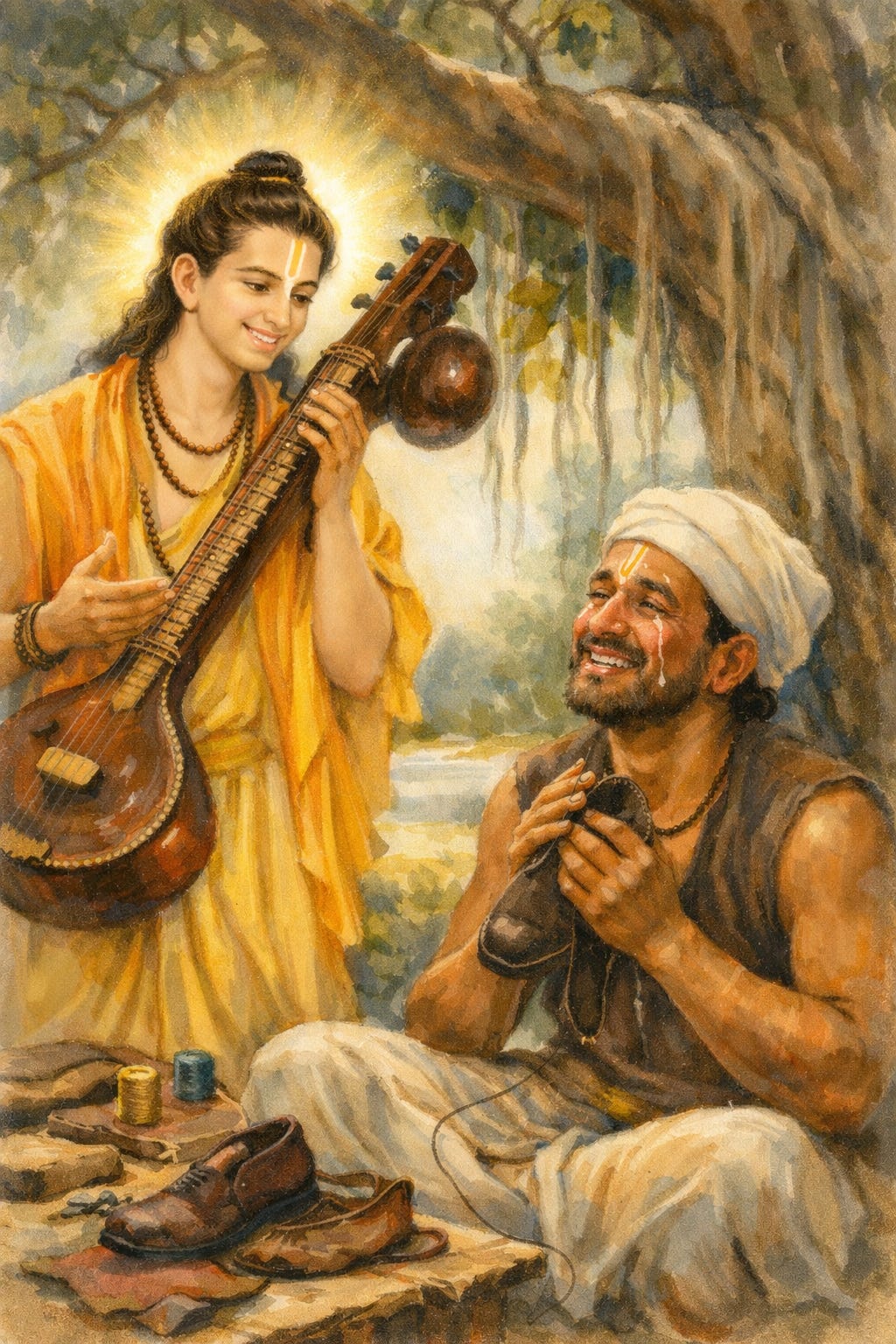
A devotee, on the other hand, can understand how Kṛṣṇa is great and can appreciate His inconceivable power. No other story illustrates this more directly than the story of the brāhmana and the cobbler.
Once, Nārada was on the way to see Lord Narāyana in Śvetadvīpa, on the Milk Ocean. Śvetadvīpa is the abode of Lord Kṣīrodakaśāyī Viṣnu, an eternal Vaikuṇṭha planet manifest inside our material universe. Most of the pastimes of demigods and other personalities from our universe visiting Lord Narāyana or visiting Vaikuṇṭha Loka, such as Jaya and Vijaya being cursed by the four Kumāras and Durvāsā Muni begging Lord Narāyana for help when being chased by the Cakra, and so on, happen there. This is just a technical difference since there is no difference between Śvetadvīpa and the other Vaikuṇṭha planets in the spiritual sky, but it’s an interesting detail.
In any case, Nārada Muni went to see Lord Narāyana, and on the way he met a learned brāhmana, who requested him to ask Lord Narāyana when he would go back to Godhead. A little later, Nārada received the same request from a cobbler. When he finally reached Lord Narāyana, he asked about the liberation of both devotees. The Lord answered that the cobbler was living his last life and soon would go back home, while the brāhmana still had several lives ahead in the material world.
Nārada was surprised that the humble cobbler was going back, while the learned brāhmana was destined to continue transmigrating in the material world, and asked Lord Narāyana to clarify. Lord Narāyana told Nārada to tell both that when He visited Him, He was passing an elephant through the eye of a needle.
When Nārada approached the brāhmana and narrated to him what Lord Narāyana was doing, the brāhmana was immediately skeptical. He showed some respect to Nārada Muni but bluntly said he didn’t believe in such nonsense. Nārada then went to the cobbler, who immediately started crying in ecstasy when he heard Nārada describing what the Lord was doing. “Oh, my Lord is wonderful. He can do anything.” When Nārada became surprised that he could believe it so easily, the cobbler explained that he was sitting under a banyan tree and observing how the tree was producing so many seeds, each seed containing a complete banyan tree inside. If the Lord was capable of putting so many banyan trees inside of so many seeds, what was the problem of passing an elephant through the eye of a needle?
Nārada then understood that the brāhmana was just reading books but had no faith, while the cobbler, although uneducated, was a pure devotee and was thus ready to go back to Godhead.
The moral of the story is that Krsna presents us with so many contradictory details about the structure of the universe, His pastimes, and also many philosophical truths. Often, we can’t really understand these things using our intelligence. When Krsna was dancing with the gopis, He made the night as long as a day of Brahmā. As Mahā-Viṣnu, He becomes so big that universes pass through the pores of His body. Similarly, the description of the universe included in the Puranas is very different from what we can observe with our senses, and it’s said that we have an eternal relationship with Krsna, while it’s mentioned that no one falls from the spiritual world.
Devotees who have firm faith can easily accept these apparent contradictions as a manifestation of Kṛṣṇa’s inconceivable power, while others who lack the same faith will become skeptical and end up rationalizing that these are just myths. Thus, this shows us not only the difference between the devotee and the non-devotee, but also between an advanced devotee who has firm faith and a neophyte who is just reading books and collecting quotes.
Once we start understanding and appreciating the greatness of Kṛṣṇa, it becomes easy to understand his inconceivable power and accept that many things are just beyond our comprehension. Not just us, but even great personalities like Lord Brahma have to go through the same process.
When Brahma tried to play his small trick of hiding the cowherd boys and calves, Krsna showed him a much bigger trick of expanding Himself into innumerable Viṣnu forms and assuming the forms of all boys and calves. Brahma thought he was the only Brahma, that there was just one material universe, and that there was just one Lord Viṣnu and one Lord Shiva, but suddenly he was forced to deal with the idea that not only were there many forms of Viṣnu, but that each of these forms of Viṣnu whom Kṛṣṇa created had his own universe, complete with innumerable living entities, as well as his own Brahma and Śiva. To add to Brahma’s bewilderment, Kṛṣṇa invoked all the Brahmas of different universes to come before him. Each of these Brahmas never leaves his own universe, but at the same time, they were all present before Krsna, who was sitting inside this particular universe. Brahma could never fully understand that; he was simply forced to accept the inconceivable power of Krsna. If even Lord Brahma can’t understand, what to say about us? Things are just much bigger and more complex than we can imagine.
In Teachings of Queen Kuntī (chapter 14), Prabhupāda makes an interesting remark on this connection: “Therefore the mentality of Vṛndāvana is the perfect status of mind for devotees. The inhabitants of Vṛndāvana have no concern with understanding Kṛṣṇa. Rather, they want to love Kṛṣṇa unconditionally. It is not that they think, “Kṛṣṇa is God, and therefore I love Him.” In Vṛndāvana Kṛṣṇa does not play as God; He plays there as an ordinary cowherd boy, and although at times He proves that He is the Supreme Personality of Godhead, the devotees there do not care to know it.”
Here is a passage where Prabhupāda narrates the pastime of the brāhmana and the clobber:
“Sometimes I recited one story. This is for very instructive, that Nārada Muni, he used to visit Narāyana every day. So when he was passing on the road, so one very learned brāhmana and taking thrice bath and everything very nicely, he asked Nārada Muni, “Oh, you are going to Lord. Will you inquire when I shall get my salvation?” “All right. I shall ask.” And then a cobbler, he was under the tree, sewing the shoes, old shoes. He also saw Nārada Muni. He also inquired, “Will you kindly inquire from God when my salvation is…?” Now, when he inquired Krsna, Narāyana… Nārada Muni goes generally to Narāyana, in another planet. So “Yes, two, one brāhmana and one cobbler, they inquired like this. May I know what is their destination?” So Narāyana said, “Well, yes, the cobbler, this after giving up this body, he’s coming here at Vaikuṇṭha.
“And what about that brāhmana?” “Oh, he has to remain there still so many births, or I do not know when he’s coming.” So Nārada Muni was astonished, that “I saw that he’s very nice brāhmana, and he’s a cobbler. Why is that?” So he inquired that “I could not, cannot understand the mystery. Why You say that cobbler is coming this, after this body, and why not this brāhmana?” “Oh, that will, you’ll understand. If they inquire that ‘What Krsna, or Narāyana, was doing in the, in His abode,’ so just explain that He was taking one elephant, “Through the hole of a needle, He’s pulling an elephant this side and this side.” “All right.” So when he again approached the brāhmana, the brāhmana said, “Oh, you have seen Lord?” “Yes.” “So what was the Lord doing?” “He was doing this: through the point of a needle He was pushing one elephant this way and that way.” “Oh, therefore I have no faith in your… I, I, I have got all respect for your garb, but we don’t believe all this nonsense.
Then Nārada could understand, “Oh, this man has no faith. He simply reads book. That’s all.” And when he went to the cobbler, he also asked, “Oh, you have seen? What Narāyana was doing?” He also said that “He was doing like this…” Oh, he began to cry, “Oh, my Lord is wonderful. He can do anything.” So Nārada inquired, “So do you believe that Lord can push one elephant through the holes of a needle?” “Oh, why not? I must believe.” “Then what is your reason?” “Oh, my reason? I am sitting under this banyan tree, and so many fruits are falling daily, and in each fruit there are thousands of seeds, and each seed there is a tree. If in a small seed there can be big tree like that, is it very impossible to accept that Krsna is putting one elephant through the holes of a needle?
He has kept such a nice tree in the seed.” So this is called belief. So unbelievers and believer means the believers, they are not blind believers. They have reason. If by Krsna’s process, by God’s process, or nature’s process, such a big tree can be put within the small seed, is it very impossible for Krsna to keep all these planets floating in His energy? So we have to believe. We have no other explanation. But we have to understand in this way. Our reasoning, our argument, our logic should go in this way.
So those who are devotee… Just like the cobbler. He may be a cobbler. They believe everything. And those who are not devotee, they’ll say, “Oh, these are all bluffs. It is all bluff.” But they are not bluff. It is simply meant for the devotees. They can understand. The nondevotees, they cannot understand.”
You can also donate using Buy Me a Coffee, PayPal, Wise, Revolut, or bank transfers. There is a separate page with all the links. This helps me enormously to have time to write instead of doing other things to make a living. Thanks! You can also receive the updates on Telegram.