


You can receive new articles directly in your inbox. Subscription is free; donations are welcome.
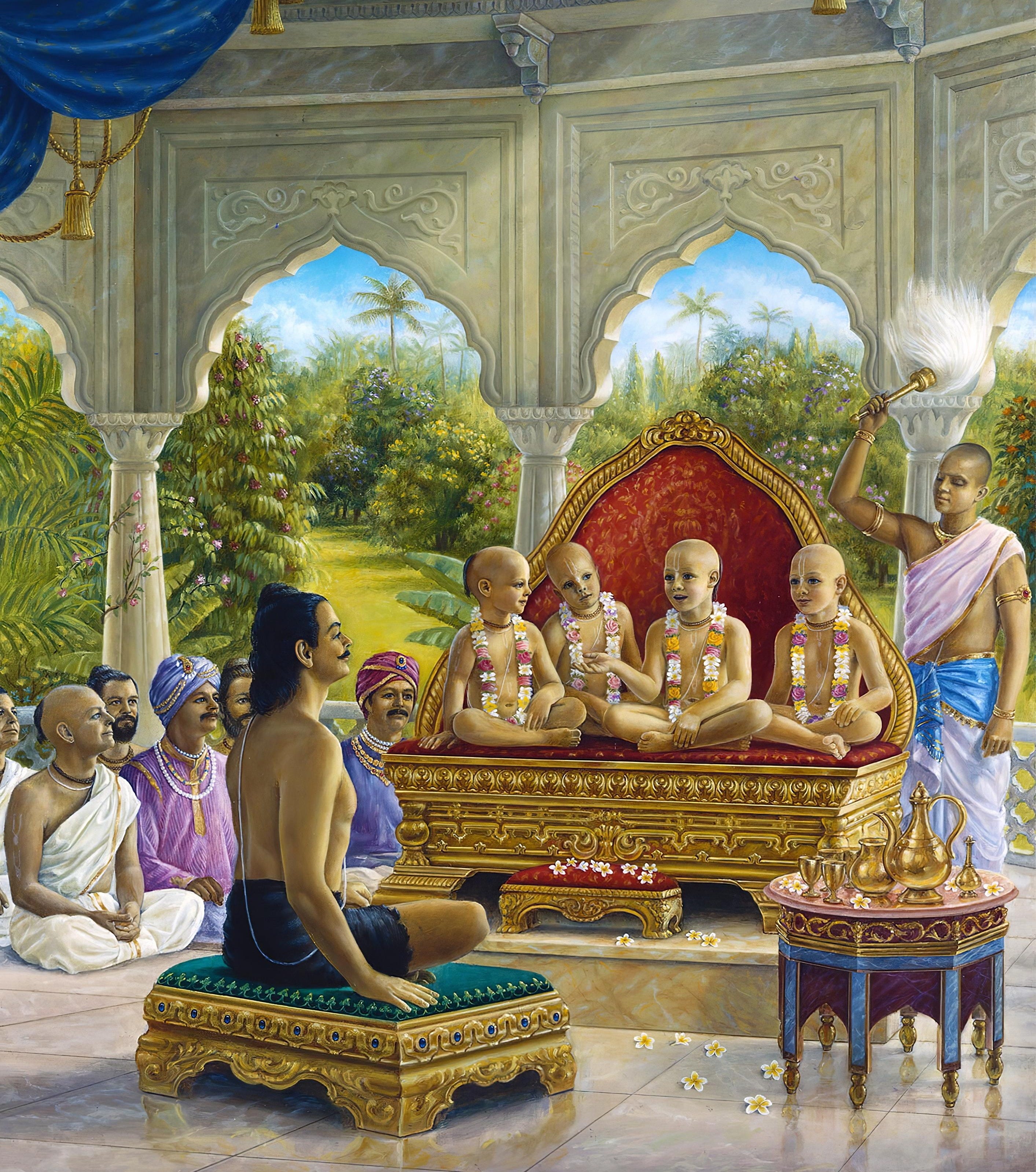
Two important sections in the Fourth Canto of Śrīmad-Bhāgavatam are the description of the pastimes of Pṛthu Maharaja and the allegory of King Purañjana. At the end of the section on Pṛthu Maharaja, there is a description of his meeting with the four Kumāras and the instructions he received from them.
The Kumāras appeared at the time Pṛthu was performing a great sacrifice, attended by all the ministers and citizens. Therefore, their instructions benefited not only the king himself, but everyone in the kingdom. Text 4.22.41 describes the satisfaction of Pṛthu Maharaja in having the opportunity of meeting them:
“The King said: O brāhmaṇa, O powerful one, formerly Lord Viṣṇu showed me His causeless mercy, indicating that you would come to my house, and to confirm that blessing, you have all come.”
In His purport, however, Prabhupāda reveals the deeper meaning of the verse. Previously, Lord Viṣnu had personally appeared in the arena of sacrifice of Pṛthu Maharaja and predicted that soon the Kumāras would come to visit him.
The question is, why did the Lord personally appear to bless the king and arrange for his meeting with the Kumāras, which benefited not only the king but all citizens? This all happened only out of His causeless mercy. Similarly, in the Gītā Kṛṣṇa exulted Arjuna to boldly declare that His devotee never perishes, and Śrī Caitanya Mahāprabhu predicted that the holy names would be chanted in all towns and villages, sending several ācāryas over the centuries to make sure this prediction was coming to fruition. The Lord also came as Lord Buddha, out of compassion to the animals, and in many other incarnations, always to show mercy to the conditioned souls.
This leads to another question: if the soul has no intrinsic relationship with the Lord, or if Kṛṣṇa insensitively selects some souls to enjoy with Him in His eternal lila and casts others mercilessly into eternal suffering in this material world, as some conclude, why does the Lord show such great compassion to the soul, to the point of following each individual soul in all their activities in the material world as Paramātmā, trying to gradually conduct them to the platform of devotional service?
Śrila Bhaktivinoda Thākura answers this question in his Jaiva Dharma:
“The independent jīva is a beloved servant of Kṛṣṇa, and thus Kṛṣṇa is kind and compassionate towards him. Seeing the misfortune of the jīva, as he misuses his independence and becomes attached to Maya, He chases after him, weeping and weeping, and appears in the material world to deliver him. Śrī Kṛṣṇa, the ocean of compassion, His heart melting with mercy for the jīvas, manifests His acintya-lila in the material world, thinking that His appearance will enable the jīva to see His nectarian pastimes. However, the jīva does not understand the truth about Kṛṣṇa’s pastimes, even after being showered by so much mercy, so Kṛṣṇa then descends in Śrī Navadvīpa in the form of guru. He personally describes the supreme process of chanting His name, form, qualities and pastimes, and personally instructs and inspires the jīvas to take to this path by practicing it Himself. Baba, how can you accuse Kṛṣṇa of being at fault in any way when He is so merciful? His mercy is unlimited, but our misfortune is lamentable.” (Jaiva Dharma, ch. 16)
This passage rhymes with the conclusion of Śrila Prabhupāda to his purport on this verse:
“The conclusion is that the Lord is so compassionate upon the fallen souls within this material world that He comes Himself or sends His devotees and His servants to fulfill His desire to have all the fallen souls come back home, back to Godhead. Thus Lord Śrī Kṛṣṇa instructed Bhagavad-gītā to Arjuna for the benefit of the entire human society. Intelligent men should therefore seriously consider this Kṛṣṇa consciousness movement and fully utilize the instructions of Bhagavad-gītā as preached without adulteration by His pure devotees.”
What about the story of Pṛthu Maharaja?
After Sanat-kumāra finished his teachings, the king spoke heartfelt verses of appreciation, offering all his possessions to the Kumāras, including his treasure, his personal wealth, and even his family.
This offering is explained by Śrila Sridhāra Swami as being similar to a servant offering food to his master, even though the food already belongs to him. Pṛthu Maharaja ruled with the consciousness that his whole kingdom belonged to the Brāhmaṇas and he was just managing it. Still out of affection, he offered it again to the Kumāras when they visited him. Being perfect Brāhmaṇas and renunciants, however, the Kumāras had no need for a kingdom or treasure, and much less a family; therefore they accepted the intention of the King who surrendered everything to them. The servant offers to his master food purchased by the master himself, but because of his devotion, the offering has value. Similarly, everything we think we possess is already owned by Kṛṣṇa, but the fact we offer to Him makes all the difference.
However, after offering all his riches, Pṛthu Maharaja understood the insufficiency of the gift and humbly asked the Kumāras to be simply satisfied with their own activities. This connects with another essential aspect, which is our relationship with the spiritual master:
“How can such persons, who have rendered unlimited service by explaining the path of self-realization in relation to the Supreme Personality of Godhead, and whose explanations are given for our enlightenment with complete conviction and Vedic evidence, be repaid except by folded palms containing water for their satisfaction? Such great personalities can be satisfied only by their own activities, which are distributed amongst human society out of their unlimited mercy.” (SB 4.22.47)
In his purport, Śrila Prabhupāda explains it brilliantly:
“Knowledge of Kṛṣṇa is such a great gift that it is impossible to repay the benefactor. Therefore Pṛthu Mahārāja requested the Kumāras to be satisfied by their own benevolent activities in delivering souls from the clutches of māyā. The King saw that there was no other way to satisfy them for their exalted activities. The word vinoda-pātram can be divided into two words, vinā and uda-pātram, or can be understood as one word, vinoda-pātram, which means “joker.” A joker’s activities simply arouse laughter, and a person who tries to repay the spiritual master or teacher of the transcendental message of Kṛṣṇa becomes a laughingstock just like a joker because it is not possible to repay such a debt. The best friend and benefactor of all people is one who awakens humanity to its original Kṛṣṇa consciousness.”
After the prayers of the King, the Kumāras left just as they came, floating in outer space. Before leaving, however, they showed their satisfaction by glorifying the qualities of the king while floating in the sky.
Read more:

This is a publication for thoughtful readers who want to go deeper into Kṛṣṇa consciousness. I publish daily, trying to offer high-quality spiritual content, and all posts are available to free subscribers. If you wish, you can support this work with a monthly contribution. When you subscribe, you can choose between a free subscription and a monthly contribution, and you can switch from a free subscriber to a supporter at any time.
You can also receive updates on WhatsApp or Telegram.
If you would like to contribute further, you can find the donation links here.