

« The Song of God—Volume 2, chapters 7-12
The components of everything that exists (Bg 7.4 to 7.7)
Everything that exists is composed of Kṛṣṇa’s different potencies. The cosmic manifestation is composed of His separated material energy, the inferior potency, while the souls who come here to enjoy this material manifestation are part of His superior potency. These two potencies are very different, but neither is independent. Both have Kṛṣṇa as their source and foundation.
Text 4: bhūmir āpo ’nalo vāyuḥ, khaṁ mano buddhir eva ca
ahaṅkāra itīyaṁ me, bhinnā prakṛtir aṣṭadhā
Earth, water, fire, air, ether, mind, intelligence and false ego—all together these eight constitute My separated material energies.
Text 5: apareyam itas tv anyāṁ, prakṛtiṁ viddhi me parām
jīva-bhūtāṁ mahā-bāho, yayedaṁ dhāryate jagat
Besides these, O mighty-armed Arjuna, there is another, superior energy of Mine, which comprises the living entities who are exploiting the resources of this material, inferior nature.
Text 6: etad-yonīni bhūtāni, sarvāṇīty upadhāraya
ahaṁ kṛtsnasya jagataḥ, prabhavaḥ pralayas tathā
All created beings have their source in these two natures. Of all that is material and all that is spiritual in this world, know for certain that I am both the origin and the dissolution.
Text 7: mattaḥ parataraṁ nānyat, kiñcid asti dhanañ-jaya
mayi sarvam idaṁ protaṁ, sūtre maṇi-gaṇā iva
O conqueror of wealth, there is no truth superior to Me. Everything rests upon Me, as pearls are strung on a thread.
In the previous section, Kṛṣṇa promised to give Arjuna complete knowledge of both the material and spiritual manifestations. Here, Kṛṣṇa starts this description, explaining the nature and components of the material creation, and His position beyond it. These four verses form the metaphysical unit of chapter seven.
The material creation is also composed of the energy of Kṛṣṇa, and is not independent of Him. Pure devotees can live in this world while remaining fully absorbed in the service of Kṛṣṇa. What causes material existence is not being here geographically, but accepting the illusion of being an enjoyer here. When we understand that this world is also the energy of Kṛṣṇa and should thus be used in His service, we can see the spiritual reality behind it.
Separated energy
Kṛṣṇa defines the material elements as bhinnā prakṛtiḥ, His separated material energies. The reason the material energy is called separated is that, although the energy is anchored in Kṛṣṇa, He is not directly present there in His personal form. This is explained later in the Gītā (9.4-5), when Kṛṣṇa says that “By Me, in My unmanifested form, this entire universe is pervaded. All beings are in Me, but I am not in them. And yet everything that is created does not rest in Me. Behold My mystic opulence! Although I am the maintainer of all living entities and although I am everywhere, I am not a part of this cosmic manifestation, for My Self is the very source of creation.”
Here, Kṛṣṇa simultaneously rejects two philosophies: crude monism (everything is one) and crude dualism (matter is different from God). Everything exists within Kṛṣṇa and depends upon Him, and Kṛṣṇa pervades everything as Paramātmā. Still, His personal form is not transformed into the material creation. He is the source of the cosmic manifestation, but at the same time, He remains transcendental and independent from it. The cosmic manifestation is thus separated, but not independent. Prabhupāda gives the example of milk. Milk comes from the cow and depends upon the cow, but milk is not the cow. The cow contains milk, but milk does not contain the cow.
The correct answer, thus, is that the material cosmos is Kṛṣṇa in one sense, because it is His energy and has no existence apart from Him; but at the same time, it is not Kṛṣṇa because the energy is not the complete energetic Person. It is one and different, as explained in the acintya-bhedābheda-tattva philosophy of Mahāprabhu.
When we use material assets for Kṛṣṇa in devotional service, they become connected with Him and thus spiritualized, but when we use the same objects for our sense gratification, they become material. This is a delicate point of our philosophy that Kṛṣṇa explains in these verses.
Prabhupāda deals with this complicated philosophical problem in Perfect Questions, Perfect Answers:
“It is not Kṛṣṇa. Or, you can say it is Kṛṣṇa and not Kṛṣṇa simultaneously. That is our philosophy—one and different. You cannot say that the things of this world are different from Kṛṣṇa, because without Kṛṣṇa they have no existence. At the same time, you cannot say, “Then let me worship water. Why worship Kṛṣṇa?” The pantheists say that because everything is God, whatever we do is God worship. This is Māyāvāda philosophy—that because everything is made of God’s energy, therefore everything is God. But our philosophy is that everything is God but also not God.”
The material creation
The material constituents of the cosmic manifestation, as well as the process of creation itself, are discussed in more detail in the Third Canto of Śrīmad-Bhāgavatam, in the teachings of Lord Kapila. There and in other passages of the Śrīmad-Bhāgavatam, we study how the sanction of Viṣṇu is necessary at every step of creation. Not even a blade of grass can move without it.
In his purport, Prabhupāda quotes a verse from the Nārada Pañcarātra that summarizes the process of material creation:
“For material creation, Lord Kṛṣṇa’s plenary expansion assumes three Viṣṇus. The first one, Mahā-viṣṇu, creates the total material energy, known as the mahat-tattva. The second, Garbhodaka-śāyī Viṣṇu, enters into all the universes to create diversities in each of them. The third, Kṣīrodaka-śāyī Viṣṇu, is diffused as the all-pervading Supersoul in all the universes and is known as Paramātmā. He is present even within the atoms. Anyone who knows these three Viṣṇus can be liberated from material entanglement.”
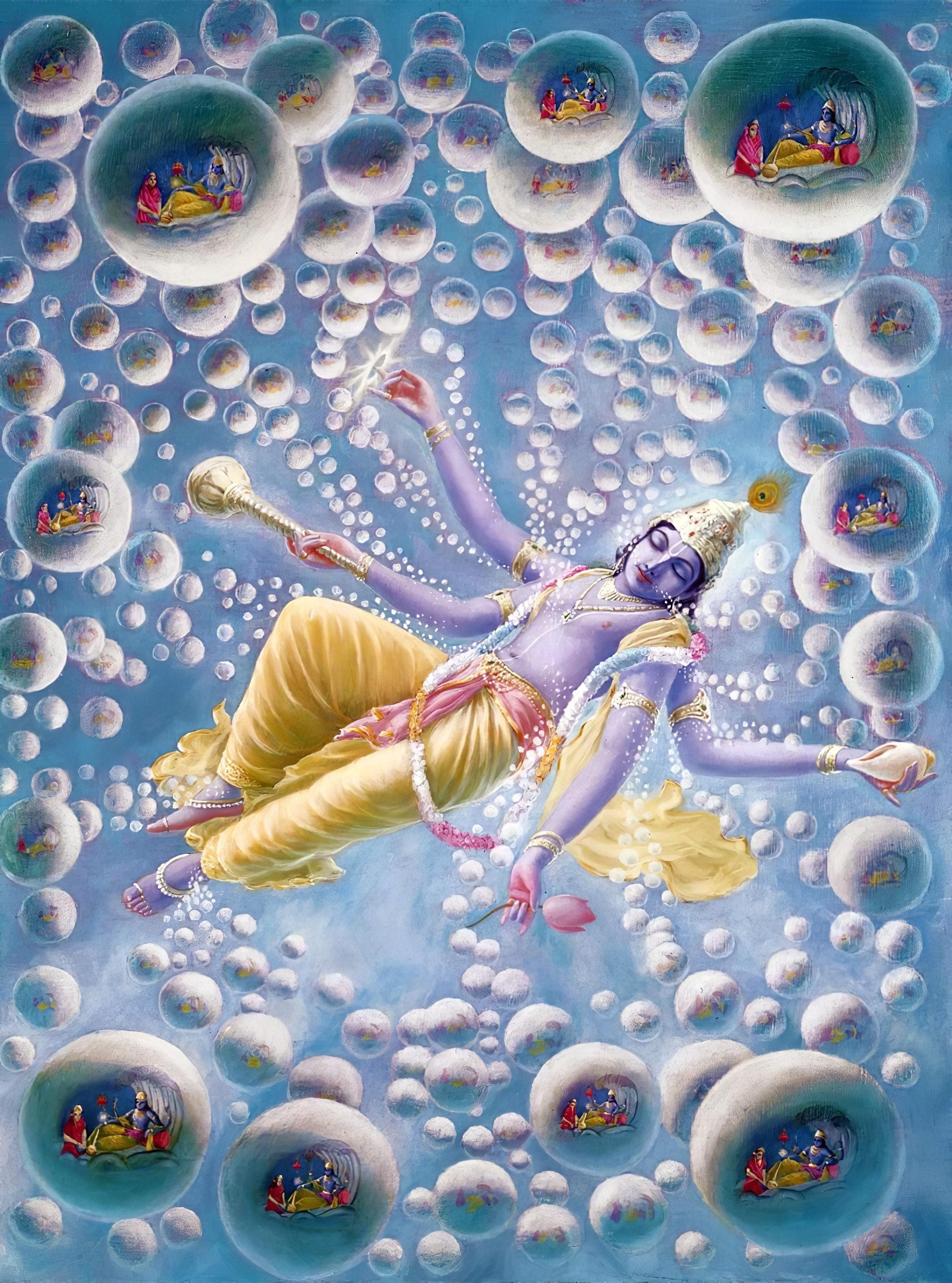
All the stars and everything else we see when we look into the sky at night are part of a single material universe, the universe in which we live, created by the four-headed Brahmā. There are many other Brahmās, each presiding over his own material universe, but we have no access to them. All these universes are collectively manifested by Mahā-Viṣṇu, who lies on the Causal Ocean. Every time He exhales, countless universes emanate from His breath and from the pores of His body, and every time He inhales, all these innumerable universes are destroyed. The whole cosmic manifestation thus lasts just a moment from His perspective, with creation and dissolution succeeding one another in an endless cycle.
Mahā-Viṣṇu activates the material potency simply by His glance, starting the process of creation. Once impregnated by this divine glance, the material potency becomes agitated, manifesting the mahat-tattva, the aggregate material principle. From successive combinations of the mahat-tattva with the three material modes, all the material elements manifest.
The same Mahā-Viṣṇu who creates the shells of the universes and activates this process, expands Himself and enters into each universe as Garbhodakaśāyī Viṣṇu, manifesting the cosmic lotus flower from which Brahmā appears, and as Kṣīrodakaśāyī Viṣṇu (Paramātmā), becoming present everywhere, in the heart of everyone and even inside the atoms. Without His presence, nothing can function.
In text 7.4, Kṛṣṇa mentions eight elements, from gross to subtle: earth, water, fire, air, ether, mind, intelligence and false ego. In chapter 13, He gives a longer list with 24 elements, and Lord Kapila gives a slightly different explanation in the Third Canto. This should not be seen as a contradiction. As He explains in the Eleventh Canto of Śrīmad-Bhāgavatam, there are many ways to count the material elements.
Another point is that the classification of the elements into earth, water, fire, air, and ether may appear primitive, but this nomenclature is used by Kṛṣṇa and throughout the Vedic literature for a simple reason: this is the classification that describes matter in a way that is consistent for all levels of existence. Each of the five elements adds a property, and each property is captured by one of the senses, leading to the whole material experience. In this way, ether comes together with sound and hearing, air comes with touch and the tactile sense, fire appears together with form and vision, water appears with taste and the tongue, and earth appears together with odor and the sense of smell. Each successive element adds one new quality while retaining the qualities already manifested by the previous elements. Ether has only sound; air has sound and touch; fire has sound, touch, and form; and so on.
All living entities receive bodies composed of these five material elements and a particular combination of senses that they use to perceive the world. The structure of matter is different in different planetary systems, going from gross to subtle. We can’t expect that our limited periodic table will describe matter in the subtle planetary systems of the demigods, for example, but Kṛṣṇa’s classification of earth, water, fire, air, and ether, along with their properties, is consistent throughout the whole universe. Everywhere, people see, touch, smell, etc.
What about mind, intelligence and false ego? These are both cosmic principles and subtle material elements that form the subtle bodies of all living entities. The false ego is the force that gives us a concept of material identity, making us identify with different material bodies. The mind is a reservoir for emotions and desires, while the intelligence is the rational force that allows us to plan and act. Every time we take birth, we receive a new body formed by the five gross elements, but the subtle body stays with us for as long as we remain bound to this material world.
Material scientists study only the physical elements. Because their process of obtaining knowledge is based solely on using their senses, they have no means of studying refined forms of matter, like the matter that constitutes the abodes of the demigods, much less of detecting or studying the subtle body. Even these, however, do not constitute the entirety of Kṛṣṇa’s energies: “Besides these, O mighty-armed Arjuna, there is another, superior energy of Mine, which comprises the living entities who are exploiting the resources of this material, inferior nature.”
All humans, animals, plants, and other living beings we can find are combinations of a material body (which includes the gross and subtle layers), and a soul, who acts using this body. The body is made from inert material energy, but the conscious self within the body belongs to the superior energy. The entire cosmic manifestation can therefore be understood as the interaction of these two energies: the material energy, which provides the field of experience (kṣetra), and the superior potency, the individual soul, who tries to enjoy it (kṣetra-jña). We are like Kṛṣṇa in the sense of sharing the same eternal, transcendental nature, but we are never like Him in terms of power. Kṛṣṇa is very big, and we are very small. Another difference is that Kṛṣṇa never falls under illusion. Vast as it may be, the material nature is just one of His potencies, and is fully under His control.
This description offers us a more detailed explanation of the concept of being distinct from the body, as we have been studying since chapter two, but the main point here is that both the cosmic manifestation and the souls are potencies of Kṛṣṇa. He is the foundation of both, and He is the ultimate destination of both. This understanding can help us to understand our eternal relationship with Kṛṣṇa, and also solve the apparent contradiction between Kṛṣṇa being a person and Kṛṣṇa being all-pervading. The material creation is His energy, and Paramātmā is His expansion, and therefore He is present everywhere, through His potencies. At the same time, however, He remains a distinct Supreme Person beyond the cosmic manifestation, situated in His own abode. He is thus just like the sun, which is present throughout the whole universe through the diffusion of its light and heat, while at the same time remaining in one place as a celestial body.
Everything rests upon Kṛṣṇa
Kṛṣṇa then concludes, “O conqueror of wealth, there is no truth superior to Me. Everything rests upon Me, as pearls are strung on a thread.”
Everything depends on Kṛṣṇa, but Kṛṣṇa does not depend on anything. A materialist could argue that God depends on the universe, because God would be meaningless without the creation, but the philosophy of the Gītā is deeper than that. Kṛṣṇa has His own abode, associates, and activities. He is not entangled in this material creation and doesn’t depend on it in any way. On the contrary, He comes here to reclaim us. The cosmic manifestation, however, cannot exist without Kṛṣṇa; the universe exists only because He sustains it, just as pearls remain together in a necklace because of the thread connecting them. We may not see the thread, but this doesn’t mean that it is not there, nor does it diminish its importance.
We are completely dependent on Kṛṣṇa at every step. Without His empowerment and sanction, we cannot move or even breathe. This point is essential for realizing the transcendental knowledge Kṛṣṇa reveals in the subsequent chapters. Once we understand that both the material and spiritual potencies belong to Kṛṣṇa and depend completely upon Him, we can begin to see Him everywhere, which is the foundation for always remembering Him, fulfilling the perfection of yoga described at the end of the previous chapter.
Text 7.7 also poses a challenge to the impersonalists. Māyāvādīs argue that Kṛṣṇa is just a manifestation of the impersonal Brahman, which assumes a form and performs activities under the influence of the material modes. Kṛṣṇa Himself, however, challenges this, by declaring mattaḥ parataraṁ nānyat (there is nothing beyond Me). Later, in 14.27, He reinforces it by declaring: brahmaṇo hi pratiṣṭhāham (And I am the pratiṣṭhā, the basis, rest, or foundation of the impersonal Brahman).
A Māyāvādī could argue based on the Śvetāśvatara Upaniṣad, which mentions: tato yad uttara-taraṁ tad arūpam anāmayam, ya etad vidur amṛtās te bhavanti athetare duḥkham evāpiyanti. The verse describes the Absolute Truth with the words arūpam (without form), and anāmayam (free from defect). Therefore, they argue, if the Absolute Truth is without form, how can Kṛṣṇa be the ultimate manifestation of this Absolute Truth? Prabhupāda, however, calls the bluff: Arūpam in this context does not mean without form. It means without material form. This is confirmed in the Brahma-saṁhitā: īśvaraḥ paramaḥ kṛṣṇaḥ sac-cid-ānanda-vigrahaḥ (The Supreme Absolute Truth is Kṛṣṇa, who is the primeval Lord, the reservoir of all pleasure, and the eternal form of complete bliss and knowledge). The correct meaning of the words “arūpam anāmayam” of the Śvetāśvatara Upaniṣad is thus “without material form and free from all material contaminations.”
This leads to the translation given by Śrīla Prabhupāda in his purport to text 7.7: “In the material world Brahmā, the primeval living entity within the universe, is understood to be the supreme amongst the demigods, human beings and lower animals. But beyond Brahmā there is the Transcendence, who has no material form and is free from all material contaminations. Anyone who can know Him also becomes transcendental, but those who do not know Him suffer the miseries of the material world.”
Kṛṣṇa is behind Brahmā and the whole cosmic manifestation. He is even behind the impersonal brahmajyoti. There is, however, nothing beyond Him. He is the Supreme Absolute Truth.
Main points in the purports of Śrīla Prabhupāda:
“Earth, water, fire, air, ether, mind, intelligence and false ego—all together these eight constitute My separated material energies.”
a) The three puruṣas are the expansions of the Lord that interact with prakṛti, the material nature. Mahā-viṣṇu creates the mahat-tattva, the total material energy. Garbhodakaśāyī Viṣṇu enters into each individual universe to manifest the cosmos, and Kṣīrodakaśāyī Viṣṇu appears as the all-pervading Supersoul. We can become liberated from material entanglement by understanding them.
b) These three puruṣa incarnations direct all the activities of the material world. The cosmic manifestation is temporary, but it is not false. It comes from the energy of Kṛṣṇa.
c) What are the ingredients of the material creation? These are the separated energies of the Lord. The brahmajyoti accepted by impersonalists is also one of His potencies, but it is devoid of spiritual varieties. The Paramātmā aspect is a temporary manifestation of Kṣīrodakaśāyī Viṣṇu. Kṛṣṇa, however, is the Absolute Truth, the complete energetic Person. Everything that exists is part of His potencies.
d) Of the eight ingredients of the material creation, the first five, earth, water, fire, air, and ether, are gross manifestations of matter that form the gigantic cosmic manifestation. They include the physical manifestations of sound, touch, form, taste, and smell, which comprise different material objects (the sense objects). Material science doesn’t go beyond these.
e) The false ego is the basic principle of material existence and of the functioning senses; it is the material identification of “I” and “mine” that makes conditioned life possible. The false ego is the principle of material identity and proprietorship, which is the basis of material experience and the function of the senses. The intelligence appears as the mahat-tattva, the cosmic organizing principle of material creation, from which the cosmic manifestation appears. The material intelligence we use in conditioned life is a minute manifestation of this cosmic intelligence.
f) The eight elements Kṛṣṇa describes expand into the twenty-four elements studied in the Sāṅkhya philosophy. The main point is that all these material elements are energies of Kṛṣṇa, who is the cause of all causes and the ultimate goal of knowledge.
“Besides these, O mighty-armed Arjuna, there is another, superior energy of Mine, which comprises the living entities who are exploiting the resources of this material, inferior nature.”
a) Both the gross elements—earth, water, fire, air, and ether—and subtle elements—mind, intelligence and false ego—are products of the inferior material energy. The souls belong to the superior nature and can thus exploit the resources of the material nature, which has no power to act on its own.
b) Even though they are superior to inanimate matter, the souls are also a potency of Kṛṣṇa, minute sparks of His energy. Energy is always controlled by the energetic, and therefore the souls are subject to the control of the Lord and have no independent existence. They cannot become as powerful as the Lord at any stage.
c) The existence of the individual soul is the same in quality as that of the Supreme, but the two are never equal in power. Because we are so minute, we are subject to forgetting our transcendental position when we come into contact with matter. However, when we become again free from this influence, we come to the platform of mukti, or liberation.
d) The soul has a transcendental mind and intelligence that are fully spiritual, but when we fall under material illusion, they are forgotten. We then receive a material mind and material intelligence with which we try to enjoy matter. Then, under the influence of the false ego, we think, “I am matter, and material acquisitions are mine.” We return to our transcendental position when all these false concepts are given up, including the idea of becoming one with God.
e) The conclusion of the Gītā, therefore, is that the living entity, the individual soul, is also one of the potencies of Kṛṣṇa, and when freed from the material contamination, the soul becomes fully Kṛṣṇa conscious. Kṛṣṇa consciousness is thus the natural state of the soul.
“All created beings have their source in these two natures. Of all that is material and all that is spiritual in this world, know for certain that I am both the origin and the dissolution.”
a) Spirit is the basic field, the conscious foundation of existence, and matter is created by spirit. Just as a material body can only develop due to the presence of an individual soul within it, the whole material universe develops due to the presence of the Supersoul. The opposite, however, never happens. Spirit never appears from matter.
b) There is a difference, however, in the power of Viṣṇu, the big spirit, and the individual soul, the small one. Lord Viṣṇu is the cause of the gigantic universal form, while the individual soul may become the cause of a factory or a building. Both can create, but the scale of their creations is vastly different. Kṛṣṇa, however, is the cause of both the innumerable small souls, and the big souls, the many forms of Viṣṇu. He is thus the original cause of all causes. Nityo nityānāṁ cetanaś cetanānām.
“O conqueror of wealth, there is no truth superior to Me. Everything rests upon Me, as pearls are strung on a thread.”
a) Different philosophers may have different opinions, but the Bhagavad-gītā is clear: the Absolute Truth is the Personality of Godhead, Śrī Kṛṣṇa. This is just one of the many verses in the text that confirm this. This same truth is also confirmed throughout the Vedic literature, as in the Brahma-saṁhitā: īśvaraḥ paramaḥ kṛṣṇaḥ sac-cid-ānanda-vigrahaḥ. The Supreme Absolute Truth, the Personality of Godhead, is Lord Kṛṣṇa, who is the primeval Lord, the reservoir of all pleasure, Govinda, and the eternal form of complete bliss and knowledge.
b) Impersonalists find arguments in the Vedas with which to try to maintain that the Absolute Truth is impersonal, but their arguments are based on incorrect interpretations. They interpret the word arūpam from the Śvetāśvatara Upaniṣad (3.10) as “without form,” or impersonal, but in reality, arūpam means without material form, indicating that the Supreme Lord has a transcendental form of eternity, bliss, and knowledge, just as described in the Brahma-saṁhitā. This is also supported by the Śvetāśvatara Upaniṣad itself, in the two verses directly preceding it.
Next: The power behind everything (Bg 7.8)
Read the entire book:
« The Song of God—Volume 2, chapters 7-12

This is a publication for thoughtful readers who want to go deeper into Kṛṣṇa consciousness. I publish daily, trying to offer high-quality spiritual content, and all posts are available to free subscribers. If you wish, you can also choose a paid subscription to support this work.
You can also receive the updates on WhatsApp or Telegram.
If you would like to contribute further, you can find the donation links here.