

Subscribe to receive new articles by e-mail. It’s free, but if you like, you can pledge a donation:
🔉 Audio of the lesson »
🎙Podcast (Search for “Mysteries of the Vedas” on Spotify, iTunes, etc. to hear all the lessons
Join the Telegram group if you would like to join the live lessons. This course is maintained with your donations. Click here to donate.
💬 Text of the lesson
The conclusion of the teachings of Rṣabadeva
Seeing the mind as an untrustworthy person
As a devotee advances in devotional service, one automatically develops the mystical perfections, just as advanced yogīs. However, because a devotee is interested in attaining spiritual perfection, he doesn’t become distracted by the material possibilities offered by mystic powers. Similarly, Ṛṣabhadeva possessed all mystic perfections, but He neglected them, refusing to exercise their powers.
It was already established that Ṛṣabhadeva was completely renounced and free from the grasp of illusory energy. This brings us another question. It is understandable that a neophyte may avoid displaying mystic power in fear that they may distract him from his practice, but what is the need of a paramahaṃsa such as Ṛṣabhadeva to hide His opulences? Certainly, there was no risk for Him in falling back into illusion.
This question is voiced by Maharaja Parīkṣit in the first verse of chapter six:
“King Parīkṣit asked Śukadeva Gosvāmī: My dear Lord, for those who are completely pure in heart, knowledge is attained by the practice of bhakti-yoga, and attachment for fruitive activity is completely burned to ashes. For such people, the powers of mystic yoga automatically arise. They do not cause distress. Why, then, did Ṛṣabhadeva neglect them?” (SB 5.6.1)
Prabhupāda connects the point made by Maharaja Parīkṣit of the powers of mystic yoga not causing distress for one who is pure in heart to the situation of a pure devotee who uses material opulences in Krsna’s service without being disturbed. As he explains: “A devotee is never distressed or satisfied by material opulence. His concern is how to please the Supreme Personality of Godhead. If, by the grace of the Supreme Lord, a devotee achieves extraordinary opulence, he utilizes the opportunity for the Lord’s service. He is not disturbed by the opulence.”
The point, however, is that a pure devotee uses everything for Krsna, and therefore, he is protected. This contrasts with many examples of yogīs who misuse their yogic perfections: “Sometimes a yogī displays a little yogic power by manufacturing gold. A little quantity of gold captivates foolish people, and thus the yogī gets many followers, who are willing to accept such a tiny person as the Supreme Personality of Godhead. Such a yogī may also advertise himself as Bhagavān.”
The example of Ṛṣabhadeva is precisely to teach neophyte yogis, as well as devotees who are not yet perfect in their devotional service, of the danger of becoming swayed by the possibilities brought about by material opulence or mystic perfections. Even great yogīs can fall.
“Śrīla Śukadeva Gosvāmī replied: My dear King, you have spoken correctly. However, after capturing animals, a cunning hunter does not put faith in them, for they might run away. Similarly, those who are advanced in spiritual life do not put faith in the mind. Indeed, they always remain vigilant and watch the mind’s action.
All the learned scholars have given their opinion. The mind is by nature very restless, and one should not make friends with it. If we place full confidence in the mind, it may cheat us at any moment. Even Lord Śiva became agitated upon seeing the Mohinī form of Lord Kṛṣṇa, and Saubhari Muni also fell down from the mature stage of yogic perfection.” (SB 5.6.2-3)
Even after controlling the mind, we should remain vigilant, because the mind can again become agitated after the least stimulation. Saubhari Muni attained a very high stage of yoga practice, but still he fell victim to sexual attraction after seeing fish mating around him inside the lake where he was meditating.
The mind should be thus treated just like an untrustworthy person, always kept under careful surveillance. Even when it appears that the mind has become peaceful, it can’t be trusted. In the practical sense, this means we should always be attentive to our spiritual practice, continuing to perform sacrifice, charity, and penance, even when we may think the mind is now under control. Krsna makes this point on Bg 18.5, when He says that “Acts of sacrifice, charity and penance are not to be given up but should be performed. Indeed, sacrifice, charity and penance purify even the great souls.”
Prabhupāda also connects this with rules regarding association with the opposite sex, which often causes even great transcendentalists to fall down: “A gṛhastha, vānaprastha, sannyāsī and brahmacārī should be very careful when associating with women. One is forbidden to sit down in a solitary place even with one’s mother, sister or daughter.”
He raises another point, however: nowadays it is not always possible for male devotees to disassociate from women, and much less for lady devotees to disassociate from men. Prabhupāda himself was criticized for allowing unmarried men and women to live in the temples, for example. Conversely, even if one rigidly follows all regulations in minute detail, there is also no guarantee that one may not be lured. What to do then?
He himself answers, revealing a higher dimension: “If we stick to the principle of chanting the Hare Kṛṣṇa mahā-mantra offenselessly, then, by the grace of Śrīla Haridāsa Ṭhākura, we may be saved from the allurement of women. However, if we are not very strict in chanting the Hare Kṛṣṇa mahā-mantra, we may at any time fall victim to women.”
The highest regulative principle is to always strive to chant our prescribed rounds attentively and without offense. We need to always be attentive to this, even when we think that we have subdued the mind. If we can maintain this principle, always chanting sincerely, praying for the mercy of the Lord, we may remain uninterested in material gratification, even if we have to take risks while working to spread Krsna Consciousness.
“An unchaste woman is very easily carried away by paramours, and it sometimes happens that her husband is violently killed by her paramours. If the yogī gives his mind a chance and does not restrain it, his mind will give facility to enemies like lust, anger and greed, and they will doubtlessly kill the yogī.
The mind is the root cause of lust, anger, pride, greed, lamentation, illusion and fear. Combined, these constitute bondage to fruitive activity. What learned man would put faith in the mind?” (SB 5.6.4-5)
The mind is here compared to a duplicitous woman, who is easily attracted by other men, who can even kill her husband. Similarly, qualities such as lust, anger, and greed, to which the mind is easily attracted, can destroy our spiritual progress. The mind thus needs to be always checked carefully and kept always engaged in Krsna Consciousness.
In his purport to text four, Prabhupāda raises the point that women are never to be given freedom, being always controlled by the father, husband, and then elderly sons. Why is this connection made? The point is that in our age, people are rarely self-controlled. This means we are at the mercy of the caprices of the mind, which leads us to do things that are not beneficial for ourselves or others. In such a desperate position, having an affectionate person who can oversee our actions and prevent us from doing immoral things is a blessing. Just as a pious woman may have the opportunity of being protected by a father, husband, and sons, a fortunate devotee may have the opportunity of being protected by the spiritual master and other seniors. An intelligent person will understand the value of it.
The final lessons of Lord Ṛṣabhadeva are described in the next three verses:
“Lord Ṛṣabhadeva was the head of all kings and emperors within this universe, but assuming the dress and language of an avadhūta, He acted as if dull and materially bound. Consequently no one could observe His divine opulence. He adopted this behavior just to teach yogīs how to give up the body. Nonetheless, He maintained His original position as a plenary expansion of Lord Vāsudeva, Kṛṣṇa. Remaining always in that state, He gave up His pastimes as Lord Ṛṣabhadeva within the material world. If, following in the footsteps of Lord Ṛṣabhadeva, one can give up his subtle body, there is no chance that one will accept a material body again.
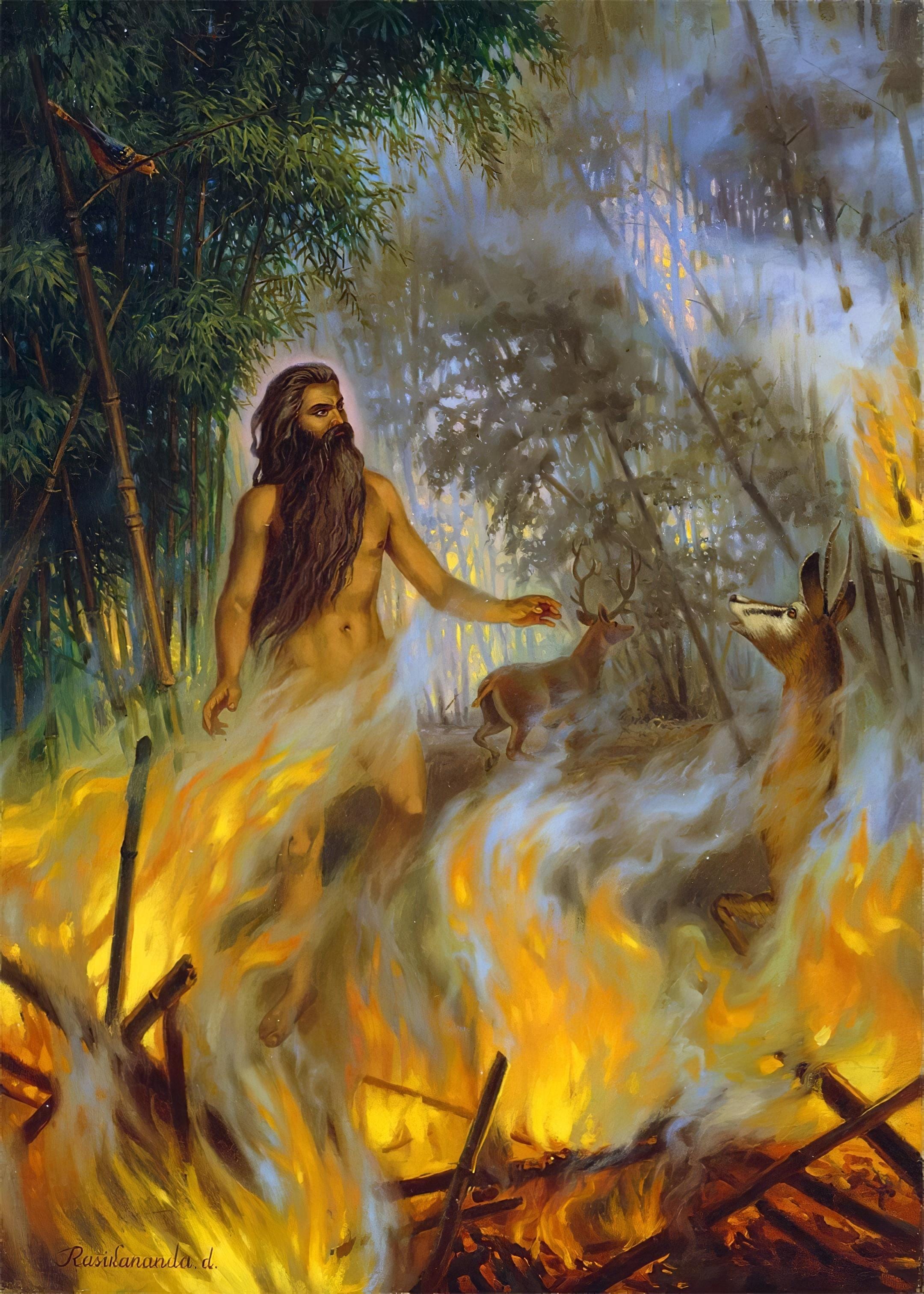
Actually Lord Ṛṣabhadeva had no material body, but due to yoga-māyā He considered His body material, and therefore, because He played like an ordinary human being, He gave up the mentality of identifying with it. Following this principle, He began to wander all over the world. While traveling, He came to the province of Karṇāṭa in South India and passed through Koṅka, Veṅka and Kuṭaka. He had no plan to travel this way, but He arrived near Kuṭakācala and entered a forest there. He placed stones within His mouth and began to wander through the forest, naked and with His hair disheveled like a madman.
While He was wandering about, a wild forest fire began. This fire was caused by the friction of bamboos, which were being blown by the wind. In that fire, the entire forest near Kuṭakācala and the body of Lord Ṛṣabhadeva were burnt to ashes.” (SB 5.6.6-8)
Ṛṣabhadeva is the Supreme Lord Himself, a plenary portion of Krsna. However, while playing His pastime as an avadhūta, no one could understand his position. He performed these pastimes in the first Manvantara, and since then His instructions and His personal example continue to serve as a source of inspiration for both yogīs and devotees. Technically, Ṛṣabhadeva was practicing the process of jñana-yoga, but the ultimate goal is to revive our eternal relationship with Krsna. As explained by Śrīla Prabhupāda in his purport to text six: “One must understand his constitutional position and the constitutional position of the Supreme Lord as well. Both have the same spiritual identity. Maintaining oneself as a servant of the Supreme Lord, one should avoid rebirth in this material world. If one keeps himself spiritually fit and thinks of himself as an eternal servant of the Supreme Lord, he will be successful at the time he has to give up the material body.”
He chose to wind up these pastimes during a forest fire in the province of Kuṭakācala. Although the words “tena dadāha” in text eight appear to suggest that His body was burned to ashes, Prabhupāda clarifies that it just appeared so. Just as Krsna appeared to have left His body after being hit by the arrow of the hunter, Ṛṣabhadeva appeared to have left due to the forest fire, even though His transcendental body can’t be burned. In the process, He liberated all the animals in the forest.
The time of death is a difficult test for any conditioned soul. There is no such thing as a peaceful death; death is always painful. Even if one falls unconscious, pain and suffering will be there, because they are connected not only with the physical body, but with the subtle body as well. Even if the physical body is unconscious, the subtle body will still be active. Death is thus a situation of intense physical and mental suffering, in which we need to remain fixed in our position of service and surrender to Krsna, a difficult test we all have to pass.
To die in a forest fire is surely painful, but Ṛṣabhadeva showed by His example how we can remain fixed even in such an extreme situation by not identifying with the body. If we practice this desidentification during our lives by following His instructions, we have a chance of putting it into practice in our last moments.
King Arhat tries to imitate the austerities of Ṛṣabhadeva
“Śukadeva Gosvāmī continued speaking to Mahārāja Parīkṣit: My dear King, the King of Koṅka, Veṅka and Kuṭaka whose name was Arhat, heard of the activities of Ṛṣabhadeva and, imitating Ṛṣabhadeva’s principles, introduced a new system of religion. Taking advantage of Kali-yuga, the age of sinful activity, King Arhat, being bewildered, gave up the Vedic principles, which are free from risk, and concocted a new system of religion opposed to the Vedas. That was the beginning of the Jain dharma. Many other so-called religions followed this atheistic system.” (SB 5.6.9)
According to most modern scholars, Jainism was founded by Vardhamāna (Mahāvīra), a kṣatriya prince who lived in 599–527 BCE, while followers claim that the Jain dharma is eternal, with Mahāvīra just reestablishing the teachings previously revealed by Ṛṣabha and earlier teachers. There may be different versions, but we should accept the version of Śrīmad Bhāgavatam as authoritative.
According to Śukadeva Gosvāmī, the founder was a king called Arhat, who, during Kali-yuga, introduced a new system of religion, contrary to the teachings of the Vedas, based on his imitation of the activities of Ṛṣabhadeva.
The original system taught by Lord Ṛṣabha is a system intended to be practiced by yogīs in Satya-yuga, Treta-yuga, and Dvāpara-yuga. We can hear and chant his pastimes and be inspired by His teachings, but it is impossible for us to follow His practice of austerity in Kali-yuga.
Prabhupāda explains this point in his purport to text 16: “The teachings of Lord Ṛṣabhadeva are for the people of all yugas — Satya-yuga, Tretā-yuga, Dvāpara-yuga and especially Kali-yuga. These instructions are so powerful that even in this Age of Kali, one can attain perfection simply by explaining the instructions, following in the footsteps of the ācāryas or listening to the instructions with great attention. If one does so, one can attain the platform of pure devotional service to Lord Vāsudeva.”
In his commentary, Śrīla Viśvanātha Cakravartī mentions that Arhat heard about Ṛṣabhadeva and started imitating his external behavior in an attempt to become similar to Him. He was thus not bathing or cutting his hair, remaining naked, and so on, without, however, ever attaining the same exalted status as Ṛṣabhadeva. His process is considered dangerous because it encourages people to abandon the Vedic process and adopt unclean habits, without, however, elevating them to a true spiritual platform.
Śukadeva Goswami condemns thus his process as an irreligious system appreciated by people of this age of Kali. It is not improper for a true paramahaṃsa who is fully detached from the body to act like Ṛṣabhadeva, but when one tries to imitate His external activities without the same internal qualification, he falls under the influence of the mode of ignorance. Paramahaṃsas don’t necessarily have to follow all the rules and regulations prescribed in the Vedas because they have already attained the goal of the Vedic teachings, but a less exalted person who does so becomes degraded.
Prabhupāda traces another parallel to modern hippies, who would think themselves transcendental while living degraded lives. He thus frames it as the classical Kali-yuga sequence of a deviation leading to other progressively greater deviations.
It was previously established that the brāhmaṇas should be followed by all. The brāhmanas are so important because they are the guardians of religious principles. When people stop following the brāhmanas, or when the brāhmanas themselves degrade, as happens in Kali-yuga, chaos ensues.
Prabhupāda summarizes the issue in his purport to text twelve. Ṛṣabhadeva also appeared to deliver the people of Kali-yuga, but we can benefit by following His instructions, and not by imitating His lila.
“The symptoms of Kali-yuga are predicted in the Twelfth Canto, Third Chapter, of Śrīmad-Bhāgavatam. Lāvaṇyaṁ keśa-dhāraṇam. It is predicted how fallen souls will behave. They will keep their hair long and consider themselves very beautiful, or they will pluck out their hair as the Jains do. They will keep themselves unclean and will not wash their mouths. Jains refer to Lord Ṛṣabhadeva as their original preceptor. If such people are serious followers of Ṛṣabhadeva, they must also take His instructions. In the Fifth Chapter of this canto, Ṛṣabhadeva gave His one hundred sons instructions whereby they could become free from the clutches of māyā. If one actually follows Ṛṣabhadeva, he will certainly be delivered from the clutches of māyā and return home, back to Godhead. If one strictly follows the instructions of Ṛṣabhadeva given in the Fifth Chapter, he will certainly be liberated. Lord Ṛṣabhadeva incarnated specifically to deliver these fallen souls.”
Śukadeva Goswami concludes:
“People who are lowest among men and bewildered by the illusory energy of the Supreme Lord will give up the original varṇāśrama-dharma and its rules and regulations. They will abandon bathing three times daily and worshiping the Lord. Abandoning cleanliness and neglecting the Supreme Lord, they will accept nonsensical principles. Not regularly bathing or washing their mouths regularly, they will always remain unclean, and they will pluck out their hair. Following a concocted religion, they will flourish. During this Age of Kali, people are more inclined to irreligious systems. Consequently these people will naturally deride Vedic authority, the followers of Vedic authority, the brāhmaṇas, the Supreme Personality of Godhead and the devotees.
Low-class people, due to their gross ignorance, introduce a system of religion that deviates from the Vedic principles. Following their own mental concoctions, they automatically fall down into the darkest regions of existence.
In this Age of Kali, people are overwhelmed by the modes of passion and ignorance. Lord Ṛṣabhadeva incarnated Himself to deliver them from the clutches of māyā.”(SB 5.6.10-12)
The glories of Ṛṣabhadeva
Śukadeva Goswami concludes chapter six with a description of the glories of Lord Ṛṣabhadeva, quoting three verses that summarize His glories:
“Oh, this earthly planet contains seven seas and many islands and lands, of which Bhārata-varṣa is considered the most pious. People of Bhārata-varṣa are accustomed to glorifying the activities of the Supreme Personality of Godhead in His incarnations as Lord Ṛṣabhadeva and others. All these activities are very auspicious for the welfare of humanity.
“Oh, what shall I say of the dynasty of Priyavrata, which is pure and very much celebrated. In that dynasty, the Supreme Person, the original Personality of Godhead, descended as an incarnation and executed religious principles that could free one from the results of fruitive activity.
“Who is that mystic yogī who can follow the examples of Lord Ṛṣabhadeva even with his mind? Lord Ṛṣabhadeva rejected all kinds of yogic perfection, which other yogīs hanker to attain. Who is that yogī who can compare to Lord Ṛṣabhadeva?” (SB 5.6.13-15)
As in the previous narrations, there is a blessing for those who study it. What is it?
“Whoever attentively hears or speaks of them, following in the footsteps of the ācāryas, will certainly attain unalloyed devotional service at the lotus feet of Lord Vāsudeva, the Supreme Personality of Godhead.”
The blessing for attentively hearing and reciting the glories of Lord Ṛṣabhadeva is to realize His teachings, attaining pure devotional service to the Lord, which is the highest perfection. As Prabhupāda explains in his purport to text 17:
“Devotional service unto the Lord is the highest attainment for anyone desiring liberation from the tribulations of material existence. As stated in Bhagavad-gītā (6.22), yaṁ labdhvā cāparaṁ lābhaṁ manyate nādhikaṁ tataḥ: “Gaining this, one thinks there is no greater gain.” When one attains the service of the Lord, which is non-different from the Lord, one does not desire anything material. Mukti means relief from material existence. Bilvamaṅgala Ṭhākura says: muktiḥ mukulitāñjaliḥ sevate ’smān. For a devotee, mukti is not a very great achievement. Mukti means being situated in one’s constitutional position. The constitutional position of every living being is that of the Lord’s servant; therefore when a living entity is engaged in the Lord’s loving service, he has already attained mukti. Consequently a devotee does not aspire for mukti, even if it is offered by the Supreme Lord Himself.”
The last verse summarizes the whole chapter:
“The Supreme Personality of Godhead, Lord Ṛṣabhadeva, was fully aware of His true identity; therefore He was self-sufficient, and He did not desire external gratification. There was no need for Him to aspire for success, since He was complete in Himself. Those who unnecessarily engage in bodily conceptions and create an atmosphere of materialism are always ignorant of their real self-interest. Out of His causeless mercy, Lord Ṛṣabhadeva taught the self’s real identity and the goal of life. We therefore offer our respectful obeisances unto the Lord, who appeared as Lord Ṛṣabhadeva.” (SB 5.6.19)
Prabhupāda expands it in his purport:
“Being the Supreme Personality of Godhead Himself, Lord Ṛṣabhadeva is complete in Himself. We living entities, as parts and parcels of the Supreme Lord, should follow the instructions of Lord Ṛṣabhadeva and become self-sufficient. We should not create unnecessary demands due to the bodily conception. When one is self-realized, he is sufficiently satisfied due to being situated in his original spiritual position. As confirmed in Bhagavad-gītā (18.54): brahma-bhūtaḥ prasannātmā na śocati na kāṅkṣati. This is the goal of all living entities. Even though one may be situated within this material world, he can become fully satisfied and devoid of hankering and lamentation simply by following the instructions of the Lord as set forth in Bhagavad-gītā or Śrīmad-Bhāgavatam. Satisfaction through self-realization is called svarūpānanda. The conditioned soul, eternally sleeping in darkness, does not understand his self-interest. He simply tries to become happy by making material adjustments, but this is impossible. It is therefore said in Śrīmad-Bhāgavatam, na te viduḥ svārtha-gatiṁ hi viṣṇum: due to gross ignorance, the conditioned soul does not know that his real self-interest is to take shelter at the lotus feet of Lord Viṣṇu. To try to become happy by adjusting the material atmosphere is a useless endeavor. Indeed, it is impossible. By His personal behavior and instructions, Lord Ṛṣabhadeva enlightened the conditioned soul and showed him how to become self-sufficient in his spiritual identity.”
How the great Bharata Maharaja ruled and renounced the kingdom
Bharata Maharaja was so successful in his reign that our planet inherited his name, being known as Bhārata-varṣa since then. However, following the footsteps of his ancestors, Bharata Maharaja eventually renounced the kingdom to aim for self-realization. This leads us to a saga that will take three lives to be completed. After living as a king, Bharata will have to take birth as a deer due to a mistake, and then take a new human body as a brāhmana to complete his spiritual path and finally go back home, back to Godhead. In this last birth, he will meet Rahūgaṇa and speak to him on self-realization, sharing the knowledge he accumulated in these three lives.
How did Bharata Maharaja rule the kingdom as a great ruler in his first life?
“Mahārāja Bharata was a very learned and experienced king on this earth. He perfectly ruled the citizens, being himself engaged in his own respective duties. Mahārāja Bharata was as affectionate to the citizens as his father and grandfather had been. Keeping them engaged in their occupational duties, he ruled the earth.
With great faith King Bharata performed various kinds of sacrifice. He performed the sacrifices known as agni-hotra, darśa, pūrṇamāsa, cāturmāsya, paśu-yajña [wherein a horse is sacrificed] and soma-yajña [wherein a kind of beverage is offered]. Sometimes these sacrifices were performed completely and sometimes partially. In any case, in all the sacrifices the regulations of cāturhotra were strictly followed. In this way Bharata Mahārāja worshiped the Supreme Personality of Godhead.
After performing the preliminaries of various sacrifices, Mahārāja Bharata offered the results in the name of religion to the Supreme Personality of Godhead, Vāsudeva. In other words, he performed all the yajñas for the satisfaction of Lord Vāsudeva, Kṛṣṇa. Mahārāja Bharata thought that since the demigods were different parts of Vāsudeva’s body, He controls those who are explained in the Vedic mantras. By thinking in this way, Mahārāja Bharata was freed from all material contamination, such as attachment, lust and greed. When the priests were about to offer the sacrificial ingredients into the fire, Mahārāja Bharata expertly understood how the offering made to different demigods was simply an offering to the different limbs of the Lord. For instance, Indra is the arm of the Supreme Personality of Godhead, and Sūrya [the sun] is His eye. Thus Mahārāja Bharata considered that the oblations offered to different demigods were actually offered unto the different limbs of Lord Vāsudeva.” (SB 5.7.4-6)
In the Fourth Canto, we studied the example of King Prācīnabarhi, who performed improper fruitive sacrifices and thus got entangled in the reactions of killing numerous animals. He taught that he was achieving the celestial planets by these sacrifices, but Nārada Muni revealed he was actually going to hell for unnecessarily killing so many animals.
Now, we have an example of a King who performed perfect sacrifices for the satisfaction of the Supreme Lord, demonstrating the true purpose of the Vedas.
In the Mundaka Upaniṣad, it’s revealed that the original purpose of the Vedas was understood in Satya-yuga, when different demigods were seen as simply servants of the Lord, and all efforts in self-realization were made simply for understanding Him. The concept of separate worship of demigods was introduced in Treta-yuga, when knowledge diminished, and people started performing sacrifices with fruitive intent, just like Prācīnabarhi.
As urged in the Mundaka Upaniṣad (1.2.1):
“Brahman is the Supreme Truth! The original understanding of sacrifice expanded into many forms in Treta-yuga. O great sages anxious to please the Lord, practice sacrifices steadily and regularly, in their original understanding, for the satisfaction of the Lord. This is your path back to Godhead.”
This is the knowledge behind the sacrifices of Bharata Maharaja, as explained by Prabhupāda in his purport to text 5.7.6:
“Because the goddess Durgā satisfies Kṛṣṇa, we should therefore offer respects to Goddess Durgā. Because Lord Śiva is nothing but Kṛṣṇa’s functional body, we should therefore offer respects to Lord Śiva. Similarly, we should offer respects to Brahmā, Agni and Sūrya. There are many offerings to different demigods, and one should always remember that these offerings are usually meant to satisfy the Supreme Personality of Godhead. Bharata Mahārāja did not aspire to receive some benediction from demigods. His aim was to please the Supreme Lord.”
Another frequent misunderstanding is about the purpose of sacrificing animals. Prabhupāda explains it in his purport to text four:
“Animals like horses and cows were offered in sacrifice to test the proper execution of the sacrifice. Otherwise, there was no purpose in killing the animal. Actually the animal was offered in the sacrificial fire to get a rejuvenated life. Generally an old animal was sacrificed in the fire, and it would come out again in a youthful body. Some of the rituals however, did not require animal sacrifice. In the present age, animal sacrifices are forbidden.”
Animals were sacrificed in Vedic sacrifices as a test and also as a visual proof of the potency of the Vedic mantras. The animal would be sacrificed and then resurrected, showing the divine potency of the mantras chanted by the brāhmanas. As Vedic sacrifices would typically attract a large audience, and such a performance would help them acquire faith in the scriptures. However, when the brāhmanas are not able to bring the animals back to life, they, as well as other people involved in the ceremony, become responsible for the killing, as in the case of Prācīnabarhi. Because such brāhmanas are now not available, animal sacrifices are prohibited in our age. Instead of performing complicated rituals, we are urged to focus on the essence of the scriptures by sincerely chanting the holy names. Yajñaiḥ saṅkīrtana-prāyair yajanti hi sumedhasaḥ: this is the process accepted by intelligent persons.
Text six clearly describes the consciousness of Bharata Maharaja, performing the sacrifices exclusively for the satisfaction of the Lord, and with perfect knowledge of the function of the demigods as different limbs of the Universal form of the Lord. One could question why he worshiped demigods at all, but this is very didactically explained by Prabhupāda in the purport:
“If we worship the hand of a person, we intend to satisfy the person himself. If we massage a person’s legs, we do not really serve the legs but the person who possesses the legs. All the demigods are different parts of the Lord, and if we offer service to them, we actually serve the Lord Himself. Demigod worship is mentioned in Brahma-saṁhitā, but actually the ślokas advocate worship of the Supreme Personality of Godhead, Govinda.”
As a King, Bharata Maharaja had the duty of performing sacrifices for the enlightenment of the general public, for this was the appropriate process prescribed in the scriptures for the age he was living in. A pure devotee does not neglect the prescriptions of the scriptures; on the contrary, he gives the example by performing them perfectly.
All of these exalted standards were upheld by Bharata Maharaja, and that’s the reason he became such an exalted king that the planet was renamed in his honor. The description continues in the next verse:
“In this way, being purified by ritualistic sacrifices, the heart of Mahārāja Bharata was completely uncontaminated. His devotional service unto Vāsudeva, Lord Kṛṣṇa, increased day after day. Lord Kṛṣṇa, the son of Vasudeva, is the original Personality of Godhead manifest as the Supersoul [Paramātmā] as well as the impersonal Brahman. Yogīs meditate upon the localized Paramātmā situated in the heart, jñānīs worship the impersonal Brahman as the Supreme Absolute Truth, and devotees worship Vāsudeva, the Supreme Personality of Godhead, whose transcendental body is described in the śāstras. His body is decorated with the Śrīvatsa, the Kaustubha jewel and a flower garland, and His hands hold a conchshell, disc, club and lotus flower. Devotees like Nārada always think of Him within their hearts.” (SB 5.7.7)
The sentence “purified by ritualistic sacrifices” may appear contradictory at first (how can karma-kanda sacrifices purify a pure devotee?), but it makes sense when understood in the context of the previous verses. Even though Bharata was engaging ordinary ritualistic brāhmanas and performing ritualistic sacrifices, he was doing everything in perfect consciousness as an offering to the Lord, and thus everything was being performed in pure devotional service. This is connected with what Krsna mentions in the Gītā (18.5): “Acts of sacrifice, charity and penance are not to be given up; they must be performed. Indeed, sacrifice, charity and penance purify even the great souls.”
“Destiny fixed the time for Mahārāja Bharata’s enjoyment of material opulence at one thousand times ten thousand years. When that period was finished, he retired from family life and divided the wealth he had received from his forefathers among his sons. He left his paternal home, the reservoir of all opulence, and started for Pulahāśrama, which is situated in Hardwar. The śālagrāma-śilās are obtainable there.” (SB 5.7.8)
Just like his ancestors, Bharata reigned for a very long time. He then divided the kingdom amongst his five sons, Sumati, Rāṣṭrabhṛta, Sudarśana, Āvaraṇa, and Dhūmraketu, and retired for Pulahāśrama, a place where śālagrāma-śilās are naturally found.
This attitude teaches us a number of important lessons. The first is that Bharata perfectly maintained the property he inherited from his ancestors, just as we inherit temples and other facilities from devotees of previous generations, and have the duty of properly maintaining them. Even if we don’t have the potency to create something new, we must at least properly maintain what is there. The second is that he transmitted it to his sons after properly raising and educating them, just as we are supposed to train and nourish the next generation of devotees, who can take up the mission. A third point is that he was not attached; he performed everything out of duty and was ready to relinquish his position as soon as qualified successors were present.
“In the gardens of Pulaha-āśrama, Mahārāja Bharata lived alone and collected a variety of flowers, twigs and tulasī leaves. He also collected the water of the Gaṇḍakī River, as well as various roots, fruits and bulbs. With these he offered food to the Supreme Personality of Godhead, Vāsudeva, and, worshiping Him, he remained satisfied. In this way his heart was completely uncontaminated, and he did not have the least desire for material enjoyment. All material desires vanished. In this steady position, he felt full satisfaction and was situated in devotional service.” (SB 5.7.11)
In contrast with the gorgeous sacrifices he performed as a king, Bharata performed a simple process of worship in his retired life, offering water, tulasī leaves, as well as flowers and other natural items. He was situated in devotional service even as a king, but now, free to focus his mind on the Lord without any distractions, his devotional sentiments developed further. This is the characteristic of the spiritual platform: there is no limit on how much one’s love for Krsna can increase. In the spiritual world, the love of all inhabitants continues to increase forever, without limit.
What about us? We may not be able to go to live in Pulaha-āśrama or in another holy place, but we can still continue to advance, even while living at home, by following the same process. As Prabhupāda explains, “Everyone is searching after peace of mind. This is obtainable only when one is completely freed from the desire for material sense gratification and is engaged in the devotional service of the Lord.”
Traditionally, devotees leave home and go to live in holy places to have more facility in serving the Lord, but the main point is not the place, but the consciousness. If one is determined in chanting and practicing the other limbs of the devotional process, one can fix his mind on the Lord and become free from material desires while living anywhere.
You can also donate using Buy Me a Coffee, PayPal, Wise, Revolut, or bank transfers. There is a separate page with all the links. This helps me enormously to have time to write instead of doing other things to make a living. Thanks!