

« Things I Wish Someone Had Taught Me When I Started Krishna Consciousness
The danger of impersonalism
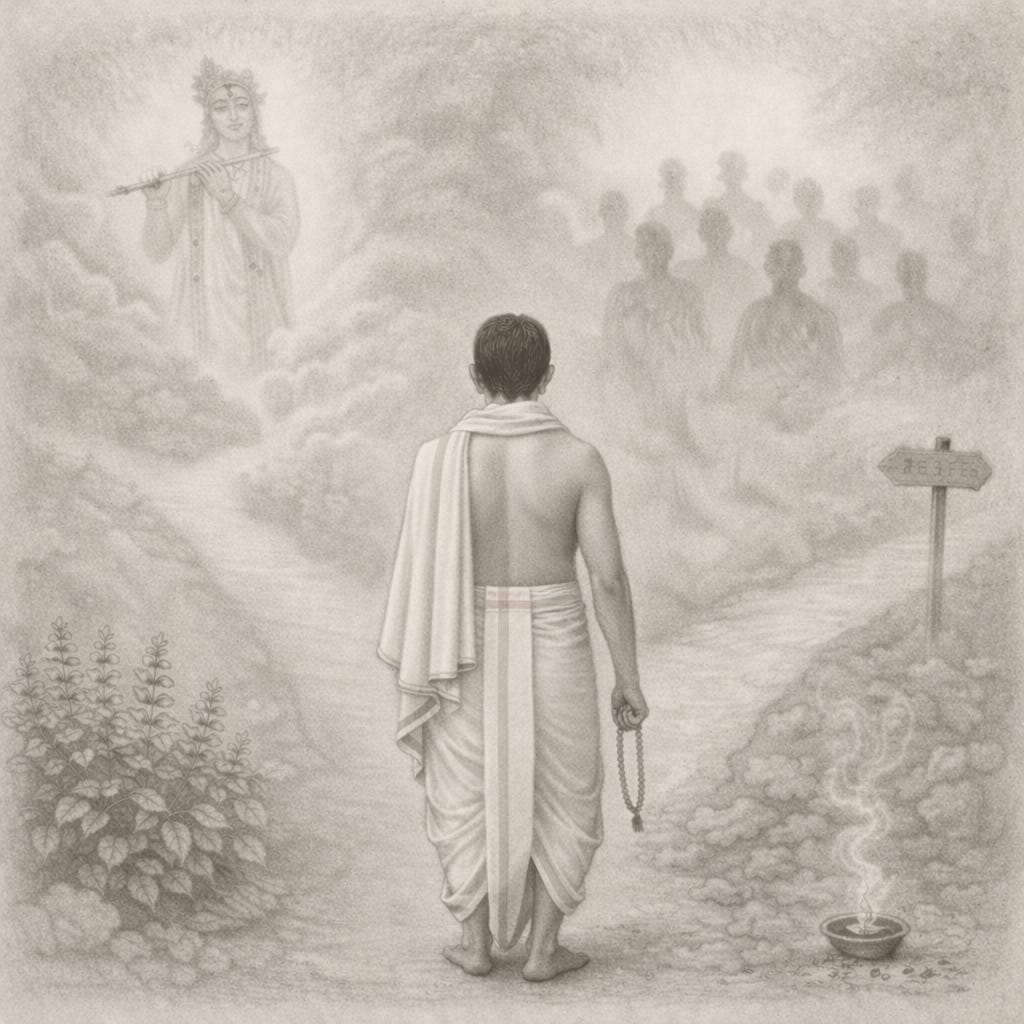
When we hear of impersonalism, we often think of a certain group in India. Unfortunately, impersonalism is much more widespread and permeates all spheres of life, including our own spiritual movement.
We can say that impersonalism is the default modus operandi for every conditioned soul. Material life means rejecting our eternal relationship with Kṛṣṇa, and when we do that, we inevitably fall into some form of impersonalism, taking Kṛṣṇa out of the picture so we can do our own thing. This happens everywhere, even amongst devotees. Until we attain a platform of pure devotion, impersonalism will continue to manifest in us to a certain degree.
It’s not very common to see devotees believing God has no form, but we can easily drift into a concept of quasi-impersonalism, in which we accept philosophically that Kṛṣṇa has a form, but deep inside we see the deity as just a statue. If we can’t see Kṛṣṇa as personally present in the deity, we will gradually slip into seeing God as a vague concept, instead of someone who is personally present in our lives. The very definition of impersonalism is to see God as just an idea or energy, and not as a person.
Another way in which this tendency may manifest is in the idea of being part of a group or institution, believing that this will automatically save us. If I see the institution as the deliverer instead of Kṛṣṇa, the priority becomes my relationship with the institution, instead of my relationship with Kṛṣṇa. In a healthy situation, the institution is supposed to foment and facilitate my relationship with Kṛṣṇa. I stay in the institution because that’s the place where I can find the right association and offer service. If, however, the institution itself (as a space or impersonal entity) replaces Kṛṣṇa as the deliverer and object of affection, we fall into impersonalism.
Another form of impersonalism is when we become mechanical, drifting from personal service to the Lord (as a person with desires, feelings, relationships, etc.) into a series of abstract rituals. We then wake up early in the morning because we believe this will save us, recite some mantra mechanically, believing it will save us, perform some mechanical worship or other activity, believing it will save us, and even hear or sing mechanically, believing it will save us. We can thus see how we can spend the whole day engaged in rituals, without ever remembering Kṛṣṇa, believing the ritual will save us. This is similar to the idea that merely living in a whole place is enough to achieve perfection.
Another trap is to practice spiritual life as a consumer, seeing spiritual life as some kind of product, something I get egoistic satisfaction from, instead of a platform of service. The central idea of spiritual life is reviving our attitude of service to Kṛṣṇa. When Kṛṣṇa is happy, we are also automatically happy. However, when we try to find satisfaction separately from Kṛṣṇa, the opposite happens. If I go to kīrtanas and other spiritual functions or to a holy place with the idea of peace, healing, mystical experiences, spiritual vibes, or some other form of personal satisfaction, I risk becoming a consumer, an attitude that nourishes my ego and individualism, instead of treating it. I then become stuck in the physical realm, locked out of the spiritual dimension that is accessed through selfless service. As a result, instead of the comfort, satisfaction, and mystical experiences I was looking for, I often find crowds, politics, noise, etc. At this point, I may either leave or become disappointed or cynical.
Yet another form of impersonalism is impersonalism in relationships, where, instead of seeing other devotees as individual souls meant for loving reciprocation and service, we start seeing them as functions, roles, or problems to deal with. This attitude flattens the whole sphere of relationships (something essential to our spiritual progress) into an ordinary, material set of transactions. Other devotees around us become thus tools to achieve things (free labor, means of validation, objects of convenience, sources of money, or emotional support, etc.), instead of personal souls, dear to Kṛṣṇa. In this case, Kṛṣṇa goes again out of the picture, replaced with myself, as the center, the object of service and control of all people I have around me, which I use as a means to achieve personal satisfaction. When we go on this path, things can become very lonely, very quickly.
Impersonalism can also manifest in the form of dry renunciation, in which we reject emotions as being Māyā, repressing them and becoming cold and distant, thinking we are above everything. This, again, can block our personal relationship with Kṛṣṇa and end up bringing us to the idea that we are the center. This is a characteristic of the Māyāvādis that we can easily fall into. Similarly, impersonalism can appear in the form of avoiding people and responsibilities, thinking I don’t need any of this, I can just chant, etc. Surely, pure devotees can sometimes act in this way, but that’s because they factually have a relationship with Kṛṣṇa and can disconnect from the physical reality and simply stay with Him. As long as we are on the material level, this attitude brings us to impersonalism, where we have neither a relationship with the world nor with Kṛṣṇa, just like a soul in the impersonal brahmajyoti.
When we fall into any of these traps, we will have less taste for hearing, chanting, and serving, and will be more attracted to solitary quietness, fault-finding, arguments with others, etc. We may start seeing other devotees as mere disturbances, instead of objects of service, and start seeing liberation or peace as the ultimate goal, instead of loving service. In this context, devotional service may be seen as just a tool to achieve this means, or rather as just another disturbance to be avoided.
Impersonalism also manifests in the “I don’t care” mentality, where we just become self-centered and stop caring about others or what is happening around us. Personalism means relationship, and relationship means I care about the person. When I stop caring, it means there is no relationship, which means, again, impersonalism. Ultimately, we may even lose the attraction to chanting and other aspects of the process and completely stop. In general, good association is the make-or-break factor. As long as we stay around good association, we are more or less safe, but as soon as we get into the wrong company, things become complicated.
« Things I Wish Someone Had Taught Me When I Started Krishna Consciousness
You can also donate using Buy Me a Coffee, PayPal, Wise, Revolut, or bank transfers. There is a separate page with all the links. This helps me enormously to have time to write instead of doing other things to make a living. Thanks!