


You can receive new articles directly in your inbox. Subscription is free; donations are welcome.
In the 6th chapter of the Bhagavad-gītā, Kṛṣṇa mentions:
“For one who has conquered the mind, the Supersoul is already reached, for he has attained tranquillity. To such a man happiness and distress, heat and cold, honor and dishonor are all the same.” (Bg 6.7)
This may look like a mysterious verse. How is it that we reach the Supersoul just by controlling the mind? Technically speaking, in the aṣṭānga-yoga system the mind is controlled in the pratyāhāra stage, while the yogī may be able to see Paramātmā in the samādhi stage. There is a long path between the two stages, so how can Kṛṣṇa say that the Supersoul is already reached by the time one controls the mind?
The point is that being in contact with the Supersoul does not mean just seeing Him. He lives with us inside the heart and dictates from within. However, because of the agitation of the mind, we cannot hear, and thus we go astray. When the mind finally silences, the guidance of the Supersoul becomes clear, and we automatically follow it. Just as a yogī who has failed in controlling the mind may fall, a devotee who is still embarrassed by the turbulence of the mind and senses may act erratically. However, as we fix our minds, we become dovetailed with the desires of the Lord and stop acting independently. That is the stage mentioned by Kṛṣṇa. We may not see Paramātma, but He is already in reach.
At this stage, we attain tranquility and become impervious to the changing conditions of this world. We become aware of our eternal relationship with Kṛṣṇa, and the mere resemblance of this realization makes the temporary situations we face in this world, such as heat and cold, happiness and distress, look small. In fact, we gradually come to realize they are all the same, different faces of the same material manifestation.
Kṛṣṇa then explains the symptoms by which such an advanced yogī or devotee can be recognized:
“A person is said to be established in self-realization and is called a yogī [or mystic] when he is fully satisfied by virtue of acquired knowledge and realization. Such a person is situated in transcendence and is self-controlled. He sees everything – whether it be pebbles, stones or gold – as the same.
A person is considered still further advanced when he regards honest well-wishers, affectionate benefactors, the neutral, mediators, the envious, friends and enemies, the pious and the sinners all with an equal mind.” (Bg 6.8-9)
The first level is that one becomes fully satisfied because of the acquired knowledge and realization. Situated in transcendence, he is self-controlled and sees all material objects, be they pebbles, stones, or gold, as the same.
The second level is that this sameness is extended even to people with whom one relates. One starts seeing well-wishers, benefactors, neutral people, as well as the envious, friends and enemies, pious and sinners, with an equal mind.
What makes these two platforms different?
A materialistic person sees gold as more valuable than stones because gold can be converted into material possessions and power. Gold is thus an instrument to satisfy desires. A self-realized soul, however, has no material desires and thus sees no value in gold or money. For him, gold is like an ordinary stone, and money is like ordinary paper. A devotee may desire for Kṛṣṇa, of course, but in terms of his self-satisfaction, there is indifference. There are other forms of “gold” in this world, such as fame or mundane scholarship, which may look valuable for others, but are also pebbles and stones for a pure devotee.
Seeing all people as the same, however, demands even higher realization. How to react the same to both offenses and praise, honor, and dishonor? It demands not only fully controlling the mind but also becoming completely free from the false ego.
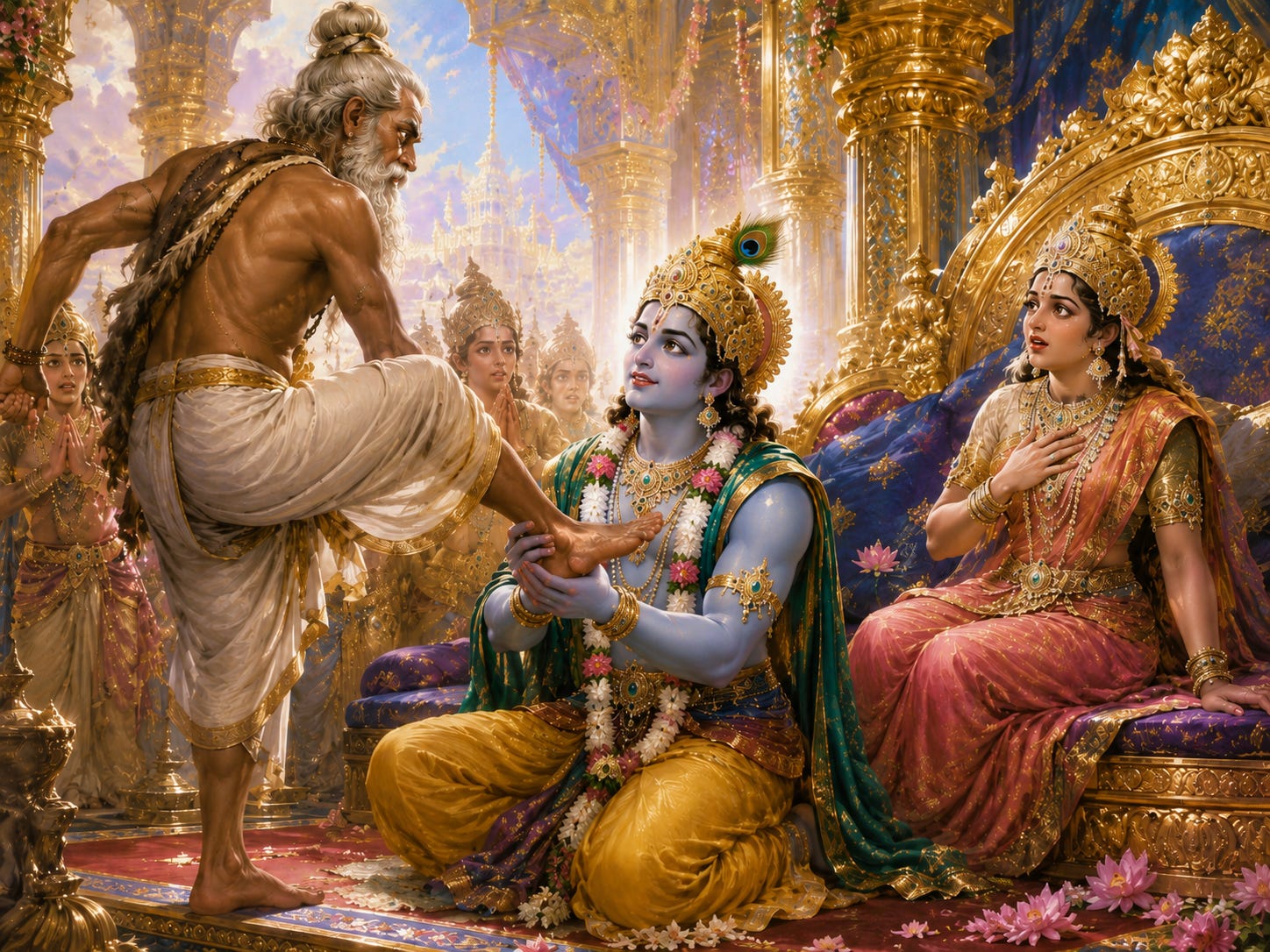
Once, great sages wanted to determine who was supreme and sent Bhṛgu Muni to test Brahmā, Śiva, and Viṣnu.
Bhṛgu went first to the assembly of Brahmā, his father. However, when he entered, he deliberately did not greet him or offer respects. Brahmā became angry, but because Bhṛgu was his son, he controlled his anger and did not punish him. Thus, Bhṛgu understood that Brahmā, although very advanced, was not completely free from the material influence.
He then went to Lord Śiva, who rose to embrace him affectionately. Bhṛgu, however, refused the embrace and seriously insulted him. Śiva became furious, but somehow controlled himself. Bhṛgu then understood that even he was not completely unaffected.
Finally, he went to Lord Viṣnu and committed the greatest offense by directly kicking Him on the chest. Lord Viṣnu, however, did not become angry. Instead, He humbly asked whether Bhṛgu’s foot had been hurt by touching His hard chest.
Lord Viṣnu is completely transcendental and thus beyond material anger. This is a platform that even great demigods cannot imitate. A pure devotee, however, rises to the same spiritual platform and becomes one with the Lord in quality, and can exhibit the same form of transcendental tolerance that is impossible even to demigods. Kṛṣṇa mentions it last, because this is the definitive proof one has reached the transcendental platform.
This also gives us a practical standard. It is easy to presume we are advanced when circumstances are favorable, when we are respected and appreciated. However, real advancement is tested when we deal with difficulties. When we are misunderstood, neglected, or even directly insulted. At these moments, we can see how much of our spiritual practice really reached the heart. If we immediately become disturbed, it means the false ego is still strong.
Conquering the mind is not just a process of suppressing thoughts. It means bringing the mind under the shelter of Kṛṣṇa so that instead of being a mere source of material agitation, it can become an instrument for our devotional service. When the mind is absorbed in hearing, chanting, remembering, and serving, the voice of the Supersoul becomes more perceptible, and we naturally become peaceful, steady, and tolerant. The equality described by Kṛṣṇa is thus not artificial indifference, but the natural vision of one who sees everything in relation to Him. Such a devotee may still act differently with different people, according to the practical circumstances, but internally he remains fixed, because his happiness no longer depends on how the world treats him.
This is a publication for thoughtful readers who want to go deeper into Kṛṣṇa consciousness. I publish daily, trying to offer high-quality spiritual content, and all posts are available to free subscribers. If you wish, you can also choose a paid subscription to support this work.
You can also receive the updates on WhatsApp or Telegram.
If you would like to contribute further, you can find the donation links here.