

Subscribe to receive new articles by e-mail. It’s free, but if you like, you can pledge a donation:
The earthly heavens of Bhū-mandala
In the Śrīmad Bhāgavatam, it is described that Bhū-mandala, the intermediate planetary system, has its center in Jambūdvīpa, which is in turn separated into nine varṣas, or different tracts of land.
Among the nine varṣas of Jambūdvīpa, Bhārata-varṣa is the field of fruitive activities, where we have to work and prove ourselves. The other eight varṣas are semi-celestial places, reserved for elevated souls.
There are three divisions of heavens in the universe: divya-svarga, bhauma-svarga, and bila-svarga. Divya-svarga means the celestial planets that compose Svargaloka, where the demigods live, while bila-svarga refers to the subterranean heavens in the lower planets, where pious demons live. The expression “pious demon” may sound contradictory, but it is important to notice that demigods and demons appeared from Diti and Aditi, two wives of Kaśyapa Muni. In other words, they are two branches of the same family. The word “demon” (asura) is used to describe all kinds of atheists that are not devotees of Viṣnu, but many of these atheists follow Vedic culture, worship the brāhmanas, etc. These are the materially pious demons who live in the bila-svarga and sometimes fight the demigods.
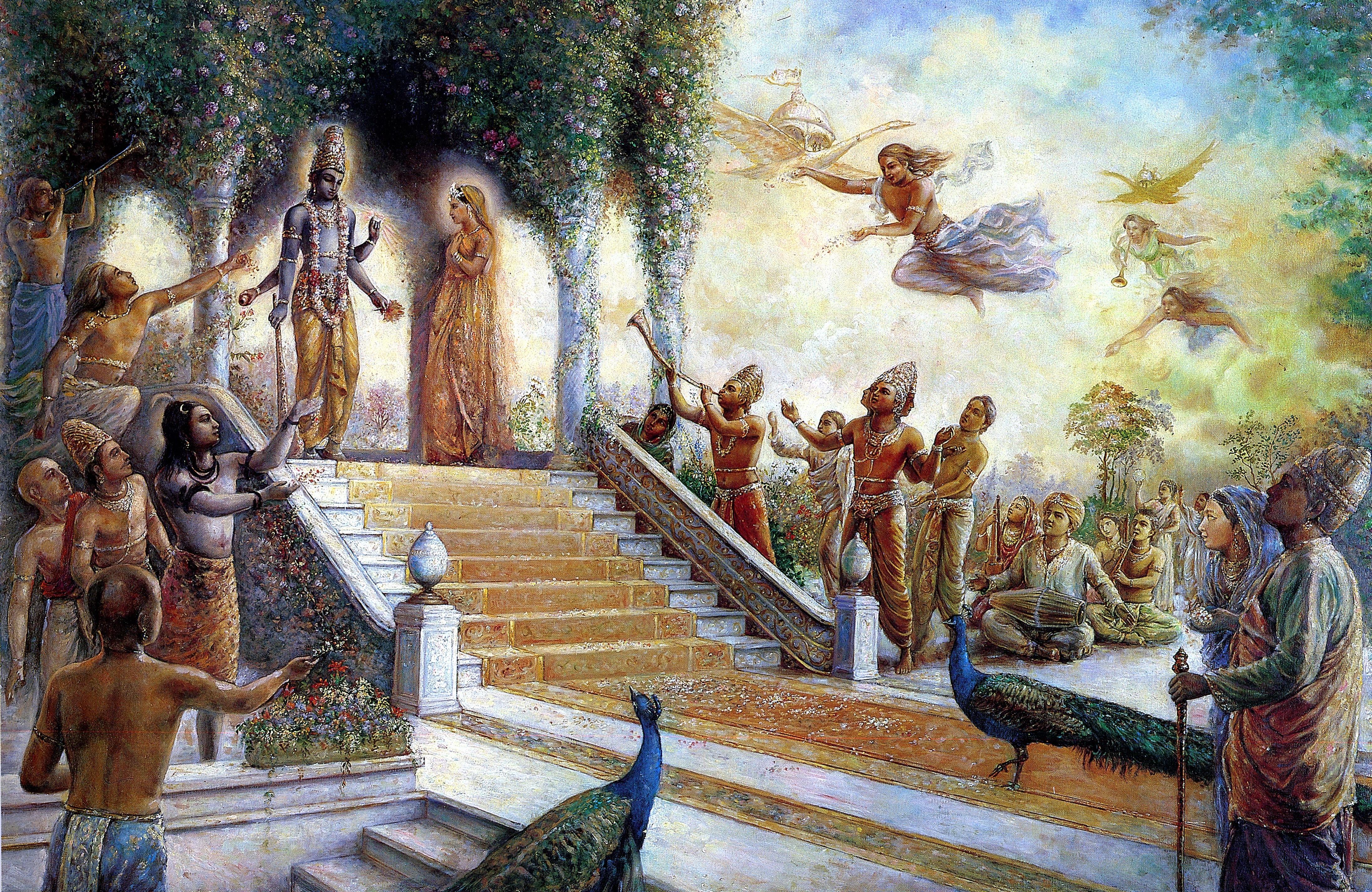
Bhauma-svarga, on the other hand, describes the earthly heavens of Bhū-mandala, where pious human beings live. The natural Vedic sequence is that human beings who have a desire for material enjoyment have the opportunity of practicing varnāśrama while living on Earth, performing pious activities, and thus being elevated to Svargaloka at the end of life. There, they can live for 10,000 years of the demigods. When their pious merits are almost exhausted, they take a last birth in heavenly circumstances in one of the eight celestial varṣas in Bhū-Mandala for another life of 10,000 years, in still comfortable conditions. After their pious merits are finally completely exhausted, they take birth again on earth, where, having their material desires satisfied, they can finally dedicate themselves to the practice of devotional service.
Although the Vedas recommend this path for ordinary people in the karma-kanda section, the scriptures also alert for the ultimate futility of this process. Why waste time going up and down an uncertain path, just to come back to the same point? Better to solve the problem once and for all.
Another interesting detail is that the cycles of four eras happen only in Bhārata-varṣa, accommodating souls of different levels of consciousness that need to take birth here. The other eight varṣas of Jambūdvīpa are places of enjoyment reserved for pious souls who are receiving the results of their past work. In all of these varṣas, they have a quality of life similar to Treta-yuga, living for 10,000 years with many opportunities for sense enjoyment. No one becomes old, and couples can enjoy sex life freely, with pregnancy happening only once close to the end of one’s life.
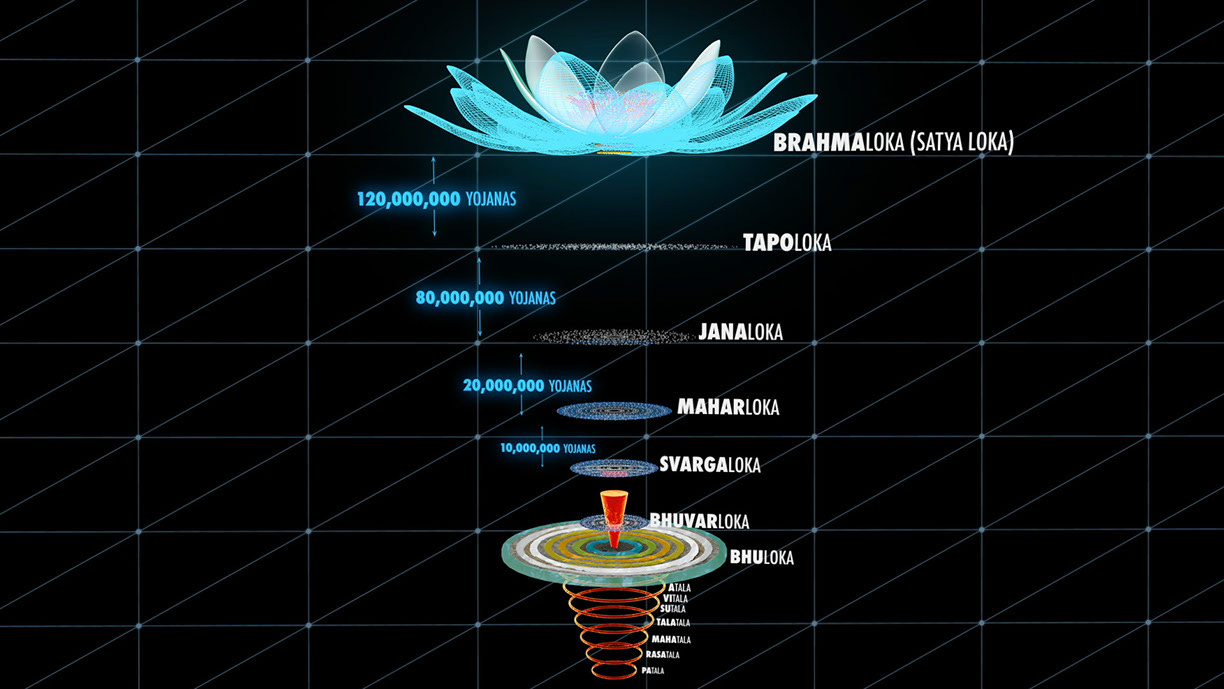
From this description, we can see that most of the population of the universe actually lives in quite comfortable situations by material standards. People in the higher planetary systems (starting from Maharloka), as well as in Svargaloka, obviously live comfortably, and even demons live comfortably in the Bila-svarga. Even on this planet, people live most of the time comfortably (from Satya-yuga to Dvāpara-yuga). Only in Kali-yuga do people experience acute suffering. Why is that?
We live now in difficult conditions because we exhausted the results of our past karma, and we are now in the test room preparing a new set of karma, which we will either enjoy in the heavenly realms or suffer in hell and in the animal species. Even if one has no desire to go back to Godhead in this life, it makes sense to at least live piously, so one can escape this difficult condition.
We can see that if people were properly educated in the cosmological model of the Vedas, understanding these different abodes and how our actions lead to one or another, they would undoubtedly become more inclined to practice Kṛṣṇa Consciousness, or at least live a pious life. It is thus not surprising that Prabhupāda put so much emphasis on the construction of the temple of the Vedic Planetarium, which can serve as a vehicle for the dissemination of this knowledge.
All the inhabitants of these heavenly varṣas in Jambūdvīpa are devotees. They enjoy an elevated standard of sense gratification and at the same time have the opportunity of worshiping the Lord, who is present in all these eight varṣas in His deity form. Prabhupāda explains this point in his purport to text 5.17.14:
“In this connection, Viśvanātha Cakravartī Ṭhākura informs us that the demigods worship the Supreme Lord in His various Deity forms (arcā-vigraha) because except in the spiritual world, the Supreme Personality of Godhead cannot be directly worshiped in person. In the material world, the Lord is always worshiped as the arcā-vigraha, or Deity in the temple. There is no difference between the arcā-vigraha and the original person, and therefore those who are engaged in worshiping the Deity in the temple in full opulence, even on this planet, should be understood to be directly in touch with the Supreme Personality of Godhead without a doubt.”
As long as we are not free from material desires, we are forced to accept material bodies, and thus we are not able to directly serve the Lord in His spiritual form. He thus mercifully appears to us in a form we can see and touch, so we can perfect our devotional service and return to Him. This is the situation both here and in the heavenly varṣas of Jambūdvīpa.
In general, devotees avoid the path of sense gratification, since their goal is to decrease their attraction to this material world and increase their attachment to Kṛṣṇa. However, if one has the desire to enjoy this world and, at the same time, practice devotional service to a certain degree, this is also possible; one just has to wait for the right time.
As Prabhupāda explains, “The inhabitants of this earth also desire such heavenly enjoyment, but when they somehow or other achieve imitation pleasures like sex and intoxication, they completely forget the service of the Supreme Lord. In the heavenly planets, however, although the residents enjoy superior sense gratification, they never forget their positions as eternal servants of the Supreme Being.”
When we are not fixed in piety, sense gratification (in special unlawful sense gratification, obtained through sinful activities) is very dangerous, because it makes us forget about the service to Kṛṣṇa. That’s why we are forced to live under strict rules on this planet. However, if we can restrain from sinful activities during this lifetime, and become fixed in devotional service, we can receive the opportunity, if we so desire, to enjoy without such restrictions in the next life, be it in one of the earthly heavens of Jambūdvīpa, or in another situation where this will not jeopardize our devotional service. Certainly, this is much better than forgetting Kṛṣṇa and ending up going to hell under a load of sins.
The text also describes hermitages, which are inhabited by great sages. Kardama Muni himself was living in one of these hermitages when practicing his austerities, on the banks of the Bindu-sarovara lake. This shows that just as on our planet, some use the facilities for sense enjoyment, while others use them for spiritual realization. Great sages are also present in Svargaloka. The problem is that these places have many distractions. That’s why Earth is considered the ideal place for practicing self-realization.
You can also donate using Buy Me a Coffee, PayPal, Wise, Revolut, or bank transfers. There is a separate page with all the links. This helps me enormously to have time to write instead of doing other things to make a living. Thanks! You can also receive the updates on Telegram.
Hare Krishna Prabhu Ji. Dandavat Pranams.
I had been having these pinching questions.
Everyone is trying to purify these material desires. Dovetailing our desires and activities, following the process sincerely, and hence ultimately by mercy, we experience the higher taste and get over them. But often I am not even aware what all are hidden within my heart.
If I am made to take birth on earth but don’t take Bhakti seriously or don’t take to Bhakti itself OR
am sent anywhere other than earth to enjoy and also do Bhakti,
I fear the risk of missing the Sankirtana movement of Mahaprabhu and our Acharyas. Bhakti is never destroyed and it’s better than going to hell and forgetting Krishna, but what is the hope of saving myself from this risk.
I know I am trying to be a controller here probably, if I take to Bhakti seriously even if I have to take another birth and be part of Mahaprabhu’s munificent Sankirtan Movement, that’s a solace.
Is there something I can do? What’s the way?