


« The Friend Who Never Left: A Dialog on the “Fall” of the Jīva
You can receive new articles directly in your inbox. Subscription is free; donations are welcome.
Chapter Twelve:
“No One Falls from Vaikuṇṭha”
The next morning, Mādhava woke up even earlier than usual. Somehow, he was feeling very energetic. He washed his face and sat to chant while the neighborhood was still completely silent. When he finished his sixteen rounds, he felt no desire to stop, so he chanted sixteen more. For the first time in many days, his chanting seemed to flow freely. His mind was clear.
Later that morning, he went to Gaurāṅga Dāsa’s house. He found him sitting with the Third Canto of Śrīmad-Bhāgavatam open on his desk.
Gaurāṅga Dāsa: Hare Kṛṣṇa! How are you today?
Mādhava Dāsa: Very well. I was thinking about our discussion yesterday. I think we have finally answered all the questions that were troubling me.
Gaurāṅga Dāsa: Jaya! But there is one more passage I would like to examine with you.
Mādhava Dāsa: Another contradiction?
Gaurāṅga Dāsa: An apparent one. Just want to be sure you understand it properly before we move on.
We already established that the nitya-siddhas in Goloka and Vaikuṇṭha are eternally situated in the service of the Lord, and others are sādhana-siddhas, attaining perfection through their practice of devotional service. We also established that once we attain the spiritual world, we never return. There are no Māyā special forces there to capture us.
But then we come to an interesting dilemma. What about Jaya and Vijaya? They are eternal associates of Lord Nārāyaṇa, but the Bhāgavatam describes them falling from Vaikuṇṭha and taking birth as demons. How can we reconcile this?
Mādhava Dāsa: That’s an interesting point. We know that there are two categories of beings: the sura and the asura; the devotee and the demon. In Vaikuṇṭha everyone is a devotee, so if they came to the material world and became demons, it seems they have fallen down. Maybe they are the exception?
Gaurāṅga Dāsa: Let’s not jump to conclusions. First we need to examine the passage. It’s in the Third Canto, starting from chapter fifteen.
Do you remember who narrates this history and why?
Mādhava Dāsa: It is connected with the birth of Hiraṇyākṣa and Hiraṇyakaśipu. They were blocking the light of the sun and the moon while still inside the womb. The demigods were very disturbed and went to Brahmā to ask for assistance.
Gaurāṅga Dāsa: Yes. There are many demons taking birth all the time, but the demigods never had to deal with two such powerful demons. Their power was incomprehensible to them. Brahmā told their stories to pacify the demigods. Once the demigods understood that there was nothing they could do and that the two demons would eventually be killed by the Lord, they became peaceful.
This is the first detail to understand this history. Jaya and Vijaya became the two most powerful demons that ever lived.
But before describing the two demons, he spends several verses explaining the nature of Vaikuṇṭha. Why do you think he does that?
Mādhava Dāsa: To establish the nature of the place from which they supposedly fell.
Gaurāṅga Dāsa: Precisely. The inhabitants have spiritual forms similar to the Lord. Everything is spiritual, and everyone is absorbed in glorifying and serving Him. There is extraordinary variety and enjoyment, but no material lust or envy. Everything is connected with loving service.
Mādhava Dāsa: Brahmā is making it clear from the beginning that Vaikuṇṭha is a place completely free from material contamination.
Gaurāṅga Dāsa: Exactly. But then what happened when the four Kumāras came to visit the Lord?
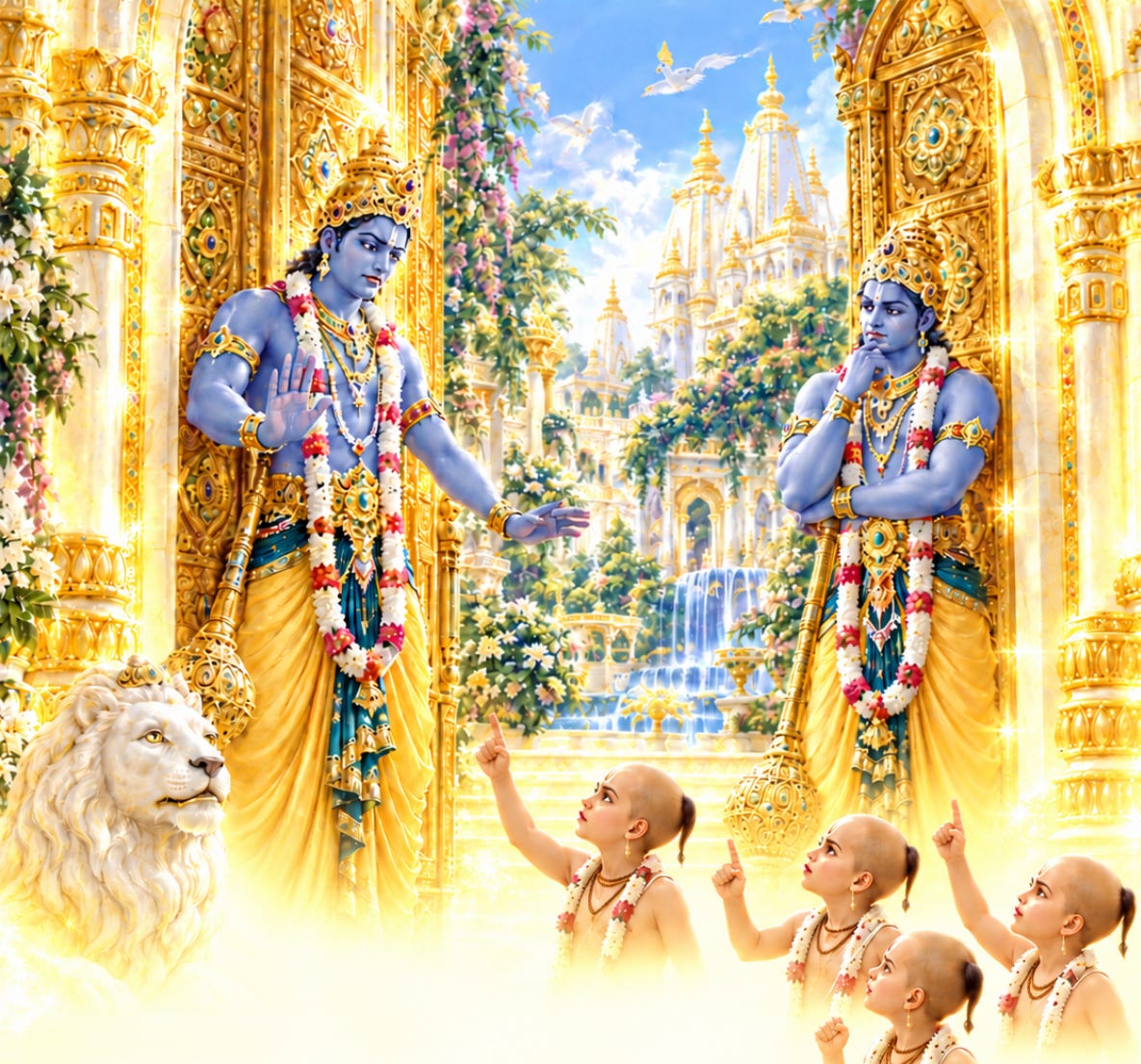
Mādhava Dāsa: They passed through six gates without difficulty, but when they reached the seventh, Jaya and Vijaya stopped them. The Kumāras became angry because they were being treated as enemies, even in Vaikuṇṭha, and questioned how Jaya and Vijaya could have developed this mentality. They then cursed them to come to the material world.
Gaurāṅga Dāsa: If we read the verses superficially, it appears to be a fall-from-paradise story, but if we read Prabhupāda’s purports carefully, we start understanding the absurdity of the situation.
First of all, how could the Kumāras have become angry in Vaikuṇṭha? If we study text 3.16.25, we see that Prabhupāda mentions that they were influenced by the modes of passion and ignorance. Even though they were great sages, they were not completely free from material contamination. It is also mentioned that they went up to the last door; they didn’t pass through it. They received the darśana of the Lord there, and then returned to the material world.
Another point is that Jaya and Vijaya committed a mistake in stopping them, but this is the kind of offense even perfect devotees can commit occasionally as part of their service. Their service was to protect the entrance, and they were just a little overzealous in carrying it out. It was not due to some material influence. We had already established that there is no such thing in Vaikuṇṭha.
But the question is, how can sages come from the material world, still with some vestiges of influence of the material modes and curse eternal associates of the Lord to fall into the material world?
Mādhava Dāsa: Only if the Lord allows it.
Gaurāṅga Dāsa: We are getting at the center of it. That’s a very unusual situation. Jaya and Vijaya are eternal associates of the Lord, but the four Kumāras are also great devotees, and on top of it, they are brāhmanas, and the Lord always protects the brāhmanas. So now Lord Viṣṇu has to somehow reconcile the situation.
Mādhava Dāsa: The first thing I notice here is the reaction of Jaya and Vijaya. They don’t become angry; they don’t retaliate. If it were me, I would already be cursing back.
Gaurāṅga Dāsa laughed heartily.
Gaurāṅga Dāsa: Now we know how we would react. Curse back, quarrel, or maybe even a fistfight. We fight over much less here in the material world, so what to say if someone would really curse us to lose the dearest thing for us?
But then, let’s see how eternal associates do it.
Mādhava Dāsa: Jaya and Vijaya became very humble. They fell at the feet of the Kumāras and accepted the curse as fair punishment for what they had done. But they begged for the benediction of never forgetting the Lord, even after descending into the material world.
Gaurāṅga Dāsa: Yes! Yes! See the difference. This is the magnanimity of the perfect associates in Vaikuṇṭha. Such humility does not exist in the material world. Only perfect devotees can have it. You see that the real issue for them is not even coming to the material world; the point is that they want to always remember the Lord.
Compare this with our situation here in the material world. We become absorbed in material consciousness precisely because we have forgotten Him. Sometimes devotees who somehow give up their practice deliberately want to forget Kṛṣṇa, so they can become absorbed again in material enjoyment. Perfect associates are the exact opposite.
Then, there is another question. What was the reaction of Lord Viṣṇu to all of this?
Mādhava Dāsa: He came personally to the door to meet the sages. Not only that, but He apologized for the behavior of His servants and accepted responsibility for their offense.
Gaurāṅga Dāsa: Exactly! You can see that the behavior of Jaya and Vijaya is already perfect, but Lord Nārāyaṇa is on a whole new level. He loves His devotees so much. See how polite and merciful He is. The whole problem was that the Kumāras were eager to see the Lord, and Jaya and Vijaya stopped them. One side was concerned about performing their service and the other side about seeing the Lord as soon as possible. Everyone was absorbed in Kṛṣṇa consciousness, but some kind of clash happened. Lord Nārāyaṇa thus appears to see His devotees, and immediately all tension is gone. Everyone is apologizing to each other and saying it was his fault, including the Lord Himself!
Mādhava Dāsa: This teaches us something.
Gaurāṅga Dāsa: Yes, we can see how most of the time we are not exactly in the same mood. But this pastime shows us the qualities we should gradually try to develop.
Now, there is an important purport here, in text 3.16.12. You can read it.
Mādhava Dāsa: “From this statement we can understand how anxious the Lord is to get his servitor back into Vaikuṇṭha. Therefore this incident proves that those who have once entered a Vaikuṇṭha planet can never fall down. The case of Jaya and Vijaya is not a falldown; it is just an accident. The Lord is always anxious to get such devotees back again to the Vaikuṇṭha planets as soon as possible. It is to be assumed that there is no possibility of a misunderstanding between the Lord and the devotees, but when there are discrepancies or disruptions between one devotee and another, one has to suffer the consequences, although that suffering is temporary. The Lord is so kind to His devotees that He took all the responsibility for the doormen’s offense and requested the sages to give them facilities to return to Vaikuṇṭha as soon as possible.”
Gaurāṅga Dāsa: Now, we come to the crucial part. How can we reconcile all of this with the fact they actually descended to the material world and became demons for three lives?
Mādhava Dāsa: There must be a distinction between descending from Vaikuṇṭha into the material world and losing one’s spiritual perfection.
Gaurāṅga Dāsa: Yes, that’s exactly the point. The Lord comes all the time in His different incarnations. This doesn’t mean He becomes conditioned. Similarly, perfect devotees often come to spread Kṛṣṇa consciousness or to follow the Lord in His pastimes. They also don’t become conditioned. They come to the material world, and they assume material bodies, but they do not fall. So the point is not about coming here, or even accepting a material body, but about forgetting the Lord.
The Lord Himself states that. You can read text 26.
Mādhava Dāsa: “The Lord replied: O brāhmaṇas, know that the punishment you inflicted on them was originally ordained by Me, and therefore they will fall to a birth in a demoniac family. But they will be firmly united with Me in thought through mental concentration intensified by anger, and they will return to My presence shortly.”
Gaurāṅga Dāsa: You can see that Prabhupāda explains the whole situation clearly in his purport:
“The Lord stated that the punishment inflicted by the sages upon the doorkeepers Jaya and Vijaya was conceived by the Lord Himself. Without the Lord’s sanction, nothing can happen. It is to be understood that there was a plan in the cursing of the Lord’s devotees in Vaikuṇṭha, and His plan is explained by many stalwart authorities. The Lord sometimes desires to fight. The fighting spirit also exists in the Supreme Lord; otherwise how could fighting be manifested at all? Because the Lord is the source of everything, anger and fighting are also inherent in His personality. When He desires to fight with someone, He has to find an enemy, but in the Vaikuṇṭha world there is no enemy because everyone is engaged fully in His service. Therefore He sometimes comes to the material world as an incarnation in order to manifest His fighting spirit.”
In this way, we can see that the whole incident happened due to the will of the Lord.
There is an interesting passage in the Laghu-bhāgavatāmṛta that describes that Jaya and Vijaya are the two strongest doorkeepers of the Lord. They had thus developed a desire to serve the Lord by fighting with Him. The Lord, at the same time, had the desire to fight, and this desire could only be satisfied by some of His associates coming to the material world and playing the role of enemies. The propensity of the Kumāras to become angry was thus used by Lord Viṣṇu to fulfill both purposes.
In this way, He came as Varāha and Nṛsiṁha to fight them in their first birth, then as Rāma to kill them in their second birth, and fought them personally in their third birth as Vāsudeva Kṛṣṇa.
Prabhupāda compares this to a theatrical performance. Actors may play the roles of enemies and fight powerfully on the stage. They may even get absorbed in playing their roles and momentarily forget that it is just a play, but in any case, that does not mean they have become enemies in real life.
Similarly, Jaya and Vijaya appeared as enemies of the Lord for three births, but their eternal relationship with Him remained unchanged. They remained absorbed in the Lord in anger, playing their role in the performance perfectly. After being killed by Kṛṣṇa, they were absorbed in His effulgence, the Brahmajyoti, and from there reached back to the Vaikuṇṭha planets, resuming their service as gatekeepers. From the perspective of the inhabitants of Vaikuṇṭha, the whole thing took just a moment. Before anyone could notice, they were already back.
Similarly, many other devotees, and the Lord Himself, come to this material world in different circumstances to play different pastimes and fulfill different missions.
Mādhava Dāsa: So, everything was a pastime.
Gaurāṅga Dāsa: Exactly. Lord Nārāyaṇa used the curse of the Kumāras as an excuse to put the whole pastime in motion and to teach us several lessons.
The curse of the Kumāras teaches us about the danger of offending brāhmanas and devotees. If their curse can affect even eternal associates, what to say about us? We should always remember this point.
The second point is the reaction of Jaya and Vijaya and the behavior of the Lord Himself while talking to the Kumāras. This teaches us a lot about Vaiṣnava behavior and the purity of the environment in Vaikuṇṭha. We should strive to elevate ourselves to the same level, instead of trying to project our material imperfections into the pastimes as sahajiyās do.
Mādhava Dāsa: This means that their example doesn’t explain how ordinary conditioned souls have become bound.
Gaurāṅga Dāsa: No, the function of the pastime in the Śrīmad-Bhāgavatam is to make it clear that perfect associates, nitya-siddha devotees, never fall, because they cannot ever forget the Lord. Even if circumstances may suggest they do so, as in the case of Jaya and Vijaya, that’s only apparent.
The function of this pastime is to reveal the nature of the spiritual world and of perfect devotees who never forget the Lord, giving us a clear glimpse of the goals we are trying to attain in the process of devotional service. The whole Śrīmad-Bhāgavatam was composed in a way that gradually teaches us how to elevate our consciousness and focus it on the Lord. This pastime is part of this sequence. We should not abuse it by trying to establish a general process for nitya-siddhas becoming conditioned.
This also explains why Prabhupāda is so emphatic in explaining that no one can fall from Vaikuṇṭha. There is no force that can pull them down into material consciousness.
Mādhava Dāsa: “No one falls from Vaikuṇṭha.”
Gaurāṅga Dāsa: That’s how he phrased it. We must accept it and take it together with all the other passages we studied.
And there is another point we can learn from it. This brings us back to the question of free will.
We hear that we became conditioned due to misusing our free will. At some point we somehow questioned our eternal position of service to Kṛṣṇa. “Why is He the center? Maybe I could be the center!” This put us on a path that gradually ended with us here, conditioned since time immemorial.
In the pastime, Jaya and Vijaya have the same free will, but we can see that they are using it positively, choosing to never forget the Lord. This is ultimately the factor that makes it impossible for them to fall down. They cannot fall even if brāhmanas go there and curse them to come to the material world as demons; what to say about ordinary circumstances?
This is the mood we should cultivate. To be so absorbed and determined in our devotional service that we can never forget the Lord. When it comes to this point, we can never fall, no matter if living in the spiritual world or in the material world, with a spiritual body or a material body, in any circumstance.
Mādhava Dāsa: Like Prahlāda Mahārāja. He was always remembering the Lord, confronting even his father, who was at that time probably the most powerful being in the entire universe.
Gaurāṅga Dāsa: That’s another lesson we can learn. You can imagine what happens when the two most powerful gatekeepers of the Lord come to the material world. No one can stand then. The Lord has to come personally to fight them; otherwise they can roam around and do whatever they please. In this way, having them come to the material world also forced everyone to abandon their false prestige and fully surrender to the Lord, and Prahlāda Mahārāja is the superlative example.
Mādhava Dāsa: There is another point that is beautiful in this description. Even though Jaya and Vijaya were apparently being expelled from Vaikuṇṭha, the Lord never abandoned them. He personally arranged everything, so they could quickly return.
Gaurāṅga Dāsa: Yes. And this connects with the story of Purañjana that appears a little later in the Fourth Canto.
Mādhava Dāsa: That’s exactly what I was thinking. Purañjana’s situation was different; he really forgot and became absorbed in material enjoyment, just like in our case. But the real point is that the Lord continued accompanying him.
In both cases—both in the case of the nitya-siddha facing some unexpected situation and the ordinary soul misusing his free will and becoming conditioned—the Lord remains faithful to His relationship with the soul.
Gaurāṅga Dāsa: That’s the message. The Lord never forgets His devotees, and He doesn’t forget the conditioned souls either. He accompanies us always as Paramātmā, giving us all opportunities to revive our original consciousness.
Mādhava Dāsa: I think that with this we finally reached the conclusion. We studied the eternal nature of the soul, the cause of material conditioning, our eternal relationship with Kṛṣṇa, His different potencies, and now we studied the eternal position of the nitya-siddha devotees. The main principles seem clear.
Gaurāṅga Dāsa: Very good. There will always be more to learn. Kṛṣṇa is unlimited, His potencies are unlimited, and they interact, creating unlimited relationships and activities. Our intelligence cannot fully understand all of it. But through the scriptures and the words of the ācārya, we can understand the important points.
The essential factor is to understand the foundations of the subject without trying to speculate explanations for what is beyond our comprehension.
He closed the Bhāgavatam and placed it on the desk.
Gaurāṅga Dāsa: Now, there is one more thing I wanted to ask you.
Mādhava Dāsa: Another philosophical question?
Gaurāṅga Dāsa: Not this time. When you first came here, you were very disturbed. Your chanting had become mechanical, and even your study of the Bhāgavatam was affected.
We have now spent several days examining the philosophy, and I can see that your understanding has become much clearer.
But what about your devotional practice? How is your chanting now?
Mādhava Dāsa: It’s going better now. Actually, something interesting happened this morning. I felt like continuing after chanting my sixteen rounds, so I ended up chanting sixteen more.
Gaurāṅga Dāsa: Thirty-two?
Mādhava Dāsa: Yes. My mind was clear, and the chanting was flowing naturally. I felt peace inside.
Gaurāṅga Dāsa smiled.
Gaurāṅga Dāsa: It seems our discussions are bearing fruit. This is the best possible outcome for a crisis.
Mādhava Dāsa: I think so. Before, I became so concerned about understanding how I came to this material world that I was missing the opportunity of remembering Kṛṣṇa.
Now I understand that the central problem was that my quest was based on an incorrect assumption, that I am separated from Kṛṣṇa here in the material world. Now I understand this premise is incorrect.
Gaurāṅga Dāsa: Here you come to the center of it. To ask “How did I fall? How did I become separated from Kṛṣṇa?” is like a crazy person in a mental asylum demanding to know how he became Napoleon. He was never Napoleon in the first place; therefore, the question is unanswerable. The question is solved when he somehow or other comes to understand that he is not Napoleon. Then, from this point, everything can be explained.
As long as we ask how we could become separated from Kṛṣṇa, how we could lose the relationship with Him, there is no possible correct answer, because the very premise of the question is incorrect. Only when we realize that we are always with Kṛṣṇa, that our relationship with Him is constitutional and eternal and thus never lost, that our constitutional position is service to Him, and that we never mix with matter, and so on, can we truly understand.
Mādhava Dāsa: At this point, the question becomes not “how did I fall,” but how can I return to my original consciousness, exactly as Śrīla Prabhupāda was explaining.
Gaurāṅga Dāsa: Now you got it. That’s the perfect realization.
You can see that ultimately, this question is not very important, because once we understand that our eternal constitutional position is of service to Kṛṣṇa, we can just serve Him, cultivating the nine limbs of the devotional process and quickly go back to Him, just as a person awakening from a sleep and quickly restarting his activities.
However, if we become disturbed by it, then we can study all the different passages where Śrīla Prabhupāda explains all the points related to it, and then connect them with the teachings of the previous ācāryas, just as we have been doing.
The point is that this philosophical quest should support our devotional service, not become a substitute for it; otherwise, we become just like the philosophers, quarreling about how the tāl fruit fell to the ground, without ever remembering to pick it up. This is one of the tricks of Māyā to keep one conditioned.
Mādhava Dāsa: That’s an important realization. Philosophical research should support our devotional service, not become a substitute for it. This also brings me to the conclusion that I should be more selective with what I study and how I allow it to influence my consciousness.
Gaurāṅga Dāsa: It may sound surprising, but not everything we find on the Internet conveys the absolute truth.
Mādhava Dāsa laughed.
Gaurāṅga Dāsa: When you first came here, you were questioning the foundations of your spiritual life. Now I see that you have regained your confidence.
So I have a last assignment for you. Apart from learning more philosophy, what has actually changed in you? And how do you plan to use what you have learned?
Mādhava Dāsa: I’ll think about it.
Mādhava offered his obeisances and left.
On his way to his apartment, he continued to think about the reaction of Jaya and Vijaya. They were not concerned about coming to the material world; their prayer was to never forget the Lord. The point is not about understanding how we came here; this is a material quest, he realized. The point is to remember Kṛṣṇa. This was the greatest lesson he learned from the entire discussion.
Next: Remembering the Friend »
Read the entire book:
The Friend Who Never Left, A Dialog on the “Fall” of the Jīva

This is a publication for thoughtful readers who want to go deeper into Kṛṣṇa consciousness. I publish daily, trying to offer high-quality spiritual content, and all posts are available to free subscribers. If you wish, you can support this work with a monthly contribution. When you subscribe, you can choose between a free subscription and a monthly contribution, and you can switch from a free subscriber to a supporter at any time.
You can also receive updates on WhatsApp or Telegram.
If you would like to contribute further, you can find the donation links here.