


You can receive new articles directly in your inbox. Subscription is free; donations are welcome.
This is the fifth chapter of The Friend Who Never Left, a novel on the “Fall” of the jīva. Gaurāṅga Dāsa and Mādhava examine how Prabhupāda personally answered the question.
Chapter Five: Crow and Tal-Fruit Logic
Gaurāṅga Dāsa laughed at Mādhava’s answer. He was glad he was in good spirits now.
Gaurāṅga Dāsa: Very good! But there is something else I want to show you today. Prabhupāda wrote a detailed letter directly answering these questions. Later it was published as an article in the Back to Godhead Magazine. It is called Crow and Tal-Fruit Logic.
Mādhava Dāsa: What does a crow have to do with the fall of the jīva?
Gaurāṅga Dāsa: You will see. Let’s start from the beginning.
He got an old magazine from inside a shelf and asked Mādhava to read it.
Mādhava Dāsa: “We never had any occasion when we were separated from Kṛṣṇa.”
Mādhava stopped and looked at Gaurāṅga Dāsa.
This is direct!
Gaurāṅga Dāsa: Yes. Just see how Prabhupāda directly addresses the question. You are not the first to ask it. His own disciples came in contact with the same ideas in the 1970s. Here Prabhupāda is directly answering it.
Mādhava read the next paragraph:
“Just like one man is dreaming and he forgets himself. In dream he creates himself in different forms: now I am the King discussing like that. This creation of himself is as seer and subject matter or seen, two things. But as soon as the dream is over, the “seen” disappears. But the seer remains. Now he is in his original position.Our separation from Kṛṣṇa is like that. We dream this body and so many relationships with other things. First the attachment comes to enjoy sense gratification. Even with Kṛṣṇa desire for sense gratification is there. There is a dormant attitude for forgetting Kṛṣṇa and creating an atmosphere for enjoying independently.”
Gaurāṅga Dāsa: What do you understand from this?
Mādhava Dāsa: He gives this example of the dream in other passages. We think we are the body and become absorbed in the physical world, but our real identity is transcendental to all of it. So, if we are now like dreaming, it means that when we become liberated, we awaken to our real identity.
Gaurāṅga Dāsa: Yes. But there is another point. Suppose that in your dream you become a king. As a king, you fight many wars, travel around your kingdom, etc. Do you ever leave your bed? Does it change who you are?
Mādhava Dāsa: No. It is just a dream.
Gaurāṅga Dāsa: And what happens to your real identity during the dream?
Mādhava Dāsa: Nothing happens. I remain on my bed. I just forget who I am and act inside the dream.
Gaurāṅga Dāsa: This is exactly the point Prabhupāda is making. The person dreaming does not become someone else. The change is in the consciousness.
Similarly, the constitutional position of the soul, of being a servant of Kṛṣṇa, never changes. Even though we may become absorbed in material existence. This is why Prabhupāda says we are never separated from Kṛṣṇa.
The relationship is eternal. We may forget Him for a long time, but this does not change what we are, just as a person dreaming cannot destroy his or her real identity.
Mādhava Dāsa: Then, our separation from Kṛṣṇa is not the same as moving from one country to the other?
Gaurāṅga Dāsa: You are getting it. That’s the point. When Prabhupāda speaks of forgetting Kṛṣṇa, he describes a change in our consciousness. It’s not about a change of identity or geographical position or a physical journey from one place to another. The soul is spiritual by nature. That nature cannot be changed by contact with the material energy.
On the other hand, we should not take the analogy of a dream literally and start thinking that our material experience is just imagination. It is illusory in the sense that this is not our real identity, but it is not false. Just as Mahā-Viṣnu is real, His creation is also real, but it is temporary and also illusory, because it is based on accepting material identities that are different from our real spiritual identity.
Mādhava Dāsa: This makes sense. But then another question appears. If the soul never actually leaves his original position, then why does Prabhupāda speak of falling into material existence?
Gaurāṅga Dāsa: There is a fall. We forget Kṛṣṇa; we become attracted to material enjoyment. We identify with a succession of material bodies. All of this is real. This is the “conditioned since time immemorial” part.
The point is that none of this changes our transcendental nature. We remain eternal souls; we remain eternally connected with Kṛṣṇa, and we remain His eternal servants. The original nature or constitution of the soul is simply covered; nothing is changed or destroyed. This is the fundamental distinction we must keep in mind.
We will examine the exact mechanism later, when we study the teachings of Lord Kapila. For now, the point to understand is that Prabhupāda is not giving us two contradictory explanations. These are two different sides of the same question.
Mādhava Dāsa: But why would a soul want to forget Kṛṣṇa in the first place? That’s the part that is difficult to understand.
Gaurāṅga Dāsa: That is where free will comes into the discussion. Prabhupāda explains that there is a dormant possibility of forgetting Kṛṣṇa and trying to enjoy independently. The soul is not a machine. We possess individuality and independence, although in a minute degree. Just as Kṛṣṇa is fully independent, we also have a minute tendency to want to act independently.
However, we need to be careful here. This is another point where many become lost, thinking they are gopīs or cowherd boys taking a vacation in the material world.
Propensity to enjoy independently does not mean that there is lust or hankering in Vaikuṇṭha and Goloka. There is no influence of material nature or of the three modes there. Prabhupāda has already established that they are eternally protected by the Lord’s internal potency. There is no influence of Māyā there, and Kṛṣṇa obviously does not want us to leave. Therefore, the bondage of the soul does not start with an external influence; it starts with the misuse of the free will that is intrinsic to the soul. The influence of Māyā appears only when we join the material creation. The exact details of how this turning away takes place are not something we can understand or reconstruct using material logic, but the analogy of the dream helps with that.
This understanding of the intrinsic free will of the soul is essential to avoid another serious misconception. Some believe that the soul has no intrinsic free will, and therefore they attribute the conditioning of the soul to Kṛṣṇa. They believe that He is the one who sends some of the souls to the spiritual world and some to the material world.
Mādhava Dāsa: No way!
Gaurāṅga Dāsa: Yes, they blame Him. How are you supposed to bow down and constantly chant the name of the person who put you into eternal bondage? Maybe out of fear, but it is difficult to believe this idea can help with developing pure devotion.
If we don’t accept the free will of the soul, and we also don’t want to accuse Kṛṣṇa, then we go back to the idea that we were never out of material conditioning, as we already discussed. We can see that without the proper conclusions, we just go from one mistaken conception to the other.
Mādhava Dāsa: How can this idea of free will and the analogy of the dream be reconciled with anādi, being eternally conditioned?
Gaurāṅga Dāsa: Prabhupāda addresses this two paragraphs later. Here. He says that the covering of Māyā may continue for an extraordinarily long period, during which many material creations come and go. Because this period is so long, the soul is sometimes described as ever conditioned. This point we already discussed. But here comes something new: when one awakens to Kṛṣṇa consciousness, that immense period becomes insignificant.
Notice the connection with what we discussed before. From within material existence, we cannot trace the beginning of our bondage. But this does not mean that material conditioning is our eternal identity. It is a condition from which we can awaken. Again, here is the difference between what we are and where we are.
There is also another intriguing point here in the same sentence:
“As soon as we try to become the Lord, immediately we’re covered by māyā. Formerly we were with Kṛṣṇa in His lila, or sport. But this covering of māyā may be of very, very, very, very long duration; therefore many creations are coming and going.”
Mādhava Dāsa: Formerly we were with Kṛṣṇa in His lila, or sport… So this means we were gopīs and cowherd boys?
Gaurāṅga Dāsa: It means Kṛṣṇa is always in the lila, and we were with Kṛṣṇa; therefore we were also in the lila. The question is how aware of it we were. This brings us again to the point of consciousness. Gopīs and cowherd boys are always with Kṛṣṇa, and they are fully awakened to this relationship. We are also always with Kṛṣṇa, but our consciousness is somehow different from theirs.
Mādhava Dāsa: Sounds reasonable. But still, it doesn’t explain how exactly the soul turned away from Kṛṣṇa. Free will helps to understand that, but free will in itself does not explain why. If we can’t explain that, are we not leaving the most important question unanswered?
Gaurāṅga Dāsa: You are assuming that this is the most important question, but our ācāryas are surprisingly mute about it. Not even Mahāprabhu Himself discussed it. He simply said, “somehow or other.” Kṛṣṇa, I’m your eternal servant, but somehow or other I came into this material conditioning; now please take me back.
Let me tell you the story Prabhupāda uses to explain this.
He moved further down the text.
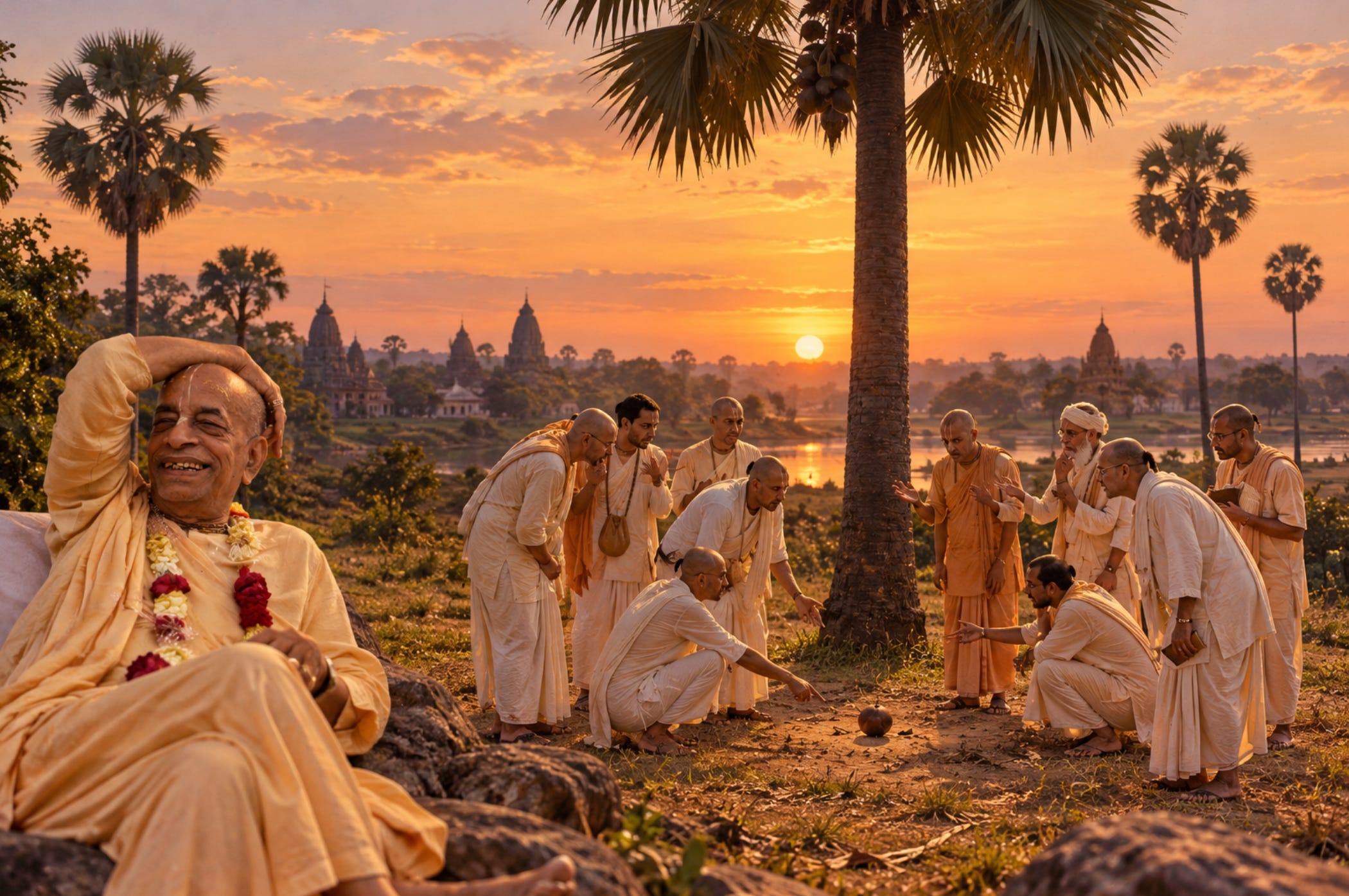
Gaurāṅga Dāsa: Imagine a large palm tree with a tal fruit hanging from the top. A crow flies in the direction of the tree, and just as it comes close, the fruit falls to the ground. A group of learned scholars see the fruit on the ground and start discussing how it fell.
One says that it is because the crow shook the branch. Another disagrees, arguing that the fruit fell first, and this scared the crow, while a third argues that the fruit was ripe, and thus fell when the crow touched the branch. In this way, the scholars create a very elaborate argument around it, while the fruit remains on the ground.
Mādhava Dāsa: And nobody takes it!
Gaurāṅga Dāsa: Exactly! They are so absorbed in quarreling about how the fruit fell that they forget that it is lying down there on the ground.
Prabhupāda uses this example to explain our situation. We are currently under the influence of Māyā. We are suffering here, forgetful of Kṛṣṇa. We have the chance of practicing Kṛṣṇa consciousness and becoming free, but instead we are discussing how we came here. It is like a sick man demanding to know exactly how he got sick before taking the medicine.
Mādhava Dāsa: That’s a good point. But why then are we spending so much time discussing it now?
Gaurāṅga Dāsa laughed. I was watering my plants; you brought it up!
Mādhava laughed.
Gaurāṅga Dāsa: There is a difference between understanding the conclusions Prabhupāda gives and trying to speculate on what he does not explain. People do get sick, and when they do, there are specific types of medicines. You may not know how you got sick, but sickness is not your normal condition. Understanding that, you accept the medicine and you get cured. If instead you demand to first know how exactly you got sick, then you have a problem. No one was there; therefore, no one really knows. You will die before getting a definitive answer.
We need to understand three points very clearly: our constitutional position as eternal servants of Kṛṣṇa; how material nature affects us, and how devotional service can bring us back to our original consciousness. When these three conclusions are well established, we go steadily in the direction of Kṛṣṇa. When we reach the spiritual world, we will understand.
Mādhava remembered what he had told Gaurāṅga during his first visit, that after reading the scholarly book he had started feeling like a stranger trying to enter a place where he did not belong.
Mādhava Dāsa: That’s exactly what I was thinking about before coming here. I had always understood that Kṛṣṇa was my eternal friend and that He was trying to bring me back. But after reading the book, I started feeling that I had never really known Him and that I was trying to establish a relationship that had never existed.
Gaurāṅga Dāsa: That’s exactly the danger. If I was never with Kṛṣṇa and have always been in this material world, then it means that being a conditioned soul is my constitutional position. Why then bother getting out?
There is a great difference between a relationship that is forgotten and one that does not exist. Prabhupāda explains that we are always connected with Kṛṣṇa. The relationship has never disappeared. The proof is that even after so much time, Kṛṣṇa is still following us inside the heart. In fact, Kṛṣṇa is with us right now. Not indirectly; He is there personally. The problem is that our awareness of Him has become covered by our attraction to this illusory world. That’s why we are now practicing Kṛṣṇa consciousness to revive what is constitutionally ours.
Mādhava Dāsa: Even though I have forgotten Kṛṣṇa, He has never forgotten me…
Gaurāṅga Dāsa: Now you are getting it. You have the opportunity to remember Him now. The fruit is lying right in front of you.
Mādhava remained silent. He got so consumed by the question that he had almost forgotten how he had started practicing Kṛṣṇa consciousness in the first place.
Mādhava Dāsa: I think I understand the main point now. Our priority is to become Kṛṣṇa conscious, not to try to reconstruct a forgotten history that is so far in the past.
Gaurāṅga Dāsa: Yes. But remember that I’m not just shutting you down. There are other points we will examine. For example, how can we become absorbed in material consciousness if our spiritual nature can never be changed? How can we identify with so many bodies while remaining eternally the same soul? How can we forget our spiritual identity?
These questions are directly connected with our understanding of our current position and how to become free from it. And it is all explained in the Śrīmad-Bhāgavatam.
Mādhava Dāsa: Is that where the teachings of Lord Kapila come in?
Gaurāṅga Dāsa: Yes. This is our topic for tomorrow. Before coming back, read the Twenty-seventh Chapter of the Third Canto. Pay attention to his explanation of how false ego makes us identify with material activities.
Mādhava Dāsa: I will. Can I also take the magazine? I think I should also read the letter again.
Gaurāṅga Dāsa: Of course. Just don’t spend the whole afternoon arguing about the crow.
Mādhava laughed and offered his obeisances.
As he rode to university, Mādhava kept returning to one thought: “Somehow I forgot Kṛṣṇa, but He did not forget me.” He still had questions, but he was looking forward to opening the Bhāgavatam when he got home.
Soon the next part…
If you want to study the philosophical basis of this story, here is the book:

This is a publication for thoughtful readers who want to go deeper into Kṛṣṇa consciousness. I publish daily, trying to offer high-quality spiritual content, and all posts are available to free subscribers. If you wish, you can support this work with a monthly contribution. When you subscribe, you can choose between a free subscription and a monthly contribution, and you can switch from a free subscriber to a supporter at any time.
You can also receive updates on WhatsApp or Telegram.
If you would like to contribute further, you can find the donation links here.