


You can receive new articles directly in your inbox. Subscription is free; donations are welcome.
Chapter Seven: What Did the Soul Forget?
Reading the 22nd chapter took longer than Mādhava expected; he kept returning to the passages Gaurāṅga had asked him to examine and comparing them with the arguments from the other book. Instead of resolving his doubts, the reading produced new questions.
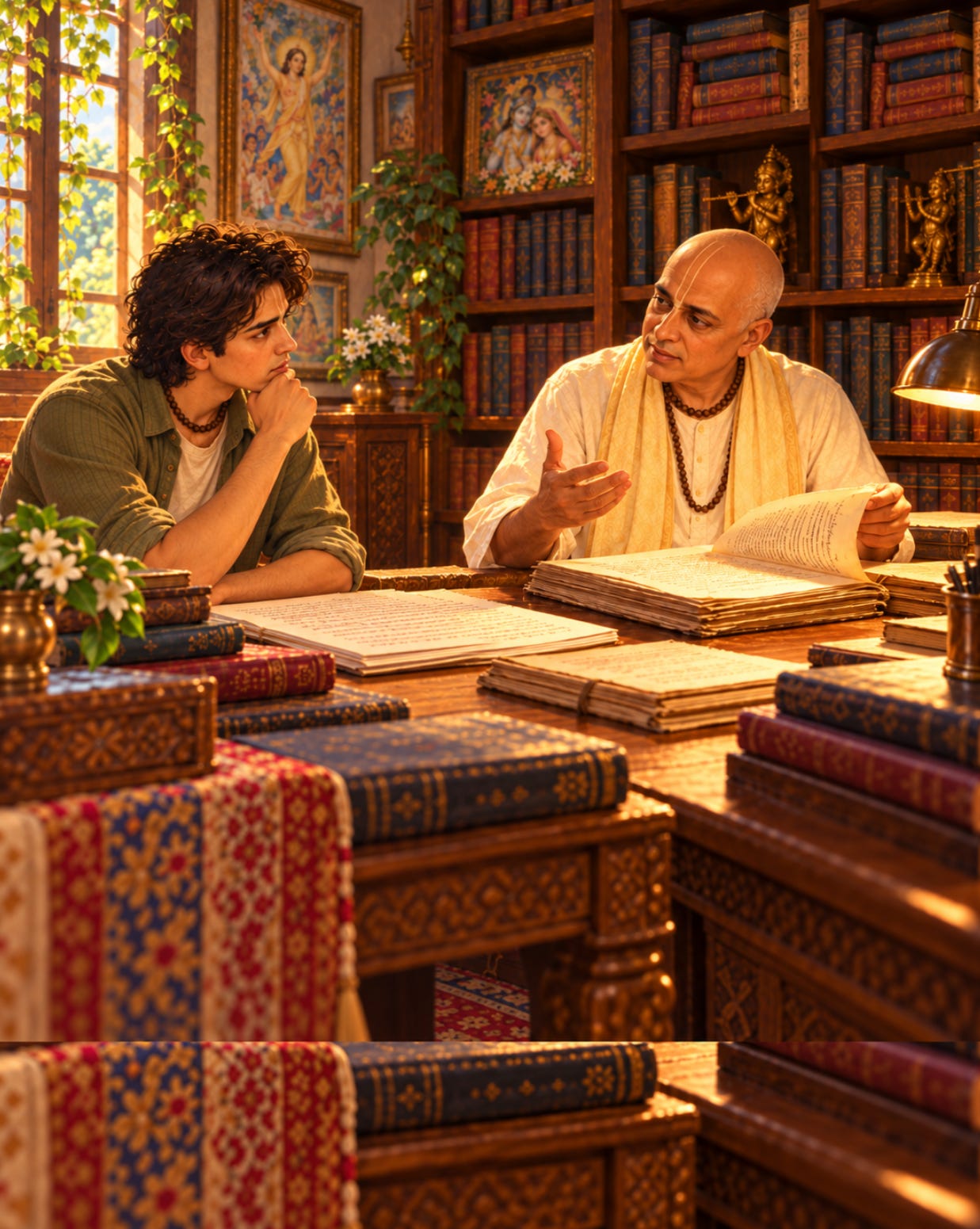
Gaurāṅga Dāsa was sitting at his desk, reading an old typewritten manuscript.
Mādhava Dāsa: I think I’ve never seen one of these before.
Gaurāṅga Dāsa: You mean, a manuscript?
Mādhava Dāsa: Typed by hand. To me, it looks almost like palm leaves.
Gaurāṅga Dāsa: I don’t think you can find this one on the Internet. It was never published. This may be the only copy.
Mādhava Dāsa hesitated for a second.
Mādhava Dāsa: I read the whole chapter. I think I have a serious problem.
Gaurāṅga Dāsa smiled.
Gaurāṅga Dāsa: Only one? That’s not bad.
Mādhava Dāsa: Actually, several, but they are connected. The first passage seems to support what the authors of the other book are saying. Mahāprabhu explicitly states that there are two classes of souls, the eternally liberated and the eternally conditioned.
Gaurāṅga Dāsa: sei vibhinnāṁśa jīva — dui ta’ prakāra, eka — ‘nitya-mukta’, eka — ‘nitya-saṁsāra’
Mādhava Dāsa: Yes, this one. “The living entities [jīvas] are divided into two categories. Some are eternally liberated, and others are eternally conditioned.”
He then mentions that those who are eternally liberated are always awake to Kṛṣṇa consciousness, and they render transcendental loving to Kṛṣṇa. These are His eternal associates, who eternally associate with Him in the spiritual planets.
But in text twelve, He says: ‘nitya-bandha’ — kṛṣṇa haite nitya-bahirmukha, ‘nitya-saṁsāra’, bhuñje narakādi duḥkha
“Apart from the ever-liberated devotees, there are the conditioned souls, who always turn away from the service of the Lord. They are perpetually conditioned in this material world and are subjected to the material tribulations brought about by different bodily forms in hellish conditions.”
The verse states it very clearly. The first group is eternally with Kṛṣṇa, and the second is eternally conditioned. Is it not exactly the argument made in the other book?
Gaurāṅga Dāsa: Yes, it supports part of their argument. We shouldn’t try to dismiss passages that make things difficult for us. We are trying to find the conclusive truth, not just prove that our perspective is correct. Whenever you find a passage that appears to contradict your thesis, you need to examine it carefully.
Now, tell me, what happens to these perpetually conditioned souls?
Mādhava Dāsa: They suffer under the influence of māyā.
Gaurāṅga Dāsa: Forever?
Mādhava Dāsa: No, of course not. In texts fourteen and fifteen, Mahāprabhu explains that a conditioned soul may meet a saintly devotee, be instructed by him, and gradually come to Kṛṣṇa.
Gaurāṅga Dāsa: Then what does nitya-baddha mean?
Mādhava Dāsa: Eternally conditioned.
Gaurāṅga Dāsa: But you just said this condition ends one day!
Mādhava Dāsa: That’s the problem.
Gaurāṅga Dāsa: Exactly. If we take nitya-baddha to mean that material conditioning is the eternal, unchangeable characteristic of the soul, we have an enormous contradiction. Mahāprabhu Himself describes the possibility of becoming free from it. The conditioned soul is not condemned to remain conditioned forever; therefore, it is not eternal in the same sense that the soul is eternal.
Mādhava Dāsa: Then nitya doesn’t always mean eternal in the absolute sense?
Gaurāṅga Dāsa: You just stated it yourself. How can it be eternal in the absolute sense if it has an end?
We discussed something similar when we examined the meaning of the word anādi. Material conditioning has existed since time immemorial. We cannot find a time when the conditioned soul was not conditioned inside material history. In this sense, the soul is perpetually conditioned, going from one body to another through innumerable cycles of creation and dissolution of the cosmos.
But this doesn’t make conditioned life the constitutional, unchangeable characteristic of the soul. This is the difference between constitutional position and the material condition we find ourselves in.
The eternally liberated devotee is always conscious of his relationship with Kṛṣṇa. For him, there is no material conditioning. He may or may not know that a place called the material world exists, but he has never been in contact with it. He simply lives with Kṛṣṇa in the eternal present.
The conditioned soul is turned away from Him. He is part and parcel of Kṛṣṇa, but his attention is focused on the material world. He is identifying with the material reflection. Since when? No one can tell, since time immemorial.
The point is that turning away from Kṛṣṇa is not his constitutional nature. If it were, becoming Kṛṣṇa conscious would mean changing his eternal nature instead of recovering it.
Mādhava Dāsa: And then we have the second passage. That’s where things became interesting. In text 107, Mahāprabhu states something that appears to be the opposite of what He said in the beginning:
nitya-siddha kṛṣṇa-prema ‘sādhya’ kabhu naya
śravaṇādi-śuddha-citte karaye udaya
“Pure love for Kṛṣṇa is eternally established in the hearts of the living entities. It is not something to be gained from another source. When the heart is purified by hearing and chanting, this love naturally awakens.”
Gaurāṅga Dāsa: And what is Mahāprabhu establishing here?
Mādhava Dāsa: That love for Kṛṣṇa is eternally present in the heart, and that devotional service awakens it. It is not something we acquire for the first time.
Gaurāṅga Dāsa: Notice how precise the verse is. First, He gives the conclusion: nitya-siddha kṛṣṇa-prema. This is Bengali, not Sanskrit. Very simple and direct. Kṛṣṇa-prema, love for Kṛṣṇa, is eternally established.
He then rejects the possible misunderstanding: sādhya kabhu naya. To be gained at any time? Not. It is not something to be newly acquired; it is there already.
Then, He explains what the devotional practice actually does: śravaṇādi-śuddha-citte karaye udaya. Śravaṇādi comes from śravaṇa-ādi. All the nine devotional processes, starting with hearing. By this devotional practice, the heart is purified, and this original love for Kṛṣṇa awakens.
Here we start to see how the two passages come together.
Mādhava Dāsa: So the conditioning covers something that is already there. However long I have been conditioned, it has not destroyed my original love for Kṛṣṇa.
Gaurāṅga Dāsa: Yes. Otherwise, what would there be to awaken?
This is a process constantly used in the scriptures to explain complex topics. One passage points us in one direction, and the second refines it. Taken separately, they appear to contradict each other. Together they show us precisely where to go. In the material world we are accustomed to thinking in terms of material duality: black and white, good and bad. Our intelligence becomes flat, like a chapati. Most spiritual topics are multidimensional. They can be understood only when different passages are taken together.
Mādhava Dāsa: But there is something that confuses me. In text 104, Mahāprabhu says that by practicing devotional service one can attain the perfection of love of Godhead. Then, in text 105, He explains that devotional service awakens the eternal devotion already present in the heart. And then, in text 107, He directly states that love is not something to be acquired. Is it not a contradiction?
Gaurāṅga Dāsa: It would be if we insisted that attaining something always means acquiring something that did not exist previously. That’s why it is dangerous to force the literal meaning of the words without considering the context.
Also, Prabhupāda uses the word “attain” in the translation, but in the word-for-word, he gives us “one can get” as a translation for the word “pāi” used in the verse. To get is the same as to attain, but if we want to force the meaning of obtaining something that was never there into the word “attain,” we start a conspiracy theory.
If, however, we keep pāi as “one can get,” then the meaning remains perfectly natural. Nitya-siddha kṛṣṇa-prema, love of Godhead, is eternally there. Somehow we forgot it; we can get it back. Note also that He uses the word upajāya, “awakens,” in text 106. It is there already; it just has to be awakened. is not something to be gained from another source. We simply need to purify the heart.
Mādhava Dāsa: But there is another difficulty. The authors of the other book could argue that this eternal love is simply the natural potential of the soul to love Kṛṣṇa, not an actual relationship previously experienced.
Gaurāṅga Dāsa: How would they explain it?
Mādhava Dāsa: Imagine a child who has a natural talent for music. The talent is there from birth, but it doesn’t mean the child was previously a musician. He has the potential, but the developed ability comes later. Similarly, the soul may have an eternal capacity to love Kṛṣṇa, but that doesn’t mean love is already present. The love would develop when the soul practices devotional service and attains perfection.
Gaurāṅga Dāsa: This example actually works against the argument you proposed. If the child has a natural propensity for music in this life, it means that he was doing it in previous lives. Then there was death, forgetfulness, and now he is remembering something that was already practiced.
Another problem with it is that it does not address the points made by Mahāprabhu. Is He speaking merely about a capacity to develop love for Kṛṣṇa, or about love for Kṛṣṇa itself?
Mādhava Dāsa: He says kṛṣṇa-prema. Love for Kṛṣṇa.
Gaurāṅga Dāsa: And He says it is nitya-siddha, eternally established. Again, it is Bengali; there is less opportunity to juggle with the words. Prabhupāda confirms this in his purport to text 105. Devotional service is already present within every living entity in a dormant condition.
But you are correct about one point. This verse doesn’t establish that the conditioned soul previously possessed fully manifested prema in a particular relationship with Kṛṣṇa. We should not conclude from it that everyone was previously an eternally perfect gopī or cowherd boy.
Mādhava Dāsa: Then what have we established here?
Gaurāṅga Dāsa: That love for Kṛṣṇa is eternally established in the soul, that it is covered by material conditioning, and that devotional practice awakens this love of Godhead that is already there. These are three very important conclusions. We also have established that being perpetually conditioned is not the same as having conditioning as one’s eternal constitutional nature.
Now, what was the other verse I asked you to consider?
Mādhava Dāsa: Bhagavad-gītā 2.16: nāsato vidyate bhāvo, nābhāvo vidyate sataḥ.
Kṛṣṇa explains that the material body is temporary, while the soul is eternal and doesn’t change.
Gaurāṅga Dāsa: Exactly. What is sat is real and eternal. What is asat has no permanent existence; it is illusory because it changes. The soul is real, sat, because it never changes. Even material conditioning does not change the soul, just like being reflected on water does not change the sun. The body, on the other hand, changes constantly; it is asat. Ephemeral.
Now, try to apply this point to what we have been discussing. Is the soul’s position as a servant of Kṛṣṇa sat or asat?
Mādhava Dāsa: Spiritual, of course. Sat.
Gaurāṅga Dāsa: And is this relationship with Kṛṣṇa part of the soul’s constitutional nature, or something produced by the material body?
Mādhava Dāsa: It is the soul’s constitutional nature.
Gaurāṅga Dāsa: Then it must be eternal and unchangeable. It cannot be something manufactured at a particular point in material time. Otherwise, it would not be the unchanging spiritual nature of the soul. It would just represent another ephemeral transformation.
And this is not just our conclusion. Look at Prabhupāda’s purport. He explains that the removal of ignorance involves the reestablishment of the eternal relationship between the worshiper and the worshipable.
We reestablish something that already exists but is no longer visible. We don’t create an eternal relationship in the sense of eternal that Kṛṣṇa uses here. Everything that is eternal exists eternally. That which is not eternal is asat, illusory, ephemeral, material.
This is also why Prabhupāda explains liberation as returning to our original position and not as attaining something new.
Mādhava Dāsa: But I see a difficulty here. You are saying that a thing that is eternal cannot change. But we know that devotional love develops. It grows; a devotee progresses through different stages until prema is attained. Even in the spiritual world, it is said that love for Kṛṣṇa is always increasing.
Gaurāṅga Dāsa: That’s another example of where material logic can lead us astray. Eternal does not mean static. Kṛṣṇa’s pastimes are eternal, but He is constantly performing different activities, and both the pastimes and the love displayed in these pastimes increase limitlessly. This is the intrinsic nature of love of Godhead. It is always expanding, without limit.
In the specific case of the conditioned soul, the material coverings prevent the original spiritual nature from being manifested in our consciousness. As these coverings are removed, the manifestation of this original love of Godhead becomes progressively clearer, just as the sun becomes visible when the clouds dissipate, although the sun does not change.
Mādhava Dāsa: In this way, we can say that the relationship remains eternally the same, even though our awareness of it can change completely.
Gaurāṅga Dāsa: Exactly. You may forget your father, but this does not mean that your relationship stops existing. This is also connected with what we studied in the teachings of Lord Kapila. The soul never changes, but our consciousness becomes absorbed in the material creation.
Mādhava Dāsa: But I think the authors of the other book would still object. They could accept that love for Kṛṣṇa is eternally present in the soul but at the same time argue that it was never previously manifested. They could say that our relationship is eternal but that we were never with Kṛṣṇa.
Gaurāṅga Dāsa: These would be relevant arguments. The verses we just studied establish that love for Kṛṣṇa is eternally present and that devotional practice awakens it. They don’t describe the precise circumstances of our original association with Him.
Prabhupāda, however, goes further. He repeatedly speaks about our former association with Kṛṣṇa, about forgetting Him, and about returning to our original position. We cannot simply discard all these statements.
Jīva Gosvāmi gives us a tentative explanation in his Paramātma-sandarbha. He mentions that some thinkers say that the jīvas are tiny particles of spiritual light, connected with the Kaustubha jewel that Kṛṣṇa wears on His chest.
He uses the expression iti eke, “some say.” He presents it as an explanation given by some authorities and not as an absolute conclusion. But notice what this implies. The Kaustubha is not an ordinary stone. It is the personal ornament that the Lord wears on His chest. This connects the jīvas directly with Kṛṣṇa’s personal form. We belong to Him, we are dear to Him, and we serve Him personally as parts of His transcendental jewel. More than that, we have natural love for Him, and He for us. This also explains Prabhupāda’s affirmation that we were with Kṛṣṇa in His lila.
But now we come to an interesting question. Does this necessarily mean that every one of us was fully conscious of Kṛṣṇa’s pastimes, just like the gopīs and cowherd boys?
Mādhava Dāsa: Not necessarily. We could be personally connected with Him without having that kind of fully perfected, eternal relationship.
Gaurāṅga Dāsa: This gives us an interesting possibility. We may eternally belong to Kṛṣṇa and be personally connected with Him, but at the same time our relationship may not yet be fully manifested in a particular rasa.
This is consistent with what we studied today. Kṛṣṇa-prema is eternal, but eternal doesn’t mean necessarily that it is already manifested to the fullest possible extent.
Mādhava Dāsa: This means we don’t have to immediately decide between the jīva having been a fully perfected associate of Kṛṣṇa and never having been with Him at all.
Gaurāṅga Dāsa: Precisely. These are not the only two possibilities. And that is why Jīva Gosvāmī’s explanation is helpful.
Mādhava Dāsa: What should I study next?
Gaurāṅga Dāsa: There is a very intriguing passage in the Fourth Canto of Śrīmad-Bhāgavatam, Purañjana. Nārada Muni gives us an allegory of how the soul becomes absorbed in material existence, identifying with the body, mind, and intelligence, and forgetting his original position. It connects directly with what we examined in Lord Kapila’s teachings.
Mādhava Dāsa: I remember it vaguely.
Gaurāṅga Dāsa: I see that you skipped a lot of parts when you read the Śrīmad-Bhāgavatam.
Mādhava Dāsa: I could not understand it very well and thought it was not so important, just the story of some king.
Gaurāṅga Dāsa: Everything in the Śrīmad-Bhāgavatam is important. Each new passage gives us a piece, and when they are all put together, we can begin to understand Kṛṣṇa and our eternal relationship with Him and appreciate His pastimes described in the Tenth Canto.
Concerning Purañjana, at the very beginning of the story, Nārada mentions that Purañjana had a friend named Avijñāta, the unknown one. This friend is mentioned at the beginning and then disappears from the narrative. Purañjana becomes so absorbed in his material life that he completely forgets him.
Mādhava Dāsa: And who is this friend?
Gaurāṅga Dāsa: That’s what I want you to find out. Read Chapters 25 to 28. The most important parts are the beginning and the end. See how where Nārada introduces the friend and the end, where he reappears. There is an important conversation there.
And remember, don’t read the story trying to prove a conclusion. Study what Nārada actually says, and then examine Prabhupāda’s explanations. We want to understand what the scriptures teach, not simply prove our preconceptions. This is the process for obtaining knowledge from the scriptures.
Mādhava thanked Gaurāṅga Dāsa and offered his obeisances. He was beginning to see how the different passages complemented one another, showing different viewpoints of the same topics. He started thinking about Purañjana’s mysterious friend. How could someone forget a friend so completely, and what did this friend say when they met again?
If you want to study the philosophical basis of this story, here is the book:

This is a publication for thoughtful readers who want to go deeper into Kṛṣṇa consciousness. I publish daily, trying to offer high-quality spiritual content, and all posts are available to free subscribers. If you wish, you can support this work with a monthly contribution. When you subscribe, you can choose between a free subscription and a monthly contribution, and you can switch from a free subscriber to a supporter at any time.
You can also receive updates on WhatsApp or Telegram.
If you would like to contribute further, you can find the donation links here.