


You can receive new articles directly in your inbox. Subscription is free; donations are welcome.
This is the first chapter of a novel I started writing with a dialogue on the “Fall” of the jīva. We have the book explaining all the philosophy, but a story can make the concepts more accessible. Practically every devotee comes to this question at some point. Post a comment if you appreciate this format.
Chapter One: A Disturbing Book
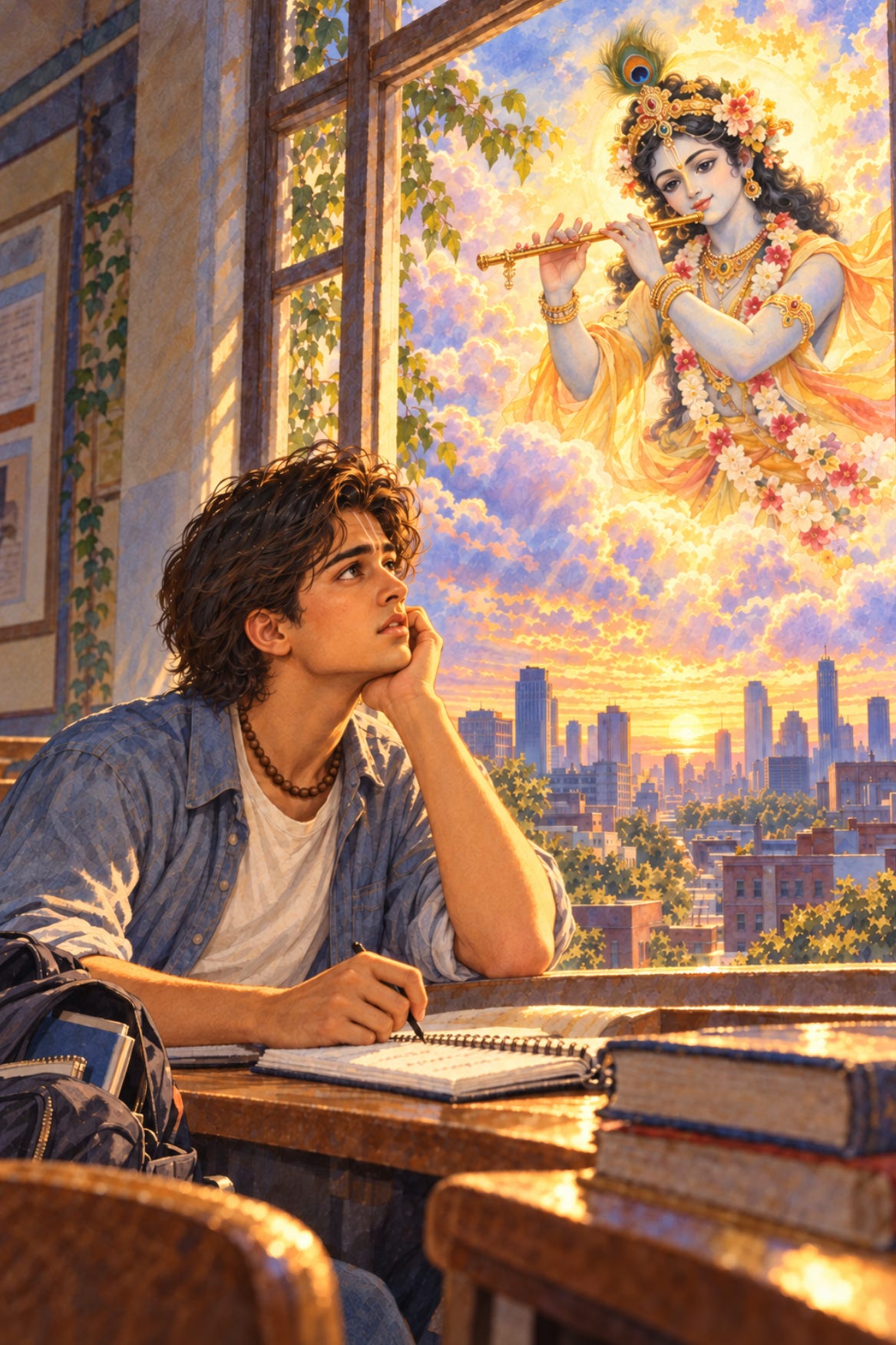
Mādhava Dāsa had started practicing Kṛṣṇa consciousness a few years before. He got a Bhagavad-gītā from a devotee who had now passed away. He still remembers it: he was walking to university when Sarasvatī stopped him with a clever question: “You’re a university student, right? Check this out. It discusses a question universities are very good at avoiding: you say ‘my head,’ ‘my hand,’ ‘my body,’ ‘my brain’—so who is the ‘I’ that owns all these things?”
He read the whole book in just a few days, and then other books from Prabhupāda. From them, he understood that the soul is the eternal servant of Kṛṣṇa, that love for Kṛṣṇa is eternally present, even though covered, and must be awakened by the process of Kṛṣṇa consciousness. He understood that material existence is a condition of forgetfulness, in which we identify with the body and mind and try to enjoy matter independently of Kṛṣṇa. The purpose of devotional service, thus, is to revive this original Kṛṣṇa consciousness and thus revive our eternal relationship with Him. These teachings seemed clear to Mādhava; he never had a reason to doubt them.
With this conviction, he was waking up early every day to chant his rounds and study the Śrīmad-Bhāgavatam before going to university. Gaurāṅga Dāsa, his mentor, an elderly, experienced devotee, had taught him that we should offer everything best we have to Kṛṣṇa, and this includes the best hours of the day, early in the morning. That’s when the brain is fresh, and we can think clearly. Just as water is clear when appearing from the spring, he said, the mind is clear in the early morning, but after being affected by so many thoughts and images during the day, it becomes murky, like the river that crosses the town. By following this, Mādhava was noticing the difference day by day.
One day, he was discussing some points about the soul coming in contact with matter with another devotee he met online. For him, these points were clear, but to his surprise, the devotee disagreed strongly. He sent him a book discussing the origin of the jīva. In the book, the authors quoted from Jīva Gosvāmī, Viśvanātha Cakravartī Ṭhākura, Baladeva Vidyābhūṣaṇa, and other ācāryas, analyzing Sanskrit terms and supporting their conclusions with many scriptural references. What Mādhava understood from their argument, however, surprised him: the conditioned souls were never with Kṛṣṇa. Material bondage is anādi, without beginning, since no one can fall from Vaikuṇṭha. The authors maintained that these conclusions represented the teachings of the previous ācāryas, the proper siddhānta.
As Mādhava continued reading, several doubts arose. If material bondage is anādi, does it mean the soul had never turned away from Kṛṣṇa, that we were simply always here in the material world? And if that’s the case, then how could the soul be at all connected with Kṛṣṇa?
He remembered that Mahāprabhu says that Kṛṣṇa-prema is nitya-siddha, eternally established in the heart, and that Prabhupāda explained that this love for Kṛṣṇa, which is already present in the heart, has simply to be awakened. If the soul has never been with Kṛṣṇa, as the book claims, then what exactly was forgotten, and to what original position are we supposed to return?
More troubling, however, was the authors’ explanation of Prabhupāda’s teachings. They argued that Prabhupāda’s explanations of the soul having been originally with Kṛṣṇa and somehow forgetting Him were just a preaching strategy and should not be accepted literally. According to them, the deeper philosophical meaning is found in the writings of the previous ācāryas. Mādhava found this point difficult to accept. He had learned that spiritual knowledge descends through paramparā, perfect knowledge that descends from a perfect source and is maintained as it is link after link, different from the scientific knowledge he studies in the university, which is composed of theories that are constantly evolving and changing. The book, however, seemed to use a scholarly interpretation of earlier authorities to determine which statements of Prabhupāda should be accepted and which should be rejected.
Mādhava did not know how to resolve these contradictions. The arguments of the book appeared convincing, but they conflicted with many conclusions he had received from the books of Śrīla Prabhupāda. The arguments themselves, however, were based on the words of the previous ācāryas, which he could not dismiss. He could never say Jīva Gosvāmī, Viśvanātha Cakravartī Ṭhākura or Baladeva Vidyābhūṣaṇa were wrong, but he also could not accept that Prabhupāda had repeatedly taught something contrary to their conclusions.
The next morning, he felt drained. He chanted his rounds somehow, but mechanically, with no taste. For the first time in months, chanting seemed like a chore he had to finish, and not something he enjoyed. He looked at the Śrīmad-Bhāgavatam but felt no desire to open it.
Then, something crossed his mind: Gaurāṅga Dāsa also woke up early every day, and he did not live very far. Maybe he could just visit him and ask. He had studied both Prabhupāda’s books and the teachings of the previous ācāryas for several decades. If there were contradictions there, he must have noticed them. Mādhava put his tablet with the book in his backpack and sped off on his bicycle.
Soon the next part…

This is a publication for thoughtful readers who want to go deeper into Kṛṣṇa consciousness. I publish daily, trying to offer high-quality spiritual content, and all posts are available to free subscribers. If you wish, you can support this work with a monthly contribution. When you subscribe, you can choose between a free subscription and a monthly contribution, and you can switch from a free subscriber to a supporter at any time.
You can also receive updates on WhatsApp or Telegram.
If you would like to contribute further, you can find the donation links here.
I love the format. Eagerly waiting for the next part