

Subscribe to receive new articles by e-mail. It’s free, but if you like, you can pledge a donation:
Any kind of society is organized into different layers. Some are lower in the social hierarchy, and others are higher. Modern societies are no different, and often much more complex than classical societies. Modern leaders tend to see themselves as the top of the chain, the ones in control, who should be obeyed. This perception is often false because democratic leaders have to please the public, and even dictators usually have to please the army and other groups and structures that keep them in power, but that’s their mentality. They see themselves as the ones in control, often with little or no accountability.
The Vedic concept of a leader, however, is quite different.
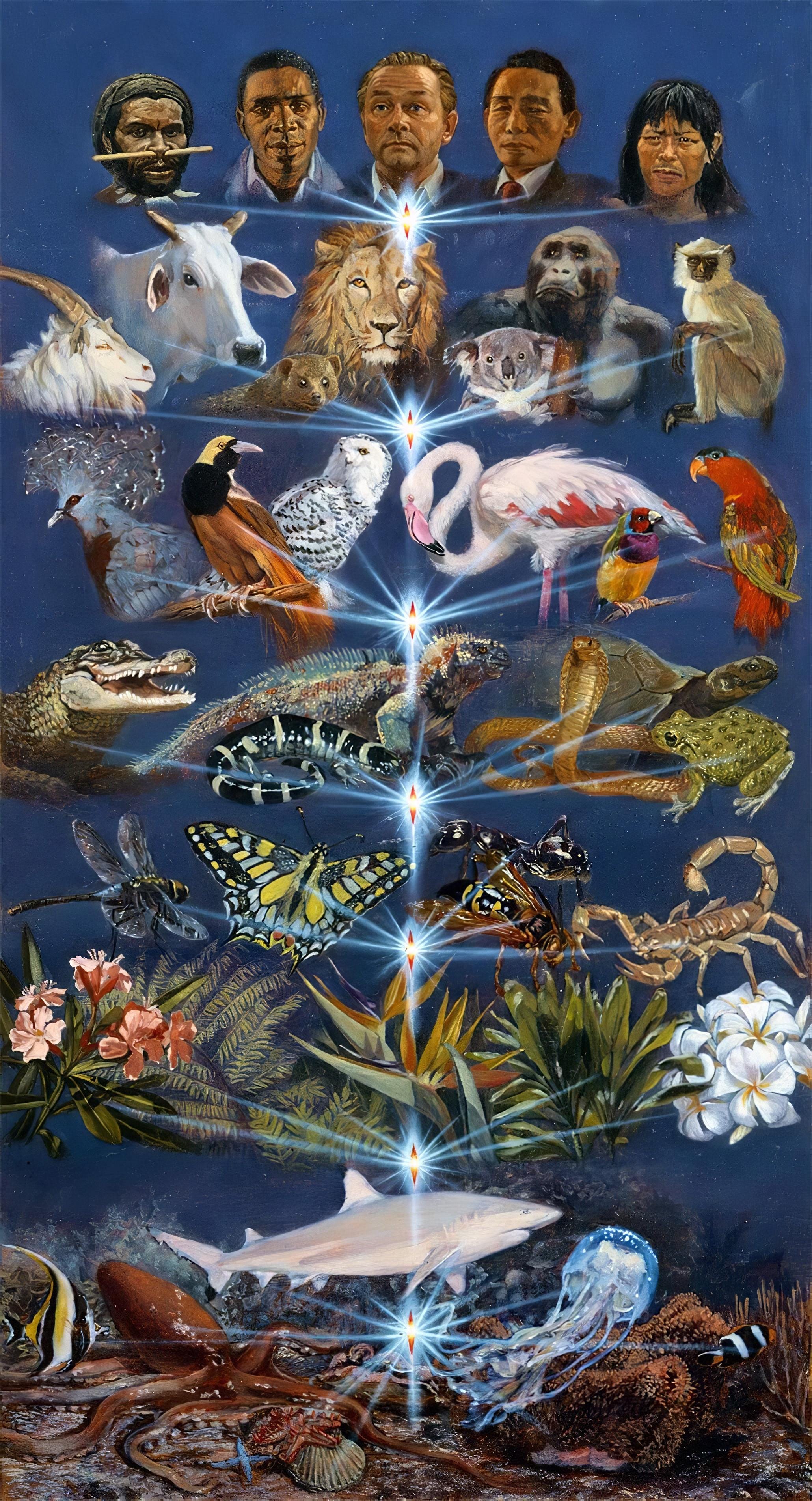
When Ṛṣabhadeva instructed his sons to accept Bharata as their leader, he didn’t mean that Bharata should act as an independent enjoyer. To clarify this point, he described the hierarchy of everything that exists, going from inanimate matter to the Supreme Personality of Godhead, Who is meant to be served by everyone. Interestingly enough, God Himself serves the brāhmanas; therefore, brāhmanas and Vaiṣnavas should be served by everyone.
Here are the relevant verses:
“Of the two energies manifest [spirit and dull matter], beings possessing living force [vegetables, grass, trees and plants] are superior to dull matter [stone, earth, etc.]. Superior to nonmoving plants and vegetables are worms and snakes, which can move. Superior to worms and snakes are animals that have developed intelligence. Superior to animals are human beings, and superior to human beings are ghosts because they have no material bodies. Superior to ghosts are the Gandharvas, and superior to them are the Siddhas. Superior to the Siddhas are the Kinnaras, and superior to them are the asuras. Superior to the asuras are the demigods, and of the demigods, Indra, the King of heaven, is supreme. Superior to Indra are the direct sons of Lord Brahmā, sons like King Dakṣa, and supreme among Brahmā’s sons is Lord Śiva. Since Lord Śiva is the son of Lord Brahmā, Brahmā is considered superior, but Brahmā is also subordinate to Me, the Supreme Personality of Godhead. Because I am inclined to the brāhmaṇas, the brāhmaṇas are best of all.
O respectful brāhmaṇas, as far as I am concerned, no one is equal or superior to the brāhmaṇas in this world. I do not find anyone comparable to them. When people know My motive, after performing rituals according to the Vedic principles they offer food to Me with faith and love through the mouth of a brāhmaṇa. When food is thus offered unto Me, I eat it with full satisfaction. Indeed, I derive more pleasure from food offered in that way than from the food offered in the sacrificial fire.” (SB 5.6.21-23)
Why are Brāhmanas and Vaiṣnavas meant to be served by all classes? Because they are the ones who understand the goal of life, and by serving them and listening to their instructions, everyone else is guided in this direction, including great saintly kings like Bharata Maharaja himself.
The Vedic idea is that even the greatest kings are not meant to rule alone: they should always rule listening to the council of saintly brāhmanas and Vaiṣnavas. In this way, they are sure to always remain on the right path.
Another meaning is that these verses reveal the process of spiritual evolution all living beings are meant to go through. One may go from plants and trees all the way to the position of a human being or demigod, but the ultimate goal is to become a pure devotee of the Lord.
What are the qualifications of a bona fide brāhmana? This is an important point indicated in text 24:
“The Vedas are My eternal transcendental sound incarnation. Therefore the Vedas are śabda-brahma. In this world, the brāhmaṇas thoroughly study all the Vedas, and because they assimilate the Vedic conclusions, they are also to be considered the Vedas personified. The brāhmaṇas are situated in the supreme transcendental mode of nature — sattva-guṇa. Because of this, they are fixed in mind control [śama], sense control [dama], and truthfulness [satya]. They describe the Vedas in their original sense, and out of mercy [anugraha] they preach the purpose of the Vedas to all conditioned souls. They practice penance [tapasya] and tolerance [titikṣā], and they realize the position of the living entity and the Supreme Lord [anubhava]. These are the eight qualifications of the brāhmaṇas. Therefore among all living entities, no one is superior to the brāhmaṇas.” (SB 5.6.24)
The first is that one should be very well learned in the Vedas, not just in the sense of mundane erudition, but in the sense of understanding the real conclusions of the scriptures. The second is that he should be fixed in the mode of goodness, and thus be fixed in śama, dama, and satya (mind control, sense control, and truthfulness). He should also practice penance (tapasya), tolerance (titikṣā), and realize the position of the living entity and the Supreme Lord (anubhava). Apart from these six personal qualities, one should preach the purpose of the Vedas to the conditioned souls, describing the scriptures in their original sense, without personally motivated changes.
Since it was already established that everyone should gradually progress up to the stage of a brāhmana and then transcend it, attaining the level of a pure Vaiṣnava, these are qualities we are all meant to develop. Śrīla Prabhupāda reveals more details in his purport:
“This is a true description of a brāhmaṇa. A brāhmaṇa is one who has assimilated the Vedic conclusions by practicing mind and sense control. He speaks the true version of all the Vedas. As confirmed in the Bhagavad-gītā (15.15): vedaiś ca sarvair aham eva vedyaḥ. By studying all the Vedas, one should come to understand the transcendental position of Lord Śrī Kṛṣṇa. One who actually assimilated the essence of the Vedas can preach the truth. He is compassionate to conditioned souls who are suffering the threefold miseries of this conditional world due to their not being Kṛṣṇa conscious. A brāhmaṇa should take pity on the people and preach Kṛṣṇa consciousness in order to elevate them. Śrī Kṛṣṇa Himself, the Supreme Personality of Godhead, personally descends into this universe from the spiritual kingdom to teach conditioned souls about the values of spiritual life. He tries to induce them to surrender unto Him. Similarly, the brāhmaṇas do the same thing. After assimilating the Vedic instructions, they assist the Supreme Lord in His endeavor to deliver conditioned souls. The brāhmaṇas are very dear to the Supreme Lord due to their high sattva-guṇa qualities, and they also engage in welfare activities for all conditioned souls in the material world.”
Because pure devotees are always busy in the transcendental service of the Lord, they are not interested in material acquisitions, even though the Lord is ready to give them anything they may ask for. Since they are not willing to ask anything from the Lord, there is also no need to ask anyone else. It is thus established that pure devotional service is the Supreme goal and the essence of godly life.
“I am fully opulent, almighty and superior to Lord Brahmā and Indra, the King of the heavenly planets. I am also the bestower of all happiness obtained in the heavenly kingdom and by liberation. Nonetheless, the brāhmaṇas do not seek material comforts from Me. They are very pure and do not want to possess anything. They simply engage in My devotional service. What is the need of their asking for material benefits from anyone else?” (SB 5.5.25)
Ṛṣabhadeva then adds another instruction that is one of the secrets for saintly life: to offer respects to everyone and give up envy, understand that Krsna is present inside the heart of everyone as paramātmā:
“My dear sons, you should not envy any living entity — be he moving or nonmoving. Knowing that I am situated in them, you should offer respect to all of them at every moment. In this way, you offer respect to Me.” (SB 5.5.26)
There is a philosophy called pantheism that concludes that everything is God and God is everything, and there is no separate God or soul apart from the cosmos itself. Māyāvādis are a little more refined, understanding that Brahman is the underlying spiritual principle behind everything, but they still fail to distinguish the Lord and the living entity. Only the devotee understands the difference between the body, the soul, and the Supersoul appropriately.
The devotee thus offers respect to everyone, seeing that the Lord is seated in everyone’s heart. He respects everyone as a temple of the Lord and gives up any envy towards others, not making a distinction between people of different social classes, the rich and the poor, etc. Seeing everything in connection with the Lord, a devotee sees matter itself as the energy of the Lord, and that inside of every body there is a transcendental soul who is dear to Him.
This is also made clear in the teachings of Krsna to Uddhava when He was about to leave the planet: “O brilliant Uddhava, one who thus views all living entities with the idea that I am present within each of them, and who by taking shelter of this divine knowledge offers due respect to everyone, is considered actually wise. Such a man sees equally the brāhmaṇa and the outcaste, the thief and the charitable promoter of brahminical culture, the sun and the tiny sparks of fire, the gentle and the cruel.”
You can also donate using Buy Me a Coffee, PayPal, Wise, Revolut, or bank transfers. There is a separate page with all the links. This helps me enormously to have time to write instead of doing other things to make a living. Thanks!