

« The ‘Fall’ of the Jīva, as Explained by Śrīla Prabhupāda
Chapter 6: The history of every conditioned soul
The final explanation on the position of the soul in this material world and the reasons for our “fall” are explained at the end of the Fourth Canto, in the allegory of King Purañjana. However, Prabhupāda’s explanations given in this section build on the previous conclusions and may not be properly understandable for one who didn’t thoroughly study the previous passages, starting with the teachings of Lord Kapila. Without this foundation, it may appear that the verses are speaking one thing and the purports of Prabhupāda another. The lack of such a systematic study appears to be behind much of the confusion that surrounds this topic. When the explanations given by Prabhupāda are properly understood, the whole discussion becomes a non-issue.
The allegory of King Purañjana is connected with the pastime of Pṛthu Maharaja, the incarnation where the Lord appeared in the dynasty of Dhruva Mahārāja to play the role of a perfect king. Later on, we come to the life of Prācīnabarhi, the great-grandson of Pṛthu Maharaja, who became absorbed in performing fruitive sacrifices.
When Nārada Muni saw that a descendant of his disciple Dhruva Mahārāja was so involved in fruitive activities, he became compassionate and decided to instruct him on the real goal of life. He did so using a very instructive analogy, which can also awaken us to the process of self-realization. In one sense, the story of King Purañjana is an allegory, but on another is a real story, since it describes not just the story of the king, but the story of every conditioned soul who is now in a human body, describing our eternal nature, our conditioning in the body and the whole process of becoming free from it, attaining our original position of service.
Why was Prācīnabarhi performing fruitive activities instead of being engaged in devotional service? Ultimately, it was due to illusion. Prācīnabarhi certainly had all the facilities to engage in devotional service, but due to illusion, he was instead wasting his life in performing complicated animal sacrifices with the idea of being promoted to the celestial planets, thinking that this would bring him happiness.
Everyone wants to be happy, but due to ignorance, we try to find happiness through processes that ultimately bring us misery. Prācīnabarhi was carefully following the process of karma-kānda prescribed in the Vedas, and still, the result would be just birth and death. Ordinary materialistic people don’t even follow this pious process; they just work hard trying to directly obtain money to then spend on various types of vices and sinful activities. As a result, they can’t even hope to achieve the celestial planets like Prācīnabarhi hoped to do; they are suffering now, dealing with stress and anxiety, and in the future, they will suffer even more in the animal species, or in hell. We can see how powerful and dangerous a force illusion is, binding so powerfully the pure soul to the miseries of this material world.
In reality, the purpose of Vedic sacrifices is not to attain material enjoyment, but to please the Lord. That’s the mentality with which great saintly kings like the Pāndavas performed sacrifices. As Kṛṣṇa explains in the Gītā, one who practices sacrifices with the proper mentality is not deprived of the material results, but these are very secondary and unimportant compared with the real result, which is spiritual perfection. Prācīnabarhi, however, was completely blinded by the desire to attain the celestial planets, and thus was unnecessarily killing many animals, performing one sacrifice after another.
To make the king realize the path he was going, Nārada called his attention to the karmic reaction of killing so many animals in his fruitive sacrifices:
“O ruler of the citizens, my dear King, please see in the sky those animals which you have sacrificed without compassion and without mercy in the sacrificial arena. All these animals are awaiting your death so that they can avenge the injuries you have inflicted upon them. After you die, they will angrily pierce your body with iron horns.” (SB 4.25.7-8)
If one receives such heavy reactions for killing animals in fruitive sacrifices, why do the Vedas prescribe such sacrifices at all? The point is that there is a great difference between the proper performance of sacrifices and the way Prācīnabarhi was doing it.
When sacrifices are properly performed, as an offering to Lord Viṣṇu, animals are sacrificed merely as a test, to show the power of the mantras chanted. These animals are immediately resurrected as younger animals, or sometimes directly promoted to human life. However, when sacrifices are improperly performed, or performed without proper knowledge, such potency is absent, and animals are simply killed, just as in a slaughterhouse. These animals have, thus, if they desire, the opportunity of taking revenge for the pain inflicted on them by attacking their tormentor when he is being escorted by the Yamadūtas on the road to hell. Prācīnabarhi had killed many animals in this way, and Nārada showed him what was in store for him. Nārada did not directly criticize the process of Vedic sacrifices, but he emphasized how risky this path is, and how the king was already implicated in the reactions of so many animals killed in improper sacrifices.
When one practices devotional service, the Lord Himself awards him results, and thus one progresses in devotion and is saved from sinful activities even if there are mistakes or deficiencies in one’s practice. On the path of karma-kānda, however, there is no such mercy. One simply deals with the mechanical laws of material nature and has to pay for every mistake that causes harm to others.
The king was certainly shocked by the vision, and Nārada used this opportunity to steer the conversation toward the allegory of King Purañjana, which is nothing more than the story of the king himself, crafted to make him understand his helpless condition and bring him to a platform of renunciation. Ultimately, this is the story of every conditioned soul, and if we study it attentively, it can have the same effect on us that it had on the king.
The fact that these instructions are transmitted in the form of an allegory doesn’t make them less important. Nārada spoke in a way that was suitable to the circumstances, but there are no untruths or exaggerations in his words, just as in all the other verses of Śrīmad-Bhāgavatam. Those who accuse the scriptures or the ācāryas of exaggerating or telling lies project their own vices on what is pure.
As Prabhupāda explains in his purport to SB 4.28.65: “There are many similar stories in the Purāṇas for self-realization. As stated in the Vedas, parokṣa-priyā iva hi devāḥ. There are many stories in the Purāṇas that are intended to interest ordinary men in transcendental subjects, but actually these refer to real facts.”
The allegory of King Purañjana
Nārada introduces the narration in texts 4.25.9 and 10:
“In this connection I wish to narrate an old history connected with the character of a king called Purañjana. Please try to hear me with great attention. My dear King, once in the past lived a king named Purañjana, who was celebrated for his great activities. He had a friend named Avijñāta [“the unknown one”]. No one could understand the activities of Avijñāta.”
Purañjana means “the soul within the body” or “one who enjoys in a body”. Nārada describes this story as itihāsam purātanam (a very old story), because the story of the conditioning of the soul is indeed very long. The influence of material time starts with the look of Mahā-Viṣṇu at the beginning of creation, but before that, the soul was already conditioned in other universal cycles. It is therefore impossible to calculate the start of our material adventure.
The body is compared to a city, because just like a city is formed by different structures and citizens, a body is formed by many different cells, microbes, etc., which are also alive. There is also one soul for each cell and microorganism in the body, each one with its own subordinate existence, enjoying its own small body, and one soul who predominates over all others and becomes the ruler of the city, reigning over the whole body. The soul inside the body becomes thus a purañjana, becoming free to use this body for one’s purposes and enjoy or suffer the results.
The soul thus travels from one city to another, all over creation, together with a friend called Avijñāta (the unknown one), who is none other than the Supersoul. Avijñāta is mentioned only once in the whole description, in text 4.25.10. He is there the whole time, but no one, including Purañjana, is aware of Avijñāta’s presence, and no one could understand his activities, just as the Supersoul is always with us, but because of our fixation on the external world, we are not aware of Him. However, later on, when Purañjana (in his next life) came to a crisis, the Lord manifested Himself in a visible form to remind him of their eternal relationship.
Together with his friend Avijñāta, Purañjana traveled for a very long time:
“King Purañjana began to search for a suitable place to live, and thus he traveled all over the world. Even after a great deal of traveling, he could not find a place just to his liking. Finally he became morose and disappointed.” (SB 4.25.11)
This describes the transmigration of the soul, going from one body to another, but never becoming satisfied due to unlimited material desires. Although no one wants to die, we still don’t find complete satisfaction in any type of body. All this traveling, suffering, and anxiety we face in our wanderings in the material world are compared by Prabhupāda to the life of hippies in the 1960s and 1970s, because that was a social phenomenon where children of well-to-do families would leave their parents and instead live a degraded life of drugs and promiscuous sex in the streets. Similarly, all our material suffering is unnecessary; we are children of a rich father, but in our foolishness, we decide to abandon His shelter and instead experience degradation in the material world. Worse than that, we fail to notice His presence, even though He is always with us, trying to bring us back home.
What happened then? While traveling, Purañjana finally came to a place different from the others:
“King Purañjana had unlimited desires for sense enjoyment; consequently he traveled all over the world to find a place where all his desires could be fulfilled. Unfortunately he found a feeling of insufficiency everywhere. Once, while wandering in this way, he saw on the southern side of the Himālayas, in a place named Bhārata-varṣa [India], a city that had nine gates all about and was characterized by all auspicious facilities.” (SB 4.25.12-13)
Sometimes, the term Bhārata-varṣa is used to indicate our whole planet, and sometimes to specifically indicate India. In this case, it is specifically described that Purañjana came to a body in the south of the Himalayas, in India, taking birth in a society where people followed Vedic culture. This is the most desired type of birth, because it gives access to spiritual knowledge and the possibility of progressing spiritually and sharing it with others, as indicated by Mahāprabhu in the verse bhārata-bhūmite haila manuṣya janma yāra, janma sārthaka kari’ kara para-upakāra, “One who has taken his birth as a human being in the land of India [Bhārata-varṣa] should make his life successful and work for the benefit of all other people.”
The city is described as having nine gates, which are the nine openings of the body (mouth, nostrils, eyes, ears, anus, and genital), and possessing all auspicious qualities. It is described that amongst all types of bodies, the best are bodies with the human form (as either human beings or demigods), because they offer better facilities.
From texts 4.25.14 to 19, Nārada Muni offers an allegorical description of the human body, comparing it to a beautiful city. Most of these descriptions are not directly connected to different parts of the body, but with situations, experiences, and facilities we enjoy at different stages of life. For example, it is described that the city had houses decorated with domes made of gold, silver, and iron, referring to different desires and activities influenced by the three modes. The beautiful trees and creepers encircling a nice lake on the outskirts represent favorable conditions for sex life, which may present themselves at certain stages of life, and so on.
After entering the body, Purañjana meets a beautiful, mysterious lady:
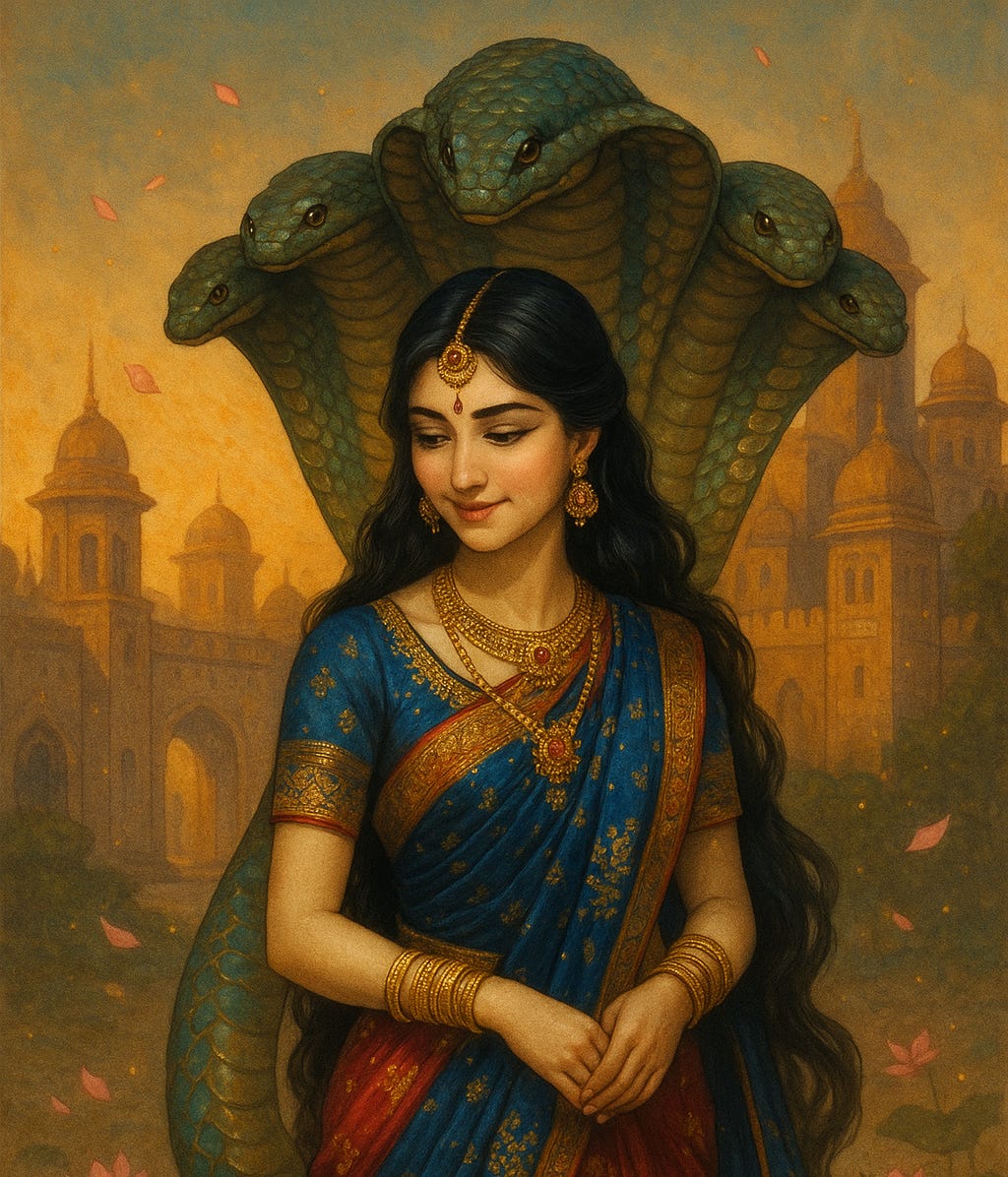
“While wandering here and there in that wonderful garden, King Purañjana suddenly came in contact with a very beautiful woman who was walking there without any engagement. She had ten servants with her, and each servant had hundreds of wives accompanying him. The woman was protected on all sides by a five-hooded snake. She was very beautiful and young, and she appeared very anxious to find a suitable husband.” (SB 4.25.20-21)
This beautiful girl represents the material intelligence. All the things that are attractive to the conditioned soul, such as the different material desires, plans, and possibilities of material enjoyment, are described as beautiful and attractive in the allegory, and similarly, the material intelligence is described as a young and attractive woman.
Although the mind is the center of material desires, the intelligence is the tool we use to understand the world and make plans to enjoy matter. Without intelligence, material enjoyment is not possible. All species of animals and even plants possess intelligence to a limited degree, but only in human life does this intelligence become developed enough to solve the real problems of life. In his pure state, the soul possesses transcendental intelligence that is used in the service of the Lord. In the material atmosphere, however, this transcendental intelligence becomes dormant, and the soul receives a substitute intelligence to act in the material world.
Although the soul can’t act materially and satisfy its desires without a material body, the body also can’t act without the soul, because the soul brings consciousness to the body. Apart from that, the material intelligence has no meaning without consciousness; thus, it is said that the beautiful woman was looking for a husband. Just as a man and a woman combine to enjoy the world, the combination of the soul and the material intelligence makes material enjoyment possible. The intelligence, however, is not a separate living entity, but is rather a tool that is given to the soul for one’s use. This, however, doesn’t prevent us from being captivated by it.
Although the mind can often overpower the intelligence, the natural order is that the intelligence guides the working of the mind. In the allegory of Purañjana, the intelligence is thus given more importance, and the mind is described as just a servant of it.
The ten servants of the woman represent the ten senses, and the hundreds of wives of each servant represent the innumerable sense objects and material desires connected with them. The five-hooded snake that protected the woman from all sides represents the five vital airs that move and sustain the body.
Prabhupāda explains it perfectly in his purport to text 21:
“The vital force of a living entity includes the five kinds of air working within the body, which are known as prāṇa, apāna, vyāna, samāna, and udāna. The vital force is compared to a serpent because a serpent can live by simply drinking air. The vital force carried by the air is described as the pratīhāra, or the bodyguard. Without the vital force one cannot live for a moment. Indeed, all the senses are working under the protection of the vital force. The woman, who represents intelligence, was searching after a husband. This indicates that intelligence cannot act without consciousness. A beautiful woman is useless unless protected by the proper husband. Intelligence must always be very fresh; therefore the word aprauḍhām, “very young,” is used here. Material enjoyment means utilizing the intelligence for the sake of rūpa, rasa, gandha, śabda and sparśa, or form, taste, smell, sound and touch.”
In the purport to text 27, he explains further:
“The ten strong servants of the mind are the five working senses and the five knowledge-gathering senses. All these ten senses work under the aegis of the mind. The mind and the ten senses combine to become eleven strong bodyguards. The hundreds of women under the jurisdiction of the senses are addressed here as lalanāḥ. The mind works under the intelligence, and under the mind are the ten senses, and under the ten senses are innumerable desires to be fulfilled. All these, however, depend on the vital life force, which is here represented by the snake. As long as the vital life force is there, the mind works, and under the mind the senses work, and the senses give rise to so many material desires.”
Some passages of the scriptures are described from the point of view of men, since most sages are of the masculine gender, but in the case of this allegory, it is the same for both men and women. Any conditioned soul is considered masculine and described as puruṣa, because we all share the same propensity to enjoy matter. Therefore, men are puruṣa, and women are also puruṣa; they just try to enjoy themselves in different ways. In both cases, man or woman, the soul is described as Purañjana, the male, entering the material body and enjoying together with the material intelligence and her servants, the senses.
The material intelligence brings us the possibility of enjoying the world using our senses, attaining things, and shaping our environment according to our purposes. The description of the physical characteristics of the woman illustrates our attraction to the power and possibilities granted to us, having a powerful brain that can learn and solve problems, etc. Her two breasts represent rāga and dveṣa (attachment and envy, or attraction and aversion), which are the basis for the working of material intelligence. The lady, however, tries to cover her breasts, which illustrates the possibility of using these characteristics in the service of Kṛṣṇa, and thus purifying them. In the same way human intelligence can be used to entangle us in the material world, it can also be used to become free of it.
Purañjana comes in contact with the material intelligence
Material desires often remain dormant until there is some opportunity for one to satisfy them. A boy who never saw a girl may not experience sexual desire, but as soon as a girl is present, the latent desires will awaken. Similarly, Purañjana becomes attracted to the woman, illustrating the attraction of the soul for material enjoyment as soon as the possibility emerges.
Material intelligence is thus a double-edged sword. On the one hand, it gives us the possibility of understanding the scriptures, practicing devotional service, and going back to Godhead, but on the other hand, it gives us the opportunity of repeating the same search for material enjoyment we already went through so many times in the past, in each of the innumerable bodies we accepted. This is a choice that every human being has.
As Prabhupāda explains in his purport to text 25:
“It is said in the Prema-vivarta that when a living entity wants to enjoy material nature, he is immediately victimized by the material energy. A living entity is not forced to come into the material world. He makes his own choice, being attracted by beautiful women. Every living entity has the freedom to be attracted by material nature or to stand as a hero and resist that attraction. It is simply a question of the living entity’s being attracted or not being attracted. There is no question of his being forced to come into contact with material energy. One who can keep himself steady and resist the attraction of material nature is certainly a hero and deserves to be called a gosvāmī. Unless one is master of the senses, he cannot become a gosvāmī. The living entity can take one of two positions in this world: he may become a servant of his senses, or he may become master of them. By becoming a servant of the senses, one becomes a great material hero, and by becoming master of the senses, he becomes a gosvāmī, or spiritual hero.”
Seeing the girl, Purañjana asks:
“My dear lotus-eyed, kindly explain to me where you are coming from, who you are, and whose daughter you are. You appear very chaste. What is the purpose of your coming here? What are you trying to do? Please explain all these things to me. My dear lotus-eyed, who are those eleven strong bodyguards with you, and who are those ten specific servants? Who are those women following the ten servants, and who is the snake that is preceding you?” (SB 4.25.25)
Prabhupāda explains that these questions reveal the purpose of human life: inquiring about the absolute truth. In animal life, there is no inquiry about the soul; one is just concentrated on satisfying basic material necessities, but now, after receiving human intelligence, the soul starts the process of inquiring about oneself, the reasons for his material condition, his origin, etc. Until one starts this process of inquiry, it is explained that one has not crossed the threshold of human life: one’s consciousness is still at the animal level, even though one is in a human body.
The girl, however, has no direct answer for these questions:
“O best of human beings, I do not know who has begotten me. I cannot speak to you perfectly about this. Nor do I know the names or the origin of the associates with me. O great hero, we only know that we are existing in this place. We do not know what will come after. Indeed, we are so foolish that we do not care to understand who has created this beautiful place for our residence. My dear gentleman, all these men and women with me are known as my friends, and the snake, who always remains awake, protects this city even during my sleeping hours. So much I know. I do not know anything beyond this.” (SB 4.25.33-35)
This shows the inherent limitations of material intelligence: although it is the tool we receive to obtain knowledge, it can’t find answers to the important questions of life on its own, because its awareness is limited to the mind, senses, and sense objects. Since the senses are imperfect, and the material intelligence is itself imperfect, it is impossible to obtain perfect knowledge through it. One will not even be able to find one’s own origin, what to say about understanding God and other spiritual topics. One may speculate for a hundred years and will simply come to the wrong answers.
The method for obtaining perfect knowledge through the imperfect material intelligence is by receiving it from a perfect source: from the scriptures and the association of devotees. As Kṛṣṇa explains in the Bhagavad-gītā, the process of obtaining spiritual knowledge starts by approaching a self-realized soul.
However, as indicated in text 28, Purañjana becomes overly attracted to his material intelligence. Everyone thinks that his intelligence is perfect, but the material intelligence is covered by ignorance, and by trusting it, one falls into materialistic life, or some kind of pious life by following some mundane religious process, such as the worship of demigods. Even when one becomes attracted to self-realization, one’s speculative search will end in impersonalism. We can see that in the allegory, Purañjana becomes engaged in sense gratification and ends up going to hell and obtaining a new material body.
When one obtains transcendental knowledge, however, one can properly engage the intelligence in the service of the Lord, which allows us to attain real opulence and real happiness. However, we can see that Purañjana didn’t go through this path, becoming instead attracted to base sense gratification:
“My dear beautiful girl, you are exactly like the goddess of fortune or the wife of Lord Śiva or the goddess of learning, the wife of Lord Brahmā. Although you must be one of them, I see that you are loitering in this forest. Indeed, you are as silent as the great sages. Is it that you are searching after your own husband? Whoever your husband may be, simply by understanding that you are so faithful to him, he will come to possess all opulences. I think you must be the goddess of fortune, but I do not see the lotus flower in your hand. Therefore I am asking you where you have thrown that lotus.” (SB 4.25.28)
Another meaning of this verse is Purañjana, as the embodied soul, identifying with the mind and intelligence, and using the body to seek material enjoyment through sexual relationships, courting a girl with the idea of marrying her. He thus presents himself as a great hero and king, trying to gain her favor. In this way, the allegory simultaneously describes the interactions and relationship of the soul with the body, mind, and intelligence, and the same soul acting outside, as a man or woman, searching for enjoyment and becoming entangled in material life.
As Prabhupāda explains: “In this verse it is clear that Purañjana is representing our intelligence while he is talking with the girl. He not only appreciated the shyness of the girl but actually became more and more attracted by that shyness. He was actually thinking of becoming her husband and consequently was asking her whether she was thinking of her prospective husband or whether she was married. This is an example of bhoga-icchā, the desire for enjoyment. One who is attracted by such desires becomes conditioned in this material world, and one who is not so attracted attains liberation.”
Relationships between men and women can be favorable for spiritual progress when properly conducted, but when the goal is simply to enjoy one’s senses, the combination leads simply to more material entanglement. As Prabhupāda explains in his purport to text 30: “When one is agitated by lusty desires, his senses are attracted by all kinds of viṣaya — enjoyable things like sound, touch, form, smell, and taste. These attractive sense objects oblige one to come under the control of a woman. In this way, the conditional life of a living entity begins. Conditional life means being under the control of a woman, and certainly, the living entity is always at the mercy of a woman or a man. Thus living entities live in bondage to one another, and thus they continue this conditional, material life illusioned by māyā.”
In this mood, Purañjana addresses the girl in text 31:
“My dear girl, your face is so beautiful with your nice eyebrows and eyes and with your bluish hair scattered about. In addition, very sweet sounds are coming from your mouth. Nonetheless, you are so covered with shyness that you do not see me face to face. I therefore request you, my dear girl, to smile and kindly raise your head to see me.” (SB 4.25.31)
Real beauty exists in the spiritual world, in the beautiful form of Kṛṣṇa and everything else that exists there. When we are situated in knowledge (vidyā), we realize that and become attracted to Kṛṣṇa’s name, form, pastimes, etc. However, when we are covered by avidyā, ignorance, we become attracted to the illusory beauty of this material world, and thus become bewildered, just as Purañjana.
As Prabhupāda explains: “When thus attracted by the beauty of the material energy, one becomes very eager to enjoy. This is elaborately described in this instance of Purañjana’s becoming attracted by the beautiful woman. In conditional life the living entity is attracted by a face, eyebrows or eyes, a voice or anything. In short, everything becomes attractive. When a man or a woman is attracted by the opposite sex, it does not matter whether the opposite sex is beautiful or not. The lover sees everything beautiful in the face of the beloved and thus becomes attracted. This attraction causes the living entity to fall down in this material world.”
In the Śrīmad-Bhāgavatam, even the forms of the demigods are described as ghastly, what to speak of others. However, when we are under strong material desires, anything can look attractive. One who is starving sees dry bread as the most desirable thing, and similarly, a very lusty man sees even an ugly woman as attractive. The mind simply perceives it as such due to the desperate desire to satisfy one’s desires. We may see a person at a distance and imagine a beautiful woman or a handsome man, just to be taken aback when we come close and see an old or ugly person. The mind simply sees a person or object and projects an illusion of beauty, but when we see it closer, the illusion dissipates, and we see that it is not what we thought. We then search for another person, or a newer car, a better house, etc., and thus our material entanglement continues life after life.
You can also donate using Buy Me a Coffee, PayPal, Wise, Revolut, or bank transfers. There is a separate page with all the links. This helps me enormously to have time to write instead of doing other things to make a living. Thanks!